













Having worked in this industry for years, one thing has become clear. And one that I sit with for longer than I would like to admit.
If your sales team is working from a contact list that has not been verified in six months, how many of those conversations are actually reaching the right person?
The honest answer, for most B2B companies, is not many. Phone numbers go stale. Job titles change. Decision-makers move on. And the database that looked solid in Q1 becomes a liability by Q3.
This is not a minor operational issue. It is a revenue problem. And the companies that are winning in competitive markets right now are not relying on generic, off-the-shelf contact lists. They are building custom databases that are designed around their exact target market, sales motion, and go-to-market strategy.
In this blog, I want to break down what that actually looks like, why it works, and what B2B companies need to know before they start down this path.
What Is a Custom Database in a B2B Context?
A custom database is a purpose-built data asset. It is not a generic list you license from a vendor and hope for the best.
When we talk about custom databases in B2B, we mean a structured, verified collection of account and contact data that is built around your specific ideal customer profile.
That includes the industries you sell to, the company sizes that convert, the decision-maker titles that matter, the geographies you cover, and the intent signals that indicate readiness to buy.
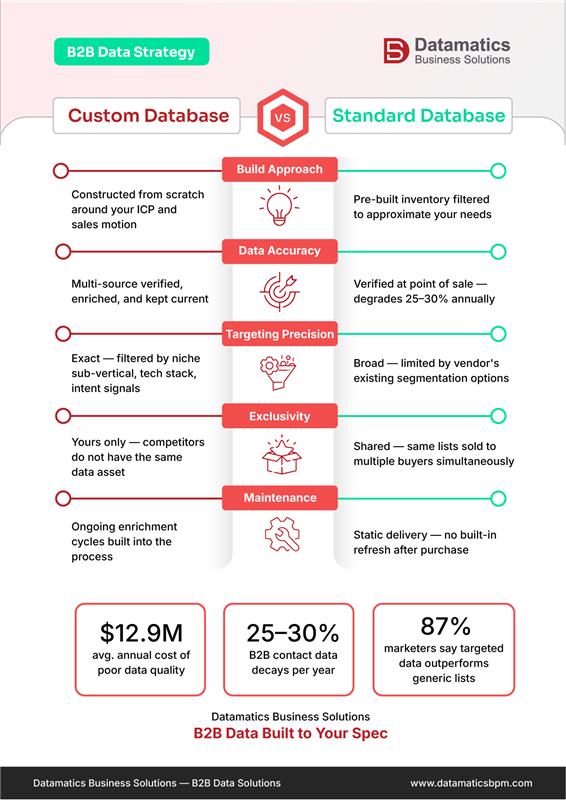
The difference between a standard database and a custom one is specificity. A generic B2B data vendor can sell you a list of 50,000 IT directors. A custom database gives you the 800 IT directors at mid-market financial services companies in North America who are currently evaluating cybersecurity vendors.
That level of precision does not happen by accident. It is the result of deliberate data architecture, ongoing enrichment, and consistent quality control.
Key Takeaway
Custom databases are built around your specific ICP and sales motion. These are precise, verified, and maintained only for you. Unlike standard databases that can include everyone, custom databases are very targeted.
Why Do B2B Companies Need Custom Database Solutions Instead of Off-the-Shelf Lists?
The B2B data market is crowded. There are dozens of vendors offering massive contact databases, and it is tempting to assume that more data equals better outcomes.
It does not.
According to research by Gartner, poor data quality costs organizations an average of $12.9 million per year.
The problem is not a shortage of data. It is the quality of the data being used.
Off-the-shelf lists come with several built-in problems. They are sold to multiple buyers simultaneously, which means your competitors may have the same list. They are often months or even years out of date by the time they reach you. And they are rarely segmented in a way that matches your actual ICP.
Custom database solutions solve for these problems directly. Instead of starting with a vendor’s existing inventory and filtering it down, you start with your ICP and build the dataset around it. That inversion matters more than it sounds.
B2B data quality is what separates companies that generate pipeline from the ones that generate activity. And activity without results is just expensive noise.
Key Takeaway
Off-the-shelf lists degrade fast and are shared across competitors. Custom database solutions are built for your ICP and maintained to stay accurate over time.
How Does B2B Data Quality Affect Revenue Outcomes?
Bad data does not just waste your sales team’s time. It creates a compounding problem across the entire revenue engine.
When your CRM is full of inaccurate records, your lead scoring breaks down. Your account-based marketing campaigns reach the wrong contacts. Your SDRs burn hours working leads that have gone cold or bounced to different companies. Your reporting becomes unreliable because the underlying data is wrong.
The numbers are stark. Experian’s Data Quality Report found that 55% of businesses believe inaccurate data is undermining their ability to deliver on customer experience initiatives.
For B2B companies, that translates directly to missed quota, failed campaigns, and wasted marketing spend.
High-quality B2B data, on the other hand, creates a different kind of compounding effect. When your contacts are accurate, your segmentation works. When your segmentation works, your messaging lands. When your messaging lands, your conversion rates improve. The whole system functions the way it is supposed to.
This is why B2B data quality is not a nice-to-have. It is the foundation that every other revenue function depends on.
Key Takeaway
Data quality problems cascade across your entire revenue operation. Accurate B2B data improves segmentation, messaging precision, and conversion rates at every stage of the funnel.
What Does It Mean to Customize a Database for Your Business?
When companies decide to customize a database, they are making a choice about how they want to go to market.
The customization process starts with ICP definition. Who exactly are you trying to reach? What industries? What company revenue bands? What departments? What decision-maker titles? What technology stack, if relevant? What triggers indicate they are ready to buy?
Once the ICP is defined, the database is built around those parameters. That means sourcing contacts that fit the profile, verifying their information against multiple data sources, appending missing fields through custom data enrichment, and structuring the data in a way that maps to your CRM and sales workflows.
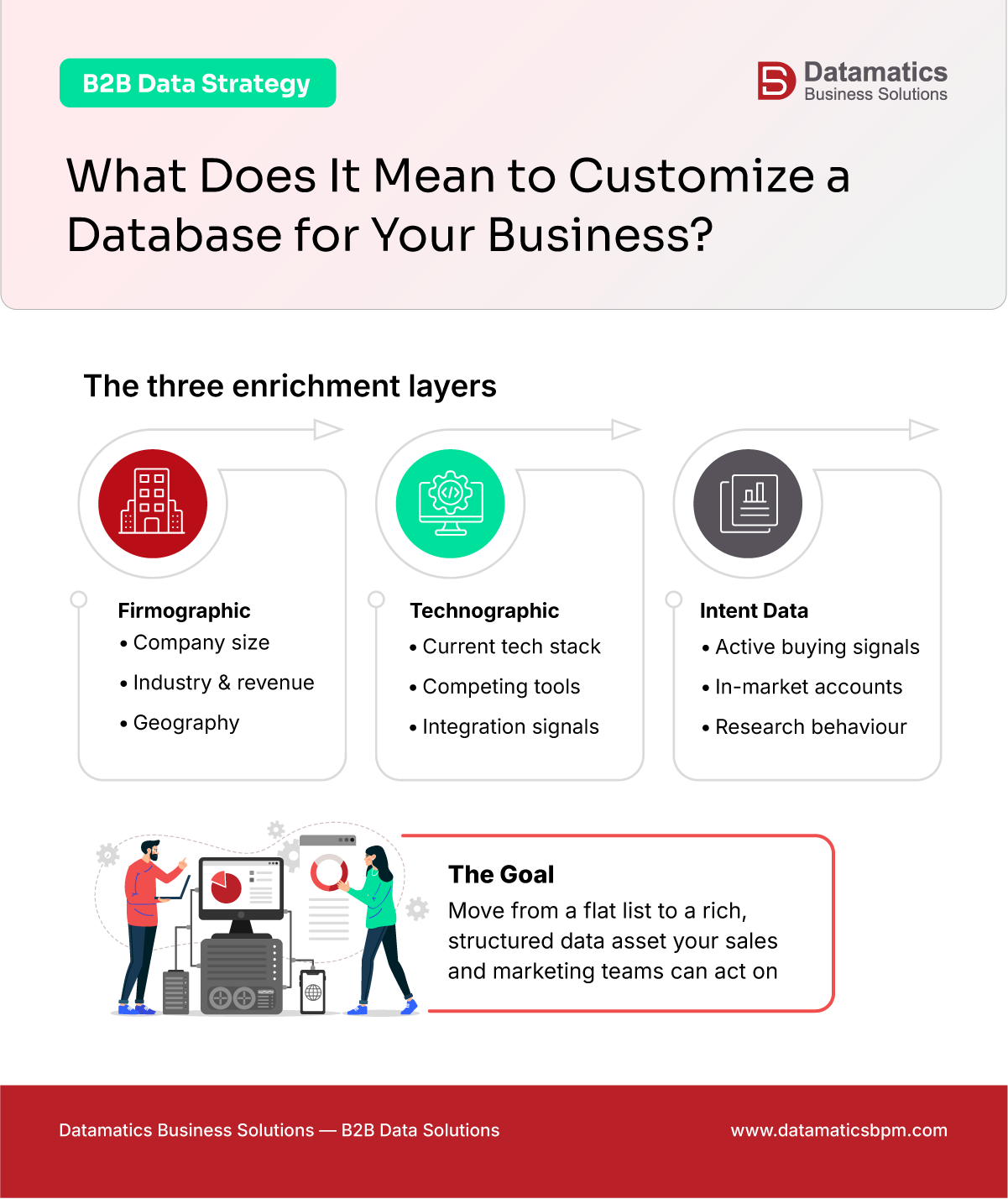
Custom data enrichment is a critical part of this process. Raw contact data is rarely complete. A name and email address is not enough to run an effective campaign. You need firmographic data — company size, industry, revenue, location. You need technographic data if you are selling a competing or complementary solution. You may need intent data to understand which accounts are actively in-market.
The goal is to move from a flat list to a rich, structured data asset that your sales and marketing teams can actually use to make decisions.
Key Takeaway
To customize a database effectively, you start with ICP clarity and layer on enrichment, verification, and structure. The end result is data your teams can act on rather than just sort through.
How Are B2B Companies Using Custom Databases to Outperform Competitors?
The practical applications vary by company size and go-to-market model, but the pattern is consistent.
Companies using custom databases are running tighter account-based marketing programs. Instead of targeting broad industry segments, they are building account lists that match specific buying signals, then personalizing outreach at the account level.
ITSMA research shows that 87% of B2B marketers report ABM outperforms other marketing investments. The underlying data quality is what makes ABM work at scale.
They are also using custom databases to shorten sales cycles. When an SDR reaches out to a contact with verified information, a relevant message, and context about that account’s current situation, the response rates are meaningfully higher.
According to LinkedIn’s B2B Institute, 77% of B2B buyers say they will not engage with a salesperson who has not done basic research on their company. Custom databases make that research possible at scale.
Beyond sales and marketing, these databases support better territory planning, more accurate forecasting, and smarter resource allocation. When you know exactly which accounts are in-market and which are not, you stop guessing and start planning.
Key Takeaway
Custom databases power ABM, reduce sales cycle length, and support better planning decisions. The competitive advantage is not just better data — it is better decisions made faster.
What Is Custom Data Enrichment and Why Does It Matter?
Custom data enrichment is the process of appending additional information to existing contact and account records.
You might start with a list of company names and email domains. Enrichment adds the right contact names, titles, direct phone numbers, LinkedIn profiles, firmographic data, technographic stack, intent scores, and behavioral signals. The goal is to turn a thin record into a complete profile.
This matters because data completeness directly affects what you can do with it. A record with just a name and company is limited to basic outreach. A fully enriched record supports sophisticated personalization, lead scoring, routing logic, and campaign segmentation.
There is also a freshness dimension to enrichment. Contact data decays at roughly 25-30% per year, according to research by SiriusDecisions (now part of Forrester).
That means a database with no active enrichment process loses a quarter of its accuracy every year. Custom data enrichment is what keeps the asset from degrading.
The best B2B data services providers do not just deliver a one-time enriched file. They build an ongoing enrichment cadence so your database stays current and accurate across every campaign cycle.
Key Takeaway
Custom data enrichment keeps your database complete and current. Without it, contact data decays by 25-30% annually and your campaigns lose precision over time.
How Do B2B Data Services Fit into the Custom Database Build?
Most companies do not build custom databases entirely on their own. It is a resource-intensive process that requires data sourcing infrastructure, verification technology, enrichment capabilities, and ongoing maintenance.
That is where B2B data services come in. The right provider brings the technical infrastructure, data sourcing relationships, and quality assurance processes that most in-house teams do not have.
What makes a B2B data services partner valuable is not just the volume of data they can provide. It is the specificity of what they can build.
- Can they source contacts within a niche sub-vertical?
- Can they verify data using multiple independent sources?
- Can they append enrichment fields that are specific to your sales motion?
- Can they deliver data in a format that drops cleanly into your CRM?
The answer varies significantly by provider. Companies that take a generic approach will hand you a filtered version of their existing database and call it custom. The providers that actually build to spec will start with your requirements and construct the dataset from the ground up.
The distinction matters because the output is fundamentally different. One gives you a modified list. The other gives you a data asset.
Key Takeaway
B2B data services providers can build and maintain custom databases at a scale and speed that most in-house teams cannot match. The key is finding a provider that builds to your spec, not one that filters their existing inventory.
How Datamatics Business Solutions Helps With Custom Database Builds
We work with B2B companies that need more than a list. The focus is on building data assets that actually match how their clients sell.
The process starts with ICP mapping. Our team works with clients to define exactly who they are targeting. From industries to company sizes, buyer titles to geographies, and any sector-specific filters that matter to the sales motion, we take everything in consideration. That definition drives everything that follows. We then build a custom list specifically designed for your requirements.
Our team also runs ongoing enrichment cycles to keep the database current. Because contact data decays continuously, the maintenance process is built into the engagement rather than treated as a one-off deliverable.
For companies running demand generation programs, we support the full data layer — from initial list builds and B2B data quality audits to segmented uploads into CRM platforms and ABM tools.
For companies in need of B2B data services across multiple regions or verticals, our team has the sourcing depth to work at scale without sacrificing accuracy.
The outcome is a database your sales and marketing teams can rely on, rather than one they have to constantly work around.
Want to know more about our services? Get in touch with us.
Conclusion
Most B2B companies are not losing deals because of a weak product or a bad pitch. They are losing because they are working from data that was never built for them in the first place.
A generic list gets you generic results. That is not a data vendor problem. That is a strategy problem.
The companies pulling ahead in competitive markets right now have made a deliberate choice. They stopped treating data as a commodity they could purchase and started treating it as an asset they needed to build. They defined their ICP with precision. They invested in custom data enrichment. They made sure their database was verified, maintained, and mapped to how their teams actually sell.
That shift does not happen overnight. But it starts with a clear decision: are you going to go to market with data that was designed for everyone, or data that was built for you?
The answer to that question determines a lot of what follows.
If your current database is not producing the pipeline your team deserves, the problem is almost certainly in the foundation. And foundations, unlike campaigns, can be fixed.
Like what you read? Subscribe to our blogs and get such detailed insights delivered straight to your inbox.
Frequently Asked Questions
1. What is the difference between a custom database and a standard B2B contact list?
A standard contact list is a filtered slice of a vendor’s existing inventory. A custom database is built specifically around your ICP, your sales motion, and the data fields that matter to your team. It is constructed to match your go-to-market requirements, not repurposed from someone else’s database.
2. How often should a custom database be refreshed?
B2B contact data decays at roughly 25-30% per year. Depending on how actively you use the database and how dynamic your target market is, a full enrichment and verification cycle should happen at minimum every six months. High-frequency sales teams benefit from quarterly refresh cycles.
3. What fields should be included in a B2B custom database?
At minimum: full name, verified business email, direct phone number, job title, company name, company size, industry, and location. For more targeted programs, add technographic data, LinkedIn profile URL, revenue band, department, and behavioral intent signals. The right fields depend on how your sales and marketing teams actually qualify and work accounts.
4. How does custom data enrichment differ from standard data appending?
Standard data appending adds one or two missing fields — typically email or phone — from a static lookup. Custom data enrichment is a more structured process that assesses the completeness of each record, identifies gaps, and appends multiple fields using verified sources. It is designed to bring records up to a defined standard of completeness rather than just filling in isolated blanks.
5. Can small or mid-market B2B companies benefit from custom databases, or is this only for enterprise?
Custom databases are arguably more valuable for smaller companies precisely because budget and time are constrained. If a mid-market sales team of five people is working from bad data, the impact is proportionally larger than at an enterprise with 200 SDRs. A clean, targeted custom database means those five reps are spending their time on the right accounts rather than chasing dead ends.
6. What makes B2B data quality different from general data quality?
B2B data quality has unique challenges because the data changes faster. People change jobs more frequently than they change home addresses. Companies restructure, merge, and rebrand. Decision-maker titles shift with organizational design changes. B2B data quality management has to account for this velocity, which is why ongoing enrichment and verification processes are so important in a B2B context.

James Libera