














Okay. Here is a question that is keeping CMOs up at night.
How do you build a marketing function that actually understands your business, moves at your speed, and doesn’t bill you $300 an hour for a junior account manager who is juggling six other clients?
The traditional agency model made sense for decades. You needed expertise you didn’t have in-house. You hired an agency. They ran campaigns. You got results. Simple.
Except it is not simple anymore. And it is definitely not working.
I have watched too many marketing leaders struggle with the same pattern. They hire a fancy agency. There is a honeymoon period where everything feels collaborative and strategic. Then reality sets in. Turnaround times stretch. The team that pitched you never shows up to meetings. Your brand guidelines get ignored because the junior designer didn’t read them. And when you ask for a change, you get a scope-of-work amendment and another invoice.
Sound familiar?
This is why CMOs are making a different choice. They are building embedded marketing teams instead of relying on traditional agencies. And the data backs up why this shift is happening.
Marketing leaders plan to bring more work in-house over the next two years. That is not a small trend. That is a fundamental shift in how companies think about marketing execution.
In this blog, I will walk you through what an embedded marketing team actually is, why it is replacing the old agency model, and whether it makes sense for your business.
What Is an Embedded Marketing Team?
Let me be clear about what we are talking about here.
An embedded marketing team is a dedicated group of marketers who work exclusively for your company but aren’t technically on your payroll. They function like an in-house team. They know your brand. They understand your goals. They are in your Slack channels, your strategy meetings, and your quarterly planning sessions.
But unlike a traditional in-house team, you don’t have to recruit them, onboard them, or manage their benefits and career development. And unlike a traditional agency, they are not splitting their time between you and five other clients.
Think of it as marketing as a service, but without the usual service-provider headaches.
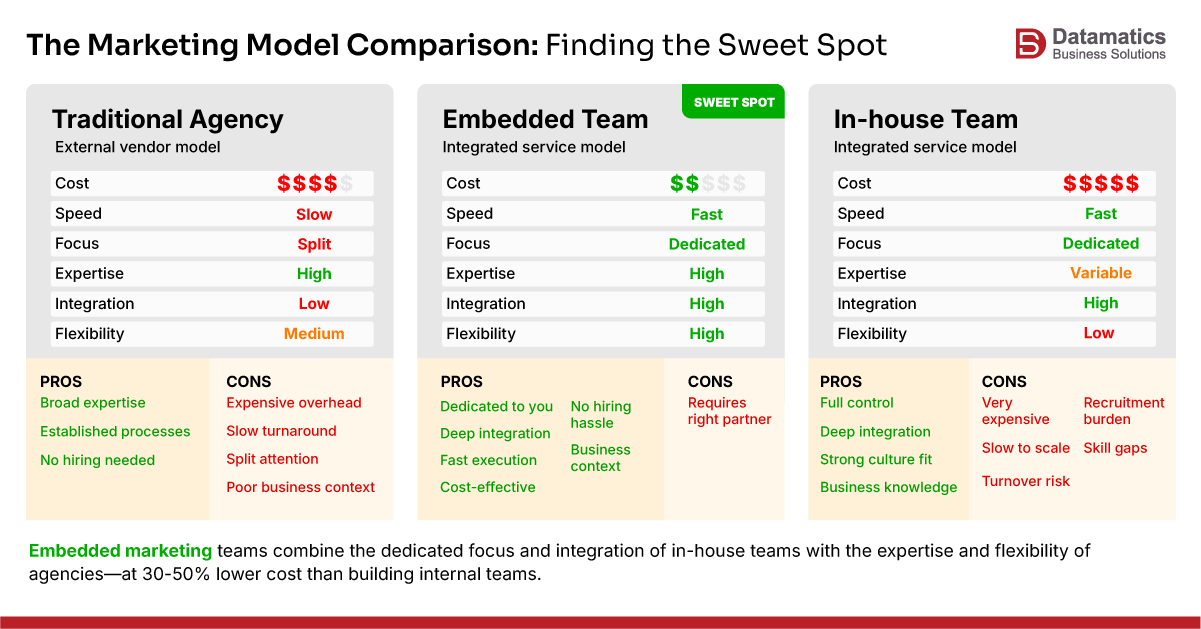
The embedded marketing team model sits in the sweet spot between in-house vs. outsourced marketing. You get the focus and alignment of an internal team. But you also get the flexibility and expertise of an external partner. It is a win-win situation.
Key Takeaway
An embedded marketing team gives you dedicated marketers who work like employees but operate through a service model, combining the best parts of in-house and outsourced marketing.
Why the Traditional Agency Model Is Breaking Down?
Here is an uncomfortable truth about traditional agencies.
They are not built to be your marketing team. They are built to be everyone’s marketing team.
When you hire an agency, you are getting a percentage of their attention. Your account manager is managing four other accounts. Your creative team is bouncing between your campaign and someone else’s rebrand. Your strategist is in back-to-back client meetings all week and has maybe two hours to actually think about your business.
This creates three major problems.
First, speed. Agencies move slowly because they are managing competing priorities. When you need a quick turnaround, you are competing with other clients for resources. Gartner surveyed marketing leaders to show that 44% of them plan to bring more work in-house over the next two years.
Second, context. Agencies lack deep business knowledge because they are not embedded in your day-to-day operations. They don’t sit in your product meetings. They don’t hear customer feedback firsthand. They don’t understand the internal politics that shape your go-to-market strategy. This creates work that looks good on paper but misses the mark in execution.
Third, cost. Agency pricing is opaque and often inflated. You are paying for overhead, account management layers, and profit margins that have nothing to do with the actual work being done. According to HubSpot’s marketing budget research, companies have reduced agency spend by more than 50% by building in-house capabilities, demonstrating the significant cost advantage of alternative models.
These reasons aren’t just small inconveniences. They are fundamental flaws in how the agency model operates, giving way to other alternatives.
Key Takeaway
Traditional agencies struggle with speed, context, and cost because they split attention across multiple clients and layer in expensive overhead that doesn’t improve output quality. Compound these together, and you will see most companies looking for other alternatives.
What Makes Embedded Marketing Teams Different?
So, what changes when you shift to an embedded marketing team?
The simple answer – Everything.
First is focus. An embedded team works exclusively on your business. They are not juggling other clients. When you need something, they are available. When a campaign need adjusting mid-flight, they can pivot immediately because they are not waiting on approvals from three other accounts.
Second, integration. These teams sit inside your organization, not outside it. They use your tools, attend your meetings, and align with your timelines. They become part of your culture, not vendors trying to decode it from the outside.
Third, accountability. When results slip, there is no finger-pointing about scope changes or misaligned expectations. The team is measured on your outcomes, not billable hours or project completion rates.
This model is gaining traction because it solves the core problems that make the in-house vs. outsourced marketing debate so frustrating. You don’t have to choose between control and flexibility anymore.
Research from Deloitte Digital found that organizations with highly automated marketing operations meet their content demands 24% more often than those relying on traditional manual processes and external agencies.
In real time, this is what it looks like. A mid-market SaaS company switched from a $15,000/month agency retainer to an embedded team. Within 90 days, they doubled their content output, reduced cost-per-lead by 40%, and most importantly their sales team stopped complaining about ‘marketing leads that don’t convert.’
The benefits of embedded marketing teams are thus many, which is also the reason for such a model to gain traction with marketing leaders.
Key Takeaway
Embedded marketing teams provide dedicated focus, deep integration, and clear accountability that traditional agencies can’t match because they’re structured to be extensions of your team, not external vendors.
When Does an Embedded Marketing Team Make Sense?
Let’s be honest. This model isn’t right for everyone.
If you are a startup that needs a single campaign for a product launch, hire a project-based agency. If you are a small business with inconsistent marketing needs, freelancers or contractors make more sense.
So, when do you consider an embedded marketing team? Let’s break it down.
You need consistent, ongoing marketing execution. If your business requires regular content production, demand generation campaigns, or multi-channel marketing programs, you need a team that understands the rhythm of your business. One-off agency engagements don’t cut it.
Your market moves fast and you can’t wait for agency timelines. If you are in tech, SaaS, or any industry where competitive positioning shifts monthly, you need a team that can react in days, not weeks.
Additionally, If you have tried the in-house route and hit scaling issues, this might be the way out. Building an internal marketing team is expensive and slow. Recruiting takes months. Training takes longer. And if someone quits, you are back to square one. An embedded team gives you the stability of in-house without the hiring risk.
And, you know when an embedded marketing team makes the most sense? When you are tired of educating new agency teams every six months. If you have cycled through multiple agencies because they never quite “get” your business, that is a structural problem. Embedded teams stick around long enough to actually learn your industry, your customers, and your internal dynamics.
Key Takeaway
Embedded marketing teams work best for companies that need consistent execution of their marketing efforts, fast turnaround times, and deep business understanding without the overhead of building and managing a full in-house team.
The Real Cost Comparison: In-House vs. Outsourced Marketing
Let’s talk money.
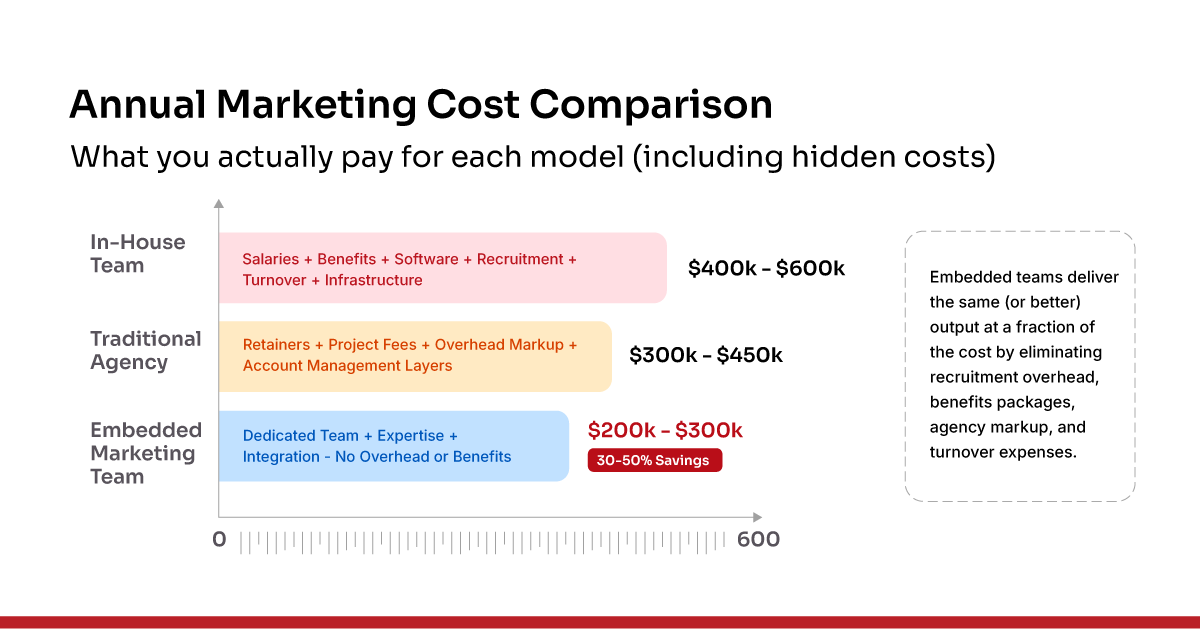
Building an in-house marketing team sounds appealing until you run the numbers. A mid-level marketing manager costs $80,000-$120,000 in salary, plus benefits, equipment, software licenses, and ongoing training. Multiply that across a content writer, a designer, a paid media specialist, and a strategist, and you are looking at $400,000-$600,000 annually before you have produced a single campaign.
Traditional agencies seem cheaper on paper. But once you factor in retainer fees, project overages, and the hidden cost of slow execution (which delays revenue), the math gets ugly fast.
Embedded marketing teams typically cost 30-50% less than building an equivalent in-house team and deliver faster results than traditional agencies because there is no ramp-up time for every new project.
Let me explain why. You are not paying for benefits, office space, or turnover. You are not paying agency markup on every billable hour. You are paying for output, not overhead.
According to Deloitte Digital’s research, marketers saw a 54% year-over-year increase in the volume of content they are expected to deliver, while organizations with advanced automation and integrated teams meet these demands 24% more often than their peers.
Let me show you what this looks like with actual numbers.
One of our clients transitioned from agency model to the outsourced marketing model. When with the agency, in 12 months they spent $180K for 24 campaigns. And the average turnaround time was 8-weeks. After partnering with us, within the span of 12 months, they have spent $110K spent for 47 campaigns. And the average turnaround time got reduced to 1-week. Same quality. Better results. Lower cost.
That is not a marginal improvement. That is a fundamental restructuring of how marketing budgets work.
Key Takeaway
Embedded marketing teams cost significantly less than building in-house teams and deliver better ROI than traditional agencies by eliminating overhead and focusing spending on actual execution.
Why This Shift Is Happening Now?
Let’s zoom out for a second.
The move toward embedded marketing teams isn’t just a trend. It is a response to fundamental changes in how businesses operate.
Marketing has become too complex for the old agency model. You are running campaigns across six channels, managing attribution across multiple touchpoints, and trying to prove ROI in real time. You can’t do that effectively with a team that is only paying half attention.
Technology has made remote collaboration seamless. Ten years ago, managing an external team felt clunky. Today, with technology and AI, an embedded team in a different city can feel more integrated than an in-house team on a different floor.
Everyone is demanding better ROI from marketing spend. The days of throwing money and hoping for results are over. Leadership wants to see clear cost-per-lead metrics, pipeline contribution, and marketing-influenced revenue. Embedded teams deliver that transparency.
This isn’t a passing trend. This is the new standard for how marketing execution happens at scale.
Key Takeaway
The shift to embedded marketing teams is driven by increasing marketing complexity, better remote collaboration tools, and leadership demand for measurable ROI and cost efficiency.
You can also read: The Rise of Outsourced Marketing Services: Why It Is Important Now
Building an Embedded Marketing Team: What to Look For
If you are convinced this model makes sense, here is what to look for in a partner.
Industry expertise. Your embedded team should understand your market, not just marketing tactics. If you are in SaaS, find a partner who has worked with SaaS companies. If you are in healthcare, work with a team that knows compliance and buyer behavior in that space.
Proven integration processes. Ask how they onboard new embedded teams. Do they have a structured 30-60-90 day plan? Do they assign dedicated account leads? How do they handle knowledge transfer and cultural alignment?
Transparent pricing. No hidden fees. No scope creep surprises. You should know exactly what you are paying for and what deliverables you’re getting.
Long-term thinking. The embedded model works because the team gets smarter about your business over time. If a partner is structured around short-term contracts or high turnover, that defeats the purpose.
A good partner doesn’t just provide bodies. They provide strategic thinking, process discipline, and a team that genuinely cares about your outcomes.
Key Takeaway
Choose an embedded marketing partner based on industry expertise, proven integration processes, transparent pricing, and a long-term partnership mindset rather than transactional project delivery.
How Datamatics Business Solutions Builds Embedded Marketing Teams That Deliver
While the benefits of embedded teams are many, most companies get stuck when they have to find a partner. They understand the embedded model makes sense. But they don’t know how to actually implement it without trial and error.
This is where Datamatics Business Solutions comes in.
We don’t just provide outsourced marketing services. We build dedicated embedded marketing teams that function as a true extension of your organization.
Our typical embedded team is live and running in 3 weeks. Not “onboarding.” Not “ramping up.” Actually delivering work.
In the first week, we dig into your business. Your tech stack, your workflows, your current bottlenecks. This isn’t a discovery call where we nod and take notes. We get into the nitty-gritties. Our goal, simple. Understand how you actually work, not how you wish you worked.
By the second week, we assign your team and map out the first sprint. You meet your content strategist, your paid media specialist, your designer —whoever is on your roster. We build the roadmap together. No surprises, no generic templates.
And by the third week, the first campaigns are launch-ready. With your approval, obviously. But here is what matters. Most clients see their first completed deliverable by day 10. Not week 10.
Every marketer on your embedded team has 5+ years of experience in their specialty. We don’t staff junior resources on client accounts. Period.
Your content strategist? They have led campaigns for Fortune 500 brands. Your paid media specialist? They have managed $10M+ in ad spend. These aren’t people learning on your dime. They are people who have already made the mistakes somewhere else.
And because this is 2026 and data privacy actually matters, all embedded team members work under strict NDAs and data privacy agreements. We are SOC 2 Type II certified. We comply with CCPA, GDPR, and industry-specific regulations like HIPAA where required. Your data stays your data.
We also maintain a 94% client retention rate. Because our embedded teams get smarter about your business every quarter. The average embedded team stays with a client for 2.3 years.
Compare that to the 8-month average agency relationship.
When the team actually sticks around, they stop asking basic questions about your brand. They stop needing three rounds of feedback on every asset. They start anticipating what you need before you ask for it.
That’s what “embedded” actually means.
With 50 years of experience in business process services and a proven track record in embedded marketing models, we know how to make this transition smooth and effective.
If you are ready to move beyond the limitations of traditional agencies without the overhead of hiring in-house, let’s talk. Fill out this form to learn more about our embedded marketing team solutions.
The Future of Marketing Execution
The CMOs who are winning right now aren’t the ones with the biggest budgets or the flashiest agency partners.
They are the ones who figured out how to build marketing functions that move fast, understand the business, and deliver measurable results without burning through cash.
The embedded marketing team model does exactly that. It gives you the focus of an in-house team, the expertise of an agency, and the flexibility of outsourced marketing services without the downsides of any of those options.
If you are still stuck in the traditional agency cycle—waiting weeks for creative approvals, re-explaining your brand for the third time this quarter, or watching your budget disappear into account management fees—it might be time to try something different.
The shift is already happening. The only question is whether you are going to lead it or follow it.
Like what you read? Subscribe to our newsletter and get insightful articles delivered straight to your inbox.
FAQ: Your Embedded Marketing Team Questions Answered
1. What is the difference between an embedded marketing team and a traditional agency?
An embedded marketing team works exclusively for your company and integrates directly into your processes, tools, and culture. A traditional agency splits attention across multiple clients and operates as an external vendor rather than an internal partner.
2.How much does an embedded marketing team cost compared to hiring in-house?
Embedded teams typically cost 30-50% less than building an equivalent in-house team because you avoid recruitment costs, benefits, turnover, and infrastructure expenses while getting dedicated, experienced marketers.
3. What types of companies benefit most from embedded marketing teams?
Companies that need consistent marketing execution, operate in fast-moving markets, have tried in-house teams but struggled with scaling, or are frustrated with slow agency turnaround times benefit most from the embedded model.
4. Can an embedded marketing team replace my entire in-house marketing function?
It depends on your needs. Some companies use embedded teams to fully replace in-house marketing. Others use them to complement a small internal team by filling skill gaps or handling execution while internal teams focus on strategy.
5. How long does it take to see results from an embedded marketing team?
Most companies see improved execution speed within 30 days and measurable ROI improvements within 90 days as the embedded team ramps up and gains deeper understanding of the business and market.

Paul van de Kamp