












The B2B landscape today is defined by data. It is what determine growth. Teams depend on data every day. Sales rely on it to reach the right accounts. Marketing uses it to segment and personalize their outreach efforts. And Operations teams use it to plan growth. But let’s be honest. Not all B2B data is ready for the road. Sometimes your database is full of typos and old contacts. Other times, it is simply too thin to be useful.
This is where the debate of data enrichment vs data cleansing begins.
Many people use these terms interchangeably. But they are not the same. Data enrichment and data cleansing are not the same thing.
While both aim to improve your database, they do it in different ways. To put it simply, one fixes what is broken. The other adds what is missing.
Recent studies show that 95% of businesses believe poor data quality hurts their operations. Furthermore, companies lose an average of $12.9 million per year due to bad data showed a study from Gartner.
Therefore, to ensure that bad data doesn’t haunt your efforts, it is imperative to understand the difference between data enrichment vs data cleansing.
This blog explains how they differ, when to use each, and why B2B organizations need both.
What Is Data Cleansing?
You run a campaign that is very well-planned. However, you get little to no traction at all. On closer inspection you realize that the data used had invalid email ids and incorrect job titles. Despite strong execution, the campaign failed. Reason? Bad data.
The horrors of bad B2B data are not lost on businesses. Ataccama in a report shows that companies can lose 20% of their revenue due to bad data. IBM estimates that poor data quality costs organizations $3.1 trillion per year in the US alone.
This highlights the need for data cleansing!
Data cleansing is the process of fixing errors in a dataset. Think of it like a “spring cleaning” for your CRM. Over time, data gets “dirty.” People change jobs, companies move, and typos happen during manual entry. According to Gartner, B2B contact data decays at a rate of about 30% per year due to job changes, company changes, and role shifts.
Data cleansing services focus on removing duplicate records, fix incorrect email addresses, highlight missing fields, flag invalid phone numbers, and correct inconsistent formatting.
Data cleansing services focus on removing these flaws. The goal is to make sure every piece of information is accurate and reliable.
Here are some of the most common data cleansing techniques:
a. Deduplication: Finding and merging two or more records for the same person or company.
b. Standardization: Making sure formats are the same. For example, changing “St.” to “Street” across all entries.
c. Validation: Checking if email addresses and phone numbers actually work.
d. Error Correction: Fixing misspelled names or incorrect zip codes.
So, what is the importance of data cleansing?
If you use dirty B2B data, your marketing efforts will fail. You might send emails to addresses that no longer exist. This hurts your sender reputation. According to Experian, 69% of organizations say inaccurate data stops them from providing a good customer experience.
With data cleansing, you know your efforts are guided in the right direction.
Key Takeaway
Data cleansing is about accuracy. It removes the “noise” so your team can focus on real, reachable leads.
What Is Data Enrichment?
Even if your B2B data is perfectly clean, it might still be too basic to be useful. Imagine having a list of names and emails but no idea who these people actually are. You don’t know their company size, their budget, or their job title. Without these details, your sales team is essentially flying blind.
This is where data enrichment services come in. If data cleansing is about removing “noise,” enrichment is about adding “signal.” It takes a thin, basic profile and turns it into a deep, actionable lead.
Instead of just fixing errors, data enrichment adds a signal to your database. By applying modern data enrichment techniques, you can layer on information that your sales team actually needs to close deals. This includes details like company revenue, industry type, and the number of employees.
Here are the most common techniques:
a. Firmographic Appending: This adds “firm” details like total company revenue, industry type, and the number of employees.
b. Technographic Data: This tells you what software or hardware a company currently uses. It is vital for software sales.
c. Demographic & Social Links: This adds specific details about the person, such as their seniority level and links to their LinkedIn or Twitter profiles.
d. Intent Data Mapping: This is one of the most powerful layers. It tracks what a company is currently searching for or reading about online, showing you who is actually ready to buy.
e. Account Hierarchy Mapping: This helps you understand how different departments and branch offices relate to a parent company.
So, now the question is – why does B2B Data need enrichment?
Clean B2B data alone is not enough for a modern sales team. A record with just a name and an email tells you who someone is, but it doesn’t tell you why they matter to your business.
Enriched B2B data helps your team work smarter in several ways:
a. Better Segmentation: You can group leads by industry or revenue rather than treating everyone the same.
b. Personalized Messaging: You can mention specific challenges related to a lead’s job role.
c. Lead Prioritization: Your team can focus on “high-value” accounts that fit your ideal customer profile and ignore the rest.
The results are visible in the numbers. Organizations that use data enrichment see a 25% higher conversion rate on average. Furthermore, 89% of companies say that the quality of their data directly impacts the experience they can provide to their customers.
In short, cleansing makes your data accurate, but enrichment makes it useful. Together, they turn a simple list of names into a powerful roadmap for your sales team.
Key Takeaway
Data enrichment adds context and depth. It moves you past simple contact info and helps your team understand exactly who to target and how to talk to them.
Also Read: 5 Data Enrichment Best Practices
Data Enrichment vs Data Cleansing: Core Differences
Although both deal with data quality, their roles are different. Let us look at both side by side to understand the differences better.
Feature | Data Cleansing (The “Fix”) | Data Enrichment (The “Growth”) |
|---|---|---|
Primary Goal | To remove errors, duplicates, and “junk” data. | To add new, missing information to existing records. |
Main Focus | Main goal is Accuracy. It ensures that the information you have is correct. | Main goal is depth. It provides more context and detail for each lead. |
Data Source | Mostly internal (fixing what is already in your CRM). | Mostly external (pulling from third-party databases). |
Typical Action | Deleting, formatting, and validating entries. | Appending firmographic, technographic, and intent data. |
Timing | Should be done first to create a solid foundation. | Should be done second to build upon clean data. |
The Result | A valid list that won’t bounce or waste time. | A rich profile that helps you close bigger deals. |
It is essential to remember that one does not replace the other. Using enrichment on dirty data leads to poor results. Using clean data without enrichment limits growth.
Key Takeaway
Data cleansing and data enrichment solve different problems. Both are required for reliable B2B data.
When Do You Need Data Cleansing?
You usually know your data is “dirty” when things stop working as they should. It isn’t always a sudden crash. It is often a slow decline in performance.
Here are some signs that show it’s time to clean up your B2B data:
a. Your email bounce rates are starting to climb
b. Your CRM reports show numbers that don’t match reality
c. You keep finding duplicate records for the same company
d. Your sales team is complaining that leads are “dead ends”
These issues are caused by data decay. If you notice these signs, it may be time to look into data cleansing companies that can help you scrub your database. Professional help ensures that your CRM remains a “single source of truth” rather than a graveyard of old contacts.
Key Takeaway
If your team no longer trusts the data in your CRM, cleansing must be your top priority.
When Do You Need Data Enrichment?
You might have a list that is 100% accurate, but if it only contains names and emails, it is still shallow. You need enrichment when your data is “clean” but not “useful” enough for a complex sale.
Here are some signs that show it’s time to enrich your B2B data:
a. Your marketing segments feel too broad and generic
b. Your Account-Based Marketing (ABM) programs are struggling to scale
c. Your sales reps spend hours researching prospects on LinkedIn instead of calling them
d. You lack basic details like company revenue or the software they use.
Enrichment is a strategic move. While some teams try to research this info one by one, most successful organizations partner with data enrichment providers to automate the process. This keeps your data fresh without slowing down your sales reps
Key Takeaway
If your data is accurate but lacks the depth needed to personalize a pitch, enrichment is the answer.
Can Data Cleansing and Enrichment Work Together?
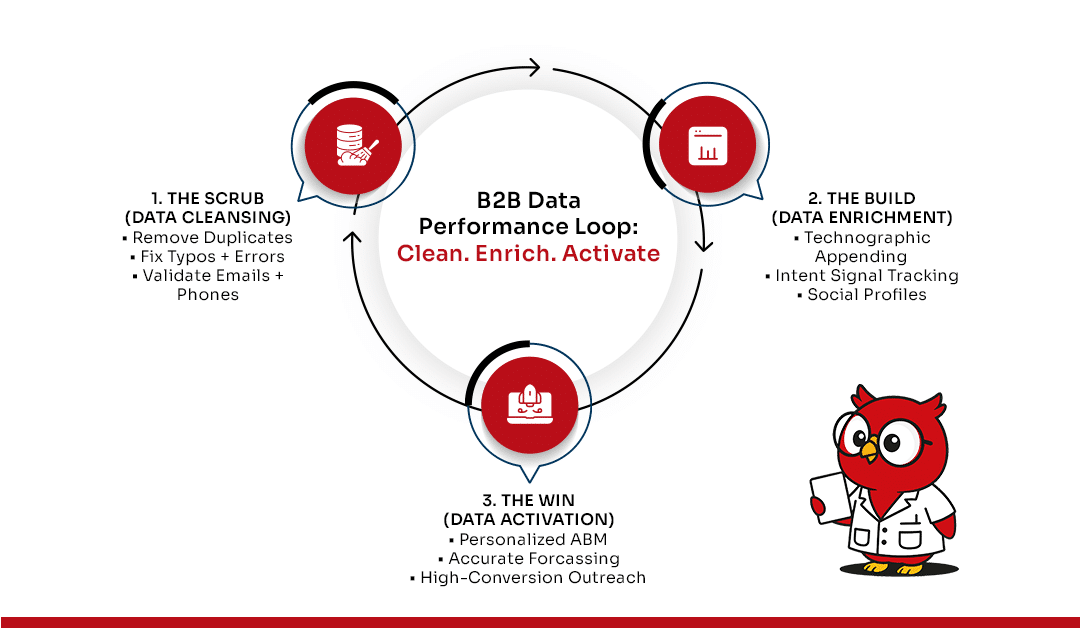
The short answer is: they should. In fact, they work best when used in a specific order.
Think of it like painting a house. You wouldn’t put a fresh coat of paint over a wall covered in dust. You clean the surface first. Following data cleansing best practices ensures that your foundation is solid before you spend money on adding new information. The standard workflow looks like this:
Step 1 – Clean existing records. Fix the typos and outdated info.
Step 2 – Remove duplicates. Merge those double entries into one.
Step 3 – Validate contact info. Make sure the emails and phones actually work.
Step 4 – Enrich the data. Add the layers like job titles, company size, and buying intent.
If you skip the cleaning and go straight to enrichment, you will waste your budget. You will end up paying to enrich duplicate records or, worse, adding data to a contact who left the company three years ago.
Key Takeaway
Data cleansing prepares the foundation. Data enrichment builds on it. Using them together ensures your data is both correct and powerful.
Bonus Read: What is B2B Data Cleansing Services?
Why B2B Growth Depends on Both?
B2B buying journeys have changed. They are no longer a simple conversation between one buyer and one seller. They are long, complex, and involve a lot of money.
Without a mix of clean and enriched data, you miss out on key decision-makers. You will fail to see intent signals that show a lead is ready to buy. It will also disturb your outreach. With clean and enriched data, everything will feel like spam because it isn’t personalized.
A study shows that a typical B2B purchase now involves 6 to 10 decision-makers. To reach modern buying groups, you need a database that is both deep and accurate. Working with established B2B data providers ensures that your team isn’t just sending emails, but is actually reaching the right people at the right time with the right message.
Key Takeaway
In a world of complex buying groups, you need both accuracy and depth to win. Therefore, you need your data to be both cleaned and enriched for it to derive maximum result.
How Datamatics Business Solutions Helps with Data Cleansing and Data Enrichment Services
DBSL offers structured data cleansing and data enrichment services designed for B2B use cases. For 50+ years, DBSL has led the charge when it comes to data cleansing and data enrichment.
The focus is simple. Make data usable, relevant, and ready for action. We help organizations clean large volumes of B2B data across CRMs, marketing platforms, and internal systems.
Our key capabilities when it comes to data cleansing services include detection and removal of duplicate data, validation of emails and phone numbers, standardization of company names and locations, normalization of job roles and titles, and data validation against trusted reference sources.
The process is repeatable and scalable. Instead of one-time clean ups, we support ongoing data hygiene programs. This helps reduce data decay over time.
When it comes to data enrichment services, we add meaningful attributes to B2B data records. From firmographic enrichment to industry and sub-industry mapping, from job role and seniority tagging to buying group identification, we do it all.
Our enrichment process is aligned with business goals. We ensure that your ABM teams get account-level insights, demand teams get better segmentation, and sales teams get context before outreach.
What makes us stand out? With access to 230+ million data records across 40+ industries, we use a hybrid approach to both cleansing and enrichment. We use a combination of human validation and our proprietary Dr D.A.T.A. platform to achieve 95%+ data accuracy.
Interested to learn more about our data cleansing and enrichment services? Fill out this form and our experts will reach out to you.
Closing Thoughts on Data Enrichment vs Data Cleansing
You shouldn’t choose between data enrichment and data cleansing. The idea is not about picking one over the other. They are two sides of the same coin. Without data cleansing, your database is full of errors that lead to failed campaigns. Without data enrichment, your data is too thin to support a modern sales strategy.
For B2B teams to grow, you need to clean first, enrich next. This two-step approach ensures that every lead in your CRM is not just a valid contact, but a detailed profile that your sales team can actually use to close a deal.
By maintaining high data hygiene and adding deep context, you turn your database into your most valuable asset.
Frequently Asked Questions
Q1. What is the main difference between data enrichment vs data cleansing?
Data cleansing focuses on fixing what is already there by removing errors, duplicates, and outdated info. Data enrichment focuses on what is missing by adding new details like company revenue, job titles, and social media profiles.
Q2. Is data cleansing required before data enrichment?
Yes. If you enrich dirty data, you waste money adding details to duplicate or incorrect records. Always clean your list first to ensure you are only spending your budget on valid leads.
Q3. How often should B2B data be cleansed?
B2B data decays at a rate of about 30% per year. To keep up with these changes, most organizations should perform a deep cleanse every quarter. High-volume businesses often benefit from continuous, automated cleansing.
Q4. Are data enrichment services useful for Account-Based Marketing (ABM)?
They are essential. ABM requires deep insights into account hierarchies, firmographics, and buying groups. Enrichment provides the specific details needed to target the right stakeholders within a high-value account.
Q5. Can data enrichment replace internal research by sales reps?
It doesn’t replace it, but it speeds it up. Enrichment handles the “grunt work” of finding basic company and contact details, allowing your sales reps to spend their time on higher-level strategic analysis and building relationships.

James Libera