














Scaling a marketing function inside a large enterprise is not a simple problem.
You need more output. You need faster execution. You need people who understand your brand, your buyers, and your internal priorities — not just the campaign brief they were handed on a Monday morning.
For years, the default answer was to hire more full-time staff or sign a bigger agency retainer. But neither option is working particularly now.
Full-time hiring is slow, expensive, and hard to reverse when priorities shift.
Traditional agencies, as anyone who has managed one can tell you, are built for breadth, not depth. They spread their talent across dozens of accounts and bill you for the privilege.
This is exactly why embedded teams are gaining serious traction in enterprise marketing.
They sit between the two old models. You get the dedication of an internal team without the overhead of building one from scratch. And you get the expertise of an external partner without the account-juggling that makes most agencies frustrating.
This blog explains how that model works, why it makes sense for enterprise scale, and what to look for when you are evaluating your options.
What Is an Embedded Team in Marketing?
An embedded team is a group of marketers, strategists, or specialists who work exclusively for your business, but are not on your direct payroll.
They operate inside your workflows. They use your tools. They attend your planning meetings. They align with your brand guidelines, your sales calendar, and your quarterly goals. For all practical purposes, they function like internal employees.
The difference is the structure. They come through an external provider, which means you are not responsible for recruiting, onboarding, managing benefits, or handling the employment complexity that comes with building a team from zero.
This is different from what most people think of as outsourced marketing. With traditional outsourced marketing services, you hand off a project or a campaign and wait for a deliverable. The vendor works at a distance. Communication goes through account managers. The output often feels disconnected from your actual business context.
Embedded teams do not work that way. They are integrated into how your marketing function actually runs. That is the core distinction.
Key Takeaway
An embedded team works inside your organization’s daily operations — not at arm’s length — which is what separates it from standard outsourced marketing arrangements.
Why Enterprises are Moving Away from the Traditional Model?
The old model — hire fast, outsource the rest — made sense when marketing was simpler and slower. It does not hold up at enterprise scale in competitive markets.
Here is what typically breaks down.
a. Speed is the first problem. Traditional agencies manage multiple clients simultaneously. When you need to respond quickly to a market shift or a competitive move, you are competing for your own agency’s time. According to Gartner, 44% of marketing leaders planned to bring more work in-house over the next two years, with speed and agility cited as primary drivers.
b. Context is the second problem. Agencies do not sit inside your business. They do not hear your customer calls. They do not understand the internal conversations that shape your go-to-market decisions. This produces work that looks fine on paper but misses the nuances that actually matter in execution.
c. Cost is the third. Agency pricing layers in overhead, account management fees, and profit margins that have nothing to do with the quality of output. Research from HubSpot shows companies have cut agency spend by more than 50% by building integrated in-house capabilities — a sign that the ROI calculation is shifting.
Full-time hiring, meanwhile, comes with its own friction. Long recruitment timelines. Onboarding periods. Rigid headcount structures that are hard to adjust when business needs change. For enterprises operating across multiple markets or product lines, that rigidity creates bottlenecks.
Embedded teams address all three problems without introducing a new set of tradeoffs.
Key Takeaway
The traditional agency model breaks down on speed, context, and cost at enterprise scale. Full-time hiring adds structural rigidity. Embedded teams offer a middle path that avoids both failure modes.
How Embedded Teams Help Enterprises Scale
Let us get specific about what actually changes when an enterprise moves to this model.
a. Execution capacity grows without proportional overhead. One of the hardest parts of scaling marketing at a large organization is the lag between demand and delivery.
You identify a new segment. You want to launch a campaign. But your internal team is at capacity, and a new hire will not be productive for months. An embedded team can be activated quickly and scaled up as the workload increases, without the recruiting cycle or the fixed cost structure.
b. Brand and strategy alignment stays intact. This is where embedded teams pull ahead of most outsourced marketing models. Because the team works inside your systems and attends your internal reviews, they develop real institutional knowledge.
They learn your product positioning, your audience segments, your tone of voice, and your internal approval processes. That knowledge compounds over time in a way that a rotating agency roster never does.
c. Multi-market execution becomes manageable. Enterprises often need consistent messaging across regions while adapting for local nuances. An embedded team that understands the brand deeply can handle this without constant back-and-forth.
According to Deloitte’s Global Marketing Trends report, companies that centralized marketing operations while allowing for regional flexibility saw measurably better campaign consistency and faster time-to-market.
d. Specialized skills fill gaps without permanent headcount. Enterprise marketing requires a wide range of expertise — content strategy, paid media, marketing operations, analytics, design.
Maintaining all of that in-house is expensive and creates workforce planning headaches. Embedded teams can bring specialized skills into the mix without locking those costs into permanent salary structures.
Key Takeaway
Embedded teams allow enterprises to scale execution, maintain brand quality, and access specialized skills. They can do this without the cost and timeline friction of traditional hiring or agency engagements.
In-House vs Outsourced Marketing: Where Does the Embedded Model Fit?
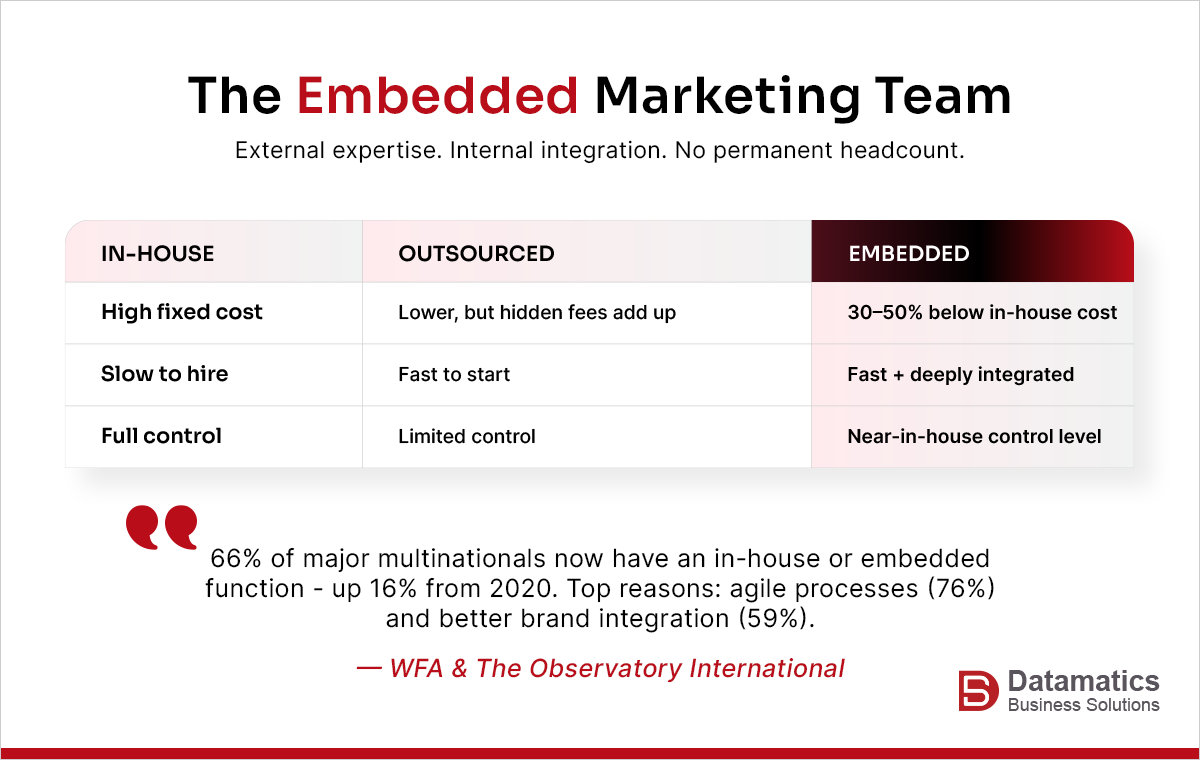
The in-house vs outsourced marketing debate has been running for years. Most enterprises end up somewhere in the middle, using a combination of internal staff and external partners.
The embedded model reframes that debate.
It is not purely in-house, because the team comes through a partner rather than your HR function. It is not purely outsourced marketing, because the team operates inside your workflows rather than at a distance.
Think of it as a hybrid structure that preserves the advantages of both sides. You get the dedicated attention and brand alignment that comes with an internal team. You get the flexibility and scalability that comes with an external engagement model.
For enterprises with complex marketing operations, this matters a great deal. You can maintain core marketing leadership internally while embedding specialist capacity around them.
Your head of demand generation, for instance, might be a full-time employee, but the content team, the paid media specialists, and the marketing operations support could come through an embedded arrangement.
This is already how many high-performing marketing organizations are structured. Forrester research shows that companies combining internal strategic leadership with embedded execution consistently outperform those relying on either model alone.
Key Takeaway
The embedded model does not replace either in-house or outsourced marketing. It sits between them, capturing the benefits of both while reducing the costs and limitations of each.
Common Objections to the Embedded Team Model
Before committing to this approach, most enterprise marketing leaders raise similar questions. Here is an honest look at each one.
“Will they really understand our business?”
The answer to this depends entirely on how the engagement is set up. A properly structured embedded arrangement includes a discovery and onboarding phase, access to internal documentation and stakeholders, and ongoing alignment with your strategy team. The knowledge gap narrows quickly and continues to shrink over time.
“Who manages them?” In most embedded arrangements, a designated lead on the vendor side manages the day-to-day coordination of the team, while your internal marketing leadership sets strategic direction. This creates clear accountability without adding management overhead to your plate.
“What if we need to scale back?” This is actually one of the strengths of the model. Because embedded teams operate through a service arrangement rather than permanent employment, scaling back is far simpler than managing layoffs or restructuring. You adjust scope rather than headcount.
“Is it more expensive than building in-house?” Not when you factor in the full cost of employment. You have to take in account factors like recruiting people, benefits, onboarding, and management time. And the productivity lag during ramp-up. According to SHRM, the average cost per hire in the US is approximately $4,700. This figure does not include the time it takes for a new hire to reach full productivity. And it can extend to eight months or more for specialized roles.
Key Takeaway
The objections to embedded teams are real but addressable. The model works best when roles, accountability, and integration processes are clearly defined from the start.
How Datamatics Business Solutions Supports Enterprise Marketing Through Embedded Teams?
Datamatics Business Solutions has spent over 50 years working with enterprise clients across industries that require precision, scale, and consistency in their marketing operations. The embedded team model is a core part of how we deliver marketing support.
When a client engages with us for embedded marketing support, we begin with a structured discovery phase. This is not a generic onboarding checklist. It involves a detailed review of the client’s current marketing infrastructure, brand guidelines, target audience definitions, and existing content and campaign assets. The goal is to make sure the embedded team starts with genuine context, not surface-level familiarity.
We integrate the team into the client’s actual workflows.
The team that clients work with is not a rotating cast. It is a consistent group of specialists with clearly defined roles. From content strategists and copywriters to demand generation specialists, marketing operations managers, and analytics support, we have a team of experts. Clients maintain direct communication with the team, not through layers of account management.
Want to know more about our outsourced marketing services? Fill out the form here and our experts will get in touch with you.
The Case for Embedded Teams Is Practical, Not Theoretical
Enterprises do not struggle with marketing because they lack ideas or budget. They struggle because the structures they use to execute marketing are sometimes not built for the speed and complexity of modern B2B growth.
Embedded teams are not a trend. They are a structural fix to a structural problem.
When the team working on your marketing actually understands your business, the work gets better. Decisions get faster. Output scales without the constant friction of onboarding, briefing, and course-correcting people who are only partially invested in your success.
The in-house vs outsourced marketing debate has been framed as a binary choice for too long. But trust me, it is not. The embedded model gives you a third option. One that is more focused than an agency and more flexible than a permanent hire.
If your marketing function is hitting a ceiling, the answer is probably not more headcount or a bigger retainer. It is a smarter structure. And for most enterprise marketing leaders, that structure looks a lot like an embedded team.
Like what you read? Subscribe to our blogs and get latest industry trends and insights delivered straight to your inbox.
FAQ: Embedded Teams for Enterprise Marketing
1. What is an embedded team in a business context?
An embedded team is a group of external specialists who work exclusively within your organization’s workflows and operations, functioning like internal employees but engaged through a service partner. They are not project-based or account-shared — their focus is dedicated to your business.
2.How is an embedded team different from a traditional outsourced marketing service?
Traditional outsourced marketing services operate at a distance. You hand off a deliverable and receive output. Embedded teams, by contrast, integrate into your daily operations — they use your tools, attend your meetings, and develop deep familiarity with your brand and strategy over time.
3. What types of marketing work are best suited to the embedded model?
The model works particularly well for ongoing functions that require institutional knowledge: content marketing, demand generation, account-based marketing, marketing operations, and campaign management. It is less suited to highly project-specific work like a one-off event or a standalone logo refresh.
4. How long does it take for an embedded team to get up to speed?
It varies by scope and complexity, but most embedded arrangements see meaningful productivity within four to six weeks. Unlike agency handoffs, the integration is continuous — the team gets faster and more contextually aware over time, not just during onboarding.
5.Is the embedded model only for large enterprises?
No. While large enterprises benefit from the scale and specialization, mid-market companies also use embedded teams when they need consistent marketing execution without the cost of full-time hiring. The model is particularly well-suited to companies in a growth phase that need capacity faster than recruiting allows.
6.What should I look for when evaluating an embedded team provider?
Look for clear integration processes, defined roles and accountability structures, demonstrated experience in your industry or marketing function, and evidence of long-term client relationships rather than short-term project work. The provider’s willingness to align with your internal tools and workflows is a strong signal of how the engagement will actually operate.

Paul van de Kamp