












Here is an uncomfortable truth that most marketing leaders already sense but rarely say out loud.
Your pipeline is not the problem. Your pipeline is just lying to you.
The numbers look fine on paper. MQLs are up. The sales team has a full queue. Marketing is hitting its lead targets. And yet the close rate is flat, the sales cycle keeps stretching, and somewhere between the handoff and the deal, something keeps going wrong.
The culprit is almost never the product. It is rarely the sales team either. More often, it is a qualification problem that starts upstream. Before a single lead ever reaches sales.
When marketing passes leads that have not been properly assessed for readiness, the whole revenue engine slows down. Sales spends time on conversations that go nowhere. Pipeline forecasts get inflated with opportunities that were never real. And marketing absorbs the blame for leads that “did not convert” — even though the issue was never conversion. It was qualification.
This is a business problem, not a process problem. And it costs more than most marketing leaders realise.
Most marketing leads never convert to sales. And it is not a small inefficiency. It is the majority of your demand generation spend producing pipeline that does not close.
The fix does not require a new tech stack or a complete process overhaul. It requires a clearer answer to four questions before any lead is considered ready for sales. That framework is called BANT. And it is one of the most straightforward tools available for turning pipeline quantity into pipeline quality.
What Are BANT Qualified Leads?
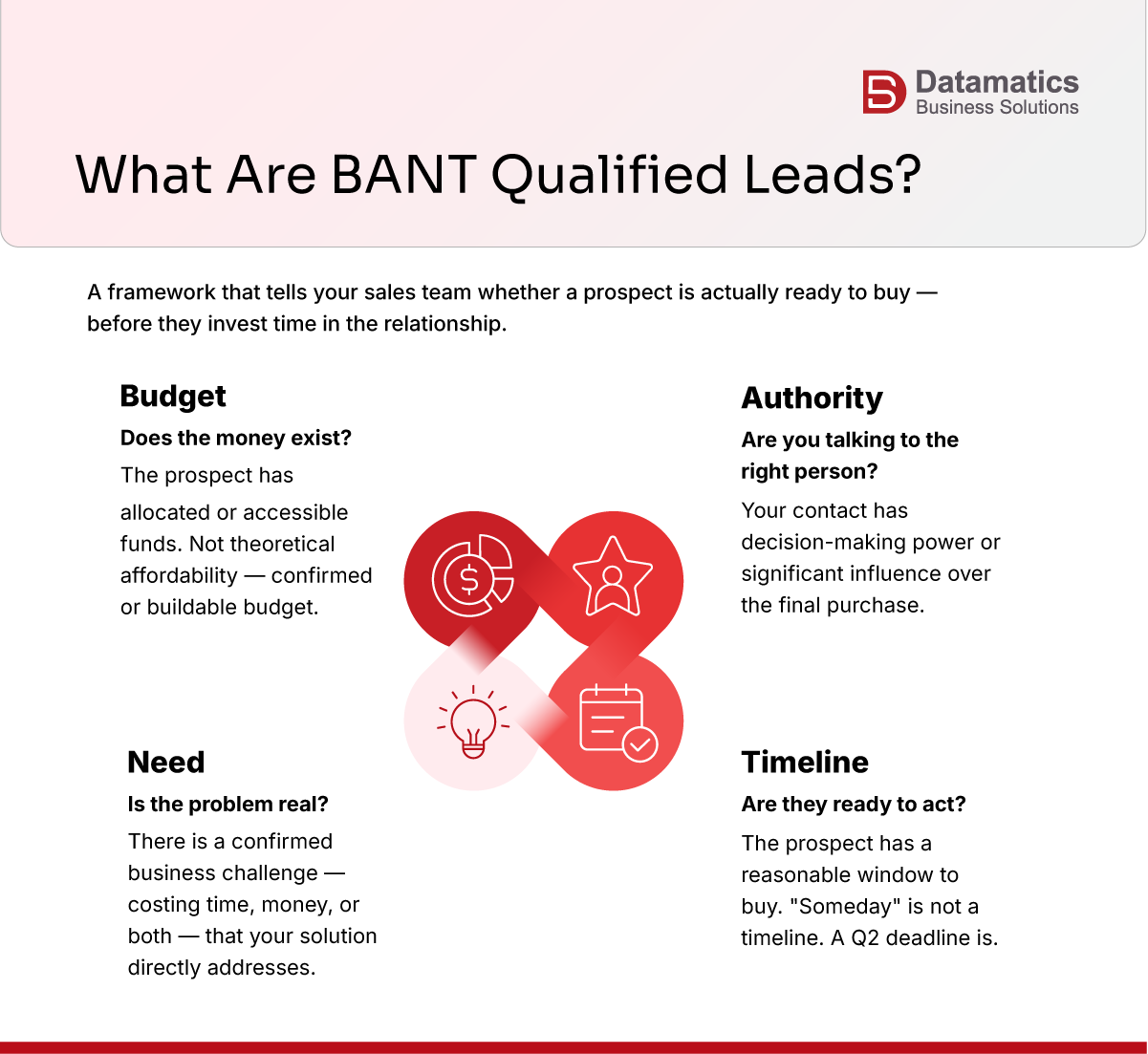
BANT stands for Budget, Authority, Need, and Timeline.
A BANT qualified lead is a prospect that has been evaluated against all four of these criteria before being handed off to sales.
Here is what each element actually means in practice:
- Budget: Does the prospect have allocated or accessible funds to make a purchase? This is not asking if they can theoretically afford it. It is asking whether money has been set aside or whether a business case can be built around it.
- Authority: Are you speaking to someone who has decision-making power, or are they going to need to get approval from someone three levels up? Authority does not always mean the final signer. It can mean an influencer with significant say in the process.
- Need: Does the prospect have a real, identified problem that your solution addresses? Not a vague interest. An actual business challenge that is costing them time, money, or both.
- Timeline: Is the prospect actively looking to solve this problem within a reasonable window? A company that is open to buying “someday” is not the same as one with a Q2 deadline.
A lead that checks all four boxes is a BANT qualified lead. One that checks two or three may still be worth nurturing, but it is not ready for direct sales engagement.
Key Takeaway
BANT qualified leads are prospects who have been assessed for budget, authority, need, and timeline. All four must align before the lead is considered sales-ready.
Why Does the BANT Sales Method Actually Work?
The BANT sales method works because it is built on one very simple principle: not every interested person is a buyer.
B2B sales is full of people who will take calls, attend demos, and engage with content out of genuine curiosity or exploratory intent. That is fine. But your sales team’s time is not unlimited.
Research from HubSpot shows that sales reps spend only about 34% of their time actually selling. The rest is eaten up by administrative tasks, follow-ups, and working leads that go nowhere. When you apply the BANT qualification process upfront, you are protecting that 34%.
The method forces a structured conversation early in the sales process. Instead of three warm-up calls before you finally ask about budget, BANT builds those questions into the discovery phase naturally. It is not interrogation. It is qualification.
According to Salesforce’s State of Sales report, high-performing sales teams are 2.8x more likely to use a formal qualification framework than underperforming teams. BANT is one of the most widely adopted of those frameworks.
Here is how it compares to the other qualification frameworks commonly used in B2B sales today.
Criteria | BANT | MEDDIC | CHAMP |
|---|---|---|---|
Best For | Enterprises, SMBs, mid-market B2B | Enterprises | Early-stage startups |
Complexity | Low — four straightforward criteria | High — six criteria including economic buyer and decision criteria | Medium — four criteria with a challenges-first approach |
Entry Point | Need or budget | Metrics and economic impact | Challenges and pain |
Time to Qualify | One to two discovery calls | Multiple touchpoints over weeks | One to two discovery calls |
Weakness | Can miss economic impact in large deals | Requires experienced reps to execute well | Less structured around budget and timeline |
Ideal Team | SDR-led qualification with structured handoff to sales | Senior AEs handling complex enterprise deals | Founders or early sales teams finding product-market fit |
For most B2B teams running structured SDR-led pipelines, BANT remains the most practical starting point. The other frameworks build on it — they do not replace it.
Key Takeaway
The BANT sales method works because it filters out unready prospects early, giving sales reps more time to focus on leads that are likely to close.
How Does the BANT Qualification Process Work in Practice?
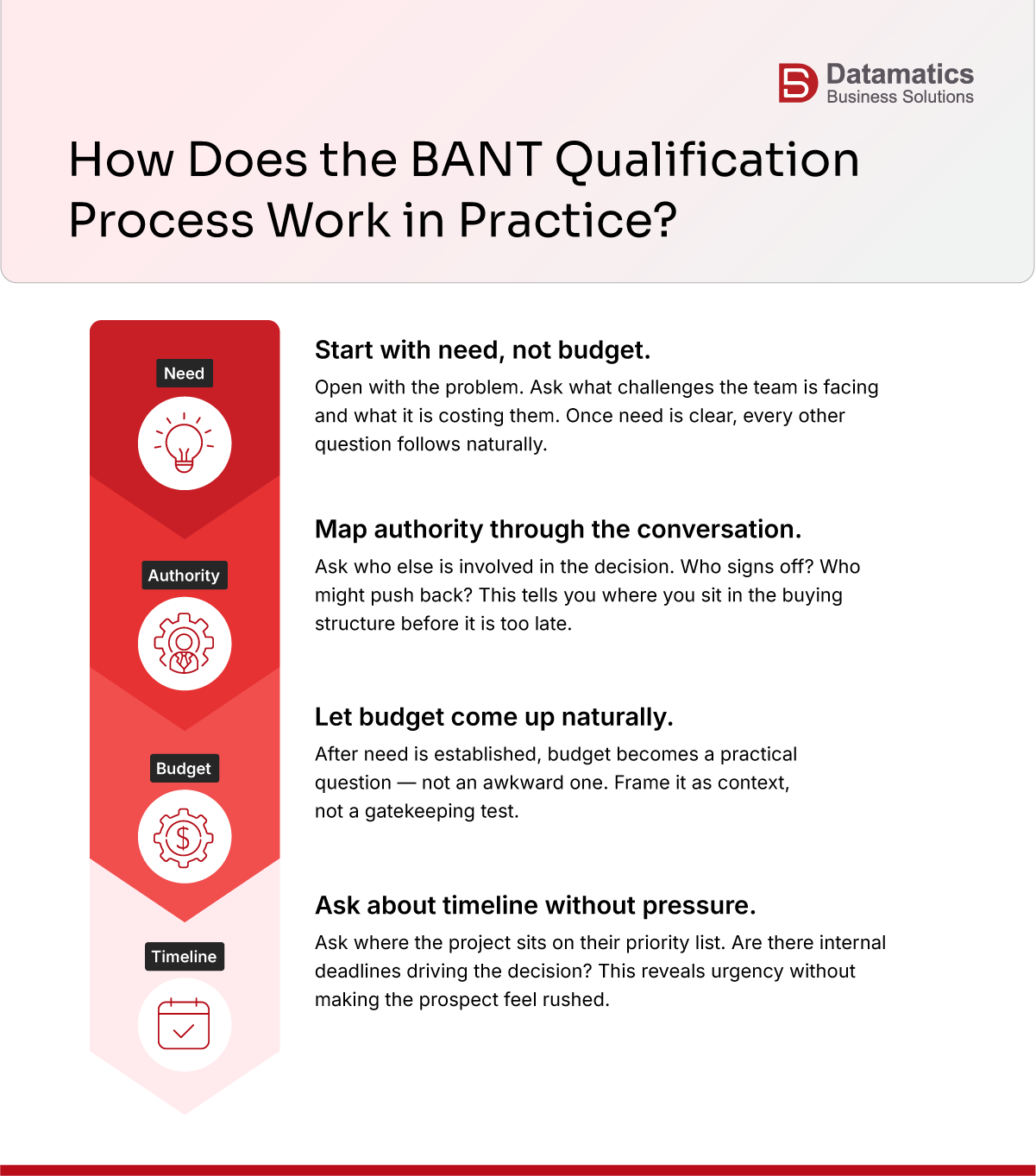
The BANT qualification process is not a rigid checklist you run through on a first call. Done well, it feels like a natural discovery conversation. Done poorly, it feels like an interrogation.
Here is how good sales teams approach it:
Start with need, not budget.
Jumping straight to “what is your budget?” early in a conversation puts people on the defensive. Instead, open with questions around the problem. What challenges is the team facing? What has already been tried? What is the cost of not solving this?
Map authority through the conversation.
Ask who else is involved in the decision. Who needs to sign off? Who might push back? This tells you where you sit in the buying structure and who else you need to reach.
Let budget come up naturally.
Once you have established need, budget becomes a practical conversation rather than an awkward one. “Based on what you have described, companies typically invest X to solve this. Does that align with what you have set aside?” That is a much easier ask.
Ask about timeline without pressure.
“Where does this project sit on your priority list right now?” or “Are there any internal deadlines driving this decision?” These questions reveal timeline without making the prospect feel rushed.
A study by RAIN Group found that top-performing salespeople are 57% more likely to have a defined qualification process than average performers. The BANT lead qualification framework is one of the most practical ways to build that process.
Key Takeaway
Effective BANT lead qualification is a conversation, not an interrogation. The best reps weave the four criteria into natural discovery questions rather than running a rigid script.
Why BANT Qualified Leads Move Faster Through the Pipeline
Here is the core reason. When a lead is BANT qualified, the sales rep is not starting from scratch on trust and context. The basics are already established.
Budget is confirmed — so there is no conversation stall three weeks in because the prospect needs to “check with finance.” Authority is mapped — so the rep knows exactly who to involve at each stage and does not get blindsided at approval. Need is validated — so the proposal addresses a real problem, not a constructed one. Timeline is clear — so both sides are working toward the same window.
That alignment matters more than most teams account for. Gartner research shows that the typical B2B buying group involves 6 to 10 decision-makers, each independently researching solutions.
Without BANT, a rep can spend weeks building a relationship with the wrong person entirely. With it, the buying structure gets mapped early — which means fewer late-stage surprises and fewer deals that collapse after a month of work.
Let us compare two scenarios.
Scenario A: A rep spends six weeks nurturing a lead, only to discover in week seven that the final decision-maker is someone they have never spoken to — and that person has a different vendor preference.
Scenario B: A rep identifies in week one that the CFO has final sign-off, arranges an intro in week two, and structures the entire pitch around the CFO’s priorities from the start.
That is the difference BANT qualified leads make. Not just speed. Direction.
According to Forrester, companies with mature lead qualification processes see 36% higher win rates compared to those without a formal qualification approach.
And there is a financial dimension to this that does not always make it into pipeline reports but shows up clearly in CAC. Every lead a sales rep pursues that was never going to close is acquisition cost with no acquisition at the end of it.
The rep’s time, the demo, the proposal, the follow-up sequence — all of it gets absorbed into your cost-per-customer whether the deal closes or not.
When qualification is weak, CAC climbs not because you are spending more on marketing but because sales is burning hours on leads that were never real. BANT removes that weight before it accumulates.
Key Takeaway
BANT qualified leads convert faster because the foundational questions are already answered. Sales reps move forward with confidence rather than guesswork — and the business stops paying acquisition costs on deals that were never going to close.
How BANT Fits into Your B2B Lead Generation Strategy
BANT does not live in a vacuum. It works best when it is woven into how your team generates and nurtures leads from the start — not bolted on at the end when a rep is already on the phone.
At the top of the funnel, the goal is simple: get the right companies into the pipeline. Whether that is through your own in-house team or external B2B lead generation partners, you are casting wide at this stage. Not every prospect will be BANT ready on first contact. That is expected.
The middle of the funnel is where intent starts to surface. B2B lead nurturing — email sequences, targeted content, event follow-ups — does two things simultaneously. It keeps your brand relevant to prospects who are not yet ready to buy. And it generates behavioral signals that map directly to BANT criteria.
A prospect who visits your pricing page three times in a week is telling you something about budget curiosity. One who attends a product-specific webinar is signaling need alignment. You just have to be paying attention.
By the time a lead reaches the handoff point, BANT acts as the final check. Not a bureaucratic gate, but a genuine readiness assessment. Budget accessible? Authority confirmed? Need validated? Timeline real? If the answer is yes across the board, sales gets a lead worth their time.
That last part matters more than most teams acknowledge. According to MarketingSherpa, 79% of marketing leads never convert to sales — and poor qualification at the handoff stage is one of the primary reasons. More leads into the pipeline does not fix that. Better-qualified leads do.
Key Takeaway
BANT works best when it runs through the entire funnel — not as a final filter, but as a thread that connects how you generate, nurture, and hand off leads to sales.
You can also read: BANT Qualified Leads: Are They Still Relevant in 2026?
How BANT Helped a B2B SaaS Company Cut Its Sales Cycle by 35%: A Real-World Case Study
A mid-market B2B SaaS company in Austin, Texas was generating 300 MQLs a month. Marketing was hitting targets. Leadership was satisfied. But the sales team was frustrated. Of those 300 leads, only 8 were closing each month. The rest stalled or got disqualified after multiple calls, demos, and proposals had already been invested.
The VP of Marketing was pulled into a revenue review with one persistent question: why is pipeline coverage at 4x but win rate below 15%? That is when they came to us.
What We Found
Leads were being passed to sales based on engagement signals alone. Signals like opens, downloads, webinar attendance were being used to qualify leads. None of it confirmed budget, authority, urgency, or timeline. Marketing was measuring interest. Not readiness.
What We Did
We rebuilt the lead handoff criteria around BANT. SDRs were tasked with confirming need, authority, and timeline before any lead reached sales. Budget qualification moved to the first discovery call. Behavioural signals were reframed as BANT indicators to investigate — not conversion triggers to act on.
What Changed
Ninety days later, MQL volume dropped to 180. Leadership pushed back. But the sales team was closing more with less. Deal cycle shortened from 94 days to 61. Win rate climbed from below 15% to 28%.
Less pipeline. Better pipeline. More revenue.
Common Mistakes That Break the BANT Qualification Process
BANT is straightforward in theory. But there are a few ways teams consistently undermine it in practice.
Treating BANT as a binary pass/fail test.
A lead that does not fully meet every criterion is not automatically worthless. It may be a strong candidate for continued nurturing. The goal of BANT lead qualification is to segment, not to discard.
Asking BANT questions without listening to the answers.
Reps who are going through the motions often check the boxes without actually processing what the prospect is telling them. A prospect saying “we have budget, but it is not approved yet” is a very different signal than “we have a signed PO.”
Skipping the authority conversation.
This is the most common and most costly mistake. Reps get comfortable with their main contact and avoid the awkward question of who else needs to be involved. Then the deal stalls at the approval stage.
Not revisiting BANT as the deal progresses.
BANT is not a one-time assessment. Budget situations change. Authority structures shift, especially in enterprise accounts. Timelines get pushed. Good reps revisit BANT criteria at key milestones throughout the deal.
Key Takeaway
The biggest BANT mistakes come from applying it rigidly or superficially. The framework requires genuine listening and regular revisiting as deals evolve.
How Datamatics Business Solutions Approaches BANT Qualified Lead Generation
At Datamatics Business Solutions, we work with B2B companies across the globe to build lead generation programs that go beyond volume. Our focus is on pipeline quality.
Our demand generation services apply the BANT qualification process as a core part of how we build and score prospect lists. Before any lead reaches a client’s sales team, we verify that the four BANT criteria have been assessed through a combination of intent data, technographic signals, firmographic filters, and direct outreach.
We work closely with sales and marketing leaders to define what “qualified” actually means for their specific ICP. That means setting realistic budget thresholds, mapping authority structures within target accounts, confirming business need through content engagement and behavioral signals, and aligning timelines with where the prospect sits in their buying cycle.
The result is a pipeline that is built on real opportunities, not inflated lead counts. Our clients see shorter sales cycles and fewer wasted conversations because the qualification work happens before the handoff.
If your team is spending too much time on leads that go nowhere, the problem is usually upstream. We can help you fix it there. Fill out the form here
Key Takeaway
Winning in modern B2B marketing isn’t about chasing more leads. It is about focusing on the right ones, aligning teams, and creating campaigns that work across every channel buyers use. With Datamatics’ intent-based demand generation, you don’t just get activity, you get momentum: high-quality leads, shorter sales cycles, and measurable growth you can count on.
 Select an element to maximize. Press ESC to cancel.
 Conclusion
The pipeline problem most sales teams face is not a volume problem. It is a quality problem. More leads do not automatically mean more revenue. Better leads do.
The BANT qualification process is one of the most practical tools available to fix that. Not because it is complicated, but because it is not. It asks four questions that everyone in B2B sales already knows are important. It just makes sure those questions get answered before the sales clock starts ticking.
Build your pipeline around BANT qualified leads, and your team will spend less time chasing and more time closing.
Like what you read? Subscribe to our monthly newsletter today and get such insights delivered to your inbox.
Frequently Asked Questions About BANT Qualified Leads
1. What is the difference between a BANT qualified lead and a marketing qualified lead (MQL)?
An MQL is typically determined by marketing based on behavioral signals, like email opens, downloads, or website visits. A BANT qualified lead goes further by confirming that the prospect has the budget, authority, need, and timeline to actually buy. MQL is an engagement signal. BANT qualification is a readiness signal. The two work together, but they are measuring different things.
2. Is the BANT sales method still relevant in modern B2B sales?
Yes. While some newer frameworks like MEDDIC or CHAMP have emerged, BANT remains widely used because it is simple to apply and covers the fundamentals of deal viability. Many sales teams use BANT as the baseline and layer additional criteria on top for complex enterprise deals. The core logic is sound and has not changed.
3. How do you qualify a lead for budget without making it awkward?
The key is sequencing. Establish need and urgency first. Once the prospect articulates their problem clearly, the budget question becomes practical rather than intrusive. You can frame it as: “To give you a realistic picture of what a solution looks like, it helps to understand the range you are working with. Is that something you can share?” That approach treats budget as a collaboration tool, not a gatekeeping question.
4. What happens to leads that do not pass BANT qualification?
They go into a nurture track, not the trash. A lead that lacks a confirmed timeline or a clear budget today may be a strong buyer in six months. The job of B2B lead nurturing is to stay relevant and maintain the relationship until the BANT criteria align. Dropping non-BANT leads entirely is a waste of good pipeline potential.
5. Can BANT qualification work for outbound prospecting, or is it only for inbound leads?
BANT works for both. For inbound leads, qualification happens after initial engagement. For outbound, the BANT criteria are used to select which prospects to target in the first place. If a prospect does not have the budget profile, organizational need, or relevant authority based on their firmographic and technographic data, they probably should not be in your outreach sequence to begin with. BANT is just as useful as a targeting filter as it is as a qualification tool.
6. How long should the BANT qualification process take?
It depends on the deal complexity. For straightforward SMB sales, BANT can be assessed in a single discovery call. For enterprise deals with multiple stakeholders and longer buying cycles, it may take two or three conversations to map all four criteria accurately. The goal is not speed. The goal is accuracy. A rushed qualification that misses a critical flag early is far more costly than taking an extra call to get it right.

Carly Jaspan