












The world of marketing and sales right now is chaotic. And it is time that is bleeding the most. For decades, marketing and sales teams have relied on a simple formula to decide who is worth talking to and who is just kicking tires. That formula is BANT.
Budget, Authority, Need, Timeline. The age old qualification framework that showed whether a lead was good or not.
But as we navigate 2026, the way people buy has changed. Be it software or services, buyers today are informed and have access to more fluid budgets. Oh, and also, buyers today come in committees. Earlier, targeting a single person would work. Today, it has to be a buying group.
This leads to a big question. Are BANT qualified leads still relevant today? Or is this framework a relic of the past?
In this blog, we will break down the current state of BANT lead qualification, explore why it still works, and look at how it has evolved to fit the modern bant sales process.
What are BANT Qualified Leads?
Before we dive into the future, we should take a short look at the past. The BANT sales method was created by IBM in the 1950 and 1960s. Why? Well, it was designed to help their sales reps identify prospects who were ready to buy.
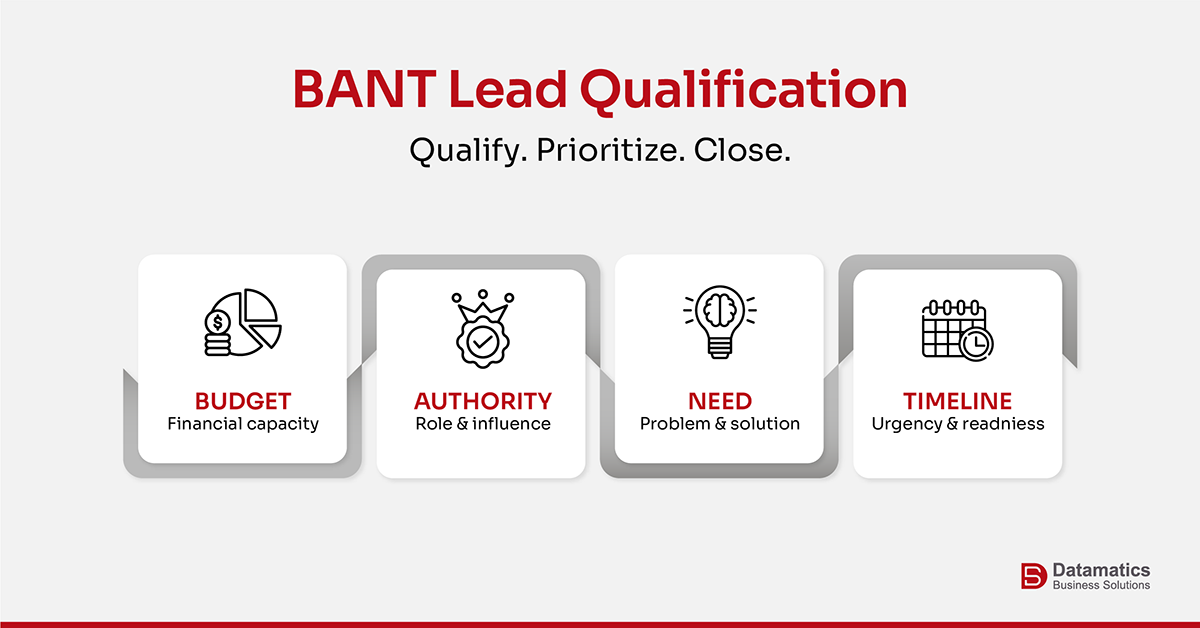
BANT is an acronym that stands for:
- Budget: Does the prospect have the funds to pay for your solution?
- Authority: Are you talking to the person who can actually sign the contract?
- Need: Does the prospect have a specific problem that your product solves?
- Timeline: When do they plan to make a decision and implement the solution?
For a long time, a lead wasn’t considered qualified unless they checked all four boxes. If a prospect had the need but no budget, they were set aside. If they had the money but no immediate timeline, they were ignored.
BANT was easy to use and simple to understand. Following this framework ensured that sales reps would not chase “window shoppers.” It added structure to the madness. Thus, popularity of BANT as a lead qualification process grew significantly.
Key Takeaway
BANT qualified leads are prospects vetted based on their budget, decision-making power, specific needs, and purchase timeline to ensure sales reps focus on high-intent opportunities.
Why the BANT Qualified Leads Method Still Matters in 2026?
You might hear critics say that BANT is too rigid for 2026. However, the core principles of the BANT sales method remain vital. According to recent report from McKinsey, nearly 67% of B2B deals fail because of poorly qualified leads.
Without a framework like BANT, teams end up chasing ghosts. You have to understand something. Not all leads that seem interested are actually a potential buyer.
Today, the B2B buying cycle has become shorter, but also involves more people. In such scenarios, it is essential to filter the noise.
Here are 3 reasons why BANT qualified leads still matter in 2026.
1. Speed and Efficiency
BANT is fast. Unlike more complex frameworks like MEDDIC, which require deep discovery, BANT allows SDRs to quickly triage leads. So, this reiterates the point – today speed is everything. Because BANT is fast and efficient, its relevancy still remains high.
2. Predictable Revenue
When you use BANT lead qualification, your pipeline becomes more predictable. Because you have vetted the buyer’s intent, budget, and timeline, you get clarity. This makes BANT qualified leads a more predictable path to take. BANT also makes it easier for sales managers to forecast revenue accurately for the quarter.
3. Better Sales and Marketing Alignment
One of the biggest friction points in any company is the handoff between marketing and sales. This is an old quarrel that never seems to get fixed. Marketing thinks they sent great leads, while sales think they are junk. Argument ensues and nobody actually wins! By agreeing on what makes a BANT qualified lead, both teams speak the same language. This helps align their goals better.
Key Takeaway
The Bant sales method provides the speed and structure needed to prevent pipeline bloat. It ensures that your sales team only spends time on deals that have a real chance of closing.
You can also read: How to Generate BANT Qualified Leads: Tips and Best Practices
How has the Process for BANT Qualified Leads Evolved for 2026?
While the acronym is the same, the way we apply it has shifted.
A hard BANT approach involves you grilling and questioning a prospect with four questions in the first five minutes. But I think we have already established that this doesn’t work anymore. Today’s buyers expect a conversation, not an interrogation.
Today’s buyers have moved from hard budget to value-based budget.
In the past, if a lead said, “I don’t have a budget yet,” they were immediately disqualified.
In 2026, budgets are often created after the value is proven. Modern BANT qualified leads are identified by asking how they typically fund new projects or what the cost of inaction is for their business.
You also have to take into consideration the buying group.
It is the Authority piece that has changed the most. Research from Hubspot shows that the average B2B deal now involves 6 to 10 decision-makers. You aren’t just looking for one boss anymore. You are looking at a group of people that includes a champion, an influencer, an economic buyer, and technical influencers.
Let’s also talk about the rise of intent data!
In 2026, we don’t have to guess if a lead has a Need. We use intent data to see what they are searching for and what whitepapers they are downloading. This allows sales reps to enter the BANT sales process already knowing the prospect’s pain points.
The process for BANT has definitely changed. And its importance? Just as prevalent as it was 20 years back!
Key Takeaway
Modern BANT lead qualification is flexible. It prioritizes the “Need” and “Timeline” while using a consultative approach to uncover “Budget” and “Authority” through multiple conversations.
Common Mistakes to Avoid with BANT Lead Qualification
Even with its benefits, many teams fail at BANT because they treat it like a checklist.
Here are some of the most common BANT pitfalls to avoid in 2026:
- Qualifying too early: Don’t ask about budget in the very first email or call. You have to earn the right to ask those questions by providing value first. So, build a rapport first, ask questions second.
- Being too rigid: If a lead meets 3 out of 4 criteria, don’t throw them away. They might just need more nurturing. Like an esteemed colleague of mine says, “You can’t microwave trust. You have to nurture it.”
- Ignoring the Champion: Just because someone doesn’t have the final authority doesn’t mean they aren’t a valuable lead. A strong champion can help you navigate the internal bureaucracy to get the deal done. Always remember, a champion drives momentum, influencers validate credibility, and decision maker approves investment.
- Treating it as a one-time event: BANT isn’t a “one and done” task. Budgets change, people leave companies, and timelines shift. You should re-qualify your leads at every major stage of the funnel.
BANT qualifies readiness on paper. It doesn’t automatically convert to readiness in reality. If you don’t nurture them and align them, even ‘qualified’ leads stall.
Key Takeaway
BANT should be a guide for your conversation, not a script. Success will come from being human and helpful while checking your qualification boxes in the background.
How Datamatics Business Solutions Helps You Generate BANT Qualified Leads?
Generating high-quality leads that actually meet BANT criteria is one of the hardest parts of sales. This is where a partner like Datamatics Business Solutions becomes a game-changer.
We don’t just give you a list of names. We use a combination of advanced AI-powered data services and human intelligence to vet every prospect. Our team understands that a true BANT qualified lead requires more than just a job title. We dive deep to ensure the “Budget” and “Authority” are actually there.
We remove the guesswork from lead generation by delivering sales-ready opportunities that meet strict BANT criteria. Interested to know more about BANT services? Fill up the form here and our expert will get in touch with you.
BANT vs. Other Frameworks: Which is Better?
Is BANT the only way? Not necessarily. In 2026, many teams use a hybrid approach.
Framework | Focus | Best Use Case |
|---|---|---|
BANT | Speed and basic fit | High-volume sales, SDR triage, SMB deals |
MEDDIC | Complexity and stakeholders | Enterprise deals, $50k+ contracts |
CHAMP | Challenges and pain points | When the “Need” is more important than budget |
NEAT | Psychology and impact | Consultative, long-cycle SaaS sales |
While BANT is the classic model, it is often used as the first filter. Once a lead passes BANT, a rep might use MEDDIC to go deeper into the “Decision Process” or “Identify Pain.”
Key Takeaway
BANT is the foundation. It is the best way to quickly clean your pipeline, while other frameworks help you “manage” the deal once it’s open.
The Verdict: Is BANT Qualified Leads Still Relevant?
Yes. BANT qualified leads are as relevant as ever in 2026, but the application of the framework has changed. You can no longer use BANT as a shield to avoid talking to people. Instead, use it as a compass to guide your time.
If you focus on the “Need” first and use data to verify the “Authority” and “Budget,” BANT will help you close more deals in less time.
Like what you read? Subscribe to our monthly newsletter and get blogs delivered straight to your inbox.
Frequently Asked Questions (FAQ)
1. What is the most important part of BANT in 2026?
Most experts agree that Need is the most critical. In a subscription-based world, if there is no real pain point, the customer will never buy (or they will churn quickly). Budget can often be found if the need is strong enough.
2. Should I disqualify a lead if they don't have a timeline?
Not necessarily. If they have a strong need and authority, you should move them to a “Nurture” track. They might not be a BANT qualified lead today, but they could be in six months.
3. How does BANT work for B2B SaaS?
4. Can AI help with BANT qualification?

Carly Jaspan