














Here is something no content syndication vendor will tell you upfront.
You can run a flawless content syndication campaign. The right assets. The right targeting. Solid volume of leads. And still close almost none of them.
How? Because the leads coming in are individuals. And B2B buying decisions are not made by individuals.
That is the core problem. Most content syndication strategies are built around capturing a single contact who downloads a whitepaper or fills a form. Meanwhile, in the actual company, five to ten people are influencing whether or not a purchase happens. Your lead from the campaign is just one of them. Sometimes not even the most important one.
If your content syndication strategy is not designed around buying groups, you are generating activity. Not pipeline.
This blog breaks down why that gap exists, what happens as a result, and how you actually fix it.
What Is Content Syndication and Why Do Marketers Still Use It?
Content syndication is the process of distributing your content like whitepapers, eBooks, reports, webinars. It uses third-party platforms and networks. The goal is to reach audiences beyond your own channels and capture contact details from people who engage with your content.
It is a core part of demand generation. You pay a content syndication company or network to get your asset in front of a wider pool of potential buyers. When someone downloads, you get their information.
The appeal is obvious. You get access to audiences that your own website or email list cannot reach. Content syndication services give you scale and speed. Instead of waiting for organic traffic to build, you get leads in days.
And when it works, it works well.
According to the Content Marketing Institute, content syndication is used by 65% of B2B marketers as part of their distribution mix. Gartner research notes that B2B buyers consume 11 to 13 pieces of content before making a purchase decision. That means there is genuine appetite for content. The syndication channel is not the problem.
The problem is what happens after the lead comes in.
Key Takeaway
Content syndication remains a widely used channel for reaching new audiences. The issue is not the channel itself — it is what marketers do (or do not do) with the leads once they arrive.
How Content Syndication Works in Practice?
Most content syndication programs run through a publisher network or a dedicated content syndication service. You submit your asset. You define your targeting parameters like job title, company size, industry, geography.
The network distributes the content to registered users who match your criteria. When someone downloads it, you receive their contact information as a lead.
Some programs use co-registration. Others use content bingeing, where a user is offered a sequence of related assets. Some content syndication companies include intent data, which tells you whether a company has been researching topics related to your category.
On paper, this sounds like a straightforward path to qualified leads. And in some cases, it is. But the structure of the process contains a fundamental flaw.
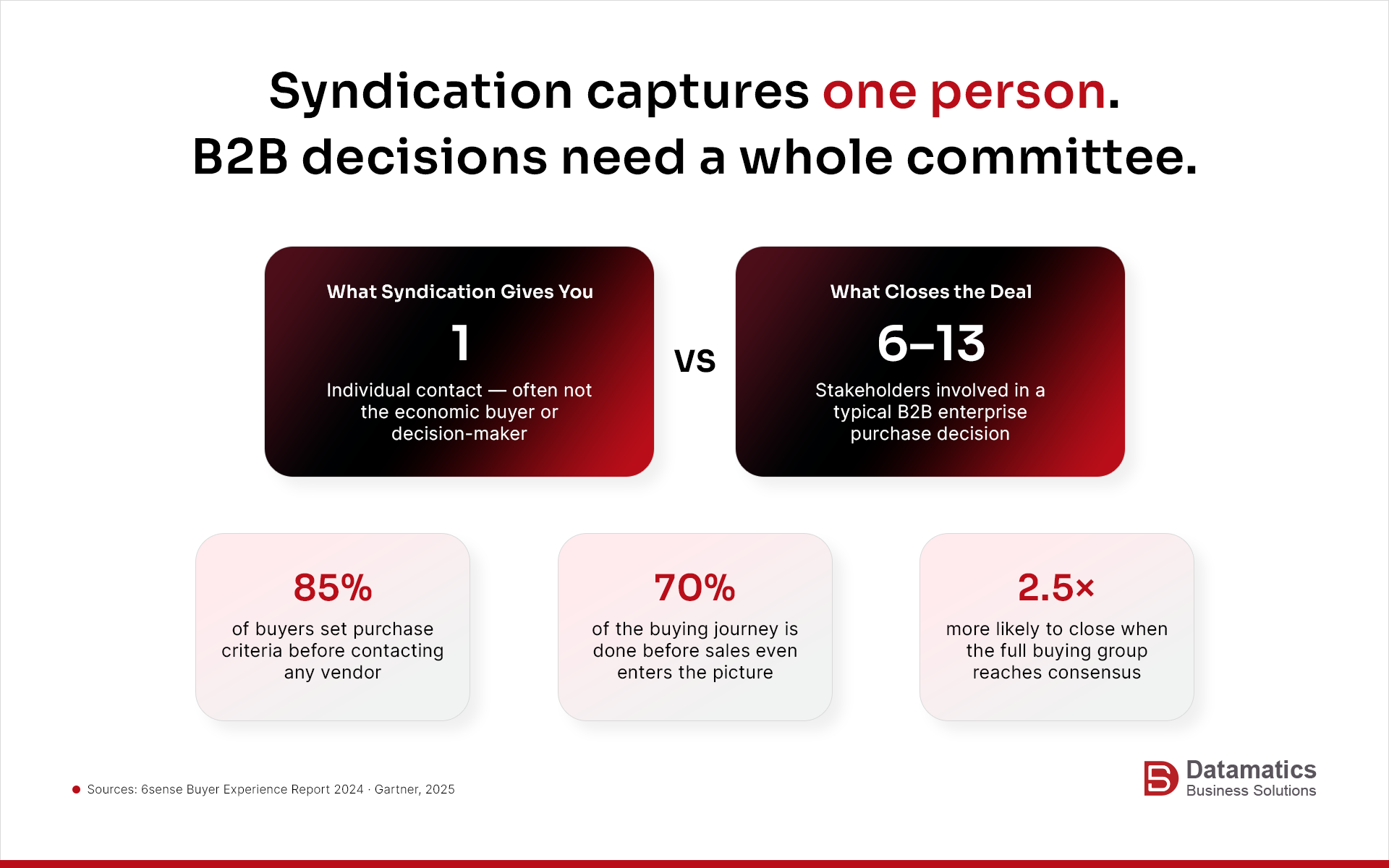
It captures the individual. Not the account. And not the buying committee.
A demand generation manager at a 5,000-person enterprise downloads your whitepaper on revenue intelligence. That person is a real human being with real interest. But they are not the economic buyer. They are probably not even on the shortlist committee.
And without the rest of the buying group in your funnel, that contact is unlikely to drive a deal forward on their own.
Key Takeaway
Traditional content syndication captures individual contacts, not the multi-stakeholder buying groups that actually drive B2B purchase decisions. That structural gap is where most programs lose momentum.
What Is Buying Group Marketing and Why Does It Change Everything?
Buying group marketing is the practice of identifying, engaging, and tracking the full group of individuals involved in a purchase decision at a target account.
Rather than pursuing a single contact, you build coverage across the entire decision-making unit.
The research here is not subtle. According to Gartner, the average B2B purchase decision at an enterprise company involves 6 to 10 stakeholders. Forrester puts the number even higher for complex technology purchases. The same Gartner research found that buying groups that reach consensus are 2.5 times more likely to report that their deal was high-quality.
Buying group acquisition shifts the goal of your marketing from generating lead volume to building account coverage.
You are not asking ‘did someone download our asset?’ You are asking ‘how many people from the buying group at this target account have we reached? What roles are missing? What topics are they researching?’
That shift in framing changes everything about how you run content syndication.
Instead of measuring success by lead count, you measure it by buying group penetration. This means that you focus on how well you are represented across the actual decision-making committee.
Without this framing, your content syndication strategy is optimized for the wrong outcome. You end up with high lead numbers and low conversion rates. Which, if you have run a syndication program before, probably sounds familiar.
Key Takeaway
Buying group marketing reframes success from individual lead capture to account-level coverage. It is the difference between collecting contacts and building genuine influence inside a target account.
Why Content Syndication Fails Without Buying Groups?
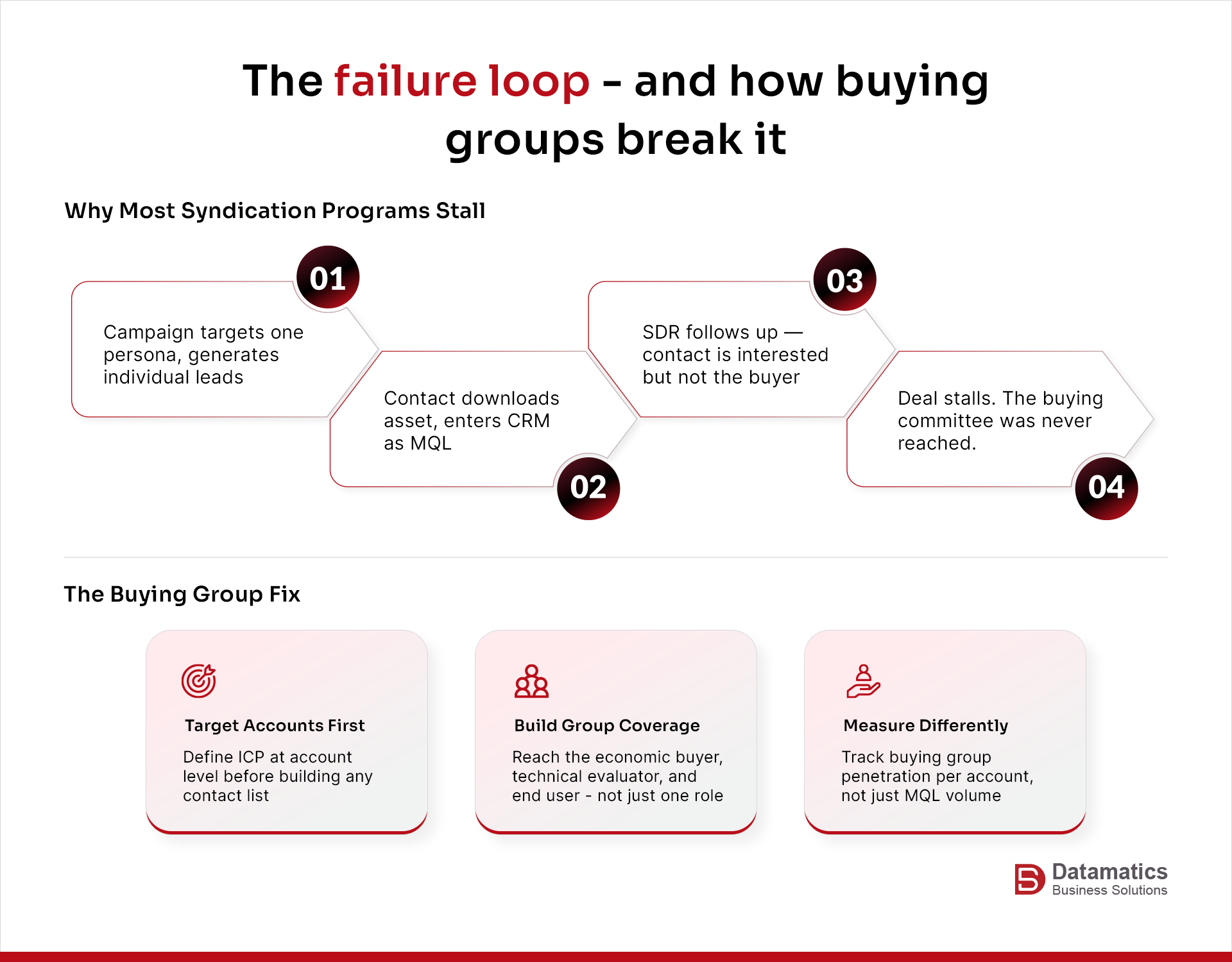
Let me walk you through what typically happens in a content syndication program that is not aligned to buying groups.
You launch a campaign. You target a specific persona say, VPs of Marketing at SaaS companies with 500+ employees. You get 200 leads over six weeks. Your SDR team starts calling.
Half of those contacts do not answer. A quarter schedule a call and then do not show. The remaining quarter have decent conversations but nothing moves.
Why?
Because you caught individuals at a moment of personal curiosity. Not accounts in an active buying cycle. And even for the accounts that are evaluating a solution like yours, the person who downloaded your content is probably not the decision-maker. The CFO, the CTO, the Head of Revenue Operations — they have not seen a single thing from you.
This is the content syndication failure loop. It has nothing to do with the quality of your content. It has nothing to do with how well your SDRs follow up. It is a structural problem.
You are funneling effort into contacts who cannot close a deal on their own.
Demand Gen Report’s B2B Buyer Survey found that 74% of B2B buyers say they conduct significant research before ever engaging with a vendor. That research involves multiple team members. Your single downloaded lead is just one thread in a much larger purchasing web.
Without a buying group strategy, you are pulling one thread and hoping the whole web follows. It rarely does.
Key Takeaway
The failure pattern in most content syndication programs is not about lead quality or follow-up speed. It is about targeting individuals when the buying decision requires organizational consensus.
What a Content Syndication Strategy Built Around Buying Groups Looks Like?
A content syndication strategy that accounts for buying groups is fundamentally different in three ways.
First, the target is the account, not the contact.
Before you syndicate anything, you define your ideal customer profile at the account level. Which companies are the right fit? What firmographic and technographic signals tell you a company is in-market? Which accounts are already showing intent around your category?
Second, the goal is coverage, not capture.
You are not trying to get one person from a target account into your database. You are trying to reach multiple roles across the buying committee.
That means your content assets need to be designed for different personas and not just the end user. It has to be for the economic buyer, the technical evaluator, the procurement contact.
Third, the measurement changes.
Rather than tracking lead volume, you track buying group engagement scores. How many contacts from the buying committee at a target account have engaged with your content? What roles are missing? What topics have they consumed?
The point is not that the technology does all the work. It is that your content syndication strategy needs to be built with the buying group in mind from the first asset to the last nurture email.
Key Takeaway
A buying-group-aligned content syndication strategy targets accounts before contacts, measures coverage before volume, and creates content for multiple roles in the buying committee — not just the most accessible one.
How Buying Group Acquisition Changes Your Lead Qualification Process?
One of the most practical changes that comes from a buying group-oriented approach is in how you qualify leads.
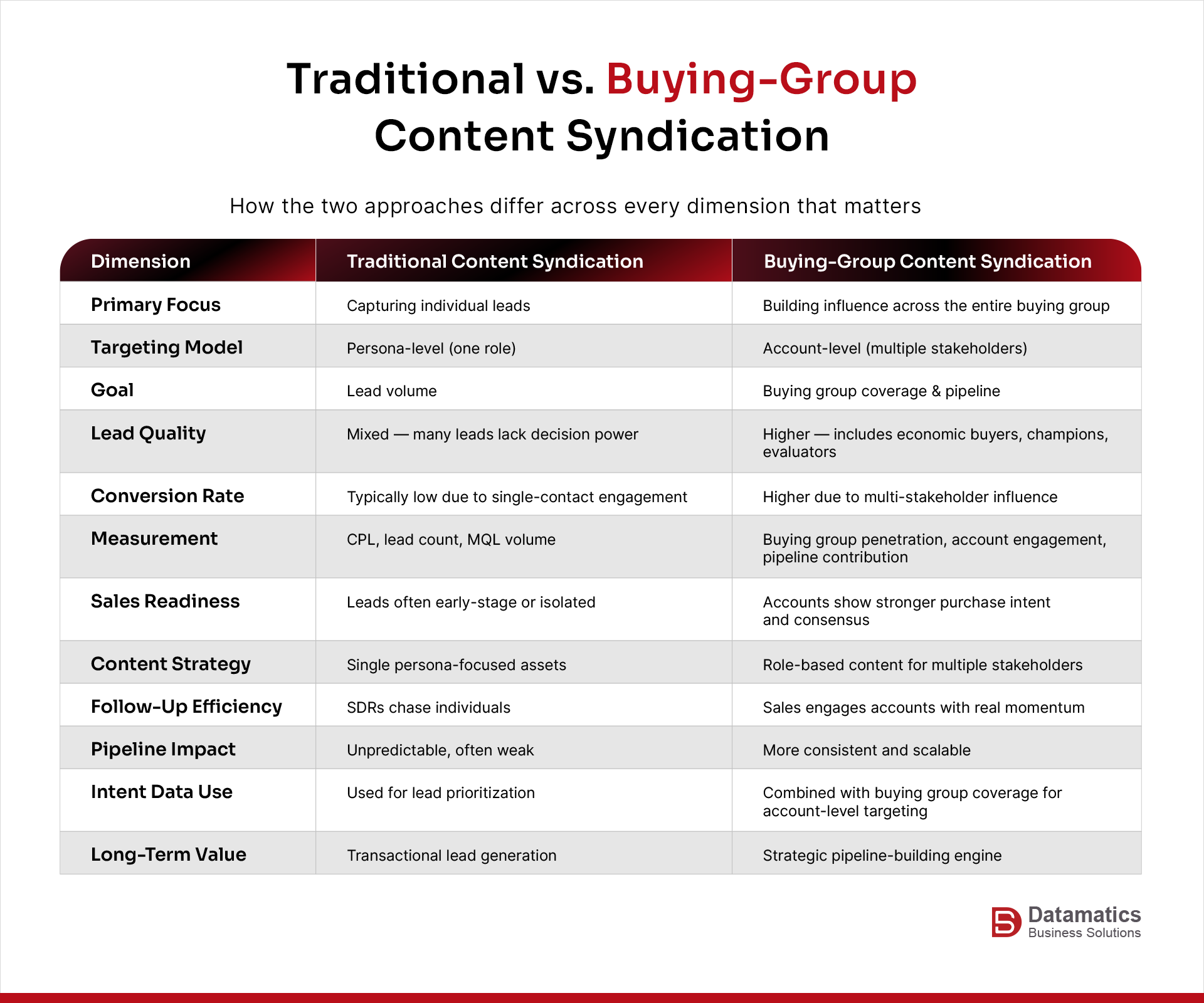
In a traditional content syndication program, a lead is qualified based on the individual’s title, company, and engagement. A VP of Marketing at a mid-market SaaS company who downloads your ROI calculator = Marketing Qualified Lead.
But here is what that MQL qualification misses. That VP might be at a company where the actual purchase decision sits with the CRO and the CFO. If neither of them is in your funnel, the deal is not real yet. No matter how many times that VP visits your site.
Buying group acquisition changes qualification to account-level signals. An account becomes sales-ready not when one person hits a lead score threshold, but when two or more people from the buying committee have engaged, and at least one of them is an economic buyer or champion.
Forrester research shows that accounts with multiple engaged buying group members have win rates 2.3x higher than single-contact accounts. That is not a marginal improvement; it is a fundamentally different conversion dynamic.
This means your content syndication services should not just generate individual contacts. They should be structured to identify and attract multiple people from the same organization, across different functions and seniority levels.
Key Takeaway
Lead qualification built around buying groups uses account-level signals and multiple engaged contacts across key roles rather than individual lead scores. This approach aligns your MQL definition with how B2B purchases actually happen.
You can also read: 12 Best Content Syndication Providers in 2026
The Intent Data Gap — And Why It Makes the Problem Worse
Many content syndication programs add intent data to compensate for the individual-lead problem. The logic is: if we know which companies are actively researching our category, we can prioritize those leads and assume the download is more meaningful.
Intent data helps. But it does not solve the buying group problem.
Here is why. Intent data tells you a company is researching a topic. It does not tell you who inside that company is driving the research. It does not tell you whether your contact is the champion or a junior analyst who has nothing to do with the actual purchase decision. And it definitely does not tell you whether the right people in that company have ever heard of you.
A study found that 78% of B2B marketers use third-party intent data in their demand generation programs. But fewer than 30% connect that intent data to buying group engagement tracking. The two systems run in parallel, not together.
When you combine intent data with buying group acquisition, the results change. You know a company is in-market AND you are actively building coverage across their buying committee. That combination — account intent plus multi-stakeholder engagement — is where content syndication actually converts into pipeline.
Key Takeaway
Intent data alone does not fix the individual-lead problem. It tells you an account is researching. Buying group acquisition tells you whether you have actually reached the people who matter at that account.
Common Objections to Buying Group-Oriented Content Syndication
Marketing teams that hear this argument often raise two objections.
The first is: this sounds more expensive. And yes, it can be. Targeting multiple contacts at the same account, with role-specific content, across different syndication placements, requires more planning and potentially more budget than a simple single-persona campaign.
But the cost comparison is wrong. The real comparison is cost-per-pipeline, not cost-per-lead.
If your current content syndication program generates 500 leads and converts 3 into pipeline, your actual cost-per-opportunity is enormous.
A smaller program built around buying groups that generates 150 leads and converts 15 into pipeline is far more cost-effective. Even if the CPL is higher.
The second objection is: we do not have content for all those different personas. That is a real constraint.
Building role-specific content requires time and editorial investment. But the alternative — sending your CFO-targeted content to a junior marketing manager and hoping they forward it — is not actually a strategy. It is wishful thinking.
Start with your two or three most critical buying group roles. Create assets specifically for those roles. Then test whether multi-role account coverage improves your conversion rates. The data will tell you whether to invest more.
Key Takeaway
The objections to buying group marketing are real but solvable. The key shift is measuring cost-per-pipeline instead of cost-per-lead, and starting with the two or three most critical roles in the buying committee.
How Datamatics Business Solutions Helps You Run Content Syndication the Right Way
Datamatics Business Solutions (DBSL) works with B2B marketing teams that are tired of high lead volumes that do not convert. Our content syndication services are built around account-level targeting and buying group acquisition. Not individual contact capture for its own sake.
Our content syndication programs are designed to reach multiple stakeholders at the same account, not just the most accessible individual.
We help your team align on what a sales-ready account actually looks like. We help define the level of buying group engagement that gives your SDRs a realistic chance of moving the conversation forward.
Our clients report significantly better conversion rates from content syndication when the program is structured this way. Not because we are doing something exotic, but because we are aligning the mechanics of the channel to how B2B purchases actually happen.
If your current content syndication strategy is generating leads that stall in the funnel, the buying group question is probably the right place to start. Get in touch with our experts and see how we can help you with our content syndication services.
The Bottom Line
Content syndication is not a broken channel. It is a powerful way to reach audiences at scale and generate genuine interest in your category. But it is a channel that has been consistently misused.
The misuse is this: treating B2B buying as an individual decision when the evidence is overwhelming that it is not. Every piece of research in the past decade says the same thing. Multiple stakeholders. Multiple roles. Multiple touchpoints. Content syndication programs that ignore this reality will keep producing the same frustrating results.
The fix is not complicated. Build your content syndication strategy around accounts first and contacts second. Define what buying group coverage looks like for your target accounts. Create content that speaks to multiple roles. Measure success at the account level, not the lead level.
That is when content syndication starts to pay for itself.
Like what you read? Sign up for our monthly newsletter and get such insights delivered straight to your inbox.
FAQs on Content Syndication
1. What is content syndication in B2B marketing?
Content syndication is the distribution of your owned content like whitepapers, eBooks, reports, webinars. It uses third-party platforms and publisher networks. The goal is to extend your reach beyond your own channels and capture contact information from potential buyers who engage with your content. It is widely used as a demand generation tactic because it delivers lead volume quickly.
2.Why does content syndication produce low-quality leads?
The most common reason is individual targeting. When a program captures one person from a company, regardless of their title, it misses the other five to eight people who influence the actual purchase decision. A single contact, no matter how engaged, cannot close a deal at an enterprise company on their own. Without reaching the full buying group, most syndicated leads stall before they ever become real pipeline.
3. What is a buying group in B2B sales?
A buying group is the set of individuals at an organization who are involved in a purchase decision. This typically includes an economic buyer (who controls the budget), technical evaluators, end users, procurement contacts, and sometimes a legal or compliance stakeholder. The composition varies by deal size and industry, but Gartner research consistently shows that 6 to 10 people are involved in complex B2B purchases.
4. How do you align content syndication with buying group acquisition?
Start by mapping the typical buying group for your ideal customer profile — the specific roles and functions involved in a purchase decision for your solution. Then design your syndication targeting and content assets to reach those roles specifically, not just the most accessible persona. Track engagement at the account level, not just the contact level. Define a sales-ready account as one where multiple buying group members have engaged, not one where a single person hit a lead score threshold.
5. How do you measure the success of a content syndication strategy?
For most programs, the right metrics shift from lead volume to pipeline contribution. Track how many target accounts have multiple engaged buying group members. Measure what percentage of those accounts progress to sales-accepted or sales-qualified status. Look at cost-per-pipeline-opportunity rather than cost-per-lead. Over time, buying group coverage percentage at target accounts is one of the strongest predictors of conversion.
6. Is content syndication worth the investment in 2026 and beyond?
Yes. But only when it is structured correctly. Content syndication remains one of the fastest ways to reach audiences at scale and generate genuine interest from companies in your category. The channel itself is not the problem. Programs that treat it as a volume play without account-level intent or buying group thinking will continue to see high CPLs and low conversion rates. Programs built around buying groups and account coverage deliver meaningfully better results.

Carly Jaspan