















Okay. Here is a truth that most content syndication vendors will not tell you.
Getting your content in front of more people does not automatically make those people want to buy from you.
Content syndication is good at one thing. Distribution. It puts your articles, whitepapers, and guides in front of a broader audience. That sounds great on paper. But distribution is not demand. Awareness is not intent. And a content download is not a pipeline.
If you have been running a content syndication program and wondering why the leads are not converting, this blog is for you.
What Is Content Syndication?
Content syndication is the process of republishing or distributing your existing content — blog posts, whitepapers, eBooks, reports — on third-party platforms, websites, or networks to reach audiences beyond your own channels.
The idea is straightforward. You create something valuable. A content syndication provider distributes it to a wider network of readers. Those readers engage with it, and some of them become leads.
Content syndication companies typically operate on a cost-per-lead model. You pay for every contact that downloads or engages with your content. Depending on the provider and targeting criteria, those leads get delivered to your CRM or marketing automation platform for follow-up.
On the surface, this sounds like a scalable demand generation tactic. And it can be. But only when used correctly.
The problem is that most companies treat it like a demand creation engine when it is really just a top-of-funnel awareness play.
Key Takeaway
Content syndication is a distribution channel, not a demand creation strategy. Understanding that distinction is the starting point for using it well.
How Does Content Syndication Work?
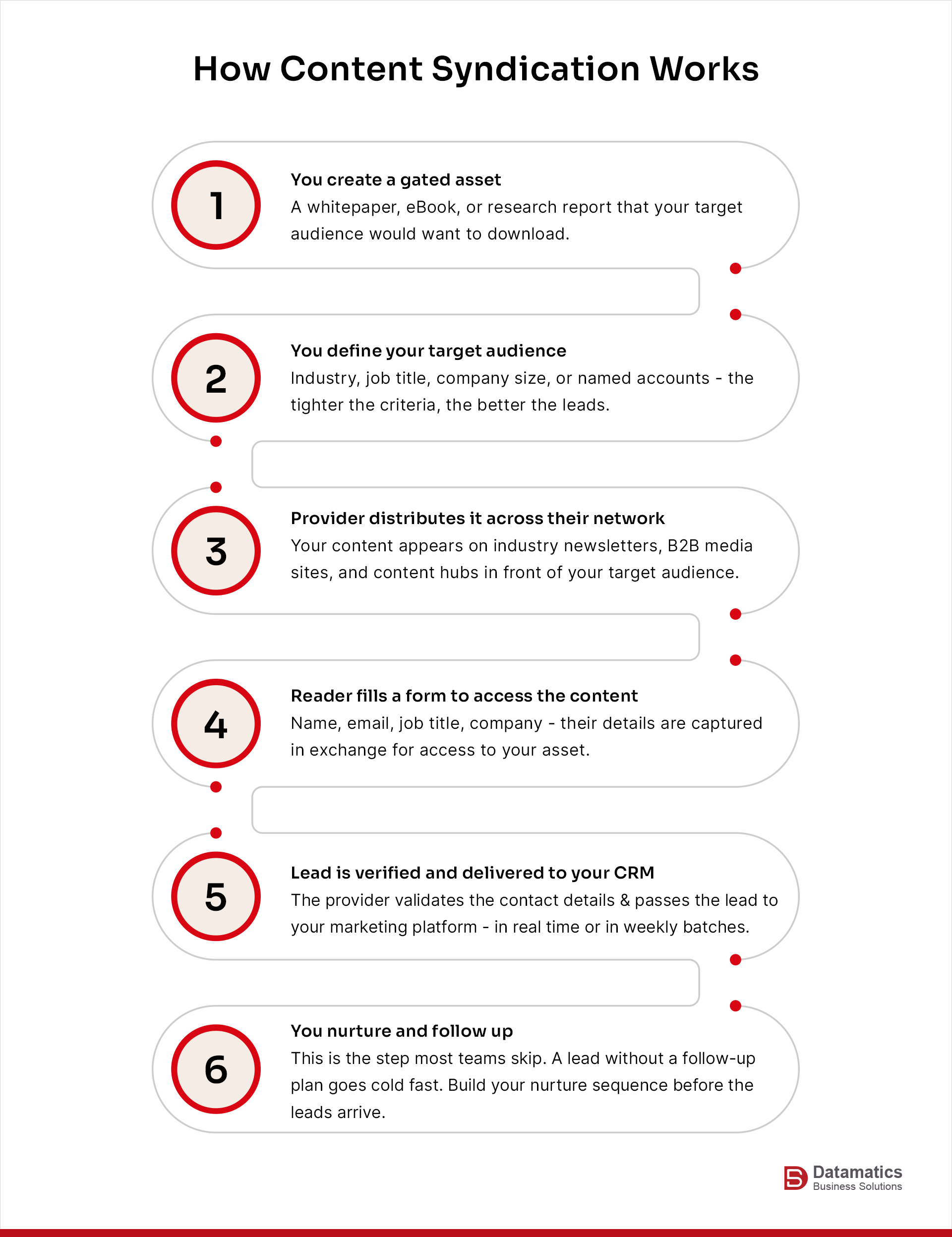
The content syndication process typically follows a few simple steps.
You choose a piece of content. Usually something gated, like a whitepaper or research report. You define your target audience based on criteria like industry, job title, company size, or geography. A content syndication provider then promotes that content across their publisher network.
When a reader downloads or fills out a form to access your content, their contact information is captured and passed on to you as a lead.
Some content syndication services go beyond simple lead capture. They offer intent-based targeting, account-level filtering, or engagement scoring that helps you prioritize follow-up. The more sophisticated providers let you get specific — syndicating to named accounts, specific verticals, or contacts that have already shown buying signals.
But here is where most teams run into trouble. They optimize the content syndication process for volume. More leads, more downloads, more contacts in the funnel. And then they wonder why none of those contacts are showing up in sales conversations.
Volume and quality are not the same thing. A contact downloading your whitepaper does not mean they are in the market for your solution. It means they found the content interesting enough to fill out a form.
Key Takeaway
The content syndication process captures contact information from engaged readers. But engagement with content is not the same as purchase intent. The gap between the two is where most demand generation strategies fall apart.
What Does the Research Actually Say About Content Syndication?
The data on content syndication is worth paying attention to.
According to a Demand Gen Report, 62% of B2B buyers consume three to seven pieces of content before engaging with a vendor’s sales team.
That tells us two things. First, content matters in the buying process. Second, one piece of content — even a well-syndicated one — is rarely enough to move a buyer forward.
Gartner research on the B2B buying journey shows that buyers spend only 17% of their purchase process in meetings with potential vendors. The rest of the time, they are doing their own independent research. Content syndication can get you into that research phase. But if your content does not build a case for your solution, distribution alone will not close the gap.
A study by Forrester found that 68% of B2B buyers prefer to research independently online before contacting a vendor. This means the quality, depth, and credibility of your content matters far more than how many platforms it appears on.
The point is this. Content syndication gets you into consideration. It does not get you to conversion.
Key Takeaway
Research consistently shows that B2B buyers consume multiple pieces of content before engaging sales. Syndicating one asset broadly is a starting point, not a complete strategy.
Why Content Syndication Alone Does Not Generate Real Demand
Here is the core issue.
Demand generation is about creating a felt need. It is about making your target audience aware that they have a problem and that your solution is the right answer. That requires more than a well-distributed whitepaper.
Real demand comes from consistent exposure to relevant, credible content across multiple touchpoints over time. It comes from connecting the dots between a buyer’s pain points and your specific solution. It requires follow-up, nurturing, and a coherent story that builds across multiple interactions.
Content syndication, by design, gives you one touchpoint. One download. One form fill. That is not enough to build demand especially in complex B2B sales cycles where buying committees involve anywhere from six to ten stakeholders.
There is also a quality problem with many content syndication leads. Because syndication networks are broad by nature, the contacts you get may not match your ideal customer profile. You could be spending budget reaching people who have no authority to buy, no budget to spend, or no immediate need for your solution.
And then there is the follow-up problem. Even when you get the right contact, most sales teams treat syndication leads like any other inbound inquiry. They send a generic follow-up email. The lead goes cold. The blame gets passed between marketing and sales.
The content syndication strategy failed, but the root cause was never the channel itself. It was the absence of a plan for what happens after the download.
Key Takeaway
Demand generation requires multiple touchpoints, a clear narrative, and a follow-up strategy. Content syndication gives you one interaction — and that is where most programs stop instead of start.
You can also read: 5 Metrics that Will Transform Your B2B Content Syndication Results
What a Real Content Syndication Strategy Looks Like
Using content syndication well means treating it as the beginning of a conversation, not the entirety of one.
Here is what that looks like in practice.
a. Choose content that serves a specific stage of the buying journey. Not all content belongs in syndication. Top-of-funnel educational content like industry trends, research reports, and frameworks perform well because these pull in buyers early in their research. Syndicating a product comparison guide to cold audiences rarely works.
b. Align your content syndication strategy with account-based targeting. The best content syndication providers now offer account-level targeting. This means you can syndicate your content specifically to contacts at your named target accounts. When combined with an ABM program, syndication becomes a multi-touch tool rather than a spray-and-pray tactic.
c. Build a nurture sequence around every syndicated asset. When a contact downloads your content, that is the opening, not the close. Map out a four to six touch nurture sequence that continues the conversation. Give them additional context, case studies, or perspectives that move them closer to a buying decision.
d. Score leads based on engagement, not just download activity. A contact who downloads three pieces of content across two weeks is a very different signal from someone who downloaded once six months ago. Your content syndication process should feed into a lead scoring model that helps sales prioritize outreach.
e. Track the full funnel, not just lead volume. Most content syndication reporting stops at the lead. To understand whether your program is working, track what happens to those leads over 90 days. How many became MQLs? How many converted to sales conversations? How many influenced a closed deal? Without this data, you are flying blind.
Key Takeaway
A strong content syndication strategy usually connects distribution of collaterals to nurture. It uses account targeting and full-funnel tracking to ensure maximum success. Without these elements, you are generating contacts, not demand.
How to Choose the Right Content Syndication Providers
Not all content syndication companies are built the same. Choosing the wrong partner is one of the fastest ways to burn budget with nothing to show for it.
Here is what actually matters when you are evaluating providers.
a. Audience quality over network size. A smaller, verified network of B2B professionals will outperform a massive, loosely qualified one every single time. Before you sign anything, ask how they verify their audience data and how often it gets updated. If they cannot answer that clearly, move on.
b. Targeting granularity. Can you filter by intent signals? Company revenue? Technology stack? The more specific your targeting criteria, the less time your sales team wastes chasing contacts who were never going to buy. Vague targeting is expensive.
c. Lead quality guarantees. Reputable content syndication services stand behind their leads. That means replacing contacts with invalid emails, wrong job titles, or companies that fall outside your ICP. If a provider does not offer this, you are absorbing all the risk.
d. Integration with your existing tech stack. Leads that sit in a spreadsheet for a week before someone manually imports them are already cold. Your content syndication process should connect directly into your CRM or marketing automation platform. The fewer the manual steps, the faster the outcome.
e. Transparent reporting. You should know exactly where your leads came from, which platforms drove the most engagement, and how performance varied across sources. If a provider is vague about this, that is usually a sign the numbers are not worth sharing.
Key Takeaway
The size of a provider’s network is the least important thing on this list. Audience quality, targeting precision, and reporting transparency are what separate a program that delivers pipeline from one that just delivers contacts.
How Datamatics Business Solutions Can Help ?
Datamatics Business Solutions has been working with B2B companies on data-driven demand generation for over 20 years. Our approach to content syndication sits inside a broader demand generation framework.
Our team helps clients identify the right content assets for syndication based on the buyer’s journey and ICP fit. They work with targeted content syndication services that cover industry-specific audiences, ensuring leads are qualified before they ever reach a client’s CRM.
Our content syndication strategy also ties into account-based marketing programs. For clients running ABM motions, we can align syndication activity to named accounts.
Our content syndication team tracks performance across the full funnel — from first content interaction to closed deal influence — so clients can make informed decisions about budget allocation. The goal is not just more leads. It is measurable pipeline contribution.
If you are trying to make your content syndication program do more than generate downloads, we are worth a conversation. Fill out the form here and get a quick walkthrough of our syndication process.
The Bottom Line on Content Syndication
Content syndication is a legitimate part of a B2B demand generation mix. It is not a shortcut.
The companies that get real value from it treat it as one input in a larger system. They syndicate the right content to the right audience, build a follow-up plan before the leads ever arrive, and track performance all the way down the funnel.
The ones that struggle are usually doing the opposite. They pick a content syndication provider, set a lead volume target, and hope that downloads translate into pipeline. They rarely do.
If your program is not delivering, the answer is almost never “syndicate more content.” It is usually “do more with the leads you already have.”
Distribution without demand creation is just noise at scale. Fix the strategy first, and content syndication will do what it is actually good at — getting you in the room with the right people at the right time.
Like what you read? Subscribe to our newsletter and get blogs delivered to your inbox every month.
FAQ: Embedded Teams for Enterprise Marketing
1. What is the difference between content syndication and content distribution?
Content distribution refers to sharing your content through channels you own or control — your email list, social media accounts, or website. Content syndication specifically means republishing or promoting your content through third-party platforms or networks to reach audiences outside your existing reach. Syndication is typically paid, while distribution may be organic or paid.
2. Does content syndication hurt SEO?
It can, if not handled correctly. If the same content appears on multiple domains without proper canonical tags, it can create duplicate content issues. Most reputable content syndication providers either link back to the original source or host a version of the content with a canonical tag pointing to your site. Always confirm how a provider handles this before signing on.
3. What types of content work best for syndication?
Research reports, original data, industry trend pieces, and practical how-to guides tend to perform well in syndication because they offer standalone value to a broad audience. Gated assets with a clear value proposition — something the reader genuinely wants to have — see higher download rates than generic thought leadership or thinly veiled product content.
4. How do you measure ROI from content syndication?
Start by tracking the full pipeline contribution of syndicated leads — not just the volume. Look at what percentage of syndicated leads became MQLs, how many entered sales conversations, and how many influenced or contributed to closed deals. Cost per lead is a starting metric, but cost per qualified opportunity is a more useful number for evaluating program ROI.
5. How is content syndication different from native advertising?
Native advertising is paid placement of sponsored content that blends into the editorial format of a platform — think sponsored articles on news sites or promoted posts. Content syndication focuses on distributing your existing content assets through publisher networks and capturing leads through form fills. Both are paid distribution tactics, but they serve different objectives and operate through different mechanisms.
6. What is the biggest mistake companies make with content syndication?
Treating it as a demand creation tactic rather than a demand capture or awareness tactic. Content syndication reaches people who may already be in a research phase. If you are using it to try to create awareness from scratch in a cold market without any supporting activity — no retargeting, no nurture, no account-based follow-up — the leads you get will rarely convert into real pipeline.

Carly Jaspan