








Demand generation used to be simple. You would run some ads, send a few emails, and wait for the leads to come in. Those days are a thing of the past.
Today’s B2B buyers are different. They research independently, consume content across multiple channels, and make decisions long before they talk to sales.
A study from Gartner shows that B2B buyers spend only 17% of their time meeting with potential vendors when considering a purchase. The rest? They are out there doing their own research.
This shift requires a new approach. You need a B2B demand generation framework that meets buyers where they are, educates them throughout their journey, and builds trust before the first sales call ever happens.
In this guide, I have broken down what modern B2B demand generation actually looks like, how to build a framework that works, and what you need to avoid the common mistakes that waste budget and time.
What is a B2B Demand Generation Framework?
Imagine a SaaS company selling CRM software. Instead of running random ads asking people to “Book a Demo,” they publish helpful content on sales productivity, run LinkedIn campaigns targeting sales leaders, host webinars on pipeline management, and retarget visitors who engaged with their content. Each step is intentional. Each touchpoint moves the buyer a little closer to saying yes.
A B2B demand generation framework is basically your game plan for creating real interest in your product. It is not just collecting a bunch of email addresses that never convert.
It is about attracting the right people, educating them, building trust over time, and guiding them toward a buying decision. But all of this in a way that actually feels natural.
That is what a demand generation framework does. It connects your content strategy, channels, metrics, and sales alignment into one clear system.
Think of it as the architecture behind your growth. When it is solid, every campaign has a purpose. Without it, you are just throwing tactics at the wall and hoping something sticks.
Key Takeaway
A demand generation framework is your complete system for creating interest and moving prospects toward purchase, not just a collection of marketing tactics
How a B2B Demand Gen Strategy Differs from Traditional Marketing?
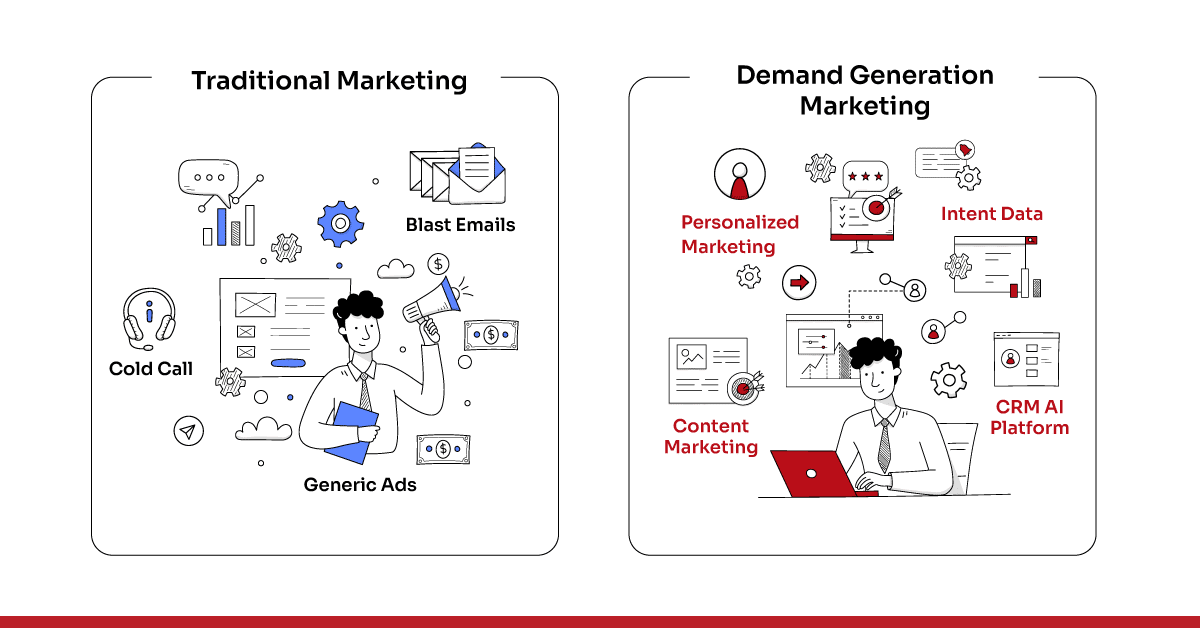
Traditional marketing focused on pushing messages out. Demand generation pulls people in.
But do you want to know where I see the real difference? Traditional marketing interrupts. Demand generation educates.
Instead of cold calling 100 prospects, with B2B demand generation, you create content that attracts the right 10. Instead of buying generic lists, with B2B demand gen, you build relationships with accounts that actually fit your ideal customer profile.
A solid B2B demand gen strategy has three core principles:
Principle 1: Focus on accounts, not just leads. You are targeting specific companies that match your criteria, not casting the widest possible net.
Principle 2: Prioritize education over promotion. Your content should help people solve problems, not just talk about your product features.
Principle 3: Align marketing and sales from day one. Both teams need to agree on what a qualified opportunity looks like and how to move it forward.
Research from Demand Gen Report shows that 96% of B2B buyers want content with more input from industry thought leaders. This claim is further substantiated by a study from Content Marketing Institute as well. Most B2B buyers are not looking for sales pitches. They want expertise.
Key Takeaway
Modern demand generation prioritizes education and relationship-building with target accounts rather than interruption-based tactics. This varies largely from traditional marketing.
Understanding the Modern B2B Demand Generation Funnel
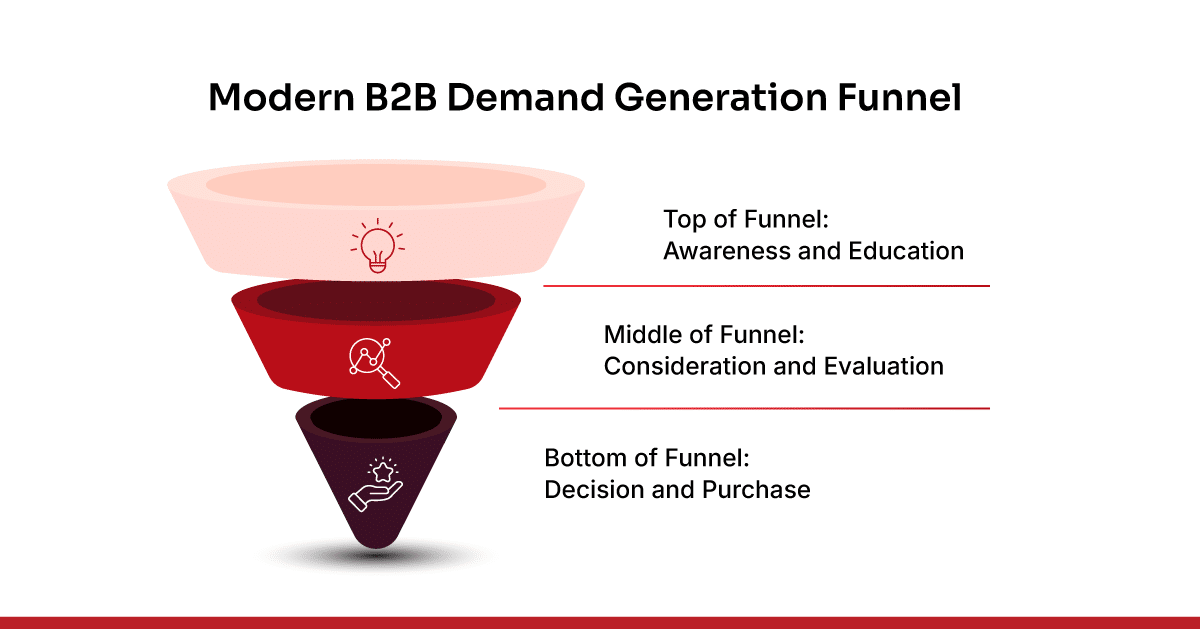
The traditional funnel (awareness, consideration, decision) still exists, but it’s messier now. Buyers don’t move in straight lines. They jump between stages, loop back, and enter at different points.
Your demand generation funnel needs to account for this reality. Here is how it actually works:
Top of Funnel: Awareness and Education
This is where you help prospects understand their problems better. Not your solution, their problems. You are creating content that shows up when they are searching for answers.
This includes blog posts, research reports, industry insights, and educational webinars. The goal isn’t conversion. It is credibility.
Middle of Funnel: Consideration and Evaluation
Now prospects know they have a problem. They are looking at different approaches to solve it. When a prospect is in the middle of the funnel, you can actually start introducing them to your methodology or framework.
And what kind of content gets included in the middle of the funnel? Case studies, comparison guides, and detailed how-to content work well here. You are showing them what good looks like without the hard sell.
Bottom of Funnel: Decision and Purchase
By the time a prospect come to the bottom of the funnel, they are already evaluating specific vendors. They want demos, pricing information, customer references, and implementation details. So, the content you need to give here should be exactly this.
This is also the stage where sales take the lead. But marketing still continues to play a role with ROI calculators, technical documentation, and customer success stories.
A Forrester Research highlighted that 68% of B2B customers prefer to research independently online rather than interact with a sales representative. Your funnel needs to support this self-service behavior at every stage.
You can also read: Crafting a Dynamic Demand Generation Funnel: Step-by-Step Guide
Key Takeaway
The modern funnel is non-linear. Prospects move back and forth between stages, requiring content that supports independent research at every level. This is the modern B2B demand generation funnel that every marketer should be familiar with.
Building an Inbound Demand Generation Strategy
When practicing inbound demand generation, people come to you because you have created something valuable. It is the opposite of outbound prospecting, where you are always chasing. According to a study from HubSpot, inbound costs 62% less than outbound methods. However, it can generate 3 times more lead.
This makes inbound demand generation a go-to for all B2B marketers out there.
Here is what makes inbound work.
Create Content that People Actually Search For
You start your content journey with keyword research. But you should not stop there. Look at what questions your sales team hears repeatedly. Check what topics generate discussion in industry forums. Use tools to see what your competitors are ranking for.
Then create content that is genuinely better. More detailed. More practical. More honest about the challenges involved.
Build Topic Clusters! Not One-Off Posts
Google prioritizes sites that demonstrate depth on a topic. Instead of scattering your efforts, build comprehensive coverage around core themes.
One pillar page that covers a topic broadly. Then 10-15 more detailed articles that dive into specific aspects. All internally linked. This signals expertise and improves your search visibility.
Use Multiple Content Formats
Some people read. Some people watch videos. Some people want interactive tools. The most successful B2B marketers? They use 10+ content formats throughout the buyer journey.
Mix written content with webinars, podcasts, templates, calculators, and tools. Make it easy for prospects to engage however they prefer.
Gate Content Strategically
Here is where many companies mess up. They gate everything. Every single asset requires a form fill. Bad idea.
Gate your highest-value content. If it is gated, it should be exclusive. And trust me, when I say this, not everything is exclusive. So all your original research, comprehensive guides, templates – gate them. But leave most content open. Build trust first. Collect contact information second.
Key Takeaway
Inbound demand generation works when you create genuinely helpful content across multiple formats and make most of it freely accessible to build trust.
The Role of Account-Based Marketing in Modern B2B Demand Generation
Account-Based Marketing has completely flipped the traditional B2B demand generation funnel.
Instead of casting a wide net to attract thousands of leads and then filtering for the right accounts, ABM starts with the right accounts and builds campaigns specifically for them.
This approach works especially well in B2B when you are selling to enterprise companies or have a clearly defined ideal customer profile.
So how does ABM work in modern demand generation?
You identify 50 to100 target accounts that perfectly match your criteria. Then you create personalized campaigns for each account. Your ads, emails, content, and outreach are all tailored to their specific industry, pain points, and buying stage.
Every touchpoint is designed to move that specific account through your pipeline.
And the results? They speak for themselves.
A Denave from 2025 study states that 97% of marketers say ABM delivers a higher ROI than traditional demand generation strategies. The reason is focus. You are not spreading your budget thin across thousands of cold leads who may never convert.
You are concentrating firepower on accounts that actually matter to your business.
But here is what most B2B teams get wrong about ABM.
They treat it as a marketing-only play. ABM doesn’t work in isolation from your broader demand generation efforts. It requires tight alignment between sales and marketing. I am talking shared goals, shared data, and shared accountability. Without this alignment, your ABM strategy falls apart quickly. And takes your pipeline with it.
The data backs this up. Only 36% of companies executing ABM programs consider their sales and marketing teams to be tightly aligned. That means nearly two-thirds of ABM programs have teams running different playbooks, targeting different people, and defining success differently.
No wonder so many ABM initiatives fail to deliver.
And when alignment is there? Companies experience a 60% higher win rate when they align ABM with their advertising efforts (2024 ABA Survey Report). Sales knows which accounts marketing is warming up. Marketing understands which buying committee members sales needs them to reach. Everyone is rowing in the same direction, and the pipeline flows faster.
The impact on your demand generation engine goes beyond just winning deals. Ad-influenced accounts progress through the sales pipeline 234% faster than those not influenced by targeted campaigns (Benzinga). That is not a typo. Your enterprise sales cycles can literally cut in half when you execute ABM properly as part of your demand gen strategy.
But let’s be real for a second.
ABM isn’t a quick fix for your demand generation problems. It requires patience, consistent execution, and a willingness to invest in relationships before you see revenue hit your books. Successful ABM strategies typically need 18-24 months of consistent execution to demonstrate their full value (MarketOne). That is a tough sell in boardrooms focused on quarterly results.
The good news? The accounts you win through ABM aren’t just bigger deals for your pipeline. Companies that use ABM report an 84% improvement in reputation and 80% improvement in customer relationships (AdRoll). They are your stickiest customers, your best expansion opportunities, and your strongest advocates. They become the engine that powers long-term demand generation, not just one-time wins.
Key Takeaway
In modern B2B demand generation, ABM concentrates resources on high-value target accounts with personalized campaigns. It ensures higher win rates. The sales cycle also moves faster and you also form the strongest customer relationship.
Channel Strategy: Where to Actually Focus Your Efforts
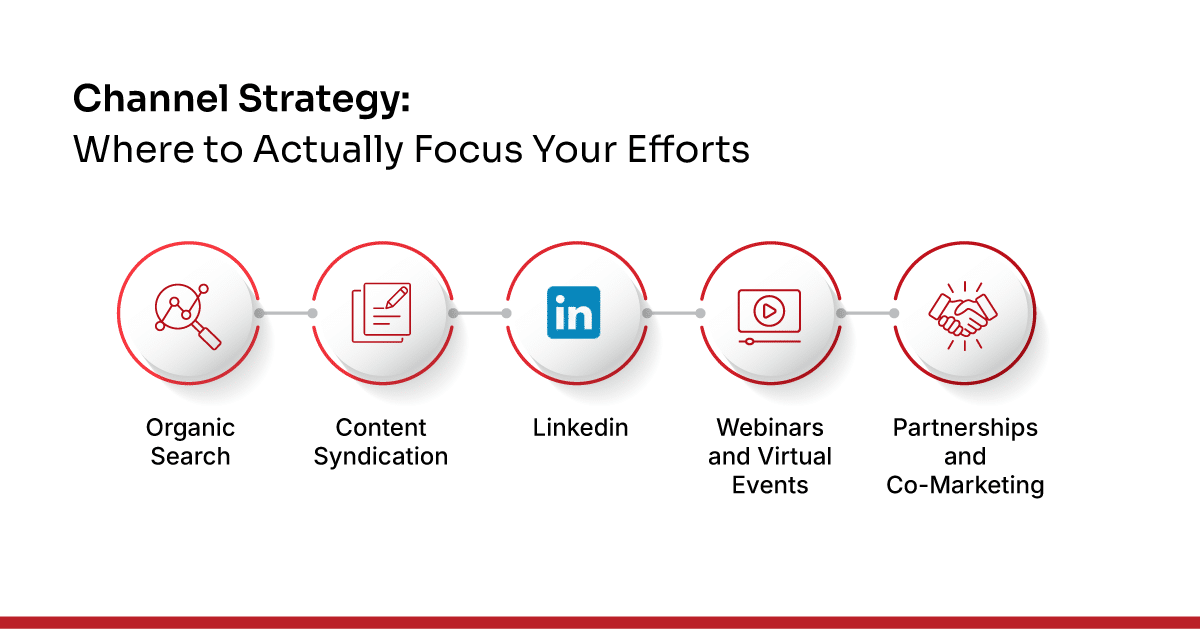
Not all channels work equally well for B2B demand generation. Here is what actually drives results.
Content Syndication
Distributing your best content on third-party platforms extends your reach to audiences who trust those publishers. The data is compelling here.
A 2024 Pipeline360 survey found that 61% of B2B marketers who use content syndication were able to reach their goals, compared to just 45% for those who do not use it. More than 90% of companies who use content syndication plan to maintain or increase their investment.
The average cost per lead for content syndication is $43 (Demand Metric), making it significantly more cost-effective than many other channels. When you syndicate an eBook or whitepaper through industry-specific platforms, you are borrowing credibility from established publications while generating qualified leads.
Organic Search
Still the most reliable long-term channel. When someone searches for a solution to their problem and finds your content, they are showing intent. The traffic is free (after the content investment) and compounds over time.
Research shows that 15% of B2B marketers consider organic search a crucial lead source for sales and marketing (The Insight Collective).
The only social platform where B2B decision-makers actively engage with business content. Good for thought leadership, company updates, and targeted ads to specific job titles and industries.
The numbers back this up. LinkedIn drives 80% of B2B leads, highlighting its effectiveness as a key channel for lead generation (The Insight Collective). When you are targeting executives and decision-makers, this is where they spend their time.
Not dead, despite what people say. But the approach has changed. Nobody wants generic newsletters. They want specific insights relevant to their situation. Segmentation matters more than frequency. According to Content Marketing Institute, 79% of businesses agree that email marketing is the most effective demand generation tool available.
Webinars and Virtual Events
These work when you have something genuinely useful to teach. Do not use webinars as hour-long sales pitches. Share frameworks, data, or skills people can use immediately. Case studies are highly preferred by 78% of B2B decision-makers, followed by webinars at 58% (The Insight Collective). When done right, they position you as the expert before the sale even begins.
Partnerships and Co-Marketing
Working with complementary vendors or industry publications extends your reach to audiences that already trust the partner. Often more credible than your own channels. When a respected industry name co-brands content with you, prospects pay attention differently than they would to your solo efforts.
The Multi-Channel Reality
Here is what separates the winners from everyone else. Multi-channel marketing campaigns achieve a 31% lower average cost per lead than single-channel outreach. But more importantly, companies that use three or more channels in their mid-funnel outreach see a 25% higher engagement rate than those sticking to a single channel. The compound effect is real.
But do not spread too thin. Pick the channels where your specific audience actually spends time. If your buyers are not on Twitter, stop tweeting. If they are not reading industry publications, skip the syndication. Focus beats presence.
Key Takeaway
Focus on 3-5 channels where your target accounts are active rather than trying to maintain presence everywhere. The data shows multi-channel approaches work, but only when each channel is executed with intention and reaches your actual buyers
You can also read: How to Build a Multi-Channel Demand Gen Strategy?
Measuring What Actually Matters
Most companies track vanity metrics. Website visits, email open rates, social media followers. These feel good but don’t connect to revenue.
Here is what you should measure instead:
Pipeline generated. How much qualified pipeline came from your demand generation efforts? This is the number that matters to executives.
Cost per opportunity. How much are you spending to create each sales-qualified opportunity? This tells you if your strategy is sustainable.
Conversion rates by stage. Where are prospects dropping off? From website visit to content download? From download to demo request? Find the weak points and fix them.
Time to close. Are prospects who engage with your content closing faster than cold outbound leads? They should be, because they are more educated.
Customer acquisition cost (CAC) payback period. How long does it take to recoup the cost of acquiring a customer? Shorter is better, obviously.
According to Salesforce, high-performing marketing teams are 2.5 times more likely to measure campaign ROI regularly. Not just run campaigns, but actually measure their return.
Set up attribution tracking from the start. Know which channels, campaigns, and content pieces contribute to closed deals. This is hard to retrofit later.
Key Takeaway
Track pipeline metrics and CAC payback rather than vanity metrics to understand true demand generation performance.
Common Framework Mistakes to Avoid
After working with dozens of B2B companies, here are the mistakes that kill demand generation programs:
Misalignment between marketing and sales. Marketing generates leads that sales doesn’t think are qualified. Sales complains marketing doesn’t deliver enough. Nobody wins. Fix this first, before you spend a dollar on campaigns.
Focusing on volume over quality. Generating 1,000 leads that never convert is worse than generating 50 that turn into deals. Target better, not wider.
Ignoring the existing customer base. Your current customers are your best source of revenue growth through upsells, cross-sells, and referrals. Yet most demand gen frameworks only focus on net new.
Creating content without distribution strategy. Writing great articles that nobody sees is pointless. Plan distribution before you create content.
Failing to nurture consistently. Most B2B purchases take months. If you are only touching prospects once or twice, you will lose to competitors who stay present throughout the journey.
Key Takeaway
The biggest framework failures come from misalignment, poor targeting, and inconsistent execution rather than tactical mistakes
How Datamatics Business Solutions Supports Your B2B Demand Generation Framework?
Building and executing a modern B2B demand generation framework requires specialized expertise and resources that many companies lack internally. Datamatics Business Solutions provides end-to-end support for organizations looking to establish or improve their demand generation capabilities.
Our approach starts with framework design. We work with your team to define your ideal customer profile, map buyer journeys, and establish the metrics that connect marketing activities to revenue outcomes. This foundational work ensures better alignment between your marketing and sales team.
On the execution side, we handle multi-channel campaigns. This includes email nurture programs, content syndication with third-party partners, webinar production, and tele calling. All activities are tracked through integrated analytics platforms that show exactly which efforts drive pipeline and revenue.
For companies running account-based programs, we provide the research support needed to create tailored campaigns for target accounts. We also help with custom data building, which ensures 95%+ accuracy.
The result is a demand generation operation that runs consistently, scales with your growth, and delivers measurable results. Companies working with us typically see improved lead quality, shorter sales cycles, and better alignment between marketing spend and revenue outcomes.
Interested to know more about our B2B demand generation services? Fill up the form here. Our representative will get in touch with you.
To Conclude
The modern B2B demand generation framework isn’t about doing more marketing. It’s about doing smarter marketing that connects directly to revenue.
Start with clarity on who you are targeting and what value you provide. Build content that educates rather than promotes. Measure what matters. And stay consistent long enough for the compound effects to kick in.
The companies that win in B2B don’t necessarily outspend competitors. They out-think them with better frameworks and better execution.
Like what you read? Subscribe to our blogs and get industry insights straight to your inbox.
FAQ: Modern B2B Demand Generation
1. What's the difference between demand generation and lead generation?
Lead generation is about collecting contact information. Demand generation is about creating awareness and interest in your solution before you ask for anything. Demand gen builds the market; lead gen captures people who are ready to engage.
2. How long does it take to see results from a demand generation framework?
Expect 3-6 months to see meaningful pipeline impact from organic channels like content and SEO. Paid channels can show results faster, within 4-8 weeks, but sustainable demand generation is a long-term investment that compounds over time.
3. What's a realistic budget for B2B demand generation?
Most B2B companies allocate 5-15% of revenue to marketing, with roughly half going to demand generation activities. For a company with $10M in revenue, that might mean $250,000-$750,000 annually for demand gen. Budget should scale with growth targets and customer acquisition costs.
4. Should we focus on inbound or outbound demand generation?
The best approach is both. Inbound builds long-term credibility and attracts prospects already looking for solutions. Outbound reaches prospects who might not be actively searching yet. The mix depends on your sales cycle, deal size, and market maturity.
5. How do we measure demand generation ROI accurately?
Track pipeline generated, opportunities created, and revenue influenced by demand generation activities. Use multi-touch attribution to understand which channels and campaigns contribute to closed deals. Calculate cost per opportunity and compare to the lifetime value of customers acquired through each channel.
6. What content types work best for B2B demand generation?
Original research, detailed how-to guides, case studies, and comparison content tend to perform well. The specific types depend on your audience and their stage in the buying journey. Test different formats and let performance data guide your content mix.
7. How often should we update our demand generation framework?
Review quarterly based on performance data. Make small adjustments monthly to campaigns and channels that aren’t performing. Do a comprehensive framework review annually to account for market changes, new competitors, and evolving buyer behavior.

Carly Jaspan