











Whether you are a consumer or a manufacturer, we are standing at the crossroads of a global packaging revolution. The movement to step away from plastic has gained significant momentum worldwide, driven by the crisis levels of plastic pollution and ever-tightening regulatory frameworks.
The change is inevitable. It’s no longer a question of whether it is coming; it is about how fast your business can adapt. The plastic vs. paper packaging war is heating up, and it is critical for strategic decision-makers to make up their minds now.
The reality for consumers is a tad complicated than you expect. While every modern consumer prefers paper’s environmental credentials, with studies in the US showing nearly 57% of consumers favor paper bags due to obvious eco-benefits, the technical performance gap between traditional paper and plastic presents serious challenges.
However, here is what is changing everything: functional treatments, breakthrough innovations in barrier coatings, and sustainable manufacturing processes. All these technological advancements are transforming paper from a simple packaging alternative into a genuinely competitive solution.
As strategic growth consultants, in this blog, we will take you through the big picture of the plastic vs. paper packaging dilemma: what’s driving the shift, what’s holding it back, and where your competitive advantage lies. So, let us dive right in.
What is the current global landscape for plastic vs paper packaging?
Comparing plastic vs paper packaging is actually like comparing two divergent material worlds. While on one hand you have plastic, which has been the dominant force in the global packaging landscape, thanks to its versatility, low cost, scalability, and lightweight; on the other hand, you have paper packaging, which is on its own growth trajectory. Globally packaging accounts for roughly 40 % of the planet’s plastic waste, with nearly 37 % in the U.S., 38 % in Europe, and 45 % in China traced to packaging systems. (Source: Our World in Data)
With those numbers, it is clear that the battleground for plastic vs paper packaging is live and global.
Why is paper packaging better than plastic?
While both packaging materials have their benefits, when you ask, “Why is paper packaging better than plastic?” the answer lies in sustainability perceptions and structural advantages.
- Recyclability and end-of-life performance: In the U.S. in 2018, ~33.9 million tons of paper/paperboard packaging were recycled, with an overall recycling rate of ~80.9% for that category. (Source: EPA)
- Consumer sentiment: According to a recent study, paper (and glass) consistently rank among the top three materials perceived as sustainable by consumers. (Source: McKinsey & Company)
- Regulatory tailwinds: With growing regulatory requirements, accelerating plastic bans, and increasing circular-economy mandates, paper stands as a timely alternative. (Source: BioLeader Pack)
Having said that, it is worth mentioning that paper is not a silver bullet. There are certain applications, such as areas where barrier properties, reusability, or ultralight weight matter, where plastic still has an advantage.
What are the key drivers behind the shift in plastic vs paper packaging?
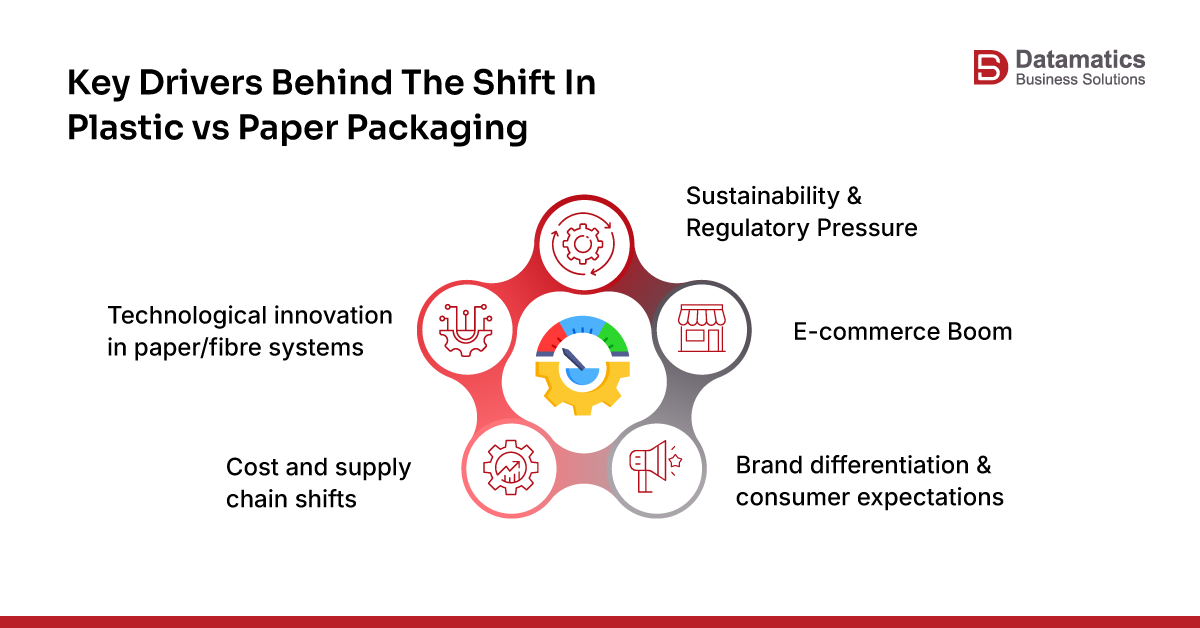
The accelerated growth of paper as a competitive alternative to plastic can be attributed to several converging forces. Understanding the key drivers behind the shift in plastic vs paper packaging can help you anticipate market trends and position your organisation strategically. These drivers will shape where and how you should invest. The major industry drivers include:
- Sustainability & regulatory pressure: With the United Nations Environment Programme (UNEP) flagging plastic pollution as a system-wide transformation challenge, nations worldwide are pushing for alternatives to plastic and paper is among the frontrunners. (Source: UNEP – UN Environment Programme)
- E-commerce boom: The growing adoption of online shopping is already accelerating the need for secondary and tertiary packaging. These are the areas where paper/corrugated solutions are already heavily used and where the substitution logic for plastic vs paper packaging often works
- Brand differentiation & consumer expectations: Globally, brands have recognised that switching to paper, or at least paper-visible packaging, improves their sustainability signalling. According to a survey, paper packaging can improve brand favourability scores by ~20% compared to plastic equivalents. (Source: BioLeader Pack)
- Cost and supply chain shifts: The rising costs of fossil and resin feedstocks for plastics, along with new investments in fibre-based materials, are shifting the economics.
- Technological innovation in paper/fibre systems: Significant advancements in recyclability, coatings, and compostability have boosted the functional performance of paper packaging, reducing the performance gap with plastic. (Source: BioLeader Pack)
What are the restraints and where will the substitution of plastic with paper hit road-blocks?
The debate on plastic vs paper packaging is not exactly straightforward. While paper lacks plastic’s barrier against greasy foods and cannot withstand heavy loads, plastic has its own limitations. The paper cost can easily shoot up due to volatility in raw materials and tightening regulations on virgin fibre supply.
Furthermore, in areas with a higher humidity quotient, paper packaging requires coatings, which can further increase its price by 10-20% compared to plastic. If you are contemplating replacing plastic with paper on a large scale, it is critical to know the obstacles. For the plastic vs paper packaging debate, key restraints include:
- Performance limitations: For some applications, plastic still outperforms paper in terms of durability, moisture/oxygen barrier, reuse, and weight. Several studies have found paper and board to be the most viable biodegradable alternatives; however, plastics outperform them in terms of associated packaging properties such as reusability, lightness, and cost.
- Lifecycle carbon and resource trade-offs: According to a study, the global warming potential (GWP) of disposable cardboard boxes is about 10 times higher than that of reusable plastic crates. (Source: ScienceDirect)
- Infrastructure constraints: The circular value and recycling systems for paper vary by region. The fibre recovery rates across markets vary significantly, and converting high-quality fibre from recycled sources is a major process.
- Cost and supply chain inertia: Several big brand owners and converters have already settled on plastic systems. As a result, the capital investment to switch to paper, validate new materials, redesign packaging, and manage supply chain changes is non-trivial.
- Material availability and competition for fibre: As more sectors push into fibre-based packaging, competition for raw materials, pulp and recycled fibre intensifies, potentially affecting costs.
- Regional disparities: While the substitution from plastic to paper might be viable in Europe or North America, in regions like Asia-Pacific, Africa, and the Middle East, manufacturers face different dynamics in terms of cost sensitivity, regulatory enforcement, and infrastructure.
Who are the leading players in the plastic vs paper packaging landscape?
The plastic vs paper packaging landscape features both modern, innovative disruptors and seasoned, established giants. Each of those has a different approach to market transition. Hence, to deduce winning approaches, we need to carefully evaluate their strategies.
The established traditional integrated manufacturers continue to dominate the market share through their global reach and meticulous vertical integration. Giants such as International Paper Company, Mondi Group, Smurfit Kappa, DS Smith, and Stora Enso control nearly 65-70% of European containerboard and carton board capacity. All these places leverage scale to their advantage in procurement, customer relationships, and manufacturing efficiency. They also continue to invest heavily in sustainable product innovation.
Speciality converters in this space focus heavily on high-value segments where functional performance commands premium pricing. Enterprises like H.B. Fuller manufacture advanced barrier coatings, which enable paper packaging to go toe-to-toe with plastic in demanding applications. They also have a water-based coating that meets global food safety regulations while providing protection against moisture, oxygen, and grease.
Another leader in the space, BioPak, leads with innovation in compostable and biodegradable paper packaging solutions specifically tailored for environmentally conscious brands, addressing niche markets willing to pay for sustainability credentials.
The young, innovative disruptors are driving technical breakthroughs that are reshaping global competitive dynamics. Amcor introduced its paper-based packaging under the AmFiber brand in January 2022. It offers significant enhancements over traditional methods. Graphic Packaging International launched Pacesetter Rainier paperboard, blending recycled paper with features of solid bleached sulphate.
All these newly launched products highlight how innovation can be a differentiator in the increasingly commoditised packaging markets.
In the fast-growing markets such as Asia, regional champions leverage local advantages.
Asian manufacturers gain significant benefits from proximity to lower production costs and the rapid expansion of e-commerce. In India alone, the paper consumption is expected to grow at 6-7% annually, reaching 30 million tonnes by FY 2026-27, driven by education, literacy initiatives, and organised retail expansion.
The Chinese producers have also scaled heavily to serve domestic demand and export markets, with processed paper and cardboard production volumes increasing substantially through 2024.
Which regions show the greatest promise and risks for paper replacing plastic?
Depending upon the geographical region you operate in, the whole plastic vs paper packaging debate plays out very differently. Let us have a quick look at the different regions that offer the greatest promise and risks for paper replacing plastic.
Asia-Pacific
The Asia-Pacific region is the largest packaging market, thanks to massive e-commerce growth, a rising middle class, and urbanisation. This region promises strong growth potential for paper packaging substitution. According to a recent report, the Asia-Pacific market held ~42.3% of the global packaging market in 2024. (Source: Market Data Forecast)
In terms of risk, these markets have lower recycling infrastructure maturity, cost sensitivity, and entrenched plastic supply chains.
Europe
The European region, with its strict sustainability regulations, e.g., the EU Packaging and Packaging Waste Regulation (PPWR), sets serious reuse/recycle targets. As a result of regulatory tailwinds and consumer willingness, this region presents a compelling case for paper.
However, the cost arbitrage from imports, e.g., cheaper folding boxboard from SE Asia, tightens the margins for local fibre players.
North America
The North American region shows moderate growth, but there are strong brand-driven opportunities.
The biggest challenges in this area are price competition, existing plastic infrastructure, and consumer perceptions.
Latin America / Middle East & Africa
As of now, this area has a smaller base; however, the growth potential is there. In these markets, plastic still holds a significant cost/availability advantage in several segments. To position the paper as a viable alternative, you will need government regulation, brand leadership, or an international export push.
As a player in this field, what should you be doing?
Based on our deep analysis and market research, if you are a player in this space, here is what you should be doing:
- Invest in paper/fibre packaging R&D: Leverage advanced R&D and innovation in coatings, barrier performance, and lighter-weight segments to gain a competitive advantage.
- Form strategic partnerships: Identify brands that demand sustainability-aligned packaging solutions and partner with them.
- Explore new regions: As a manufacturer in the packaging space, you must expand capacity in high-growth regions (e.g., Asia-Pacific) where paper substitution is gaining momentum.
- Re-balance portfolios: You need to re-balance your portfolios to maintain plastic capability while scaling paper to hedge risk.
Strategic Take-Away
By now, it is quite obvious that the plastic vs paper packaging ecosystem is not all about a straight material swap. It is a strategic transformation that will need manufacturers to carefully chart their paths to make maximum impact. While the paper packaging does present a compelling alternative in different aspects of the packaging industry, thanks to the global push for sustainability, regulation, and consumer demand, the overall shift requires supply-chain alignment, careful segmentation, functional innovation, and regional nuance.
Whether you are a brand owner, investor, converter, or packaging strategist, the real value lies in using custom market research to identify the segments, geographies, and competitive moves that will yield the highest return in the transition from plastic to paper. Being a first-mover in a niche where paper outperforms plastic can give you a durable competitive advantage.
If you’d like tailored insights such as country-level substitution potential, competitor benchmarking, growth forecasts by packaging format, or brand-specific impact, just write to us at marketing@datamaticsbpm.com, and we will reach out to you to discuss a custom market research engagement. Let’s help you turn packaging innovation into real growth.

Somnath Banerjee