












A marketing team runs a solid campaign. Engagement numbers look good. A stakeholder at a target account downloads a whitepaper, attends a webinar, and even visits the pricing page. The lead gets handed to sales. The rep reaches out.
Nothing happens.
Not because the account was not interested. But because the person who engaged was not the one making the decision. The actual decision involved six other people who never saw any of the campaign content.
This is the buying groups problem. And it is more common than most B2B marketers want to admit.
The reality is that B2B purchases are rarely made by a single person. They are committee decisions. Multiple stakeholders, different priorities, different objections. If your go-to-market motion is built around individual leads, you are missing the entire picture.
According to Gartner, a typical B2B buying group involves 6 to 10 decision-makers, each bringing their own research and agenda to the table. That number keeps growing as deals get larger and more complex.
This blog breaks down what buying groups actually are, how to find them inside your high value accounts, and how to build a strategy that gets the right message to the right person at the right time.
What is a Buying Group?
A buying group is the full set of people inside an organization who are involved in a purchase decision. It is not just the economic buyer. It includes the end users, the technical evaluators, the procurement team, the security reviewer, the legal department, and sometimes the executive sponsor.
Each member of the buying group has a different role and a different set of concerns. The CFO is thinking about cost and ROI. The IT lead is thinking about integration and security. The end user is thinking about ease of use. If your content and outreach only speak to one of them, you are leaving the others completely unaddressed.
Buying group organization varies by company size and deal complexity. In smaller companies, one or two people may handle multiple roles. In enterprise accounts, you could be dealing with a formal committee structure where no single person can greenlight the deal alone.
The concept is not new. But most marketing and sales motions still treat accounts as individuals rather than committees. That gap is exactly what buying group strategy is designed to close.
Key Takeaway
A buying group is the full set of stakeholders involved in a B2B purchase. Understanding this group, not just one contact, is the foundation of any serious account-based approach.
Why Buying Groups Matter More Than Individual Leads?
For years, demand generation was built around one metric: the lead. Someone fills out a form. They get a score. They get passed to sales. Simple.
But that model breaks down when you are selling into mid-market or enterprise accounts. Those deals have longer cycles, bigger budgets, and more risk. That means more people are involved in saying yes.
Forrester’s Buyers’ Journey Survey found that a buying group consists of at least 13 people. And that number climbs higher in complex enterprise deals.
The same study found that most B2B deals where sales and marketing engaged the full buying group were significantly more likely to close than those where only one or two contacts were touched.
A real-world example of this would be when Palo Alto Networks shifted to a buying group approach. Their win rates doubled. At full scale, pipeline progression to forecast grew by 800%. The difference in win rates is not marginal. It is substantial.
Here is why individual lead tracking fails in complex deals:
- One person’s engagement does not represent the group’s intent
- The person who downloads your content may have no budget authority
- If the economic buyer never sees your messaging, the deal stalls at the final stage
- Sales ends up having the same conversation with different people from scratch
B2B buying groups are where deals actually happen. Your pipeline reporting needs to reflect that.
Key Takeaway
Individual lead metrics do not capture real buying intent in complex accounts. Measuring engagement at the buying group level gives you a much clearer picture of where deals actually stand.
How to Identify Buying Groups Inside Your High Value Accounts?
Identifying buying groups is fundamentally a go-to-market visibility challenge. It takes data, intent signals, and a structured approach to mapping stakeholders before you start outreach.
Here is a practical framework:
1. Start with the job title map
For every high value account, build a list of the roles that typically participate in decisions for your category. If you sell marketing technology, your buying group probably includes the CMO, the VP of Demand Gen, the Marketing Ops lead, the CTO or IT director, and sometimes the CFO. Start there.
2. Use intent data to find who is already researching
Intent data tools can show you which companies are actively researching topics related to your solution. But more importantly, some platforms can tell you which job titles within those accounts are doing the searching. That is your buying group starting to take shape.
3. Cross-reference with CRM and engagement history
Pull every contact you already have at the account. Look at who has attended events, responded to emails, or been active on your website. Then look at the gaps. Who is missing? That gap is usually where the deal is getting stuck.
4. Talk to your sales team
Your reps often know more about the internal buying dynamics of their accounts than any tool can tell you. Who showed up to the discovery call? Who was cc’d on the proposal email? Who sent the last objection? That is buying group intelligence that lives in your team, not your platform.
5. Use LinkedIn for organizational mapping
LinkedIn Sales Navigator lets you see the organizational structure of target accounts, recent job changes, and who is connected to whom. Use it to validate your job title map and find names that should be part of your outreach list.
Key Takeaway
Identifying buying groups requires combining job title mapping, intent data, CRM history, and direct sales input. No single source gives you the full picture — you need all of them working together.
How to Build a Buying Group Strategy That Actually Works?
Identifying the group is only half the job. The harder part is activating them. It is getting the right content and messaging in front of each stakeholder in a way that actually moves the deal forward.
So, here are a few tried and tested methods that can help you build a buying group strategy.
1. Map content to roles, not just stages
Most content strategies are built around funnel stages: awareness, consideration, decision.
That is fine, but in a buying group context, you also need to think about roles. The CFO at the consideration stage needs a different piece of content than the IT lead at the same stage. Role-based content mapping makes your outreach far more relevant.
2. Do not run single-threaded outreach
Single-threaded selling is when one rep builds one relationship with one contact. This type of selling is one of the fastest ways to lose a deal. If that contact leaves, gets busy, or loses internal influence, your entire deal collapses.
Multi-threaded outreach to the full buying group reduces that risk and builds broader support for the purchase.
3. Coordinate marketing and sales plays
Marketing should know which accounts sales is actively working. Sales should know which stakeholders have been touched by marketing and what content they engaged with. When those two motions are coordinated, the buying group gets a consistent experience instead of competing messages from different channels.
4. Use account-level engagement scoring
Instead of scoring individual leads, score accounts based on how many members of the buying group are engaging and at what depth. An account where three buying group members have engaged across multiple touchpoints is a much stronger signal than one person downloading a single piece of content.
According to a recent study, 62% of B2B buyers say they make purchase decisions as part of a formal buying committee. That means your activation strategy needs to reach and influence the committee, not just the champion.
Key Takeaway
Activating buying groups means coordinating role-based content, multi-threaded outreach, and account-level engagement scoring. It is a team effort between marketing and sales — not a single campaign.
You can also read: How to Identify Micro-Influencers in Buying Groups and Engage with Them
What Does Buying Group Organization Look Like in Practice?
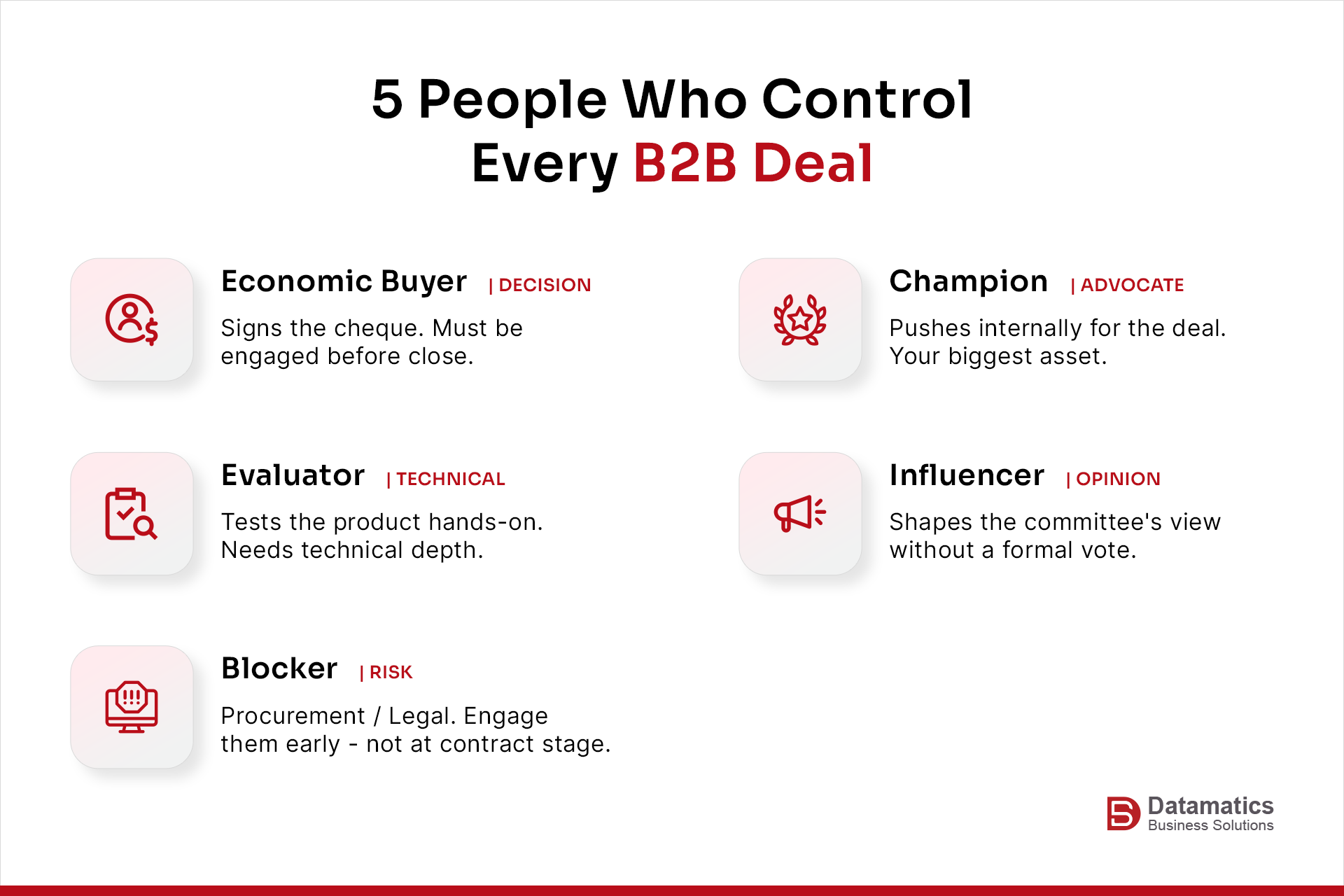
Buying group organization is the internal structure of who owns what role in the purchase decision. Understanding this structure helps you prioritize your outreach and tailor your messaging.
In most enterprise buying groups, you will find five recurring roles:
- The Economic Buyer — Controls the budget and ultimately signs off on the deal. This person may not be involved in early evaluation but is critical at the final stage.
- The Champion — Your internal advocate. This is usually the person who originally identified the problem and is pushing for a solution internally.
- The Evaluator — Does the hands-on product assessment. Often a technical or operations person who will test your solution against alternatives.
- The Influencer — Shapes the buying committee’s opinion without having a formal vote. This could be a senior analyst, a trusted colleague, or someone who has been through a similar purchase before.
- The Blocker — The person most likely to raise objections or slow the deal. Procurement, legal, and security leads often play this role — not because they want the deal to fail, but because their job is to manage risk.
Not every deal has all five roles filled by different people. But understanding which roles exist in your target account helps you anticipate where friction is going to come from and address it before it becomes a stall.
Key Takeaway
Buying group organization follows a consistent pattern of economic buyers, champions, evaluators, influencers, and blockers. Know which person plays which role before you start a deal.
Common Mistakes When Targeting Buying Groups
Most teams know they should be thinking about buying groups. But in practice, a few common mistakes keep showing up. Here is a summary.
- Over-indexing on the champion. Your champion is important, but if they are not the economic buyer, the deal will need executive support you have not built yet.
- Ignoring the blocker until it is too late. Procurement and legal are easier to work with early in the process than at the contract stage. Get them involved before they have a reason to push back.
- Treating all buying group members the same. Sending the same email to the CMO and the IT director is a waste of both their time. Personalize by role and by what they care about, not just by name.
- Not updating the group map as the deal progresses. Buying groups shift. People leave companies, change roles, or get added to the committee late in the process. Your map needs to be a living document, not a snapshot from the first discovery call.
- Measuring success by individual lead volume. If your reporting dashboard only shows leads, you are flying blind on whether you are actually reaching the people who matter in your target accounts.
Key Takeaway
The most common buying group mistakes come down to too-narrow focus. Champion-only outreach, ignoring blockers, and lead-based measurement all create blind spots in complex deals.
How Datamatics Business Solutions Helps You Identify and Activate Buying Groups
Finding buying group members inside high value accounts requires accurate, up-to-date contact data, strong intent signals, and a process for organizing that intelligence into actionable outreach lists.
At Datamatics Business Solutions, we help B2B marketing and sales teams do exactly that. We work with clients to build verified contact data mapped to specific buying roles within target accounts. This includes identifying key stakeholders by job title, seniority, and department. We do this so you are not just targeting companies. You are targeting the actual decision-makers inside them.
We also support buying group activation through demand generation programs designed to reach multiple stakeholders within the same account. Intent data, account-level engagement tracking, and content syndication programs are used together to build engagement across the full committee, not just one contact.
For teams running account-based marketing programs, we can also help with account selection, ICP validation, and ongoing data hygiene to ensure your target account list stays accurate as organizations change.
The goal is to make sure your buying group strategy is built on a reliable foundation; where the data you are working from actually reflects the reality of who is inside your accounts.
Need to know more about our buying group services? Fill out the form here.
The Datamatics Advantage
B2B buying decisions are not made by one person. They never were. But for a long time, marketing and sales teams built their entire go-to-market motion as if they were.
The shift to buying group thinking is not a tactical adjustment. It is a fundamental change in how you define success. Instead of asking “did we get a lead?”, the question becomes “did we reach the full committee?”
That change in question changes everything — how you build your contact data, how you score accounts, how you brief your sales team, and how you measure pipeline health.
The teams getting this right are not the ones with the biggest budgets. They are the ones who mapped the group before they started outreach, coordinated marketing and sales around the same accounts, and treated every deal as a committee decision from day one.
That is where buying group strategy starts. And that is where the gap between stalled deals and closed ones begins to close.
Subscribe to our monthly newsletter to stay updated with the latest news.
FAQ: Embedded Teams for Enterprise Marketing
1. What is a buying group in B2B marketing?
A buying group is the full set of people inside a company who are involved in making a purchase decision. In B2B, this typically includes the budget owner, end users, technical evaluators, procurement, and sometimes legal or executive leadership — depending on the size and complexity of the deal.
2. How many people are typically in a B2B buying group?
According to Gartner, the average B2B buying group involves 6 to 10 stakeholders. Forrester says that number can be higher for complex enterprise deals. For larger enterprise deals, that number can be higher. The more complex and expensive the purchase, the more people tend to be involved in the decision.
3. How do I find buying group members in a target account?
Start with a job title map based on your typical buyer profile. Then use intent data to identify who is actively researching, cross-reference with your CRM for existing contacts, and use LinkedIn to fill in gaps. Your sales team is also a valuable source — they often have direct knowledge of who is involved in a deal that no tool will surface.
4. What is the difference between a buying group and a buyer persona?
A buyer persona is a profile of a type of individual buyer based on common characteristics, goals, and pain points. A buying group is a specific set of people at a real account who are making a real purchase decision. Personas help you build content. Buying group mapping helps you execute account-based outreach.
5. How do I measure buying group engagement?
Track engagement at the account level, not just the individual level. Look at how many unique buying group members have interacted with your content, how many touchpoints have been created across the group, and which roles remain unengaged. Account-level scoring that reflects group-wide activity is a much stronger signal than a single lead score.
6. Is buying group marketing the same as ABM?
They are related but not identical. Account-based marketing (ABM) focuses on targeting specific high-value accounts rather than broad audiences. Buying group marketing is a more specific layer within ABM — it focuses on reaching all the key stakeholders inside those target accounts, not just the primary contact. Good ABM programs incorporate buying group thinking into their execution.

Paul van de Kamp