













You launch an eBook. You syndicate it. 300 leads come in. Sales rejects 70%. The rest goes silent.
Your first instinct might be to look at the content. But the real driver often lies elsewhere. This is what happens when you hire a vendor optimized for volume, not quality. And most of the content syndication industry is built exactly that way.
Here is the pattern. A vendor promises reach and targeting. You agree on a number. They hit the number. The leads look right on paper. Correct titles, right industries. But they do not convert. Because the audience was not a publisher network. It was a contact database with a new name.
If your content syndication provider guarantees volume upfront, your lead quality is already compromised. Real syndication partners size campaigns to your ICP. Lead factories size your ICP to their inventory.
Knowing how to choose a content syndication provider is what separates a channel that builds pipeline from one that produces reporting-friendly noise.
What Does a Content Syndication Partner Actually Do?
A content syndication services partner takes your content and puts it in front of an audience you do not own.
In theory, this is straightforward. In practice, that means handling audience targeting, publisher placement, lead capture, quality filtering, and delivery. All on your behalf.
To put it simply, you provide a whitepaper or a guide. They manage where it goes, who sees it, and what gets passed to your sales team.
Demand for gated B2B content is growing fast. NetLine’s data shows a 14.3% year-over-year rise in demand, with one major network logging 5.4 million downloads in a single year.
But rising demand also means more competition for attention. More vendors willing to fill your lead quota with contacts who never actually engaged.
The difference between a real partner and a lead factory comes down to three things:
a. How they built their audience
b. How they define a qualified lead
c. How they report results
It is also imperative to know that verified, opted-in publisher networks and third-party aggregated databases are not the same thing. Both get called content syndication services. The output is not the same.
How to Choose Content Syndication Providers that Actually Deliver ?
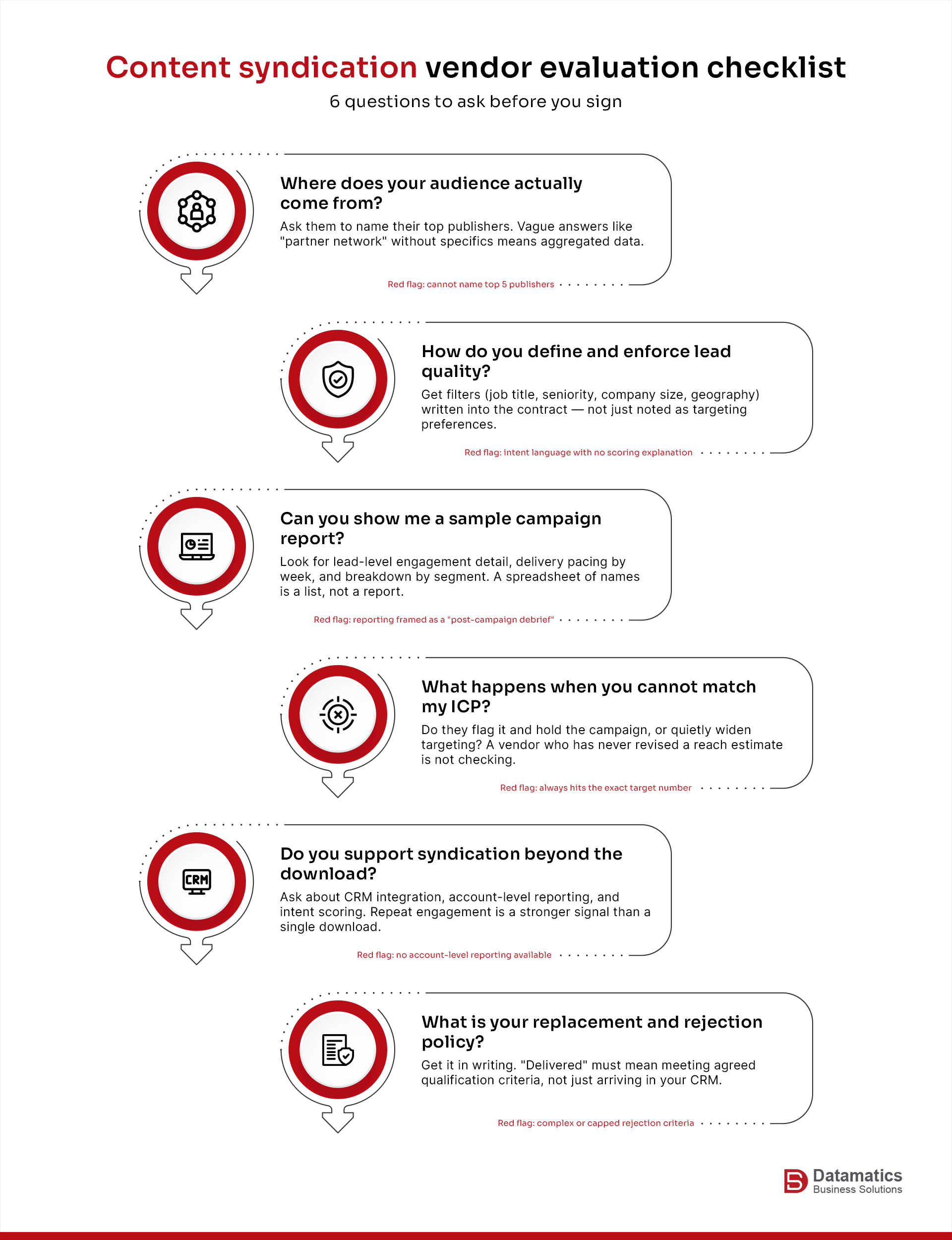
Question 1: Where does your audience actually come from?
This is the first question on any serious content syndication partner checklist. And the answer will tell you almost everything.
Ask specifically – Is this an owned publisher network or a purchased contact database?
If the answer is partner network, ask them to name the publishers. Credible content syndication providers can do this without hesitation.
Red flag: Any vendor who cannot name their top five publishing partners is almost certainly running off aggregated lists. Vague answers like we have relationships across multiple channels is third-party data aggregation with better branding.
Key Takeaway
Audience sourcing is not a minor detail. It is the foundation everything else is built on.
Question 2: Where does your audience actually come from?
Ask what a lead actually means in their system. A form fill is not the same as a verified intent signal. A content download from a job title match is not the same as an engaged buyer.
Then ask what filters are applied before a lead reaches you?
Job title, seniority, company size, geography – which of these are enforced. Which are just targeting preferences the vendor will quietly drop to hit delivery numbers?
The data on this is clear. Companies that prioritize lead quality in content syndication see a 45% higher sales achievement, according to Forbes. That gap does not come from better content. It comes from better filtering upstream.
Red flag: If a vendor talks about intent signals but cannot explain how those signals are captured or scored, they are using the language of quality without the infrastructure.
Key Takeaway
Define qualification criteria in writing before the campaign starts. If a vendor resists, they are protecting their ability to deliver volume over quality.
Question 3: Can you show me sample reports from past campaigns?
Ask for an actual campaign report, not a capabilities deck.
What you should be looking for?
Delivery pacing by week, lead breakdown by segment, engagement detail beyond the download.
The best content syndication companies show you what content a lead engaged with, how many times, and what happened next.
If the report is a spreadsheet of names and emails, you are buying a list. You are not buying demand generation.
Red flag: Vendors who frame reporting as a post-campaign debrief rather than an ongoing dashboard are usually buying time before you notice the quality gap.
Key Takeaway
Good vendors report on lead context. If reporting is just a spreadsheet, you are paying for names, not intent.
Question 4: What does your ICP matching actually look like under pressure?
This is where most content syndication vendor evaluations fall short.
Everyone agrees on targeting criteria at the brief stage. But the question is what happens when the vendor cannot find enough matched contacts?
Do they hold the campaign and tell you? Or do they widen the targeting without flagging it?
The better content syndication providers will give you a realistic reach estimate before launch. If the number is lower than you hoped, that is a sign they are being honest.
A vendor who always hits your target audience number exactly, regardless of ICP complexity, is almost certainly adjusting the definition of matched.
Red flag: If a vendor has never once come back to you with a revised reach estimate, they are not checking.
Key Takeaway
Push on ICP matching before you sign. A vendor who gives you honest reach constraints is more valuable than one who promises the number you want.
You can also read: 12 Best Content Syndication Providers in 2026
Question 5: Do you support content syndication beyond the download?
Basic content syndication services stop at lead capture.
The better vendors integrate with your CRM or MAP. They support intent scoring and flag accounts that engaged multiple times. This is because repeat engagement is a far stronger buying signal than a single download.
This matters more if you are running account-based marketing alongside syndication.
Look for content syndication providers who can match against a target account list and report at the account level, not just the individual contact level.
Key Takeaway
The best partners extend the value of a lead beyond the first touch. Ask specifically about CRM integration and account-level reporting.
Question 6: What is your replacement and rejection policy?
Even strong vendors deliver some leads that miss the mark. What separates them is how they handle it.
At an average cost per lead of $43 as per the industry benchmark from Demand Metric, a weak rejection policy adds up fast.
Ask for the policy in writing. Tell them what qualifies as a rejectable lead, what the replacement timeline looks like. Also inquire whether there is a cap on replacements.
Red flag: Any clause that defines delivered as sent to your CRM rather than meeting agreed qualification criteria is worth challenging before you sign.
Key Takeaway
Replacement policy is a quality signal. Make it part of contract negotiations, not an afterthought.
Signs You Chose the Wrong Vendor
Even with the right questions, some poor choices only become clear post-launch. Watch for these patterns.
- Leads arrive in bulk at the end of the month, not steadily throughout the campaign. This suggests the vendor is sourcing reactively to hit delivery targets, not running a live publisher program.
- Sales cannot reach anyone. A single unreachable lead is normal. A pattern of unreachable leads across the same job titles and companies suggests the contacts were never actively opted in.
- Engagement drops to zero after the download. Intent-driven leads typically show follow-on behavior. They revisit your site and engage with nurture emails. If syndication leads are completely dark post-download, the intent was not real.
- Reporting gets vague when you ask hard questions. Quality vendors get more specific under scrutiny, not less.
Content Syndication vs Intent Data Platforms: Which Do You Need?
These two are often confused. And sometimes sold as the same thing.
Content syndication captures leads by distributing gated assets to a publisher audience. The lead opts in by downloading.
Intent data platforms track anonymous research behavior across the web and flag accounts that are actively investigating your category.
This without necessarily capturing a contact.
They serve different purposes.
Intent data tells you who is in-market. Content syndication puts you in front of them and captures a contact.
The strongest demand generation programs use both. Intent data to prioritize accounts, content syndication to generate the actual lead.
According to Demand Gen Report, over one-third of B2B buyers actively seek third-party content before engaging a vendor. That is the window syndication is designed to capture. However, it works only if the intent infrastructure behind it is real.
If a vendor is selling you intent-based syndication as a single product, ask them to explain exactly how the intent signal is generated and how it connects to the lead capture. Vague answers here usually mean they are layering intent language onto a standard syndication product.
How Datamatics Business Solutions Approaches Content Syndication
Content syndication lead quality is a systems problem, not a luck problem. The right infrastructure, the right audience, and the right filters produce consistent results. The wrong ones produce volume that looks good in a report and disappears in pipeline review.
This is exactly where most vendors break. And it is exactly where DBSL is built differently.
Audiences are verified and opted in. They are not pulled from aggregated databases. Targeting goes down to job function, seniority, industry vertical, and company size. Before any campaign goes live, our team maps realistic reach against your actual ICP and flags constraints honestly.
We also support content syndication services as part of broader demand generation and account-based marketing services. This means syndication leads can feed directly into intent-based nurture tracks rather than sitting in a static list.
For B2B teams comparing content syndication companies, the right starting point is a conversation about what qualified actually means for your sales team. Not a pitch about reach numbers.
Ready to audit your current vendor against these criteria? Book a syndication quality assessment with the DBSL team.
Always remember – In content syndication, volume is easy to buy. Pipeline is not.
Frequently Asked Questions
1. What should I look for when evaluating content syndication vendors?
Structured cabling provides the standardized, flexible, and high-performance backbone necessary to handle real-time data, automation, and connected devices that modern OT environments depend on.
2. How do I know if a syndication lead is actually qualified?
Set qualification criteria — job title, seniority, company size, geography — before the campaign starts and get them written into the contract as enforceable filters, not targeting preferences.
3. What is the difference between content syndication and intent data?
Intent data identifies accounts researching your category. Content syndication captures a contact from that audience by distributing gated content. The two work best together: intent data for account prioritization, syndication for lead capture.
4. What are red flags when evaluating content syndication providers?
5. Can content syndication work for ABM programs?

Carly Jaspan