











Data cleansing has always been a routine task for most organizations. Teams fix missing entries, remove duplicates, correct formats, and clean up obvious errors. For many years, this manual work was enough. But today, the volume and speed of data have grown so much that human review alone cannot keep up. Most organizations multiple systems like CRMs to gather and maintain their data. The more such systems they add, the more scattered the data becomes.
This is where predictive data cleansing comes in. Instead of waiting for issues to show up, AI scans large datasets, spots hidden patterns, and identifies gaps that are easy for teams to miss. It does not replace people. No. Humans are still integral to the data cleansing process. AI supports them by handling repetitive checks, improving accuracy, and doing it at a scale that manual work cannot match.
Modern organizations now rely on AI not only to clean data but also for intelligent data enrichment, format correction, and early error detection. This shift has also increased the demand for data cleansing services and the best AI tools for data cleansing, especially in the US where companies depend heavily on fast, clean, and compliant data.
In this blog, we will look at how predictive models work, why traditional methods fall short, and how businesses can build reliable data pipelines with AI support.
Why B2B Data Cleansing Matters More Than Ever?
Bad data is no longer a small problem. It affects revenue, slows daily operations, and leads teams toward decisions that are not based on facts. As companies grow, the impact becomes even stronger. With the systems becoming complicated with more tools, channels, and workflows, data produced daily has also increased.
Here are a few numbers that show how serious the issue is:
- Gartner reports that dirty data costs companies an average of $12.9 million every year.
- A Forrester study found that 27% of revenue is lost because of inaccurate or incomplete data.
- Another study showed that 40% of business objectives fail when leaders rely on incorrect or outdated information.
The scale of the problem keeps rising. CRMs, marketing platforms, billing tools, and operations systems all generate new entries, and each system stores data in its own format. Without regular data cleansing, errors spread across the entire pipeline, which ultimately impacts revenue.
Let’s be honest. The sheer volume of data is impossible to manage manually. This is why many organizations are now looking for data cleansing services. They are adopting automated tools to stay ahead of the problem before it becomes mammoth.
Key Takeaway
Bad data has a direct financial impact. Manual cleansing alone is not enough to match modern data volume. This has given way for the rise of data cleansing.
What Is Predictive Data Cleansing?
Imagine you run a toys factory. But having your workers check the toys one at a time is time consuming. So, you install a smart quality-check machine. The machine scans each product at high speed, spots defects instantly, and corrects small issues on the spot. Your workers then do a mandatory overall check before sending the toys out.
Predictive data cleansing does this but for your data. It looks at each data entry as it flows through your system. It identifies anything unusual and resolves it early so it never reaches your teams or customers.
To put it in simple words, predictive data cleansing is the use of machine learning to scan your data, spot issues early, and fix them before they disrupt business operations.
With predictive data cleansing, you don’t wait for the problems to crop up. You seek them out and address them in advance. Also, predictive data cleansing studies historic data patterns and predicts where new problems are likely to appear. This makes the entire cleansing process faster and far more accurate.
Now, if you look at most predictive models, they work in three simple steps:
Step 1: Recognizing the Pattern
The first step is where AI learns what clean and correct data usually looks like. From analyzing the common data formats to understanding repeated values, such predictive models study the behavior across large datasets.
Step 2: Detecting Anomaly
Once the data pattern is clear, the system flags entries that look different. How different? Well, these can be anything from missing fields, spelling mistakes, invalid emails or phone formats, or even possible duplicates.
Step 3: Automating Corrections
After detecting issues, the predictive data cleansing model suggests or applies the correct value. From fixing a name to completing a phone number, or even standardizing a job title, multiple functions can be performed to fix the data inaccuracies. When needed, it also uses reference databases to fill gaps with intelligent data enrichment.
Predictive data cleansing is more than a faster way to clean data. It is a proactive method that prevents errors from spreading across connected systems such as CRMs, marketing platforms, and reporting tools. This is why many companies now consider it an essential part of modern data cleansing services.
Key Takeaway
Predictive models don’t wait for errors. They find and fix issues before humans notice them. There is an increasing need for such models.
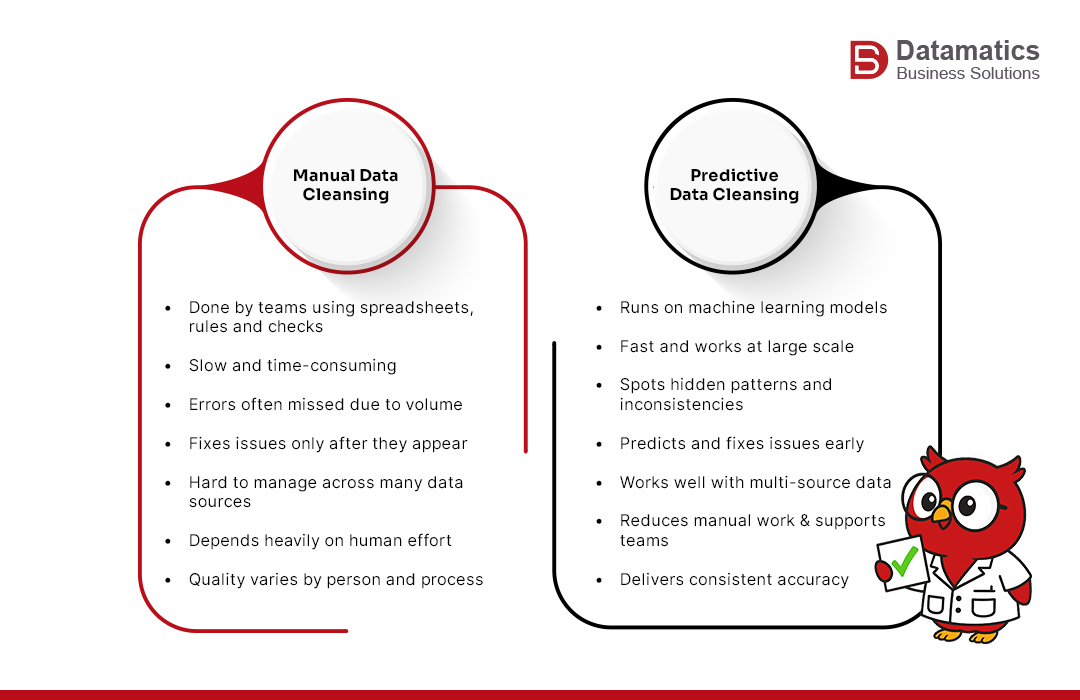
Understanding Manual Cleansing vs Predictive Cleansing
Why Traditional Data Cleansing Falls Short?
Most teams still rely on spreadsheets, rule-based scripts, or manual checks. These methods once worked when data came from only a few sources. But today, businesses use multiple systems.
From CRMs to marketing automation tools, from web analytics to sales-engagement platforms, and customer-support systems, teams use multiple platforms all at once. This creates a complex data environment. Manual cleansing struggles with this complexity.
Here is how and why traditional methods fail, supported by real-world data:
High Data Volumes and Many Sources
Many organizations now use dozens to hundreds of data tools, each adding its own data stream. The fractured landscape makes it nearly impossible for manual processes to keep pace.
Fast Data Changes
Customer data, such as contact info, job titles, addresses, changes rapidly. And we know that poor data quality can cost a company on average US $12.9 million per year in lost revenue, wasted effort, and inefficiencies.
Hidden Errors and Inconsistencies
The poor quality of data is not something you can see. But its impact is something that can be felt overall. Issues like duplicates, small spelling mistakes, outdated records, and inconsistent formatting can often go unnoticed. There is a 8 to 12% decline in revenue due to bad data quality
Inconsistent Tagging and Conflicting Formats
When different teams use different naming conventions or systems store data in different formats, manual cleansing becomes messy and error-prone. This is especially true when combining data from different CRMs or marketing tools.
It is clear that manual data cleansing is no longer just the available option. With growing volume of B2B data, many companies are now turning to data cleansing services providers who use a combination of AI-based tools and human intervention to clean and enrich data.
Key Takeaway
Traditional cleansing methods cannot handle the speed, volume, and complexity of today’s data. Therefore, many B2B companies are turning to data cleansing service providers who combine human and AI to clean and enrich data.
Recommended Reading: Why Bad Data is a Threat to Your 2026 Strategy?
How Predictive Models Improve Data Cleansing Accuracy?
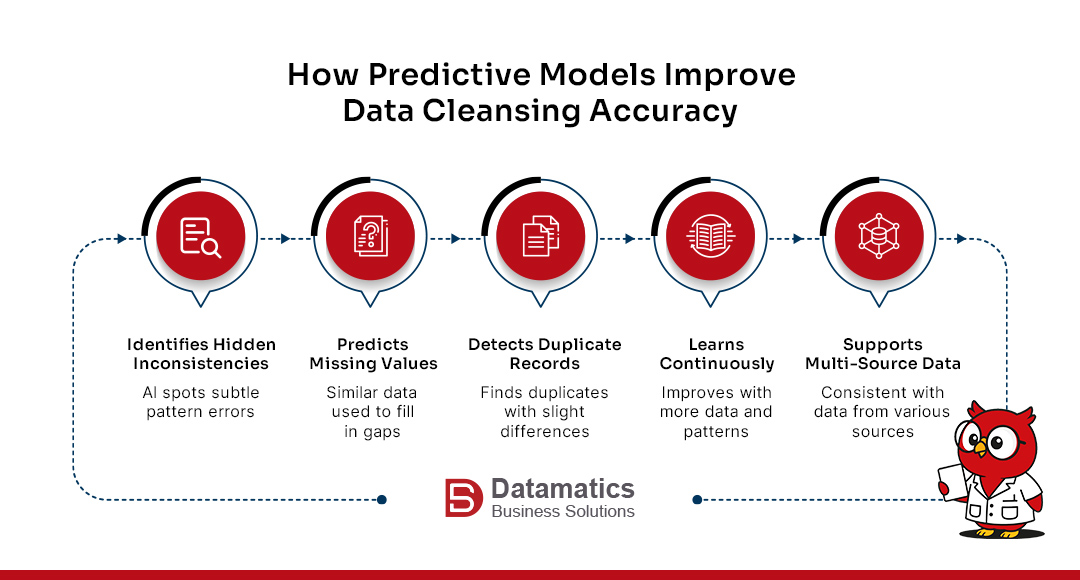
It is clear by now that predictive data cleansing models bring a level of speed and consistency that honestly manual checks cannot match.
Most predictive models help teams detect issues early. This in turn helps the teams maintain clean records across departments. It also reduces the daily workload on data teams.
We have compiled ways predictive models can help improve data cleansing accuracy.
1. Identify Hidden Inconsistencies
AI can scan millions of rows at once. It can also notice details that are easy for people to miss. Small typos, unusual spacing, mixed date formats, or values that appear out of place are flagged quickly. This prevents wrong entries from moving into reports or customer-facing systems.
2. Predict Missing Values
Instead of leaving blank fields for someone to fix later, the model looks at related data and fills in the most likely value. For example, if a postal code is present but the city is missing, the system can complete it. This helps keep records complete without manual research.
3. Detect Duplicate Records
Many duplicates are not obvious. Two entries may refer to the same person but have slightly different spellings or email formats. AI reviews these fields side by side and groups possible duplicates for faster cleanup. This is especially useful for CRMs that receive frequent updates.
4. Learn Continuously
Predictive models improve over time. As the system sees more data from different sources, it learns what “correct” looks like for that business. If naming styles change or new fields are added, the model adapts without needing constant rule updates.
5. Support Multi-source Data
Modern companies pull information from CRM systems, marketing tools, sales platforms, and customer support tools. Each platform stores data differently. Predictive tools apply the same logic across all sources, which keeps the final dataset consistent and ready for intelligent data enrichment.
Because of these strengths, predictive data cleansing leads to higher accuracy, fewer manual corrections, and cleaner pipelines. It also helps teams trust the reports and dashboards they use every day.
Key Takeaway
AI strengthens cleansing by detecting patterns and inconsistencies at a level humans cannot match. This increases data accuracy.
Common Use Cases of Predictive Data Cleansing
Businesses use predictive data cleansing to complete multiple daily tasks. It helps teams keep information updated and consistent as it moves across systems. Some of the most common use cases can be summarized as follows:
1. CRM Data Quality
Businesses use predictive data cleansing to complete multiple daily tasks. It helps teams keep information updated and consistent as it moves across systems. Some of the most common use cases can be summarized as follows:
2. Lead Scoring & Segmentation
Clean records make segmentation more accurate. Marketing and sales teams can group leads better and run campaigns with fewer errors.
3. Data Migration and Integration
When data is moved from one system to another, formats often do not match. Predictive tools remove duplicates and clean fields before the data is merged.
4. Reporting and Analytics
Reports depend on correct inputs. Predictive cleansing reduces mistakes, which helps teams trust the numbers they see each day.
5. Personalization
Targeted messages need complete profiles. Clean and enriched data helps marketing teams send more relevant content.
These use cases improve daily work, reduce manual checks, and keep information reliable across teams.
Key Takeaway
Predictive cleansing improves CRM quality, reporting accuracy, segmentation, and integration workflows.
Also Read: 5 Data Enrichment Best Practices for 2026
How Datamatics Business Solutions Helps Companies with B2B Data Cleansing Services?
DBSL supports organizations with complete data cleansing services built for modern business needs. Companies today face a mix of legacy systems, new platforms, and fast-changing customer details. This leads to scattered, outdated, and inconsistent records. DBSL’s data cleansing approach focuses on accuracy, consistency, and long-term reliability.
From data building to data enrichment, DBSL is often regarded as one of the best AI data quality vendors in the US. We use a combination of manual review and AI models, and ensure 95% data accuracy. We have access to 230M+ data records across 40+ industries.
Want to learn more about the services? Get in touch with the experts. Fill out the form here.
Conclusion
Predictive data cleansing gives companies a practical way to manage the growing volume of B2B data. It helps teams reduce errors, keep systems aligned, and maintain reliable records without extra manual effort.
By combining AI with human review, businesses can build cleaner pipelines and make decisions with confidence. As data continues to grow, predictive cleansing will become a standard part of every organization’s workflow.
Subscribe to our blogs to stay ahead of the latest data cleansing trends
Frequently Asked Questions about B2B Data Cleansing
Q1. What is data cleansing?
Data cleansing is the process of fixing errors, removing duplicates, correcting formats, and completing missing details in datasets.
Q2. How does predictive data cleansing work?
It uses AI and machine learning to detect and fix issues automatically based on patterns and historical data.
Q3. Why do companies need data cleansing?
Bad data leads to lost revenue, poor targeting, wrong decisions, and CRM clutter.
Q4. Can AI detect errors humans miss?
Yes. AI identifies subtle patterns across large datasets that are hard for manual review teams to catch.
Q5. How often should businesses cleanse data?
Most companies refresh their datasets every 30 to 90 days, depending on volume and workflow needs.

James Libera