















After decades of China’s manufacturing dominance and of raw-material costs dictating market dynamics, the global silicone industry today stands at an enthralling crossroads. The global silicone landscape is going through a seismic transformation as we approach 2030. The new variables driving this transformation are supply chain diversification, sustainability mandates, and breakthrough innovations. While these variables alter the global equation, it is critical to look beyond traditional industry drivers to develop a comprehensive silicone pricing outlook for 2030 and embrace a more complex, interconnected reality.
The key drivers of the growth will be renewable energy infrastructure, automotive electrification, and advanced healthcare applications. However, the new pricing trajectory will not align with historical patterns.
The current global silicone market is witnessing a structural transformation, with geopolitical tensions, technological breakthroughs, and carbon pricing mechanisms creating volatility that traditional forecasting models will have a tough time capturing. The question industry leaders want answered is whether prices will continue to soar or slow. The answer lies in understanding the factors that will dominate your specific market segments, then positioning your business to capitalize on these shifts. By harnessing the power of qualitative business research, smart businesses have already begun recalibrating their strategies, moving away from reactive purchasing to proactive market intelligence to anticipate forthcoming disruptions before they impact the bottom line.
Will raw materials remain a major driver of the silicone pricing outlook 2030?
Historically, raw materials have accounted for a substantial portion of silicon production costs, with silicon metal and methanol as the primary inputs. Businesses in this space, are already aware how fluctuations in these sectors directly impact procurement budgets. In 2021 – 2022, we witnessed a surge in silicon metal prices, which surged by nearly 3-4 times, with metallurgical grade silicon going up to $6,000-9,000 per metric ton in 2022, due to the ongoing energy shortages in China’s Yunnan and Sichuan provinces. While this volatility is expected to persist, our research has established that their relative influence on the silicone pricing outlook for 2030 is anticipated to diminish as other factors gain prominence. So, yes, the raw materials will continue to be the primary driver of the silicone pricing outlook 2030, and here is why you should care:
1. Silica Feedstocks and Silicon Metal
China produced nearly 70% of global silicon materials in 2023 (used in silicone downstream). Their industrial silicon production capacity grew from 1.13 million tons to 2.61 million tons between 2012 and 2021, increasing its share from ~58% to ~77% (Source: Hensfate Metal).
2. China’s Abundant Raw Material Deposits
China is the largest producer of quartz/silica, which lends it a significant cost advantage. This dominance makes it easy for Chinese manufacturers to obtain raw materials at a considerably lower cost.
3. Feedstock Cost Volatility
Several global pricing reports have shown a direct correlation between raw-material costs and silicone product pricing (e.g., siloxanes, chlorosilanes). Furthermore, several macro factors, such as energy costs, logistics, and environmental and regulatory factors, push costs even higher.
4. Capacity Expansion & Supply-Cost Pressure
China, with its large new capacity, is increasing the supply of raw materials, which could offset some cost increases and intensify competition and margin pressure. According to siliconeoil.net, China’s organic silicon production capacity is projected to reach ~3.399 million tons/year (vs. ~2.289 million previously predicted) if the projects are completed.
Thus, raw materials will continue to play an instrumental role in shaping the silicone pricing outlook for 2030. However, there is a limit to the upside unless an unforeseen bottleneck arises, thanks to most of the capacity coming online. The primary risk here is raw-material cost inflation (energy, carbon/ESG costs) or an unanticipated supply disruption that can trigger price spikes.
How is China's economic transformation reshaping the silicone pricing outlook 2030?
China accounts for 55-60% of global silicone production capacity; however, in recent times, its dominance is undergoing a vital metamorphosis, which will have a defining role in determining the silicone pricing outlook for 2030. China is slowly moving away from the low-cost manufacturing hub of yesteryears to a powerful innovation hub and major consumer market simultaneously. According to a recent study the domestic consumption of China grew at 8.2% annually from 2018 to 2023, outpacing the overall production growth, supporting complex price floors internationally, and constraining export availability. Some other factors that strengthen China’s position as a global power in reshaping the global silicone market pricing outlook include:
- The increase in silicone monomer production and the decrease in manufacturing capacity are aggressive. China’s production capacity for silicone methyl monomers was expected to exceed 5.9 million tons/year by 2025, accounting for nearly 70% of global capacity. (Source: oliviasealant.com)
- China is not only a leading producer of silicone but also a key consumer, particularly in the electronics, construction, and automotive sectors. According to a recent study with India and China leading the pack, the Asia-Pacific region will continue to account for the largest share of silicone demand.
- Thanks to the integrated supply chain for raw materials, intermediates, and finished silicone, manufacturers in China will continue to enjoy a significant cost advantage, which will eventually translate into lower regional pricing. As a result, global pricing benchmarks will come under downward pressure.
However, China’s monumental growth will be moderated by regulatory, energy, and environmental constraints. In addition, as the economy matures, the growth of the Chinese market will plateau as it shifts to other emerging regions.
What are the key drivers shaping the global silicone market pricing outlook 2030?
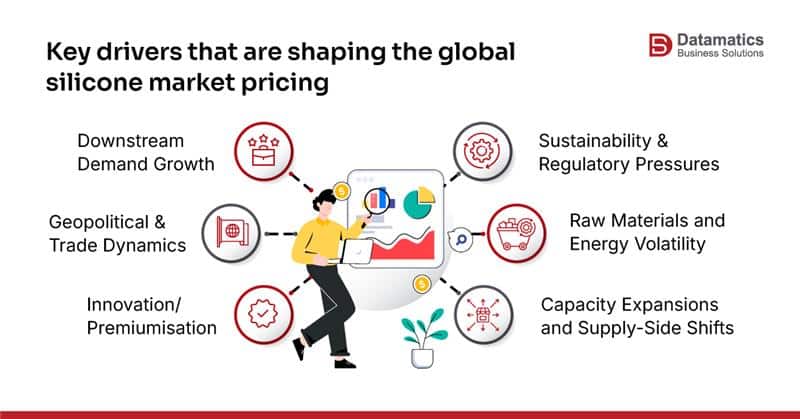
Going by the global silicone market trends, here are some of the key drivers that are shaping the global silicone market pricing:
- Downstream Demand Growth: With significant growth in sectors such as electronics, solar/renewables, EVs, and construction (particularly green/energy-efficient buildings), demand for high-performance silicone has increased.
- Sustainability & Regulatory Pressures: The Global manufacturing industry is subject to stringent environmental standards (e.g., VOC limits and use of bio-based raw materials). These standards raise the cost base, pushing prices higher. This push also encourages innovation into premium grades, which support higher pricing.
- Raw Materials and Energy Volatility: The cost of key inputs, such as silicon metal, siloxanes, electricity, and coal, in China can also have a significant impact on margins and drive price movements.
- Capacity Expansions and Supply-Side Shifts: Factors such as overcapacity in certain regions, new entrants, and the concentration of China’s production affect pricing in the global silicone market.
- Geopolitical & Trade Dynamics: Export restrictions, tariffs, energy policy, and regional incentives (e.g., in the US/EU to onshore production) can also affect global costs and supply chains, consequently influencing the global silicone market & pricing.
- Innovation/Premiumisation: With innovation in the silicone market, specialty silicones with higher purity and enhanced functional performance can command higher prices. This creates a bifurcated pricing outlook: commoditised grades may see pressure; specialty grades may see premium growth.
All these key drivers have a direct impact on the silicone pricing outlook 2030: whether pricing will trend upward, remain stable, or even decline in some commoditised segments.
How will regional dynamics shape the silicone pricing outlook 2030?
The global silicone market’s pricing for 2030 and beyond will largely be shaped by geopolitics, as we see price disparities and supply chain vulnerabilities emerge as key factors. The ongoing US-China technology competition is another key driver of strategic decoupling in advanced materials, with the CHIPS Act allocating $52 billion to domestic semiconductor supply chains that depend heavily on high-purity silicones. Here are some of the key regions we feel will play a role in determining the silicone pricing outlook for 2030.
Asia-Pacific (led by China & India)
The Asia-Pacific market is well poised to continue its reign as the fastest-growing and largest region. The silicone market in the Asia Pacific is expected to reach ~US$15,157 million by 2030, with a ~6.8% CAGR from 2023-30. The global benchmarks will have a strong influence on the silicone pricing trends as China’s dominance in raw materials, production capacity and downstream demand continues. In the Indian and Southeast Asian markets, growth will be stronger (from a lower base), which will put upward pressure on regional pricing, particularly when local supply lags.
North America & Europe
The North American and European markets are more value-added with premium grades, specialty silicones, and stricter regulations. Because feedstock is regularly imported or manufacturing is higher-cost, regional pricing tends to be higher (see ~US$10,190/MT in Germany for silicone rubber in Q3 2025) vs China’s ~US$3,485/MT. For 2030 and beyond, we can expect slightly narrower growth rates than in Asian markets; however, pricing might enjoy premium margins due to its technical/specialty positioning.
LAMEA (Latin America, Middle East & Africa)
Although the LAMEA markets are smaller bases than other markets, they offer significant growth opportunities as manufacturing shifts and construction/renewables pick up. Another key driver that might push pricing upwards is a supply constraint, which will drive locally imported silicone to higher landed costs, meaning the pricing outlook may lean upward, but volumes may remain modest.
Takeaway on regional pricing
- China/APAC: Base pricing for silicone will remain lower globally; however, upward drift will depend on raw-material & energy costs.
- Premium Regions (North American & European Markets): Higher baseline pricing, slower volume growth, but healthier margin potential.
- Regions with supply constraints/import dependence (Latin America, Middle East & Africa): These regions will have higher prices compared to the global average; cost inflation and logistics become critical.
Hence, when you are modelling silicone pricing outlook 2030 for your business, make sure you have region-specific inputs and supply-chain cost assumptions, not a single global number.
What are the strategic implications for buyers and suppliers of silicone, given the pricing outlook 2030?
For the buyers and suppliers of silicone globally, here is our well-researched advice:
For buyers (downstream manufacturers)
- Bifurcate your silicone spend by geography, grade, and supplier cost profile. It must not be considered as a single monolithic input.
- Go for longer-term contracts (2-3 years) for stable supply and price safety, particularly for specialty grades.
- Go for dual-sourcing: one low-cost region (e.g., China/Asia) and one specialised region (premium grade). It will help you strike a balance between cost and risk.
- Keep a close eye on raw-material indices (silicon metal, siloxanes, energy) as early warning indicators of input price shifts.
- Create flexibility in bills of materials: if the silicone price rises significantly, can you switch to an alternative grade or material?
- Contemplate the sustainability premium: Are you willing to pay more for “green silicone”? If so, align sourcing accordingly.
For suppliers (upstream/intermediate manufacturers)
- Ensure your capacity expansion aligns with high-growth segments such as EV, renewable, and specialty silicones, rather than relying solely on commodity grades.
- You must either vertically integrate into raw materials such as silicon metal and siloxanes or secure feedstock to protect margins.
- Invest in innovation/sustainability: recyclable silicones, low-carbon processes, and premium features to command price premiums.
- Monitor regional cost differentials: production base in low-cost geographies (China, Southeast Asia) may win on volume but face pricing pressure; premium positioning offers better margin resilience.
- Strategic partnerships with key downstream customers (OEMs) to co-develop silicone grades specific to the application can lock in demand and pricing.
Whether you are a supplier or a buyer, you must be able to read the silicone pricing outlook 2030 thoroughly to identify where you sit, commodity vs specialty, region, and grade. Managing risk will be a key differentiator
Why custom market research is essential for making smart moves in the silicone space
The global silicone market pricing outlook for 2030 will be shaped by several intertwining forces, including raw materials, China’s supply dominance, sustainability mandates, downstream demand trends, capacity expansions, and geopolitical shifts. While businesses certainly can use the publicly available data like market size forecasts, major player announcements, and price indices, you can gain a serious competitive edge by leveraging custom market research tailored to your business needs, such as the grades you use, the regions you source from, your cost base, your volume growth, and your downstream application mix.
By having a tailored market research by your side, you know how to deliver:
- Region and grade-specific silicone pricing projections to 2030 (not just global averages)
- Scenario modelling (e.g., moderate / upside / downside) in line with your sourcing footprint
- Deep-dive into supplier landscape: which players are expanding capacity, who has feedstock access, and where cost curves are going
- Sustainability/innovation outlook: the premium silicones that are emerging, the cost implications, and the price delta you can expect
- Risk-map: raw-material volatility, trade/regulatory shocks, energy cost drivers
- Strategic implications for your supply-chain, sourcing strategy, pricing negotiation and risk mitigation
- To sum it all up, relying solely on generic data leaves value on the table. While leveraging custom research means gaining a severe competitive edge.
Conclusion
To conclude, China’s growth, combined with raw materials, is still critical to the silicone pricing outlook for 2030. However, they are not the only key factors. The emergence of specialty-grade silicones, combined with regional dynamics, innovation, sustainability trends, geopolitics, and capacity expansions, is instrumental in shaping global silicone prices. Whether you are a buyer or a supplier in the silicone value chain, it’s time to re-benchmark your assumptions. With our expert market research services, we can help you chalk out grade- and region-specific pricing scenarios, identify margin risk, guide sourcing strategy, and build competitive resilience.
If that sounds exciting, let’s work together. Write in to us at marketing@datamaticsbpm.com, and we will get back to you with a customised silicone pricing outlook to 2030, tailored specifically to your grade mix, geography, and strategic context.

Somnath Banerjee