














Every marketing leader hits this question at some point. Do you build your own team? Or do you bring someone in from outside?
The in-house vs outsourced marketing debate has been going on for years. And yet, no one has a clean universal answer. That is because there is not one. The right call depends on where your business is, what your budget looks like, and honestly, if you ask me, how much internal capacity you actually have right now.
Most conversations about this topic go straight to cost. That is fair. But cost is only half the story. Control matters just as much. So does speed, institutional knowledge, and whether the people running your marketing actually understand what you sell and who you sell it to.
This blog breaks down all three models — in-house, outsourced, and embedded — so you can make a decision that actually fits your situation.
What Does an In-House Marketing Team Actually Look Like?
When people say “in-house marketing team,” they mean a group of full-time people on your payroll who work on nothing but your brand. No other clients. No split attention.
What that looks like in practice depends on company size. A mid-market B2B setup might have a marketing manager, a content person, a designer, and someone running paid campaigns. That is already four salaries, four sets of benefits, four software seats — before a single campaign goes live. Larger organizations tend to add more specialization over time. Dedicated SEO, social, marketing ops. Each function gets a specialist as the team scales.
The real advantage is not the org chart. It is the context. Your team is in the room when strategy shifts. They hear sales feedback firsthand, not three weeks later in a debrief. That kind of institutional knowledge is genuinely hard to replicate from the outside.
The cost, though, adds up fast. According to the ANA’s In-House Agency Report, 82% of major marketers now have some form of in-house capability. This is up from 42% in 2008.
The growth is real. But so is the price tag. A marketing team of five, fully loaded with benefits, tools, and management overhead, can easily run between $600,000 and $900,000 a year for a mid-market B2B company. That is before any campaign spend.
The bottom line on in-house: It gives you the deepest brand alignment and the most direct control. But the fixed costs are significant, and scaling up takes time. If your business needs shift, you are carrying headcount that may not fit anymore.
What Is an Outsourced Marketing Team and Who Uses It?
An outsourced marketing team means you are bringing in external agencies, freelancers, or specialist vendors to handle some or all of your marketing under a contract. You are not hiring employees. You are paying for output, capacity, or a specific skill you do not have in-house.
This model is common across early-stage startups, mid-market B2B companies going through fast growth, and enterprises running campaigns outside their core team’s focus area. And it is not going anywhere.
According to Gartner’s CMO Spend Survey, agencies take up 23.3% of total marketing budgets — making it the third largest line item after paid media and Martech. Even as companies invest more in internal capabilities, the outsourced piece is not disappearing. Most organizations are running a hybrid of some kind, whether they acknowledge it formally or not.
The problem with pure outsourcing is structural. Agencies work across multiple clients. Your account manager is juggling three other accounts while yours sits in the queue. The junior designer on your project has not read your brand guidelines. And when you need a fast turnaround, you are competing with everyone else on their roster for bandwidth.
That friction is not a failure of any individual agency. It is just how the model is built.
The bottom line on outsourced: You get speed, flexibility, and access to skills you do not have internally. But you trade off brand depth, prioritization, and the kind of continuity that comes from a team that actually knows your business
What Is an Embedded Marketing Team?
This is where it gets more interesting.
Embedded marketing is a model where an external team integrates directly into your organization. They are in your meetings, your Slack channels, your content calendars. They work within your systems, align to your timelines, and build context on your business over time; without being on your permanent payroll.
Think of it as the advantages of both models, without the most painful parts of either. Unlike a traditional agency, an embedded team is not operating at arm’s length. They are not sending you a monthly deliverables report from a distance. They are inside your workflows, functioning more like a dedicated extension of your internal team than a vendor you manage.
This model has gained real traction in B2B marketing specifically, because B2B is different. The sales cycles are long. The messaging is complex. Surface-level campaign execution does not cut it. You need people who understand your ICP, your pipeline dynamics, and the pressure your sales team is under. That is a lot to ask of an agency that is also running campaigns for five other companies.
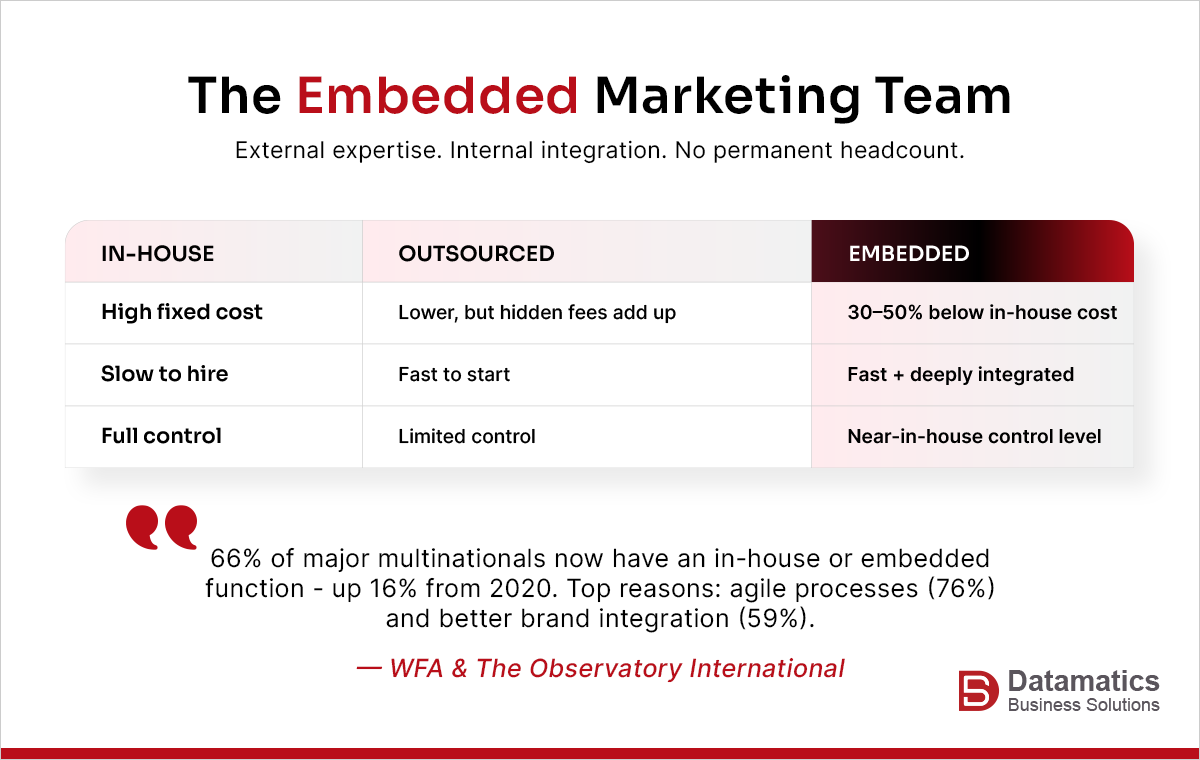
According to the World Federation of Advertisers and The Observatory International, two-thirds of major multinationals now have an in-house or embedded marketing function — a 16% rise from 2020.
The reason cited most often? Quicker, more agile processes (76%) and better brand integration (59%). That is not a coincidence. That is the embedded model working.
The bottom line on embedded: You get dedicated expertise and near-in-house alignment without the overhead of permanent headcount. For B2B companies with complex messaging needs and lean internal teams, this is often the model that actually moves the needle.
Why Build an In-House Marketing Team?
If budget is not your primary constraint and you need consistent, high-volume marketing output over the long term, building in-house is a legitimate strategy.
It makes sense when your marketing output is high-frequency and deeply brand-specific. When you are in a regulated industry where handing work to external vendors creates compliance risk. When your product is technically complex enough that building real knowledge takes months, not weeks. And when you need full ownership of your data, creative assets, and campaign IP.
The ANA’s In-House Agency Report found that 88% of companies with in-house teams saw their workload increase and 67% said it increased “a lot.” That tells you something. When companies commit to building internal capacity, they use it.
But here is the thing no one says out loud. Building the right team from scratch takes time.
Typically, six to twelve months before a new hire is genuinely productive in a complex B2B environment. And hiring is only the first part.
Onboarding, knowledge transfer, team culture — all of that takes longer than most marketing leaders account for when they are making the case to the CFO.
Key Takeaway
If you have the budget, the patience, and the volume to justify it — build in-house. If any of those three are uncertain right now, keep reading.
Why Companies Choose an Outsourced Marketing Team?
Outsourcing is not a sign that a company has not figured out its marketing. For a lot of businesses, it is a deliberate, strategic call.
It makes sense when you need to move fast and cannot wait three to four months to hire and onboard. When you have a specific campaign need — a product launch, a geographic expansion, a demand generation push — that does not justify a permanent hire. When your internal team is strong on strategy but short on execution capacity. Or when you are a lean startup that needs breadth — design, copy, ads, analytics — without building each function from scratch.
The Gartner survey reported that agencies account for 23.3% of total marketing budgets across North American and European enterprises. That number has held steady even as more companies invest in internal capabilities. Most organizations are not choosing one or the other. They are running both, and trying to figure out where to draw the line.
The honest downside? When you work with multiple vendors, the costs stack up. And you often end up spending as much time managing agency relationships as you do on actual marketing. That is time your team is not getting back.
Key Takeaway
Outsourced teams work best as a short-to-medium-term play, or as a supplement to a lean internal team. Treating them as a permanent standalone solution is where it usually breaks down.
In-House vs Outsourced Marketing: The Real Cost Comparison
Cost is always the first thing that comes up in this debate. And the numbers people use are almost always incomplete.
When you hire in-house, you are paying salary, payroll taxes, benefits, equipment, software licenses, and the management overhead it takes to lead that team. A marketing team of five, fully loaded, can run between $600,000 and $900,000 a year for a mid-market B2B company in the United States. That is before a single dollar goes to campaigns.
Outsourced arrangements can look cheaper on paper. A content agency might charge $8,000 to $20,000 a month. A performance marketing firm might run $5,000 to $15,000 monthly plus ad spend.
But when you are paying multiple vendors across different functions, the bills stack up fast and the hidden costs of briefing, revision cycles, onboarding new teams, and managing deliverables are real, even if they do not show up on an invoice.
Embedded marketing sits in an interesting cost position. You are paying for a dedicated, integrated team without the overhead of full employment.
Typically, embedded arrangements run 30% to 50% below the fully loaded cost of equivalent internal headcount while keeping a higher degree of control and alignment than traditional outsourcing.
Several studies show that agencies now represent 23.3% of total marketing budgets, the third largest allocation. That is a significant spend. The question is whether you are getting proportional output.
Key Takeaway
The real cost of any model — in-house, outsourced, or embedded — includes overhead, management burden, and the time it takes to build context. Whatever the headline number looks like, those are the costs that usually catch people by surprise.
Which Model Gives You More Control?
Control is not just about approving content before it goes out. It is about how fast decisions get made, how well the team understands your brand’s nuances, and how quickly the work adjusts when the business shifts direction.
In-house wins here by design. Your team has direct access to leadership, product updates, sales feedback, and customer data. There is no communication lag. No account management layer filtering what gets shared. No agency keeping you at a distance from the people doing the actual work.
Outsourced teams, even the best ones, operate with structural distance. Briefs get written. Revisions happen. Feedback cycles slow things down. That is not a failure of any individual agency — it is just how vendor relationships work. You are one client among many, and the process is built around that reality.
The embedded model closes most of that gap. When your embedded team is in your project management tools, your planning meetings, and your internal conversations, the control dynamic starts looking much more like in-house than outsourced.
The difference is they bring specialized capability and an outside perspective that internal hires often take years to develop.
59% of companies that moved to in-house or embedded functions cited better brand integration as a top benefit. That is control showing up in real outcomes, not just org chart decisions.
Key Takeaway
In-house gives you the highest control. Outsourced gives you the least. Embedded sits close to in-house on the control spectrum when the integration is done properly.
How Datamatics Business Solutions Can Help
Datamatics Business Solutions works with B2B marketing teams that need more than a vendor. They need a working partner that understands their pipeline, their buyers, and their messaging well enough to actually function as part of the team.
The work spans demand generation, Account-Intelligence Based Marketing (AIBM), and data solutions. Rather than packaging services that get bolted on at the edge of a client’s operations, we integrate into existing marketing workflows. Our experts learn the brand voice, understand the target segments, and align with the sales team’s feedback loops from day one.
For marketing leaders navigating the in-house vs outsourced marketing decision, we offer an embedded model that provides dedicated capacity without the constraints of permanent headcount.
It is particularly useful for organizations that need to build or expand marketing functions quickly, whether for a campaign launch, a new market push, or a full content program buildout.
Clients get clear ownership of deliverables, measurable outputs tied to pipeline and revenue goals, and a team that adjusts as business priorities shift. The process is structured to minimize onboarding friction.
If you are evaluating whether to grow your in-house team, bring in outside support, or explore what an embedded arrangement could look like for your specific situation that is exactly the conversation we are built for.
Fill out the form here and our experts will get in touch with you.
To Conclude
The in-house vs outsourced marketing decision does not have a universal answer. It has a right answer for your business, at this stage, with this budget, and this team.
Most marketing leaders get stuck because they treat it as a permanent choice. It is not. The best marketing functions are built on honest assessments of what they actually need — not what sounds most sophisticated on a strategy deck.
Figure out where your gaps are. Build or buy accordingly. And revisit the decision as the business grows, because what works at $5M in revenue rarely works the same way at $50M.
Subscribe to our monthly newsletters to stay updated on the latest trends.
Frequently Asked Questions
1. Is in-house or outsourced marketing better for B2B companies?
Neither is universally better. In-house works well when you have consistent marketing volume, sufficient budget, and need deep brand alignment. Outsourced works when you need speed, specialized skills, or budget flexibility. Most B2B organizations end up running some version of both — keeping strategy in-house and outsourcing execution capacity where it makes sense.
2.What are the biggest risks of outsourcing marketing?
3. What is the difference between an embedded marketing team and a traditional agency?
A traditional agency works at a distance — delivering outputs against a brief, with formal approval cycles. An embedded team works inside your organization. They participate in planning meetings, use your internal tools, and build ongoing context about your business. The relationship is much closer to an internal hire than an external vendor, even though the people are not on your permanent headcount.
4. At what stage should a company consider building an in-house marketing team?
There is no strict revenue threshold. But most B2B companies start building meaningful in-house capacity once marketing spend consistently exceeds $500,000 annually and output volume is high enough to justify dedicated headcount. Before that point, the cost-to-output ratio often favours outsourced or embedded models.
5. Can embedded marketing replace an in-house team entirely?
For some organizations, yes. For others it works better as a complement to a lean internal team. The embedded model works best when there is at least one internal stakeholder — a marketing lead or CMO — who owns strategy and direction. The embedded team then carries execution, content production, demand generation, and campaign management without putting that burden back on the internal person.
6. How do I evaluate whether outsourced marketing is actually working?
Look past the vanity metrics. Strong outsourced marketing shows up in qualified pipeline growth, sales-accepted leads, content that the sales team actually uses, and measurable engagement from target accounts. If your external team cannot clearly tie their work to pipeline or revenue conversations, that is a problem worth addressing directly — not something to let sit.

Paul van de Kamp