















Sales and marketing are running campaigns on a database they built two years ago. Reps are calling numbers that are no longer in service. Nurture emails are bouncing because half the contacts have changed jobs. The lead scoring model is making decisions based on firmographic data that has not been touched since the original import.
Nobody is asking the hard question: is this data still accurate?
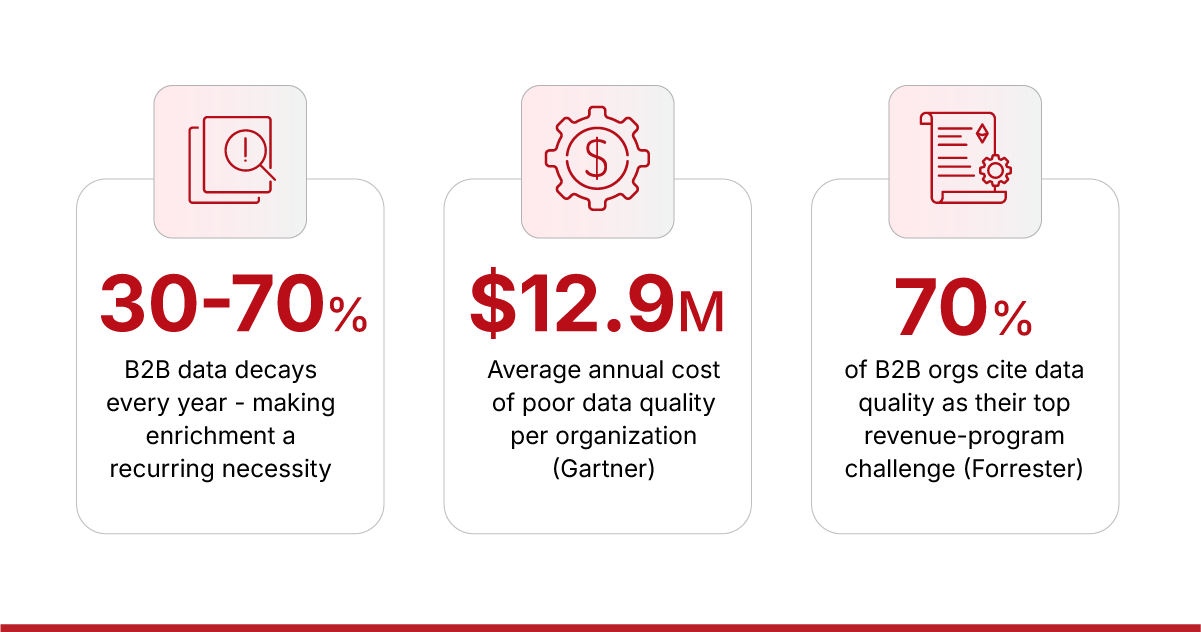
They probably should be. According to Gartner, poor data quality costs organizations an average of $12.9 million per year. And B2B data decays faster than most teams account for — job titles change, companies restructure, people move on.
That is where data enrichment comes in. Not as a one-time cleanup project, but as an ongoing discipline that keeps your commercial data reliable, relevant, and ready to use.
This guide covers what data enrichment actually is, how it works, when you need it, and how to pick the right data enrichment provider for where your business is today.
What Is Data Enrichment?
Data enrichment is the process of adding missing, updated, or supplementary information to your existing records. You take what you already have — a contact name, a company, maybe an email — and you fill in the gaps with verified, accurate data from external sources.
Those gaps might include job titles, direct phone numbers, LinkedIn profiles, technographic data (what tools a company uses), firmographic data (company size, industry, revenue), or intent signals (whether a company is actively researching a product like yours).
The goal is simple. You want your data to tell you more about a prospect or account than you could gather on your own, without requiring your team to manually research every record.
Data enrichment is different from data cleansing, though the two often work together. Cleansing removes inaccurate or duplicate records. Enrichment adds information that was never there to begin with, or replaces stale data with current, verified details.
Key Takeaway
Data enrichment adds verified, up-to-date information to your existing records so your sales and marketing teams are working with a complete, accurate picture of every contact and account.
Why Does Data Enrichment Matter in B2B Marketing?
The answer is straightforward: incomplete or outdated data leads to bad decisions.
When your CRM has patchy contact records, your sales team makes calls blind. When your firmographic fields are empty, your segmentation falls apart. When your lead scoring runs on incomplete data, you send high-priority accounts to the bottom of the queue and waste time chasing low-fit leads who look good on paper.
The importance of data enrichment becomes clear when you look at how fast B2B data decays. Sirius Decisions has reported that B2B data decays at a rate of 30% to 70% per year, depending on the industry. That means in 12 months, up to seven out of every ten records in your database could be partially or fully inaccurate.
For demand generation teams, this matters because targeting depends on accurate segmentation. For SDR teams, it matters because time spent chasing wrong numbers or outdated decision-makers is time not spent closing. For ABM teams, it matters because personalization fails the moment your account data is wrong.
And the broader commercial impact is real. IBM estimates that poor-quality data costs the US economy around $3.1 trillion annually.
The benefits of data enrichment are not just about having cleaner records. They are about building a data foundation that makes every downstream commercial activity — from campaign targeting to pipeline forecasting — more reliable.
Key Takeaway
B2B data decays at 30–70% annually. Without regular data enrichment, your campaigns, outreach, and segmentation are built on a foundation that is actively crumbling underneath you.
How Does Data Enrichment Work?
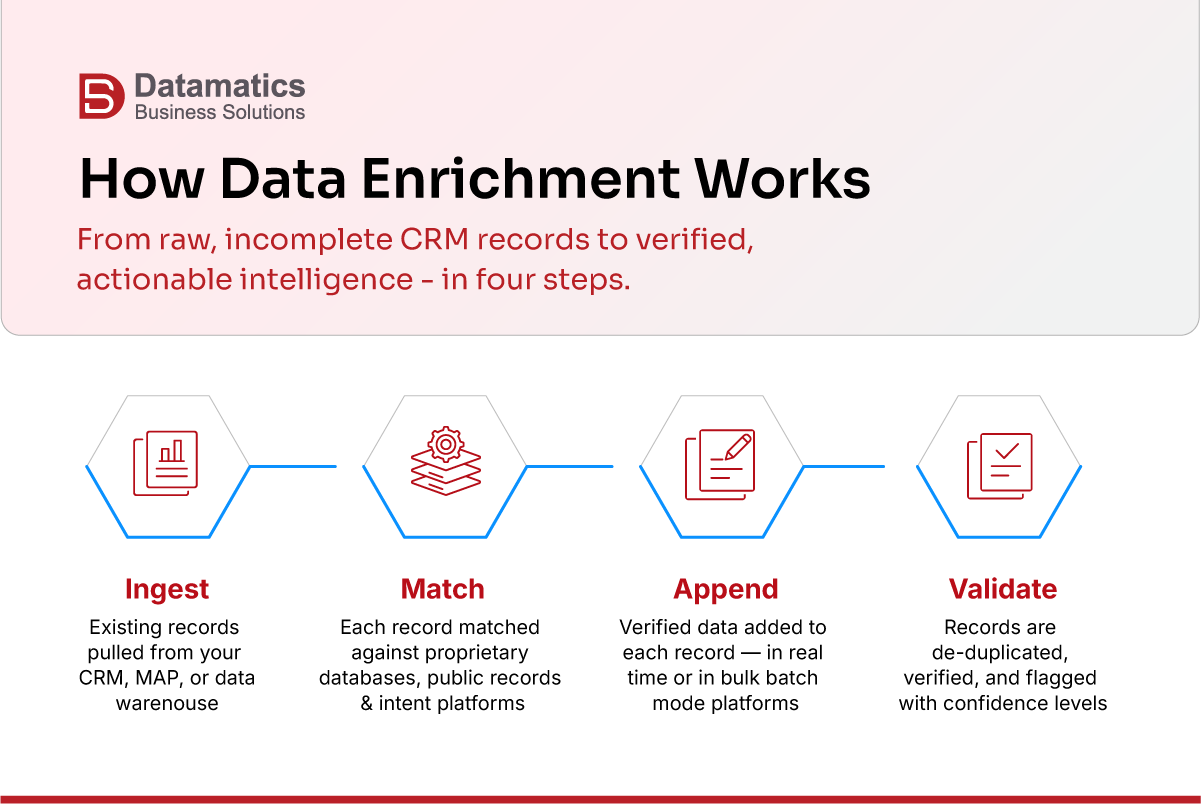
The process varies depending on the provider and the type of enrichment you need. But at a high level, most data enrichment services follow a similar pattern.
First, your existing records are ingested — pulled from your CRM, MAP, or data warehouse. Then, each record is matched against one or more external data sources. Those sources might include proprietary databases, public records, professional networks, web crawls, third-party data partnerships, or intent data platforms.
Once a match is found, verified information is appended to the record. The enrichment might happen in real time (as a new lead comes in) or in batch mode (processing a full database at set intervals). Most modern data enrichment providers offer both options.
The specific data enrichment techniques used depend on what you are trying to add. Contact enrichment adds personal professional data like email, phone, and job title. Account enrichment adds company-level information like revenue, headcount, tech stack, and buying signals. Intent enrichment layers in behavioral data — which topics an account is researching and how actively.
After enrichment, records go through a validation step. A good provider does not just append data. They verify it, de-duplicate it, and flag confidence levels so you know how reliable each field is.
Key Takeaway
Data enrichment works by matching your existing records against verified external sources and appending accurate, current information — either in real time or in batch — so your database reflects the real state of your prospects and accounts.
What Are the Main Data Enrichment Techniques?
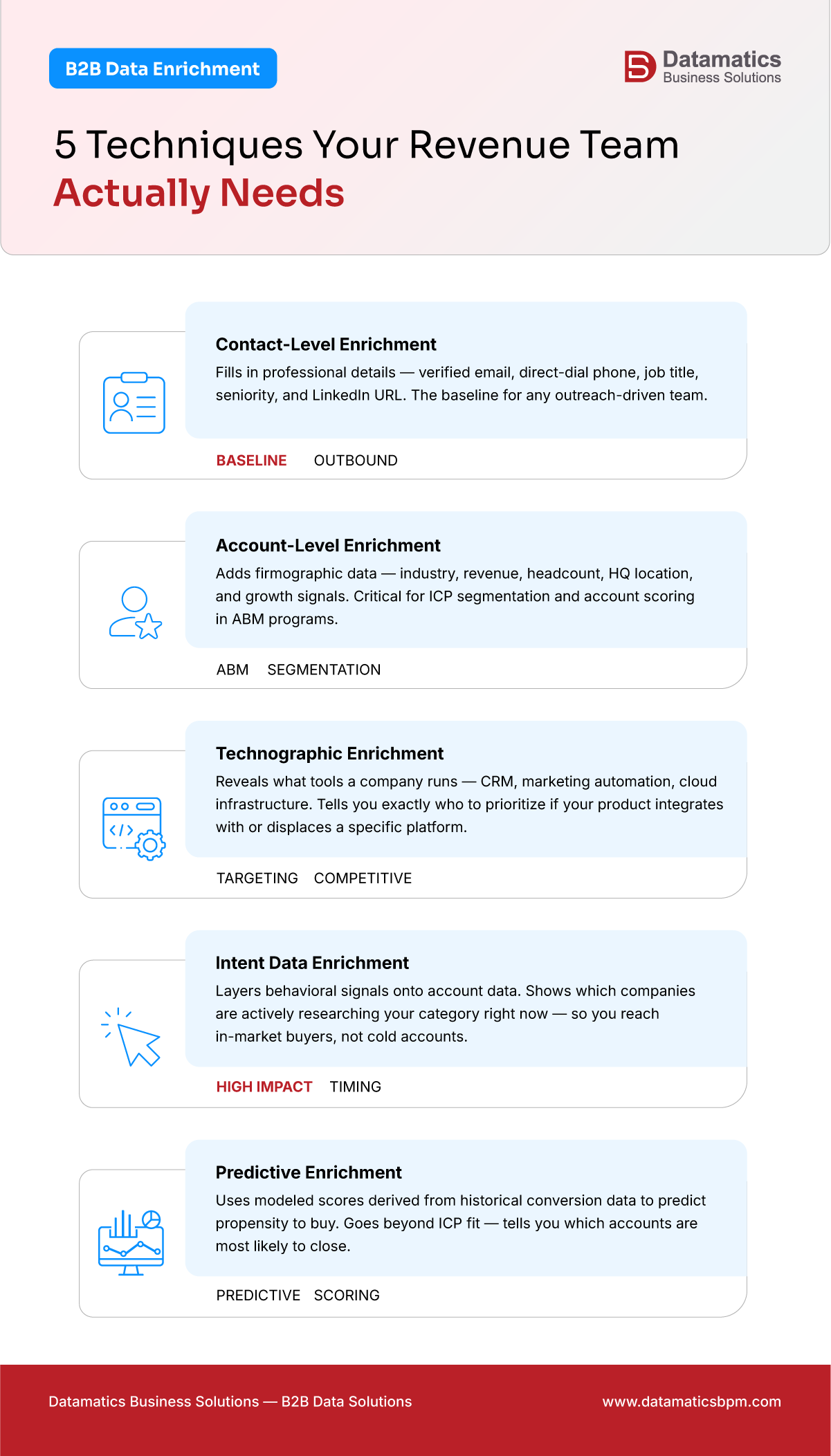
Different businesses need different kinds of enrichment. Here are the main data enrichment techniques used in B2B settings.
Contact-Level Enrichment
This fills in the professional details of individual contacts. Think verified business email addresses, direct-dial phone numbers, current job titles, seniority levels, and LinkedIn URLs. This is the baseline for any outreach-driven team.
Account-Level Enrichment
This adds firmographic data at the company level. Industry classification, annual revenue, employee headcount, HQ location, subsidiary relationships, and growth signals. Critical for segmentation and account scoring in ABM programs.
Technographic Enrichment
This tells you what technology a company is using. CRM platform, marketing automation tools, cloud infrastructure, analytics stack. If your solution integrates with or displaces a specific tool, this data tells you exactly who to prioritize.
Intent Data Enrichment
This layers behavioral signals on top of firmographic data. Which accounts are actively researching topics related to your product category right now? Intent enrichment helps you time outreach to accounts that are already in-market, rather than trying to create demand from scratch.
Predictive Enrichment
Some providers now offer predictive attributes — scores or signals derived from modeling historical conversion data against enriched firmographic and behavioral inputs. This tells you which accounts have the highest propensity to buy, not just which ones match your ICP on paper.
Key Takeaway
The right data enrichment technique depends on your use case. Contact enrichment is essential for outreach. Account enrichment drives segmentation. Technographic and intent enrichment are game-changers for ABM and demand generation teams.
You can also read: Customer Data Enrichment- A Roadmap for Implementation and its Impact
When Does Your Business Actually Need Data Enrichment?
The honest answer: most B2B companies need it far more frequently than they currently do it. But there are specific moments when the need becomes urgent.
- Before a major campaign launch — If you are about to invest budget in outbound, advertising, or ABM, run enrichment first. Bad data going into a campaign does not get fixed by good creative.
- After a CRM migration — Data gets shuffled, de-normalized, or dropped during migrations. Enrichment restores what was lost and fills structural gaps in the new system.
- When lead-to-opportunity conversion drops — If your pipeline velocity is slowing down without an obvious cause, data quality is often the culprit. Reps are burning time on contacts who have moved on.
- Before a sales territory realignment — Account and contact data needs to be current before you reassign ownership or restructure coverage models.
- During an ICP refinement exercise — If you are redefining your ideal customer profile, you need enriched data to properly segment your existing database against the new criteria.
- As a scheduled discipline — The most sophisticated revenue teams do not wait for a pain point. They run enrichment on a quarterly or rolling basis to prevent decay from accumulating.
Key Takeaway
Data enrichment is not a one-time fix. The most effective approach is to build it into your operational calendar so data quality does not silently erode between campaigns.
How Do You Choose the Right Data Enrichment Provider?
This is where most teams get stuck. The market for data enrichment companies is crowded, and vendors tend to sound similar until you start asking specific questions.
Here are the things that actually matter when you are evaluating a data enrichment provider.
Data coverage and depth
Does the provider cover the geographies, industries, and seniority levels you care about? A provider with strong North America coverage might have thin data for APAC or EMEA markets. Ask to see match rates for your actual target segments before signing anything.
Verification methodology
How does the provider verify the data they append? Human verification, automated validation, third-party confirmation? Unverified data can cause as many problems as no data. Look for providers who are transparent about their verification process and can share accuracy benchmarks
Real-time versus batch enrichment
Do you need enrichment at the point of lead capture, or are you running bulk updates on an existing database? Some providers specialize in one or the other. Many businesses need both.
Integration with your existing stack
The best enrichment in the world is useless if it cannot reach your CRM, MAP, or CDP. Check native integrations and API documentation before you commit.
Compliance posture
With GDPR, CCPA, and evolving regional data regulations, your data enrichment provider needs to process and store data in a compliant way. Ask directly about their legal basis for data collection and how they handle deletion requests.
One of the most referenced data enrichment companies in the B2B space includes Datamatics Business Solutions. But the right choice depends on your market, your tech stack, and whether you need contact enrichment, account enrichment, or a combination. According to a Forrester report, 70% of B2B organizations say data quality is their top challenge when it comes to executing revenue-generating programs.
Key Takeaway
Evaluate data enrichment providers on match rates, verification methodology, integration capability, and compliance posture — not just on brand name or sales pitch.
How Datamatics Business Solutions Can Help with Data Enrichment
We work with B2B organizations that are serious about data quality as a commercial asset, not just an IT project.
Our data enrichment service is built around three principles: accuracy, relevance, and operationalization. That means we do not just append data fields. Our team builds enrichment processes that are tied to how your sales and marketing workflows actually run.
We combine proprietary data sources with multi-channel verification — phone, email, and web — to deliver enriched records with documented confidence levels. For clients running ABM programs, we add technographic and intent-layer enrichment to help identify accounts that are actively in-market for solutions like yours. For demand generation teams, we provide contact-level enrichment that feeds directly into segmented campaign lists, with verified business emails and direct-dial numbers ready for activation.
What separates us from a generic data vendor is the process depth. Every enrichment engagement begins with a data audit of your existing records — identifying where decay is concentrated, which segments have the most coverage gaps, and where the highest-value enrichment opportunities sit. The enrichment is then prioritized around your revenue objectives, not just applied uniformly across a database.
We also work within your existing tech stack. Whether you run Salesforce, HubSpot, Marketo, or a custom CRM environment, the enriched data is delivered in a format and structure that integrates cleanly without requiring your team to do significant manual work on the backend.
If your organization is dealing with high bounce rates, low SDR connect rates, or ABM campaigns that are not reaching the right decision-makers, it is worth having a conversation about what your data is actually telling you — and what it is missing.
Get in touch with us for more information on our data enrichment services.
The Bottom Line on Data Enrichment
Bad data is not just an operational inconvenience. It is a revenue problem.
Every campaign you run, every account you target, every SDR sequence you build — all of it sits on top of your database. When that database is incomplete, outdated, or riddled with gaps, you are not just wasting budget. You are making strategic decisions based on a version of reality that no longer exists.
Data enrichment fixes that. Not by magic, and not overnight. But through a disciplined, repeatable process that keeps your contact and account data aligned with how your market actually looks right now.
The companies getting the most out of data enrichment in 2026 are not the ones who ran it once and called it done. They are the ones who built it into their quarterly rhythm, tied it directly to their pipeline goals, and treated data quality as a commercial function — not an IT ticket.
If your outreach connect rates are dropping, your campaign targeting feels off, or your ABM plays are not reaching the right people, the answer is probably sitting in your CRM. Specifically, in all the fields that are empty, wrong, or three years out of date.
Start there.
Subscribe to our newsletter to get informative blogs delivered to your inbox.
Frequently Asked Questions About Data Enrichment
1. What is the difference between data enrichment and data cleansing?
Data cleansing removes inaccurate, duplicate, or incomplete records from your database. Data enrichment adds new information — verified details that were missing or have become outdated. In practice, most data quality programs run both processes together, since cleansing without enrichment still leaves you with incomplete records.
2. How often should a B2B company run data enrichment?
At a minimum, quarterly. High-velocity sales teams or those running active ABM programs often run enrichment monthly or on a rolling basis as new leads enter the system. The right frequency depends on how fast your target market moves and how critical data accuracy is to your pipeline.
3. What types of data can be enriched in a B2B database?
Contact data (email, phone, job title, seniority), account data (revenue, headcount, industry, location), technographic data (tech stack), intent signals (research behavior), and predictive scores. Most data enrichment services offer some combination of these, with different providers stronger in different areas.
4. Is data enrichment GDPR compliant?
It can be, but this depends entirely on the provider and their data collection methodology. Reputable data enrichment companies operate with clearly defined legal bases for data processing and can provide documentation on their compliance posture. Always ask a prospective provider directly about GDPR, CCPA, and any region-specific regulations relevant to your target markets before you sign a contract.
5. What is a realistic match rate for data enrichment?
Match rates vary by segment, geography, and the type of data being enriched. Contact enrichment for North American mid-market companies typically sees match rates of 70% to 90% with quality providers. Rates can be lower for APAC markets, SMB segments, or niche industries where data coverage is thinner. Ask any prospective provider to run a sample match against your actual database before committing.
6. How does data enrichment support ABM programs?
ABM depends on knowing exactly who your target accounts are, who the key stakeholders are within those accounts, and what signals indicate buying intent. Data enrichment provides the firmographic depth to build proper account tiers, the contact-level detail to reach the right decision-makers, and intent signals to time outreach when an account is actively researching solutions in your category. Without quality enrichment, ABM personalization is built on assumptions rather than evidence.

James Libera