


A vendor can lose a deal without ever knowing a deal existed. Somewhere in a private Slack channel, a buyer asks a peer for an honest opinion, gets it, and moves on with the shortlist already narrowed. No form gets filled. No alert reaches the CRM.
Exchanges like these sit inside what marketers call the dark funnel. This is the stretch of buying activity that shapes a shortlist long before anyone visits a website. AI has only widened this blind spot. Buyers now put the same question to ChatGPT or Gemini that they once put to a peer. For the most part, this conversation stays just as invisible to a dashboard.
This blog looks at what the dark funnel is and how marketers can navigate it in a buying landscape increasingly shaped by AI-assisted research.
What is the dark funnel?
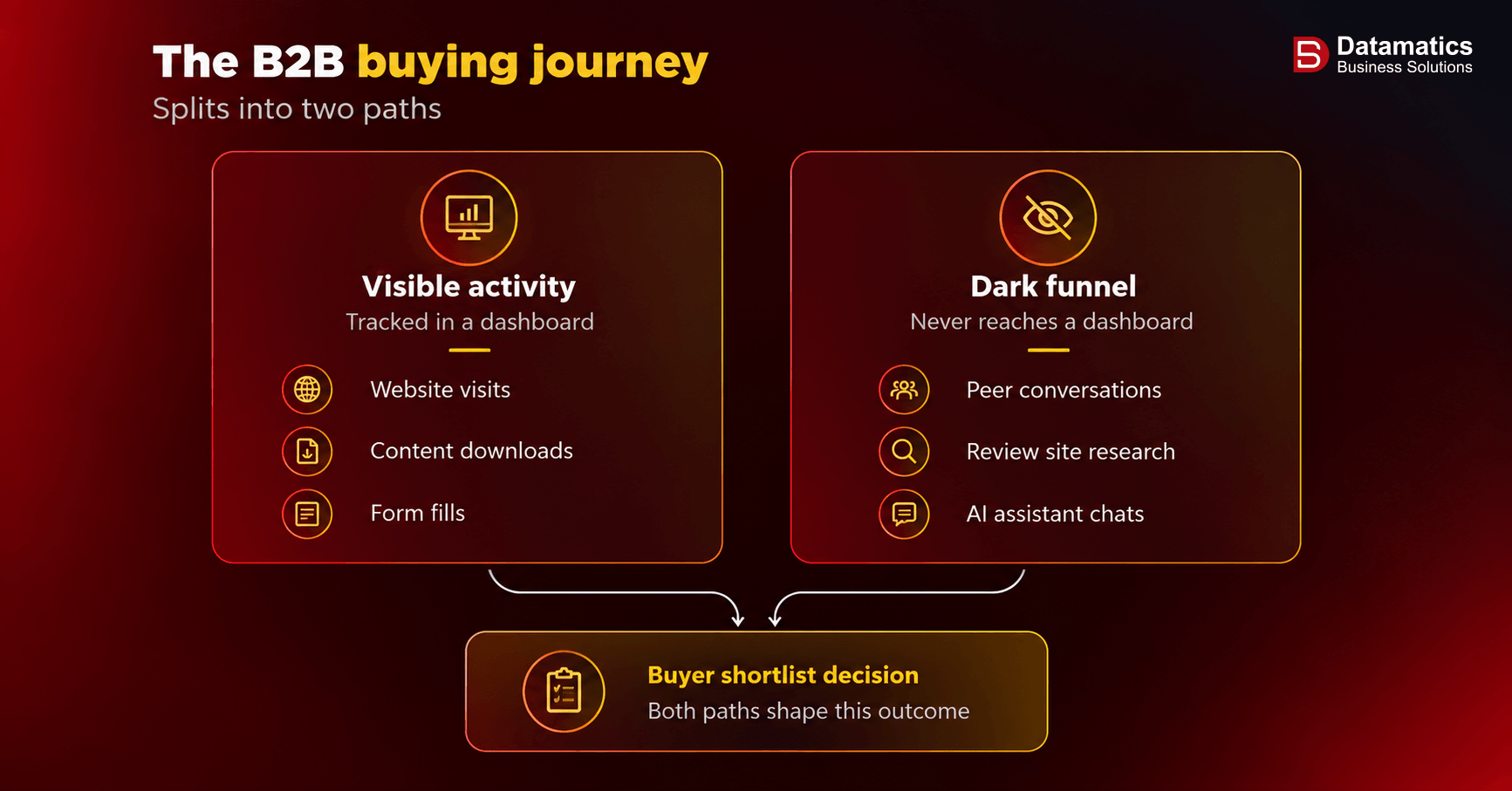
A buyer weighing a new vendor rarely starts with a phone call anymore. They ask a colleague what they think, skim a few reviews, read a comparison someone posted in a private group, or type the question straight into ChatGPT. None of it touches a CRM. All of it decides who makes the shortlist.
That is the dark funnel: research, conversation, and opinion-forming that happens entirely off a vendor’s radar. It used to mean peer chats and review sites. Now it includes a buyer asking an AI assistant to size up two competitors before either company knows the deal exists.
Marketing systems were built to watch website visits, downloads, and webinar sign-ups. Buyers moved on. Most of their research now happens well before any of those actions take place, whether through a peer, a review site, or a quick prompt to ChatGPT or Gemini.
Buying committees have never had this many independent sources to consult, and they use nearly all of them before a vendor knows a deal is even underway. AI tools have only added to that list, giving buyers a fast, low-friction way to sense-check a vendor without picking up the phone.
For marketing and revenue teams, this gap comes with a real cost to visibility. Budgets tend to follow the channels a dashboard can show, while the channels actually shaping buyer preference, peer chatter, reviews, and now AI-assisted research, receive only a fraction of that investment.
- KEY TAKEAWAY
The dark funnel, now stretched further by AI-assisted research, is where B2B buyers actually form their preferences, largely invisible to standard attribution tools.
Why the dark funnel matters for B2B demand generation
Buying groups now spend the bulk of their journey researching independently, and vendor contact happens only after most decisions have hardened. According to Gartner, B2B buyers spend only 17% of their total purchase time meeting with potential suppliers, and time with any single vendor drops to 5 or 6%.
That leaves a substantial share of the journey, the dark funnel, taking place away from any vendor’s direct view. Research from 6sense supports a similar pattern. Its 2025 Buyer Experience Report found that buying groups now split their journey close to 60% independent research to 40% seller engagement, and in 95% of purchases, the vendor buyers selected was already on their shortlist on day one.
Deal stalls are the clearest symptom. In Forrester’s State of Business Buying, 2024 report, 86% of B2B purchases stalled somewhere in the process, and late engagement with buying groups is a common reason why.
Buying group complexity compounds the challenge. A typical buying group for a complex B2B solution involves 6 to 10 decision makers, each gathering information independently and reconciling it with the rest of the group.
For demand generation teams, these figures carry a practical implication. Pipeline quality and deal velocity depend increasingly on activity that happens well ahead of any inbound form or outbound call, which places a premium on visibility, not just volume.
- KEY TAKEAWAY
The dark funnel shapes the outcome of most B2B deals. Demand generation strategies built around form fills often engage buyers after the decision has largely formed.
Benefits and challenges of the dark funnel for B2B marketers
A buyer who has already read reviews and asked a peer for an opinion walks into a sales conversation further along than one starting from zero.
Increasingly, that buyer has also asked an AI assistant to compare two or three vendors first. That head start is the main upside of the dark funnel. Trust gets built before a vendor says a word, and a strong review, a well-ranked comparison page, or a piece of content an AI assistant pulls from keeps working long after it goes live, with no extra budget required.
The same channels that build this trust are the ones a vendor cannot see or steer. A CRM will not show which peer conversation tipped a decision. There is no way to correct an outdated review the moment it goes stale. AI assistants raise the stakes further. A vendor has no visibility into what ChatGPT or Gemini told a buyer about them, and no way to correct it if the summary drew from an outdated page or a competitor’s framing.
Sales teams can also end up chasing a deal that looks brand new in the pipeline, when in reality a buying group already spent weeks forming an opinion elsewhere, AI assistants included.
Benefits:
- Buyers reach sales conversations more informed and closer to a decision
- Peer, review, and AI-assisted research builds trust vendor content cannot manufacture alone
- Strong, well-sourced content keeps generating influence long after it is published, including inside AI-generated summaries
Challenges:
- Attribution breaks down, since most of the activity leaves no trace
- Vendors lose the ability to correct outdated or inaccurate mentions, whether on a review site or inside an AI assistant’s answer
- Sales can misread pipeline origin when a deal surfaces late in the process
Getting either side wrong costs a vendor a shot at a deal it never even knew was in play.
- KEY TAKEAWAY
B2B dark funnel activity favors peer validation, so visibility depends on tracking indirect signals alongside direct engagement.
Where B2B dark funnel activity actually happens
Dark funnel activity spreads across several channels, most of them outside a vendor’s direct reach:
- Peer conversations and referrals within professional networks
- Private community and forum discussions, including Slack channels and industry groups
- Review platforms such as G2 and Capterra
- Anonymous content consumption, including whitepapers, podcasts, and video
- Links and recommendations shared through private, unmeasured channels
Buyers value these sources for the independent judgment they provide, which strengthens confidence alongside vendor messaging. A buying group member consulting a peer or a review site is seeking validation drawn from real, first-hand experience.
This pattern holds across company size and industry. Even in highly technical categories, buying committees still lean on informal networks to sense-check vendor claims before those claims reach a formal evaluation stage.
Content format plays a role too. Long-form guides, comparison content, customer stories, and analyst commentary all circulate through these channels independently of a vendor’s own distribution, often reaching stakeholders a sales team has never directly engaged.
For B2B dark funnel visibility, marketing teams benefit from signals beyond the CRM. Intent data, review platform activity, and content engagement patterns offer measurable proxies for behavior happening in these channels, giving demand generation teams a fuller picture of account-level interest.
Large language models have added a new layer to this pattern. The 6sense 2025 Buyer Experience Report found that 94% of B2B buyers now use large language models at some stage of their purchase journey. They often use LLMs to compare vendors or summarize reviews well before any direct contact with a sales team.
- KEY TAKEAWAY
B2B dark funnel activity favors peer validation, so visibility depends on tracking indirect signals alongside direct engagement.
Building a dark funnel marketing framework
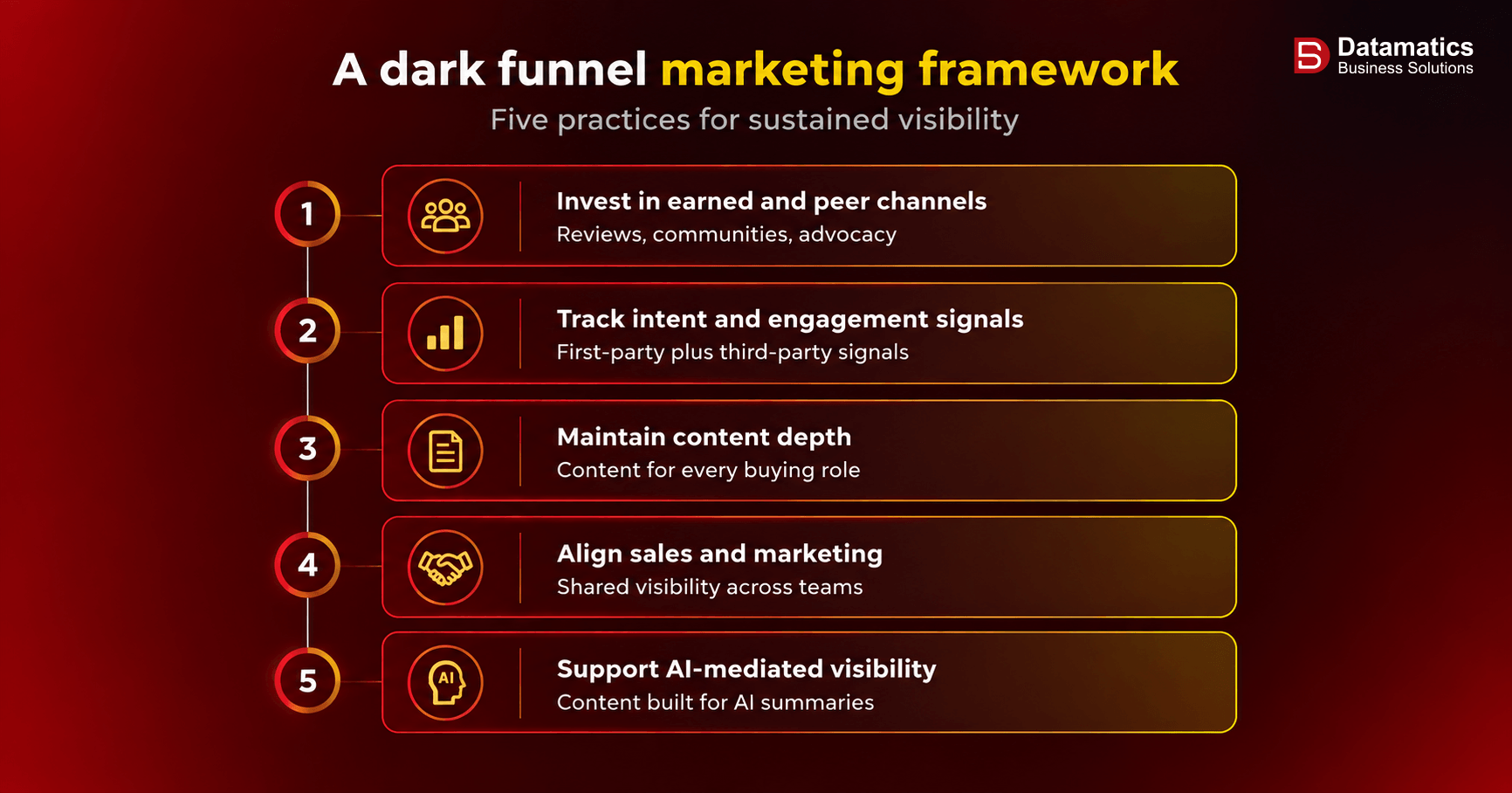
Influencing the dark funnel calls for a shift from lead capture toward sustained presence across the channels buyers already trust. A vendor that only shows up once a form gets filled has already missed most of the conversation. A structured approach to dark funnel marketing rests on a few core practices, each addressing a different part of the buying journey a CRM cannot see.
1. Invest in earned and peer channels
Nothing convinces a buyer faster than a review left by someone with no reason to lie. Vendor content cannot buy that kind of trust. It gets earned through steady presence in the communities buyers already frequent, and a customer advocacy program gives satisfied customers an easy way to speak up on a brand’s behalf. Buyers notice the difference between a brand that shows up only when it wants something and one that has actually stuck around.
2. Track intent and engagement signals
An account can be deep into research on a category weeks before anyone on that team visits a vendor’s website. First-party data alone will not catch this. Pairing it with third-party intent signals, such as review platform activity or a spike in category-level searches across a buying group, gives sales a reason to reach out before a single lead raises a hand.
3. Maintain content depth across the buying journey
Buying groups consult multiple pieces of content across several roles and functions, from technical evaluators to budget owners. Comprehensive, well-structured content needs to speak to each of these roles, not just the one contact who happened to fill out a form. A single generic asset rarely holds up across a group with six to ten different priorities in the room.
4. Align sales and marketing around shared visibility
Gartner found that only 17% of surveyed sales and marketing leaders collaborate on buyer journey mapping. Most organizations end up working from two different pictures of where their buyers really are. Marketing keeps funding the channels a dashboard happens to show, and sales keeps chasing leads that show up late, well after most of the decision has already formed elsewhere. A joint review of where deals genuinely start, not just where they get logged, tends to close that gap faster than any new tool.
5. Support visibility in AI-mediated research
A buyer now might ask an AI assistant to compare two vendors before ever reading a review or talking to a peer. Whatever that assistant says about a brand depends on the content it can actually find and parse: structured pages, clear claims, sourced numbers. Content built to persuade a human reader does not automatically read the same way to a model. Writing for both audiences at once is becoming as necessary as writing for search ever was.
Applied together, these five practices move demand generation away from a model built solely around capturing visible leads. They build toward one designed for sustained visibility, wherever buyers happen to be researching, human or AI-assisted.
- KEY TAKEAWAY
Dark funnel marketing depends on earned credibility, layered intent data, cross-team alignment, and content built for AI-mediated research, working together rather than in isolation.
How Datamatics Business Solutions supports dark funnel visibility
Datamatics Business Solutions works with B2B organizations to build visibility into the buyer behavior most tracking systems miss entirely. That starts with verified B2B data, paired with intent signals that flag when an account is actively researching a category. Marketing and sales teams use this combination to spot buying groups earlier, sometimes weeks before a form ever gets filled. Account prioritization gets sharper as a result, and sales and marketing start working from the same picture instead of two different ones. Pipeline numbers begin to reflect activity that used to sit entirely outside attribution, which is often where deals actually get won or lost.
- FAQS
Frequently asked questions
1. What is the dark funnel in B2B marketing?
The dark funnel covers everything a buyer does to evaluate a vendor away from any tracking system: a peer conversation here, a private community thread there, research nobody logs anywhere. By the time a vendor gets contacted, most of the decision has usually already taken shape.
2. Why do vendors struggle to track the dark funnel directly?
Analytics tools are built to catch clicks, form fills, and page visits, not a conversation happening in a private Slack group or a recommendation passed along outside any measurable channel. If it never happens on a tracked surface, it never shows up in a CRM.
3. How does the dark funnel differ from dark social?
Dark social is one piece of it, specifically content shared through private channels like messaging apps or email. The dark funnel is the larger picture: dark social plus every peer conversation, community discussion, and quiet bit of research that shapes a buyer’s opinion before a vendor ever finds out.
4. Can B2B marketers measure dark funnel activity?
Direct measurement stays out of reach, though a few signals come close. Intent data and review platform activity are the most reliable proxies, and how deeply an account engages with content adds another layer worth watching for accounts that are actively in-market before anyone raises a hand.
5. How should demand generation strategy respond to the dark funnel?
Lead capture alone will not cut it anymore. Demand generation strategy needs a real presence in the places buyers already trust: peer review platforms, industry communities, wherever the research actually happens. Paired with intent signals and closer coordination with sales, that presence turns into earlier conversations instead of leads that show up already decided.