
Your next conference is six weeks away. Registrations are below target, sponsors want access to more relevant attendees, and your sales team is still checking whether contacts hold the right roles. More outreach will not solve the problem if the underlying data is incomplete.
Data enrichment helps event organizers add verified professional and company information to existing records. These details can improve audience targeting and help sponsorship teams identify qualified prospects.
This guide breaks down the ROI of data enrichment for event organizers, with a financial model covering registration revenue, sponsorship sales, and enrichment costs. It also explains how to evaluate data enrichment services and measure their commercial impact.
Why event organizers need better data
For event organizers, data quality directly affects how well they can attract the right attendees and generate revenue from exhibitors and sponsors. A registration database may contain thousands of contacts, yet lack the professional and company details needed to identify high-value prospects.
Start by identifying where incomplete records affect registration campaigns, sponsorship sales, or post-event follow-up. The following will help you decide which data to enrich and how to measure the results.
1. Registration campaigns reach professionals outside the target audience
A trade show for industrial procurement teams needs attendees who influence supplier selection or purchasing decisions. If the organizer’s database contains only names and email addresses, the marketing team cannot reliably distinguish these professionals from contacts with limited relevance to the event. Campaigns may generate registrations, but sponsors receive fewer opportunities to engage with potential buyers.
Adding job titles, seniority, industry, and company details helps organizers segment their audiences according to exhibitor expectations. They can then measure registration conversion within priority segments and assess whether acquisition spending reaches the intended audience.
2. Sponsorship teams spend time researching prospects
An event organizer preparing its next sponsorship campaign may have a list of companies that match its target profile. However, the database may contain former employees or contacts who have no involvement in partnership decisions. Sales representatives must verify each account before they can identify the right person to approach.
Data enrichment services can update contact details and append relevant company information. Buying-group mapping can also help identify stakeholders involved in sponsorship decisions. This gives sales teams a more reliable starting point for prospect qualification and reduces the research required before outreach.
3. Post-event follow-up lacks the information needed to qualify leads
Badge scans show which attendees visited an exhibitor’s booth, but they may not indicate purchasing authority or company fit. An exhibitor selling enterprise software, for example, needs to distinguish a relevant decision-maker from an attendee who has no role in the buying process.
Enriching attendee records with current job titles and company attributes gives sales teams more context for qualification. Organizers can also help exhibitors assess lead quality by measuring the proportion of scanned contacts that match their target audience.
These examples point to a practical starting point: identify where incomplete records restrict registration targeting, sponsorship sales, or post-event lead qualification. The resulting data audit can establish which fields need enrichment and which performance metrics should be tracked to assess its commercial value.
5 ways data enrichment influences your event revenue
Data Enrichment can improve revenue across the event lifecycle, from attendee acquisition to exhibitor retention. Here are five ways enriched data can contribute to measurable financial gains.
1. Attracts more qualified attendees
Job titles, seniority, industry, and company size help organizers target professionals who fit the event’s audience criteria. Marketing teams can use these attributes to segment invitations and reduce spending on poorly matched contacts.
Higher conversion among qualified prospects can increase paid registration revenue. Track qualified registration rates and cost per qualified registration to measure the impact.
2. Generates more sponsorship revenue
Updated company profiles and verified decision-maker details help sponsorship teams identify relevant prospects. Buying-group mapping can reveal additional stakeholders involved in sponsorship decisions.
Better prospect qualification can create more opportunities to sell sponsorship packages. Measure qualified opportunities, close rates, and incremental sponsorship revenue.
3. Improves exhibitor renewals
Exhibitors invest in events to connect with potential customers. Enriched attendee profiles help organizers assess how closely the audience matches exhibitors’ target markets.
Organizers can use these insights to demonstrate audience quality during renewal discussions. Track exhibitor renewal rates and incremental renewal revenue to evaluate the impact.
4. Converts more event leads into sales
Badge scans often lack the company and professional details needed to qualify attendees. Enrichment adds context that helps sales teams prioritize contacts and match them to existing CRM records. Better qualification can help exhibitors follow up with relevant prospects sooner. Measure qualified opportunities generated from event leads and the revenue eventually attributed to them.
5. Reduces wasted event marketing spend
Duplicate records, invalid contact details, and outdated job information can lead to wasted outreach. Data cleansing and verification help organizers identify these issues before launching registration or sponsorship campaigns.
Removing unusable records can reduce avoidable campaign costs and manual research. Compare campaign expenditure and data preparation costs before and after enrichment to quantify the savings.
How to calculate the ROI of Data Enrichment
Calculating the ROI of Data Enrichment requires a clear baseline, a full cost estimate, and evidence of incremental financial gains. Organizers can use the following steps to assess whether enrichment delivers a positive return.
- Calculate the total investment: Include data enrichment services, implementation, and additional campaign costs. Account for internal staff time spent preparing or correcting records.
- Measure incremental revenue: Track additional paid registrations and sponsorship sales attributable to enriched data. Use baseline comparisons or control groups to support attribution.
- Quantify cost savings: Calculate reductions in wasted outreach and manual data preparation. Include only savings supported by actual expenditure or time records.
- Avoid double-counting benefits: If an existing sponsor upgrades its package, count the additional revenue from the upgrade, not the entire package value.
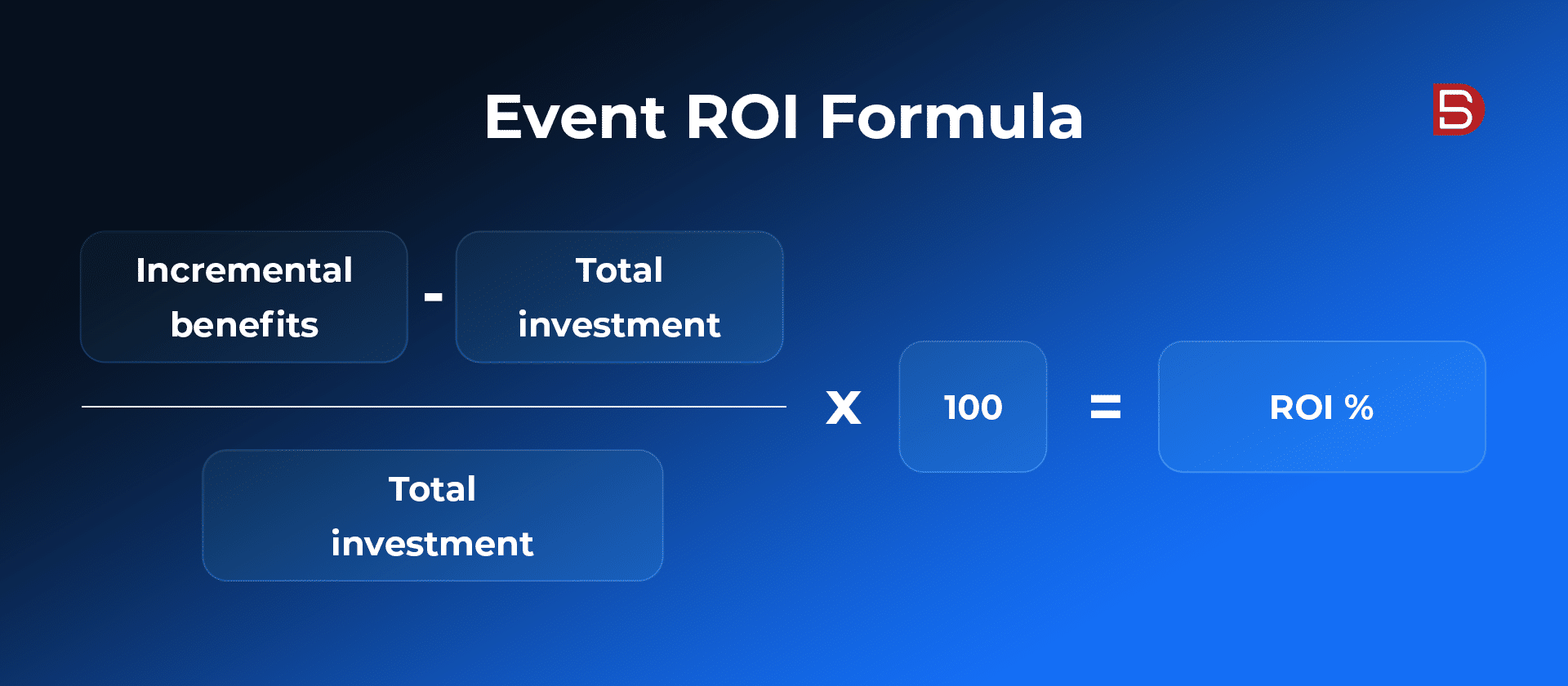
- Calculate net ROI: Subtract total investment from incremental benefits, divide the result by total investment, and multiply by 100.
Use this formula to calculate your event’s ROI:
For example, consider a B2B conference organizer that enriches a database of 5,000 contacts before launching its registration campaign. Assume registration conversion rises from 4% to 4.5%, generating 25 additional registrations. At $600 in net revenue per registration, these generate $15,000. Suppose the organizer also attributes $20,000 in additional sponsorship revenue to enrichment and verifies $3,000 in campaign cost savings. Total incremental benefits would reach $38,000.
Financial outcome | Amount |
|---|---|
Additional registration revenue | $15,000 |
Incremental sponsorship revenue | $20,000 |
Verified campaign cost savings | $3,000 |
Total incremental benefits | $38,000 |
Enrichment and implementation cost | $8,000 |
Net benefit | $30,000 |
Modelled net ROI | 375% |
These figures are illustrative assumptions, not an industry benchmark or our client result. The calculation assumes that all benefits are incremental, attributable, and non-overlapping. Organizers should validate conversion improvements against a suitable baseline or control group and substantiate sponsorship gains and cost savings before reporting the ROI.
Which event data should you enrich?
The priority fields depend on the event’s revenue model and audience requirements.
Data field | Application for event organizers |
|---|---|
Job title and seniority | Identify attendees who fit the event’s professional audience. |
Industry and company size | Segment invitations and qualify exhibitor prospects. |
Current role and verified contact details | Reduce outreach to former employees or invalid addresses. |
Company profile and organizational structure | Assess sponsor fit and identify relevant stakeholders. |
Historical attendance | Support re-engagement campaigns for future event editions. |
A trade show seeking qualified buyers may prioritize industry and job-role data. A sponsorship-led conference may place greater emphasis on company profiles and decision-making authority. Start with an audit of existing records. The audit should identify which missing fields prevent effective segmentation or prospect qualification. This gives the data enrichment process a defined scope and helps teams assess improvements after delivery.
How you can choose data enrichment services
Data enrichment services should address the specific gaps identified in the audit. A high volume of appended fields has limited value if the information is outdated or irrelevant to the target audience. Evaluate providers against the following four criteria:
- Field coverage: Can the provider supply the professional and company attributes your event requires?
- Verification: How does the provider validate current roles and company details?
- System compatibility: Can the enriched records be mapped to your CRM and registration platforms without extensive manual work?
- Measurement: Can you compare record completeness before and after enrichment and track subsequent campaign performance?
A good data enrichment process starts with a review of your existing records, followed by enrichment, validation, and delivery in a format your team can use. Ask providers where their data comes from, and what they do with records they cannot verify. If you operate in the US, check that the provider’s data sourcing and handling practices comply with applicable privacy requirements.
The bottom line
Data enrichment can support event revenue when improved records lead to measurable gains in registration performance or sponsorship sales. Organizers should establish a baseline, prioritize high-value data gaps, and compare attributable benefits with total costs.
The financial case depends on evidence, not database size. A focused enrichment initiative gives event teams a practical way to test whether better data can improve commercial performance.
Turn better event data into measurable revenue with Datamatics Business Solutions
Incomplete attendee records can weaken registration campaigns, limit sponsorship opportunities, and waste sales time. Datamatics Business Solutions provides data enrichment services for event businesses, including record verification, database cleansing, and sponsorship prospecting. DBSL supported an events company in the construction and oil and gas sectors, helping deliver 19,970 qualified attendees at one event in Korea and over 14,970 additional visitors within four months.
Ready to improve your event ROI? Talk to Datamatics Business Solutions to identify data gaps and discuss how enrichment can support your registration and sponsorship goals.
- FAQS
Frequently asked questions
1. What is the difference between content syndication companies and content syndication platforms?
The core difference comes down to execution: companies are managed-service partners, while platforms are self-service software. A content syndication company handles the audience targeting, lead validation, and campaign optimization for you. A platform gives you direct, self-service access to a distribution network to run campaigns yourself. Most enterprise teams lean toward managed services because they provide tighter quality control and manual reporting oversight.
2. How do I evaluate lead quality from a content syndication vendor?
3. What pricing model should I expect from B2B content syndication services?
You will almost always encounter Cost Per Lead (CPL) or Cost Per Qualified Lead (CPQL) models. While a standard CPL model is cheaper upfront, pricing fluctuates heavily based on how niche your targeting is. CPQL models demand a higher price per lead but filter out junk data before it hits your database, ultimately yielding much stronger downstream conversion rates and saving your sales team time.
4. How does content syndication fit into an ABM strategy?
Content syndication acts as a high-intent, top-of-funnel engine for Account-Based Marketing. Instead of spraying content across a broad audience, you hand your vendor a specific list of target named accounts and tiered buyer personas. The vendor then concentrates distribution strictly within those high-value accounts, accelerating engagement with the exact stakeholders your sales team is actively chasing.
5. What content formats perform best for B2B syndication?
High-value, educational assets always outperform product pitches. Original research reports, comprehensive whitepapers, and tactical “how-to” guides pull the highest engagement because enterprise buyers download them during their initial research phases. Webinar recordings and benchmark reports also convert well. Purely promotional or product-heavy content consistently underperforms because syndication audiences are looking to solve a problem, not sit through a sales pitch.