


Ask yourself a simple question. When did you last verify that the records feeding your pipeline forecast are actually true? Your CRM looks full. Your dashboards look healthy. Yet a quarter of the contacts you are forecasting against went stale in the last twelve months, and nobody flagged it. That is the reality behind most revenue systems. This piece lays out a practical way to measure the return on data cleansing services, so you can defend the spend with numbers instead of instinct.
The bill you are already paying and cannot see
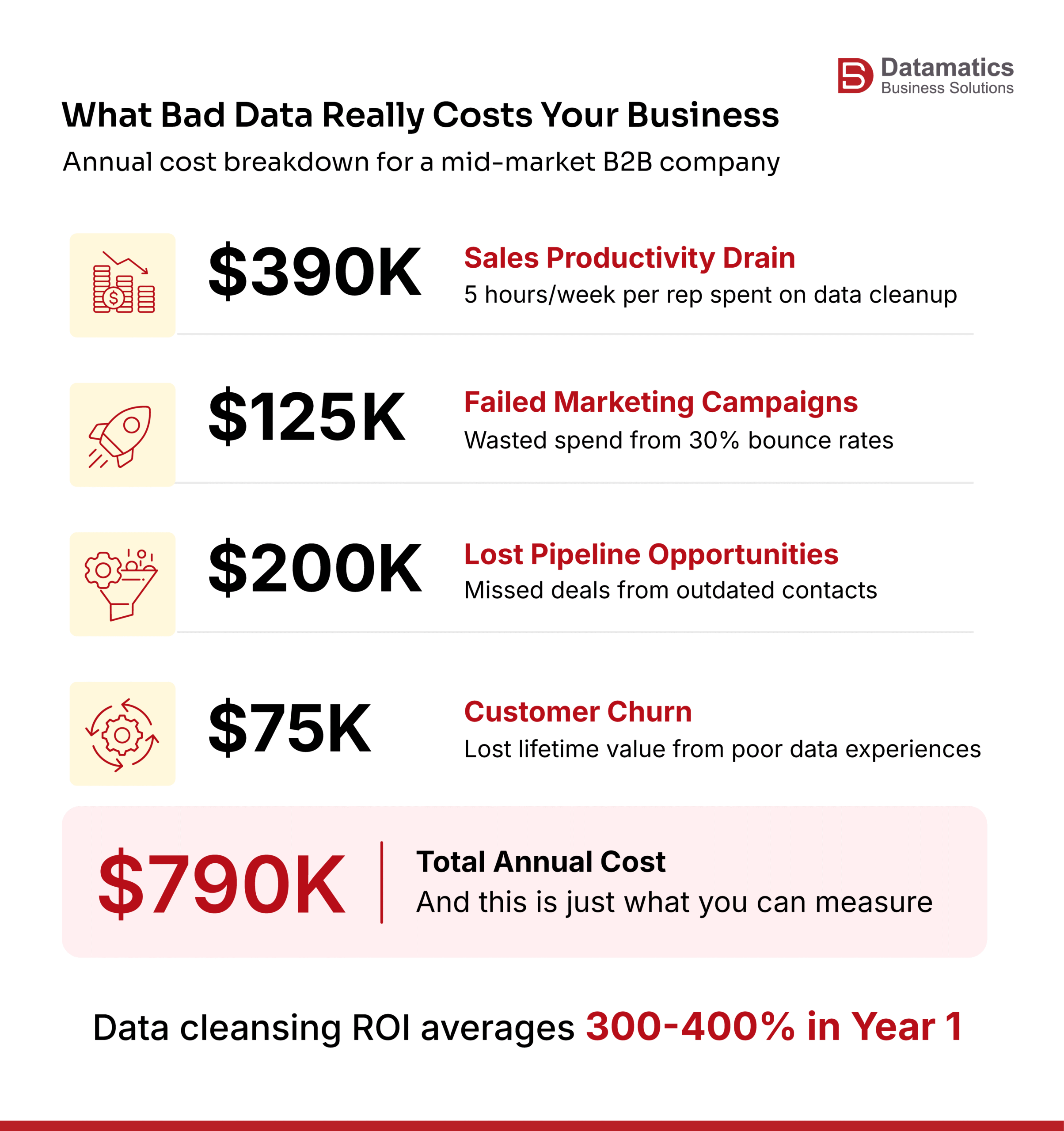
Bad data gets paid for whether or not anyone measures it. The cost hides in places finance does not label.
The most cited figure in the field puts the annual damage in the millions. Gartner’s estimate of $12.9 million per organization each year covers wasted resources, missed opportunities, and operational drag, and it describes data quality broadly rather than contact records alone. Treat that figure as a ceiling, not your specific number.
More recent operational data tells a sharper story. Validity’s 2025 State of CRM Data Management report, based on 602 CRM users across the US, UK, and Australia, found that 37% of organizations lose revenue directly because of poor data quality, and companies lose an average of 16 sales deals per quarter to unreliable data.
Isolating your exact dollar figure at the company level is difficult. Costs sit across sales, marketing, and operations, and no single line item reads “bad data.” Building a model that exposes the cost is what makes it visible.
- KEY TAKEAWAY
The Gartner figure is not your number, and treating it as one is how ROI conversations lose credibility with finance. The real work is building a company-specific model, because “bad data costs millions industry-wide” doesn’t get anyone a budget line
Why most teams never measure data cleansing ROI
Most teams never counted the cost of bad data in the first place, so the return has nothing to compare against.
Most leaders can quote their CAC to the dollar. Ask what a stale record costs them, and the answer is usually a shrug. That gap defines the problem. When the denominator is missing, the ROI of data cleansing services looks like a discretionary expense rather than a recovery of lost revenue.
A mirror-image mistake is worth naming as well. Some teams overcorrect and try to measure the accuracy of every field on every record. In practice, that effort burns more analyst hours than the cleanup ever recovers.
The goal is not perfect measurement. The goal is measuring the fields that drive revenue: email validity, title accuracy, account ownership, phone connectivity. Verify those relentlessly, and let the low-stakes fields age. A focused data cleansing process outperforms an exhaustive one that nobody can afford to sustain.
- KEY TAKEAWAY
Both failure modes come from the same root cause, no baseline. Teams either ignore the cost entirely or overcorrect into measuring everything, and both produce the same result, a program nobody can defend financially.
The four cost buckets a real ROI model has to capture
Break the cost of bad data into four buckets. Each one is measurable, and together they form the return side of the equation
Cost bucket | What it captures | How to size it |
|---|---|---|
Wasted rep time | Hours spent chasing dead contacts and fixing records | Bad records × minutes per attempt × loaded hourly cost |
Revenue leakage | Deals lost to misrouting, bad routing, missed timing | Lost opportunities × average deal value × close rate |
Wasted marketing spend | Sends to invalid emails, ad targeting on wrong personas | Bounce rate × cost per send + misdirected ad budget |
Decision risk | Forecasts and strategy built on distorted inputs | Hardest to quantify, largest in impact |
Wasted rep time is the easiest bucket to defend, and the numbers back it up. Research from ZoomInfo and Everstage puts the productivity loss at roughly 27% of a sales rep’s time, spent dialing disconnected numbers, chasing outdated contacts, and re-verifying details a clean database would have already confirmed.
Opportunity cost, the fourth bucket, is the largest and the hardest to prove with a clean number. Since a credible figure undermines the three solid ones, estimate it conservatively.
- KEY TAKEAWAY
Three of the four buckets are easy to defend and one is not, and the one that isn’t, decision risk, is also the largest. Most ROI pitches quietly drop the hardest bucket to avoid a messy number, which is exactly the wrong instinct if the goal is credibility.
Building your baseline before you touch a single record
Measure first, before cleaning anything. Without a baseline, the lift is never provable.Start small and structured. Begin with an audit of a sample of existing records to establish the baseline decay rate, then add real-time validation at entry, set a regular refresh cadence, apply trigger-based enrichment, and assign ownership over data quality.
Score the sample across three dimensions: accuracy (is the field true today), duplication (how many records describe the same person or account), and completeness (which revenue-critical fields are blank). Pull a random sample rather than the best-looking segment. Two hundred to four hundred records is usually enough to read a large database with confidence.
A baseline built on a flawed sample produces a confident but wrong ROI number. Cherry-picking recently touched records makes the database look healthier than it is, and the projected return collapses on contact with reality. Randomizing the pull and documenting the method keeps the number defensible to finance.
- KEY TAKEAWAY
The baseline is the whole argument. A number built on a cherry-picked sample doesn’t just weaken the case, it actively lies in the company’s favor and collapses the moment reality contradicts it.
The metrics that actually move after a cleanse
Once cleansing runs, a specific set of signals responds first, and those signals are what turn a hygiene project into a solid business case.
Email health moves first and fastest. Industry benchmarks generally treat 95% or higher deliverability as healthy, with bounce rates held to 2 to 3%, against the 5 to 7% typical of an aging list. Bounce rate drops first, and deliverability recovers behind it as sender reputation heals.
Downstream, connect rate on outbound calls improves, followed by conversion rate from touch to meeting, and eventually forecast accuracy as the pipeline starts reflecting reality.
Not every metric lifts on the same timeline. Bounce and deliverability improve within days. Connect and conversion take a few weeks. Forecast accuracy takes a full quarter or two, since it depends on a complete cycle of cleaner data moving through the funnel.
Reporting a conversion lift after two weeks invites a reasonable question from finance about whether the quarter simply ran hot. Letting the slower metrics mature before presenting them keeps the case credible.
- KEY TAKEAWAY
Reporting an early metric that hasn’t matured yet hands finance a legitimate reason to dismiss the whole program, so the sequencing of what gets reported when matters as much as the results themselves.
A simple formula for the return side of the equation
Finance approves programs on numbers, not on faith, so the formula needs to hold up under scrutiny.
Start with two recovered inputs. First, rep time: multiply the hours the team wastes on bad records by the fully loaded cost per rep hour. Field research consistently shows SDRs spend roughly 27% of their selling time on bad data, so even a partial recovery adds up quickly. Second, recovered pipeline: take the deals that stalled or misrouted because of wrong contact information, and apply the average win rate.
Add those two figures. Subtract the cost of the data cleansing service. Divide by that same cost. The result is an ROI ratio a CFO can follow in plain arithmetic.
Conservative assumptions make the model durable. Assume recovery of half the wasted hours rather than all of them, and deflate the pipeline number. An understated model that holds up under scrutiny outperforms an inflated one that collapses the moment someone questions it.
- KEY TAKEAWAY
The formula is simple on purpose. A CFO doesn’t need to trust the cleansing process, they need to trust the arithmetic, which is why deliberately conservative assumptions are a feature of the model, not a hedge against criticism.
One-time cleanup versus continuous hygiene
A project-based cleanup feels satisfying. Duplicates get purged, emails get verified, and the database looks pristine for a quarter. Then it decays again.
The math is unforgiving. B2B data decays at roughly 22.5% per year, close to 2.1% per month, compounding quietly. By December, one in four records driving the pipeline is wrong. A one-time cleanse resets the database temporarily; it does not solve the underlying problem. Within twelve months, the same work gets paid for twice.
Continuous verification wins on ROI because it caps decay before it compounds, maintaining accuracy rather than repeatedly restoring it.
Always-on data cleansing services carry a recurring line item, and some budgets resist anything that resembles a subscription. Weighed against a database that loses a quarter of its value every year through neglect, the recurring cost is the cheaper path.
- KEY TAKEAWAY
A one-time cleanse doesn’t fail, it just has an expiration date nobody put on the calendar. The real comparison isn’t cost versus no cost, it is paying once and decaying back to zero, or paying continuously and never returning to zero.
The AI multiplier nobody priced into their model
AI raised the stakes on data quality instead of lowering them. Lead scoring, segmentation, predictive routing, and automated outreach all run on CRM records, and stale inputs do not cause these systems to fail quietly. They act on the error at machine speed, and a lead scoring model trained on inaccurate contact data surfaces the wrong prospects consistently rather than occasionally.
The consequences reach into strategy, not just daily operations. Gartner projected in 2024 that at least 30% of generative AI projects would be abandoned after proof of concept by the end of 2025, citing poor data quality, unclear value, and weak governance among the leading causes. Whether that figure held exactly, the direction lines up with what shows up in CRM data: flawed inputs do not just miss targets, they reinforce mistakes across every automated workflow built on them.
The same AI that punishes dirty data also lowers the cost of cleaning it, automating match, validation, and enrichment tasks that once consumed analyst hours. That shifts the ROI math in favor of the team that gets its data right first.
- KEY TAKEAWAY
Choosing between in-house cleanup and outside providers
Three paths exist, each with a real tradeoff.
Building in-house preserves full control and context. The tradeoff: analysts spend time cleaning records instead of analyzing them, and manual verification stops scaling past a certain database size.
Buying tooling handles volume and deduplication well, but most tools automate the easy checks and leave the judgment calls, edge cases, ambiguous matches, and compliance nuances to humans who still need to be staffed.
Engaging a specialist provider brings scale, a human verification layer, and documented compliance. Vendor-cached records can arrive already stale unless re-verification runs continuously, since a one-time list purchase does not equal ongoing hygiene.
Approach | Cost profile | Compliance control | Human verification |
|---|---|---|---|
In-house | High labor | Full | Limited by headcount |
Tooling | Moderate, recurring | Partial | Minimal |
Specialist provider | Recurring service | Contractual | Built in |
The right choice depends on database size, regulatory exposure, and how much analyst time the team can spend on maintenance.
- KEY TAKEAWAY
All three paths carry real tradeoffs, so the decision isn’t which one is “best,” it’s which tradeoff the team can actually absorb given database size and how much analyst time is realistically available.
Before you commit budget, run the audit
The smartest first move costs almost nothing: run the baseline audit on the database before approving a dollar of spend. Sample the records, score them for accuracy and duplication, and put a real number on the decay already present. That baseline turns a vague hunch into a business case finance can act on.
The B2B Data Solutions team at Datamatics Business Solutions offers a no-obligation data health assessment to pressure-test those numbers and model the return, for teams that want a second set of eyes before committing budget.
- FAQS
Frequently Asked Questions
1. How do I calculate the ROI of data cleansing services?
Start by quantifying the cost of bad data: wasted rep hours, bounced campaigns, misrouted leads, and inaccurate forecasts. Then measure the improvement after cleansing, such as higher deliverability, better conversion rates, and reduced sales cycle waste. ROI equals the net financial gain divided by the total cost of the cleansing effort. Track a baseline before you begin so you can attribute changes credibly.
Even conservative estimates, like recovering a few hours per rep each week, often justify the spend within a single quarter.
2. What metrics best show the business impact of data cleansing?
Focus on metrics tied to revenue and efficiency. Track email bounce and deliverability rates, duplicate record counts, lead-to-opportunity conversion, and forecast accuracy. Operationally, measure rep time saved on manual data fixes and the percentage of records with complete, valid fields. Financially, watch campaign cost per qualified lead and pipeline value tied to verified contacts. Comparing these before and after cleansing gives you a defensible picture. Choose three or four metrics that leadership already trusts rather than tracking everything at once.
3. How often should we run data cleansing on our CRM?
Data decays continuously, so treat cleansing as ongoing rather than a one-time project. Contact data can degrade by roughly 25 to 30% per year as people change jobs and companies restructure. A practical approach combines a thorough initial cleanse with automated ongoing validation at the point of entry, plus quarterly deep audits. High-velocity teams with heavy inbound volume may need monthly reviews. Match the cadence to how fast your records go stale and how much your revenue depends on their accuracy.
4. What is the real cost of bad data if we do nothing?
The cost is real even when it stays invisible. Poor data quality drains revenue through wasted marketing spend, missed opportunities, and misinformed decisions. It also inflates operational cost as teams spend hours correcting errors instead of selling. Forecasts built on stale records lead to bad resource allocation. Studies often cite bad data costing organizations a meaningful percentage of annual revenue. The danger is that finance rarely labels these losses, so they compound quietly. Measuring the baseline exposes the bill you are already paying.
5. Can we clean our data internally instead of using a service?
You can, though the tradeoffs deserve an honest look. Internal cleansing works for smaller datasets when you have skilled staff and time. At scale, dedicated data cleansing services bring specialized tools, verification databases, and repeatable processes that reduce error and free your team for higher-value work. The right choice depends on data volume, complexity, and how quickly records decay. Many organizations use a hybrid model: a service handles bulk cleansing and enrichment, while internal teams maintain validation rules at data entry to keep records accurate over time.