


Your CRM looks fine on paper. Dashboards are green, record counts keep climbing, and yet your best reps still dial numbers that ring straight to voicemail, or email a contact who left for a competitor two roles back.
That gap between what the system reports and what’s actually true doesn’t announce itself in a single alarming moment. It shows up quietly, in missed forecasts and reps who’ve stopped trusting their own pipeline. A working data enrichment program closes that gap, and the signs you need one are more visible than most teams realize.
Why your pipeline reports keep missing
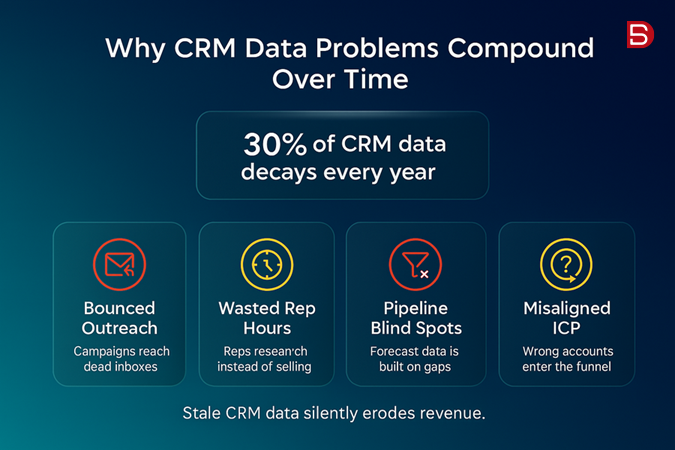
Database decay isn’t an event. It’s constant. The moment a record is entered, the clock starts: people change jobs, companies merge, phone systems get replaced, and the CRM keeps showing yesterday’s version of the world as though it’s still current.
The numbers back this up. Validity’s 2025 report found that 90% of organizations treat CRM data as central to how they operate, yet 76% admit less than half of that data is actually accurate and complete. The same report found something sharper: one in four companies see annual revenue drop by 20% or more because of it, and the average company loses 16 sales deals a quarter to bad data.
Decay rates vary widely by industry, so treat these figures as directional rather than a precise benchmark for your own list. The underlying pattern doesn’t change, though: data quality erodes quietly, and every report built on top of it inherits the error.
Why the usual fixes don't hold
Most teams reach for one of two remedies: a quarterly manual scrub, or a one-off list purchase. Both feel like progress. Neither lasts, because records start degrading the moment they land in the system.
Manual cleanup only ever captures a snapshot. Clean 5,000 records in March, and by June a good chunk of them have gone stale again. Purchased lists are arguably worse, since the data is often months old before it even reaches your instance.
Automated tools are a real improvement over spreadsheets, but even good automation drifts without a human check behind it. Machine matching moves fast, but it’s still guessing, and small guesses compound into large errors over time. This is where solid data enrichment techniques earn their keep: pairing automated matching with human review so accuracy holds.
The short version: one-time fixes treat an ongoing problem as a single task. Enrichment works because it’s ongoing too.
Sign 1: Your email bounce rate keeps creeping up
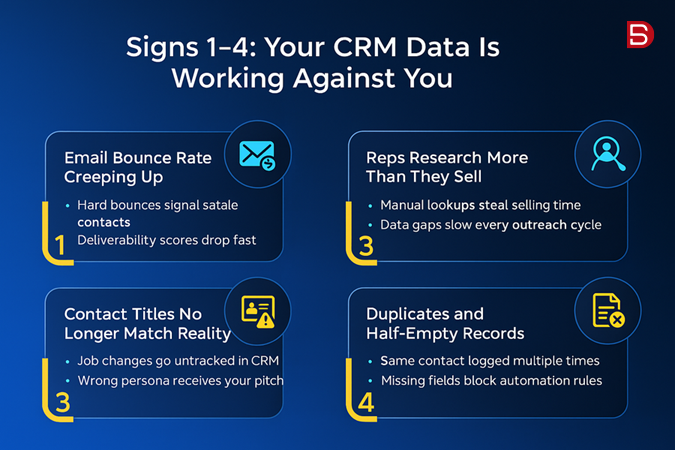
A rising bounce rate is usually the first thing anyone notices. When outreach starts hitting invalid addresses more often than it did last quarter, that’s decay surfacing in real time.
ZeroBounce analyzed more than 11 billion email addresses verified in 2025 and found that at least 23% of email lists degrade every year, down from 28% in 2024. That’s an improvement, but data decay is still a persistent drain on any business that depends on email for revenue. B2B lists tend to decay faster still, since frequent job changes make contacts invalid, and more likely to bounce, sooner.
One thing worth flagging: chasing a lower bounce rate on its own can hide a deeper problem. You clean out the dead addresses and call it done, while the firmographic gaps behind those contacts, company size, industry, tech stack, go untouched. Deliverability is a symptom. Treat it as an early warning, then check what else the record is missing.
Sign 2: Reps are spending more time researching than selling
Watch how your reps actually spend an hour. If a meaningful chunk of it goes to hunting down a direct dial, confirming a title on LinkedIn, or guessing at headcount, the CRM isn’t doing its job.
The drain adds up. Recent industry analysis puts the waste at 27.3% of a rep’s time, roughly 546 hours a year, spent chasing bad leads. Every minute spent verifying a phone number is a minute not spent in a conversation that actually moves the pipeline.
To be fair, not all rep research is wasted effort. A seller reading up on a prospect’s recent funding round or product launch is doing something no enrichment feed replaces. The goal isn’t to eliminate that thinking; it’s to hand reps clean, complete records so their research starts at insight rather than data entry. Solid data enrichment services free up those hours and let people focus on the parts a machine can’t do.
Sign 3: Contact titles no longer match reality
Titles rot faster than almost any other field in the database. People get promoted, reorganized, or poached, and the CRM keeps insisting they’re still the Director of Marketing they were three years ago.
Tenure data explains why. Median employee tenure in the US sits around 3.5 years (Bureau of Labor Statistics, 2024), which means a meaningful share of your contacts change roles within a single sales cycle. In fast-moving functions like marketing and sales, it happens faster still.
An accurate title still doesn’t confirm buying authority, though. Someone can carry an impressive VP title with no budget for what you sell, while the real decision sits with a director two levels down. Title enrichment gets you closer to reality, but pair it with signals of actual influence, department, seniority, reporting line, before routing a “decision-maker” to a rep.
Sign 4: Duplicate and half-empty records keep multiplying
Search for one account and find four versions of it. One has the phone number. Another has the correct address. A third has nothing but a name. This kind of fragmentation quietly breaks routing, scoring, and reporting, because the system can no longer tell which record to trust.
It’s more common than most teams assume. Experian puts duplicate records at 15-20% of all data in a typical organization. Multiply that across a large instance, and the downstream cost, misrouted leads, double-counted pipeline, split engagement history, adds up fast.
Cleanup itself carries risk. Deduplication without clear precedence rules can do real damage: merge two records the wrong way and you overwrite good data with worse, keeping the stale field instead of the accurate one. Good B2B data enrichment services solve this with defined survivorship logic, deciding which source wins, which field takes priority, and what gets preserved. Merging records is easy. Merging them correctly takes discipline and a verification layer.
Sign 5: Your ICP and TAM math stops adding up
When your addressable market estimate starts to feel off, missing firmographic and technographic fields are usually why. You can’t size a segment you can’t see. Records without industry codes, employee counts, or revenue bands don’t just sit idle; they quietly shrink your view of the market, because segmentation logic skips whatever it can’t read.
The effect is subtle: your TAM looks smaller than it is, or your ICP filters exclude accounts that would actually fit, simply because a field was blank rather than false.
There’s a cost tradeoff here too. Broadening enrichment scope, adding technographic layers, install-base data, intent signals, raises the price per record. So don’t enrich everything to the same depth. Tie the deeper passes to the segments that actually convert, and keep lighter coverage elsewhere. The goal isn’t to fill every cell. It’s to fill the ones that change a decision.
Sign 6: Campaign targeting feels like guesswork
If segmentation keeps landing wide of the mark, incomplete attributes are usually the reason. You can’t target on data you don’t have, so campaigns default to broad strokes, and the response rate tells the story.
The fix isn’t more records; it’s better ones. Industry commentary through 2025 has pointed to enrichment delivering precision over raw completeness, meaning a smaller set of well-attributed contacts consistently outperforms a bloated list (Forbes, 2025). Clean, complete data shows up in the numbers too: recent analysis links it to 20% better campaign response rates, 15% higher close rates, and 12% higher conversion rates.
One thing enrichment won’t do is rescue a weak offer. Better targeting gets the right message to the right person faster, but it won’t make a mediocre value proposition land. Get the offer right first, then let enrichment sharpen who sees it and when.
Sign 7: Sales and marketing keep arguing about lead quality
The same standoff resurfaces every quarter. Marketing insists the leads were qualified. Sales says half of them went nowhere. Both sides are partly right, and the actual culprit usually sits underneath the argument: incomplete records.
When a lead lands in the CRM missing a company size, a verified title, or a working phone number, marketing scores it on optimistic assumptions, and sales inherits the gap. The handoff breaks down before anyone picks up the phone.
A steady enrichment cadence removes a lot of that friction. When both teams work from the same complete, verified fields, MQL-to-SQL conversations shift from blame toward strategy. That said, alignment is partly a process problem too, shared definitions, SLAs, and routing rules still matter, and enrichment won’t settle every dispute over what “qualified” means. What it does is remove the easy excuse, so the harder conversation can happen.
Sign 8: Your AI and scoring models are producing noise
Predictive scoring and AI-assisted routing are only as good as the records feeding them. Point a sophisticated model at thin, stale data, and it will confidently rank the wrong accounts at the top. That’s not a modeling problem. It’s a data problem.
A 2025 IEEE review of AI and machine learning in data governance found that poor data quality costs businesses 15-25% of annual revenue, and that traditional rule-based validation can no longer keep up with large-scale, dynamic data. Models trained on decayed fields simply inherit the gaps.
Enrichment is what makes scoring trustworthy in the first place. Complete firmographics, current titles, and verified intent signals give models real patterns to learn from, rather than noise dressed up as signal. Worth planning for: once your inputs are clean, “the data was bad” stops being an excuse, and leadership will expect the models to deliver.
What a working data enrichment program looks like
A one-time cleanup feels productive, and it fixes almost nothing long term; records start decaying again the day the project ends. What holds up is a program, not a project.
Four components tend to show up in the ones that work:
Component | What it does |
|---|---|
Continuous refresh | Updates records on a set cadence, so decay never compounds |
Multi-source matching | Cross-checks fields against several providers instead of trusting one |
Human QA layer | Catches the edge cases automation gets wrong |
CRM governance rules | Sets precedence and field ownership so updates don’t overwrite good data |
The strongest data enrichment services combine automated matching with human verification, running continuously rather than in bursts. The more governance and structure you already have in place, the less enrichment you’ll need to do from scratch.
In practice, in-house teams rarely sustain this cadence on their own. The work isn’t difficult so much as relentless, and it’s usually the first thing dropped when a quarter gets busy.
Building in-house or partnering out
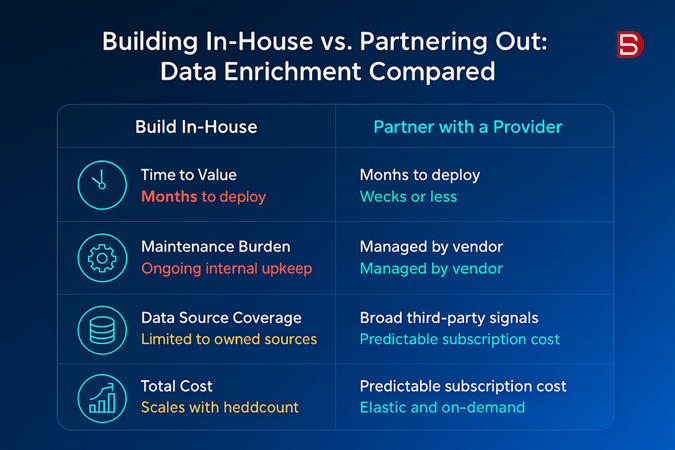
The build-versus-partner question really comes down to sustained capacity, not capability. Most teams can enrich a list once. Few can keep it current every month while also running campaigns, managing the stack, and hitting pipeline targets.
Building in-house gives you full ownership and context, but headcount and continuity become the risk: the moment your data steward leaves, the cadence stalls. Partnering with specialist data enrichment companies buys you capacity and compliance depth, CCPA, GDPR, and PIPEDA processing that’s genuinely hard to staff for internally.
One caution: established data vendors vary widely in verification rigor, and some sell volume and call it accuracy. Before committing to any provider, test their claims on a sample of your own list. Match rates and bounce rates on real records tell you more than any deck will.
Whichever path you choose, the deciding factor stays the same: can it hold a steady, verified cadence over years, not weeks?
Where to go from here
Run your CRM against these eight signs this week. If three or more sound familiar, your data is quietly costing you pipeline, and a structured B2B data enrichment services program will pay for itself faster than most teams expect.
For teams that want a verified, compliant program rather than another self-serve tool, Datamatics Business Solutions Ltd. runs ISO 27001:2022-certified B2B Data Solutions, pairing multi-source enrichment with a 600+ person human QA layer, a combination that’s hard to replicate in-house at scale. If you’d like to pressure-test your current database and see where the gaps really are, it’s worth a conversation with the Datamatics Business Solutions Ltd. team.
- FAQS
Frequently asked questions
1. What is a CRM data enrichment program?
A data enrichment program is an ongoing process that fills gaps and corrects errors in CRM records, adding verified details like job titles, direct phone numbers, company size, and industry. Rather than a one-time cleanup, it runs continuously to counter database decay, keeping contact and account data accurate enough that reps can act on what’s real rather than what’s outdated.
2. How do I know when my CRM needs data enrichment?
Watch for the signs above: reps hitting disconnected numbers, emails bouncing, contacts who’ve changed jobs, missing fields on key accounts, forecasts that keep missing. If the dashboards look healthy but outcomes lag, decay is probably hiding in plain sight. Duplicate records, inconsistent formatting, and segmentation that no longer produces reliable lists are other clues. When your team stops trusting the data, that skepticism itself is a signal you need enrichment.
3. How often should CRM data be enriched?
Since database decay never really stops, enrichment should be ongoing rather than an annual event. Roughly 2-3% of B2B records go stale every month as people switch jobs and companies change. Many teams run automated enrichment monthly or quarterly, with real-time enrichment triggered as new leads enter the system. The right cadence depends on data volume and how fast your market moves, but set it and forget it doesn’t work here.
4. What data points should a data enrichment program add?
Focus on fields that drive outreach and decisions: verified email addresses, direct dial and mobile numbers, current job titles, company size, revenue, industry, and location. For account-based strategies, add technographics, funding events, and organizational hierarchy. Prioritize what your reps actually use to qualify and contact prospects, since enriching everything wastes budget. Tie each field back to a workflow: routing, scoring, personalization, or segmentation.
5. Does data enrichment improve sales pipeline accuracy?
Yes. When records reflect current contacts, titles, and account details, reps spend less time chasing dead ends and more time in real conversations. Accurate data also sharpens lead scoring, routing, and segmentation, which produces cleaner pipeline reporting. The gap between what the CRM shows and what’s actually true shrinks, so forecasts become more reliable. Enrichment doesn’t create demand, but it removes the hidden friction that quietly distorts the numbers.