


Most revenue teams pick their B2B data provider the wrong way.
They sit through a demo. They compare pricing tiers. They pick the one with the biggest database number and the smoothest sales rep. And then, three months in, they wonder why their connect rates are flat, their SDRs are frustrated, and their pipeline looks thinner than it should.
The problem is not the vendor. It is the questions you did not ask before signing.
Bad data is expensive. According to Gartner, poor data quality costs organizations an average of $12.9 million per year. That number includes wasted outreach, missed pipeline, and the compounding cost of decisions made on wrong information.
Here are the seven questions that actually matter when choosing a data vendor. Ask all of them. Write down the answers. And if a vendor cannot give you a straight response to any of these, that is your answer.
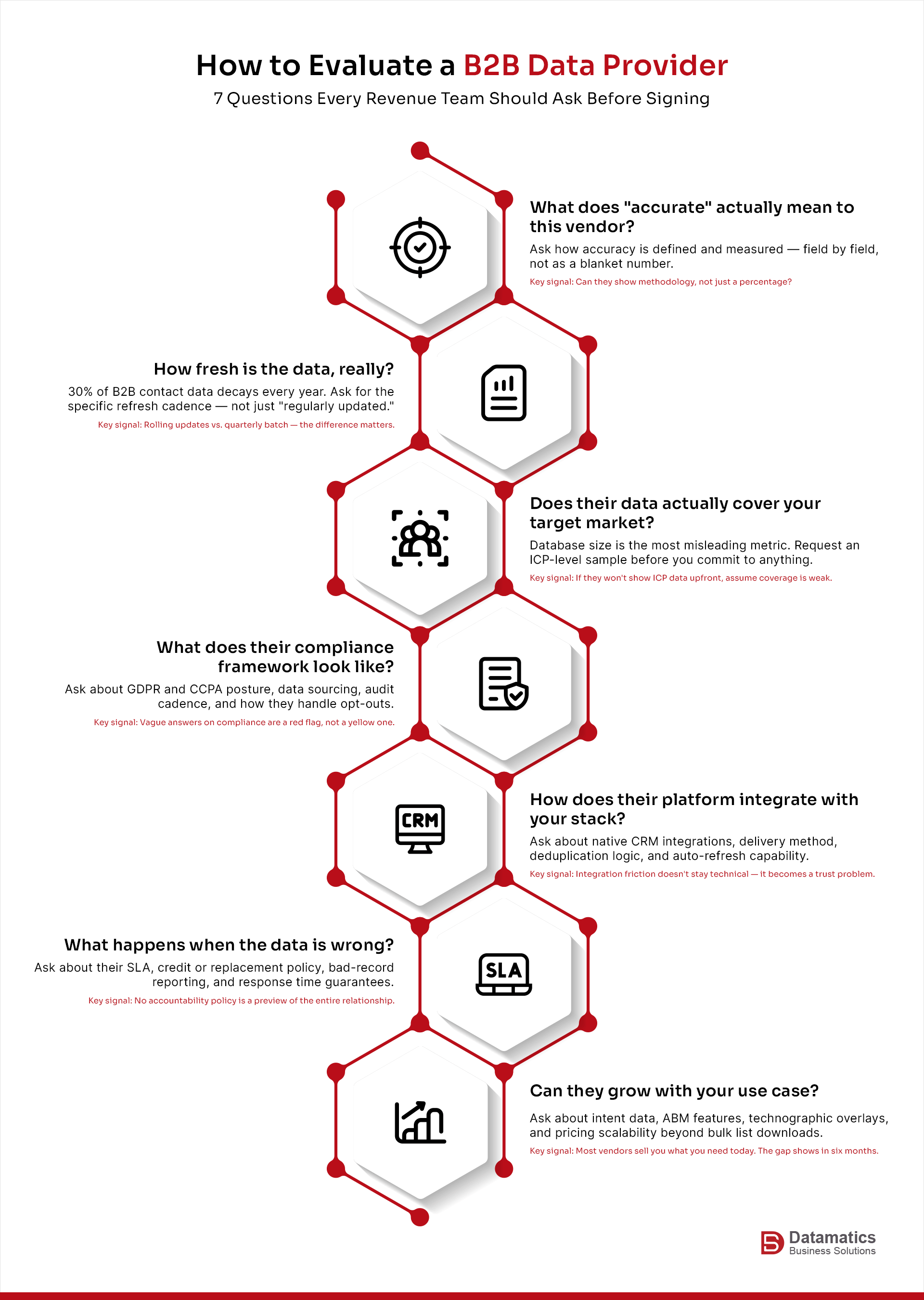
Question #1 what does "Accurate" actually mean?
In most cases, accuracy rates reflect what vendors choose to measure. Not the quality you actually receive.
Every B2B data provider claims high accuracy. Very few define it the same way.
Some vendors measure accuracy at the point of collection. Others measure it after validation. Some only count records that pass their internal verification checks, quietly excluding everything else from the accuracy rate they advertise.
A vendor claiming 94% accuracy might be measuring just one field across a subset of their database.
Ask directly how do you define and measure data accuracy? What percentage of records are verified, and by what method? Is accuracy reported across all fields, or just select ones like email?
According to Experian’s Global Data Management Report, 97% of organizations believe inaccurate data undermines key business initiatives.
The problem is not just having bad data. It is not knowing you have bad data until it is already costing you.
- KEY TAKEAWAY
Push vendors to show you how they calculate accuracy, not just what number they claim. A vendor who can explain their methodology clearly is worth more than one who throws around an impressive percentage.
Question #2 how fresh is the data, really?
“Regularly updated database” means nothing. Data doesn’t fail overnight. It decays quietly until your marketing efforts stop working.
A record that was accurate eighteen months ago may be completely useless today. B2B data decays faster than most teams realize.
LinkedIn research suggests that roughly 30% of B2B contact data becomes outdated every year. People change jobs. Companies get acquired. Phone numbers get reassigned.
When doing a B2B data provider comparison, most teams overlook refresh cadence entirely.
Ask each vendor how frequently their database is updated. Ask whether refreshes happen in bulk once a quarter or on a rolling, continuous basis. Ask what triggers a record update: is it a verified job change, or just a crawl of a public profile?
The difference between a quarterly batch refresh and a continuous verification model is significant. For demand generation and account-based campaigns, stale data translates directly into wasted spend.
- KEY TAKEAWAY
“Regularly updated” is not an answer. Ask for the specific refresh cadence, the data sources behind it, and how they handle records that have not been validated recently.
Question #3 does their data actually cover your target market?
Coverage is where most B2B data vendors quietly fail. Most buyers don’t notice until after the contract is signed.
A vendor may have an impressive total database size but thin coverage in the industries, geographies, or company sizes that matter to you. Some providers are strong on North American mid-market tech companies and patchy everywhere else. Others have deep coverage in enterprise but limited SMB data.
Database size is the most misleading metric in this industry.
During your B2B data vendor evaluation, ask for sample data pulled specifically from your ICP. Check for completeness across the fields you actually use like job title, direct phone, company revenue, tech stack, intent signals.
If a vendor won’t show you ICP-level data before you sign, assume the coverage is weak.
Also ask about firmographic segmentation depth. If you need data filtered by specific verticals, revenue bands, or headcount ranges, confirm they can deliver it before you commit.
- KEY TAKEAWAY
Total database size is a marketing number. What matters is coverage density within your target segment. Always request a sample that mirrors your actual ICP before evaluating further.
Question #4 what does their compliance framework look like?
Compliance isn’t a legal checkbox. It is a direct reflection of how responsibly your vendor handles data at scale.
This question does not get asked often enough, and it should be the first one.
GDPR, CCPA, and other data privacy regulations have real teeth. If your vendor is collecting or processing data in ways that are not compliant, your company shares the exposure.
A compliance failure at the vendor level can become a legal and reputational problem for you.
Ask how they source their data. Ask whether they have a published privacy policy that covers third-party use. Ask specifically about their GDPR and CCPA compliance posture. Find out whether they conduct regular audits, and how they handle opt-outs and data deletion requests.
Data quality management is not just about accuracy and coverage. It includes the legal and ethical integrity of how the data was gathered. Any serious B2B data solutions provider should be able to answer compliance questions clearly and without hesitation.
Vague answers on compliance are not a yellow flag. They are a red one.
- KEY TAKEAWAY
If a vendor is vague about compliance, treat it as a dealbreaker. You are not just buying data; you are taking on a share of their data practices.
Question #5 how does their platform actually integrate with your stack?
If your data doesn’t fit into your workflow, your team will quietly work around it. Or stop using it altogether.
Integration friction does not show up in vendor demos and kills adoption faster than bad data does.
Ask about native integrations with your CRM, marketing automation platform, and sales engagement tools. Ask how data is delivered through API, CSV export, direct sync, or all three. Inquire whether their system can push updates automatically or whether your team has to manually pull refreshed records.
A thorough B2B data provider checklist should always include a technical integration review. A clunky integration means your team will spend time on data hygiene instead of selling or marketing.
Also ask about deduplication logic. If their data imports create duplicate records in your CRM, that is a workflow problem and a data quality problem at the same time.
- KEY TAKEAWAY
The cleanest data in the world still causes friction if your team cannot access it where they work. Test the integration experience before you finalize any contract.
Question #6 what happens when the data is wrong?
A vendor’s real quality shows up after the data breaks, not before the contract is signed.
Every vendor will have some bad records. The question is what they do when you find them.
Ask what their SLA is for data accuracy. Ask whether they offer credits or replacements for records that bounce, fail verification, or turn out to be incorrect. Ask how you report bad records and how quickly they respond.
According to Salesforce’s State of Sales report, sales reps spend up to 28% of their week on non-selling tasks, including cleaning and chasing down bad contact data. A vendor with no accountability mechanism keeps your team in that cycle indefinitely.
No accountability policy is not a minor gap in service. It is a preview of what the relationship looks like when things go wrong.
- KEY TAKEAWAY
Accountability is part of the data quality equation. A good vendor has clear policies for handling errors and does not make you fight for basic remedies.
Question #7 can they grow with your use case?
The right data partner shouldn’t just support your current campaigns. It should keep up with your next growth phase.
Most vendors sell you what you need today. The gap shows up in six months, when your use case evolves and their product does not.
Ask whether they support intent data, buying signals, or technographic overlays.
Ask whether they have account-based features relevant to B2B data providers for ABM campaigns.
Ask whether their pricing model scales reasonably as your team grows or your usage increases.
Switching B2B data solutions vendors mid-program is expensive and disruptive. You lose three months to migration, re-verification, and re-integration. The cost of picking a limited vendor is never just the contract. It is everything that comes after.
- KEY TAKEAWAY
Evaluate vendors for where your program is going, not just where it is today. A vendor who only solves your current problem may become a limitation faster than you expect.
Data Quality Vendor Evaluation
To make this easier, we have turned these questions into a quick evaluation checklist you can use during vendor conversations.
B2B Data Provider Evaluation Checklist
Work through each question before signing with a vendor. Check every item you can confirm.
How Datamatics Business Solutions can help?
At DBSL, we build B2B contact and company data for revenue teams that cannot afford to work from a bad list.
Our data process covers sourcing, multi-layer validation, ICP-level segmentation, and direct delivery into your CRM or marketing automation platform. Enterprises from across 15 key industry verticals use our data services to improve connect rates, reduce bounce rates, and build pipeline from accounts that are actually in-market.
Our data quality management process is built around freshness and compliance, with regular refresh cycles. Every data records are verified and meet GDPR and CCPA requirements.
Want to see how your ICP maps against our database? Request a sample dataset and see the coverage before you commit to anything.
The right vendor is out there. The right questions get you there faster.
- FAQS
Frequently Asked Questions
1. What is the most important factor when evaluating a B2B data provider?
Data accuracy and compliance tend to be the highest-stakes factors. Accurate data directly affects campaign performance. Compliance affects your legal exposure. Both should be evaluated before pricing.
2. How often should B2B contact data be refreshed?
Industry benchmarks suggest at least every quarter, with continuous or rolling updates being preferable. Given that roughly 30% of B2B data decays annually, a batch-only refresh model will leave you with stale records faster than most teams expect.