


Here is a question most revenue leaders do not want to sit with.
What if the data your sales team is working from right now is wrong? Not catastrophically wrong. Not “the entire database is corrupted” wrong. Just quietly, persistently wrong.
A contact who left six months ago. A phone number that has been disconnected. A target account that got acquired last quarter. Individually, these look like minor gaps. Collectively, they are a structural problem and it is bleeding your pipeline.
This is B2B data decay. And it is happening to every organization that relies on a contact database to drive growth. The only question is whether you are managing it or ignoring it.
What Is Data Decay?
Data decay is the gradual loss of accuracy in your B2B database over time. It is not a one-time event you can fix and forget. It is a continuous process, running in the background whether you are paying attention or not.
Every time a contact changes jobs, a company relocates, or an organization restructures, the records in your CRM get a little less reliable. What was accurate six months ago might be actively misleading today.
According to Dun and Bradstreet, B2B data decays at roughly 30% to 40%per year. That is a third of your database gone unreliable within 12 months. Without a single data entry error.
For organizations running outbound sales, targeted campaigns, and ABM programs out of a B2B contact database, that is not a minor inconvenience. That is a material risk to revenue performance.
- KEY TAKEAWAY
Data decay is continuous. Without active management, a significant portion of your B2B database becomes unreliable within a year.
Why does this keep happening?
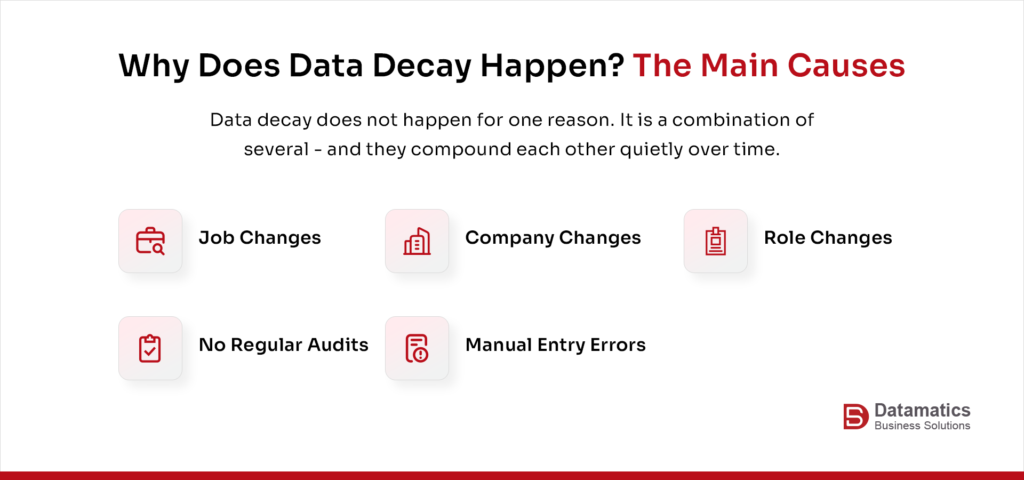
It helps to understand the root causes because the fix has to match the problem.
Employee mobility is the biggest driver. Professionals change roles constantly, especially in tech, financial services, and consulting. The moment a contact moves organizations, their title, email, and direct line become outdated. Instantly.
Company-level changes compound it. Mergers, acquisitions, rebrands, office relocations, these alter firmographic data across entire segments of a B2B customized database at once.
Manual data entry adds another layer. Inconsistent formatting, incomplete fields, duplicate records, these accumulate over time, especially when multiple disconnected systems feed into the same CRM.
And incomplete capture at the point of entry is its own problem. Records created without mandatory fields create downstream gaps in segmentation, routing, and reporting that only surface later, usually mid-campaign.
- KEY TAKEAWAY
Data decay has multiple causes. Fixing it means addressing people-driven changes and process-driven gaps simultaneously.
What is B2B data decay actually costing you?
More than most organizations realize! Gartner estimates poor data quality costs organizations an average of $12.9 million per year. For large enterprises managing multi-region databases, that number climbs considerably.
But the damage shows up before it hits the P&L. Here is where you feel it first.
Sales productivity takes the first hit. When reps work from inaccurate records, they waste hours chasing dead-end leads, clearing bounced emails, and revisiting accounts that changed ownership months ago.
Campaign performance degrades. Email deliverability falls. Sender reputation takes damage. Conversion metrics get harder to read because the audience data itself is flawed.
ABM falls apart at the seams. Consider a sales team running an account-based campaign off contact data that has not been refreshed in nine months. Key stakeholders may have changed roles. Email addresses may no longer exist.
Target accounts may have gone through restructuring. The result is wasted outreach, low engagement, and reps spending time on contacts who are no longer part of any buying process.
Forecasting becomes guesswork. Revenue models built on CRM data inherit the inaccuracies in that data. When decision-makers rely on those models, they’re building strategy on a degraded foundation.
Customer experience suffers. Personalization requires knowing who you are actually talking to. When data decay has corrupted contact profiles, outreach becomes generic at best, and damaging at worst.
- KEY TAKEAWAY
The cost of data decay compounds across sales productivity, campaign performance, ABM effectiveness, forecasting, and customer experience. It is not just operational. It is strategic.
AI makes bad data a bigger problem, not a smaller one
AI is embedded across the B2B revenue stack now. Lead scoring, predictive segmentation, intent modelling, pipeline forecasting, they all run on machine learning models trained on CRM data.
But AI does not compensate for poor data quality. It amplifies it.
A lead scoring model trained on inaccurate contact data surfaces the wrong prospects. A segmentation engine working from outdated firmographics creates cohorts that no longer reflect reality. A personalization layer built on stale profiles produces outreach that feels off-target.
Harvard Business Review’s research puts the cost of bad data at $3 trillion annually for the US economy alone, with AI-dependent workflows among the most exposed.
As organizations invest in AI-powered demand generation and B2B data enrichment services, the quality of underlying data becomes a first-order business decision. Not a back-office concern.
- KEY TAKEAWAY
AI-powered tools are only as reliable as the data they run on. Data decay doesn’t reduce AI accuracy gradually. It distorts it significantly.
Six ways to actually get B2B data decay under control
You can’t eliminate data decay entirely. But you can manage it systematically. Here is how
1. Assign ownership
Someone has to be responsible for data quality. Assign accountability at both the team and record level. When no one owns it, everyone assumes someone else is handling it and maintenance gaps multiply quietly.
2. Validate at entry
3. Audit on a schedule
Quarterly is a reasonable baseline. Review your B2B contact database for obsolete records, conflicting data, and missing firmographics. Don’t wait for a campaign to fail to find out the data behind it was unreliable.
4. Invest in enrichment
Records degrade even when no one touches them. B2B data enrichment services restore accuracy by appending verified firmographic, technographic, and contact-level data to existing records. Any record untouched in 90 days is a candidate.
5. Integrate your systems
Fragmented tech stacks are where data quality goes to die. When your CRM, marketing automation platform, and data management systems are not connected, the same contact can exist in five places with five different versions of the truth.
6. Bring in a specialist
Most internal teams don’t have the bandwidth to sustain ongoing verification and cleansing at scale. Specialist B2B data providers bring the infrastructure and process discipline that most organizations can’t build in-house.
- KEY TAKEAWAY
Data quality management requires discipline across process, technology, and partnership. No single intervention is enough on its own
The warning signs are consistent
Poor data quality tends to show up in the same patterns across organizations. If you are seeing any of these, you already have a problem.
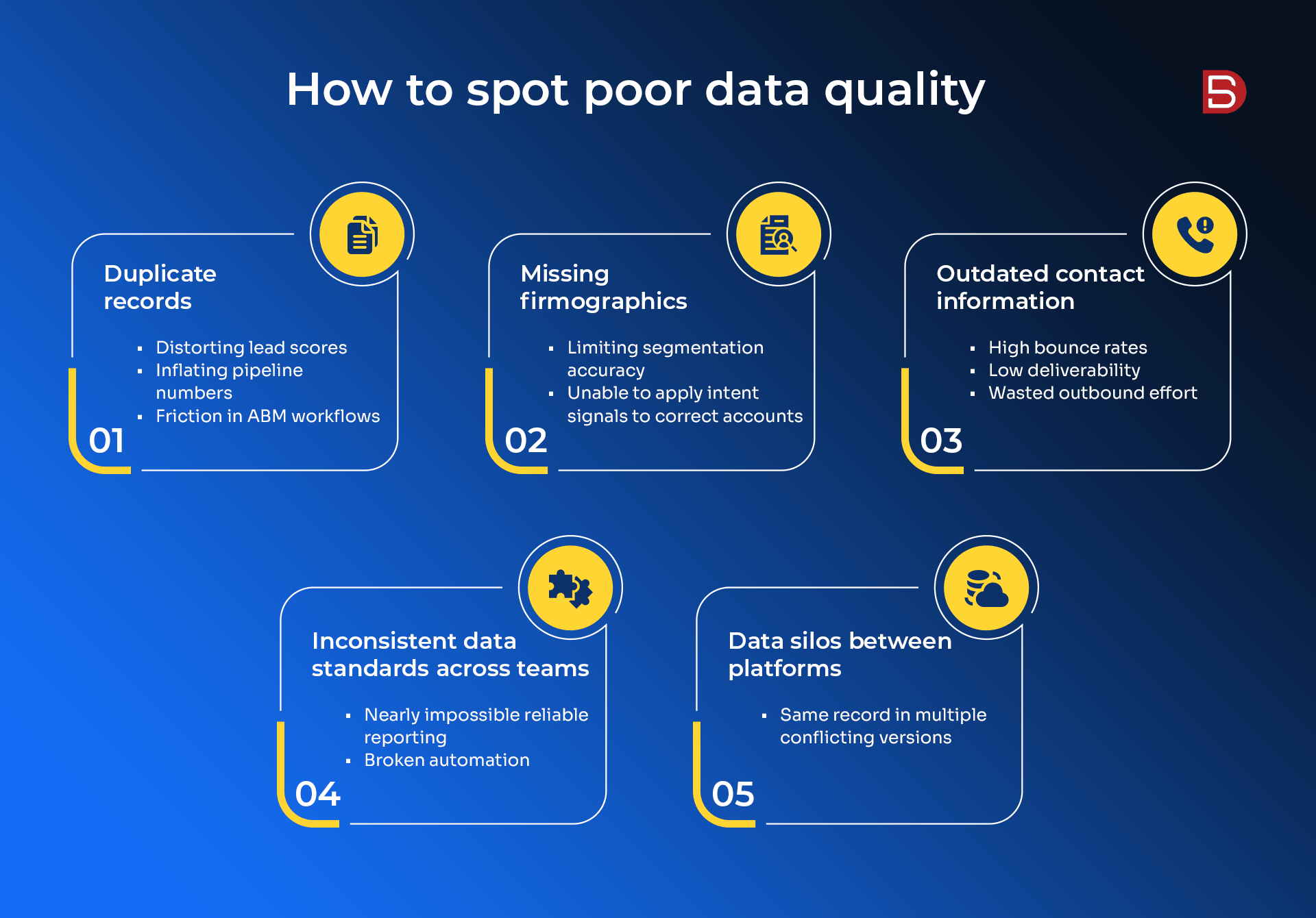
These are not edge cases. These are the default state for any organization that has not implemented a structured data quality program.
- KEY TAKEAWAY
Data quality problems follow consistent patterns. Identifying which ones apply to your organization is the starting point for any real remediation plan.
How Datamatics Business Solutions helps organizations stay ahead of B2B data decay
Most organizations address data quality reactively. When a campaign underperforms or a pipeline review throws up anomalies. By that point, the damage is already done.
Datamatics Business Solutions Ltd. (DBSL) works with organizations to build the kind of ongoing data discipline that prevents those moments. That means identifying duplicate and obsolete records, enriching existing databases with verified contact and firmographic intelligence, and validating data at the point of capture so errors don’t enter the system in the first place.
The outcomes are practical. Better campaign performance. Less time wasted on dead-end outreach. Reporting that leadership can actually rely on.
For organizations entering new markets, rebuilding ageing databases, or scaling account-based programs, data quality isn’t a preparatory task. It is a continuous one.
The organizations that treat it that way operate differently. Their pipeline numbers reflect reality. Their AI-powered tools score and segment from accurate inputs. Their sales teams spend time on the right accounts, not correcting the record.
Clean, verified B2B data isn’t a back-office function. It is the infrastructure everything else runs on.
- FAQS
Frequently Asked Questions
1. What is data decay and why does it matter for B2B organizations?
Data decay is the gradual decline in accuracy within a B2B database over time. It matters because your CRM data drives sales outreach, marketing campaigns, forecasting, and AI-powered workflows. When that data is unreliable, every downstream process is compromised.
2. How quickly does B2B contact data actually decay?
Research from Dun and Bradstreet puts the rate at approximately 30 to 40 percent per year. That rate accelerates in high-mobility sectors like technology, financial services, and professional services.
3.What are the most effective ways to manage data decay?
The most effective approaches: validate data at the point of entry, run regular audits, establish clear data ownership, invest in B2B data enrichment services, and integrate systems to maintain a single accurate record. Partnering with specialist B2B data providers adds ongoing verification capacity that most internal teams can’t sustain alone.
4. How does data decay affect AI tools in B2B marketing and sales?
AI models depend on the quality of the data they’re trained and operated on. When data decay affects contact records and firmographic data, AI-powered lead scoring, segmentation, and forecasting produce inaccurate outputs. Poor data quality doesn’t reduce AI performance gradually. It can distort it significantly.