


Every trade show badge scan adds a record to your database. So does every webinar registration and conference sign-up. Most of those records start losing accuracy the moment they land, and the database keeps expanding faster than most teams can review it.
For data and insights managers running events at scale, that decay carries a real cost. It shows up later, in bounce rates, misrouted leads, and pipeline reports nobody fully trusts. By the time a sales team notices the problem, the database has usually absorbed several event cycles’ worth of unverified contacts.
This guide covers what data cleansing services actually do for event data, how the data cleansing process works end to end, and what separates dependable data cleansing companies from vendors offering a one-time scrub. It is written for teams that run events regularly enough that data quality has become a recurring operational question, not an occasional cleanup task.
Choosing the right data cleansing services early in an event program saves far more effort than trying to repair a database after several quarters of unmanaged growth.
Why event-generated data breaks down faster than expected
Event data arrives differently than data collected through a form fill or a content download. Badge scans skip validation steps that a web form would normally enforce. Names get truncated. Titles get abbreviated. Company names appear in five different formats across five different events, depending on how each registration system was configured.
Add multiple booth staff scanning the same badge, or a prospect registering under both a personal and a work email, and duplication compounds quickly. A single attendee can generate three or four separate records before the event even ends.
Decay does not pause once the event closes. B2B contact data decays at roughly 2.1% a month, compounding to about 22.5% a year, according to HubSpot’s Database Decay Simulation, built on long-running MarketingSherpa research. Job changes, company moves, and title updates continue eroding accuracy long after the badge has been scanned.
A database built from a full year of events is, by definition, a blend of fresh and already-stale records on the day that year ends. Records from an early spring conference are already several months into their decay curve by the time the year-end campaign goes out.
- KEY TAKEAWAY
Event data starts messy at the point of capture and keeps degrading after the event closes. Cleansing needs a schedule, not a one-time fix.
Common data quality issues found in event databases
Before choosing a data cleansing process, it helps to know exactly what tends to go wrong with event-sourced records. A few issues show up consistently across trade shows, conferences, and webinars.
Duplicate contacts created by multiple badge scans, repeat attendees, or overlapping registration systems
- Missing or incomplete fields, particularly job title, direct email, and company size
- Inconsistent formatting across phone numbers, country names, and industry classifications
- Invalid or expired emails collected at the point of registration and never revalidated
- Mismatched company records where the same account appears under several name variants
Each of these compounds the others. A duplicate record with an invalid email and an inconsistent company name is effectively three separate problems wearing one contact card.
- KEY TAKEAWAY
Event databases accumulate a predictable set of quality issues. Recognizing the pattern makes it easier to scope the right data cleansing process rather than treating every record as a unique problem.
What the data cleansing process actually covers
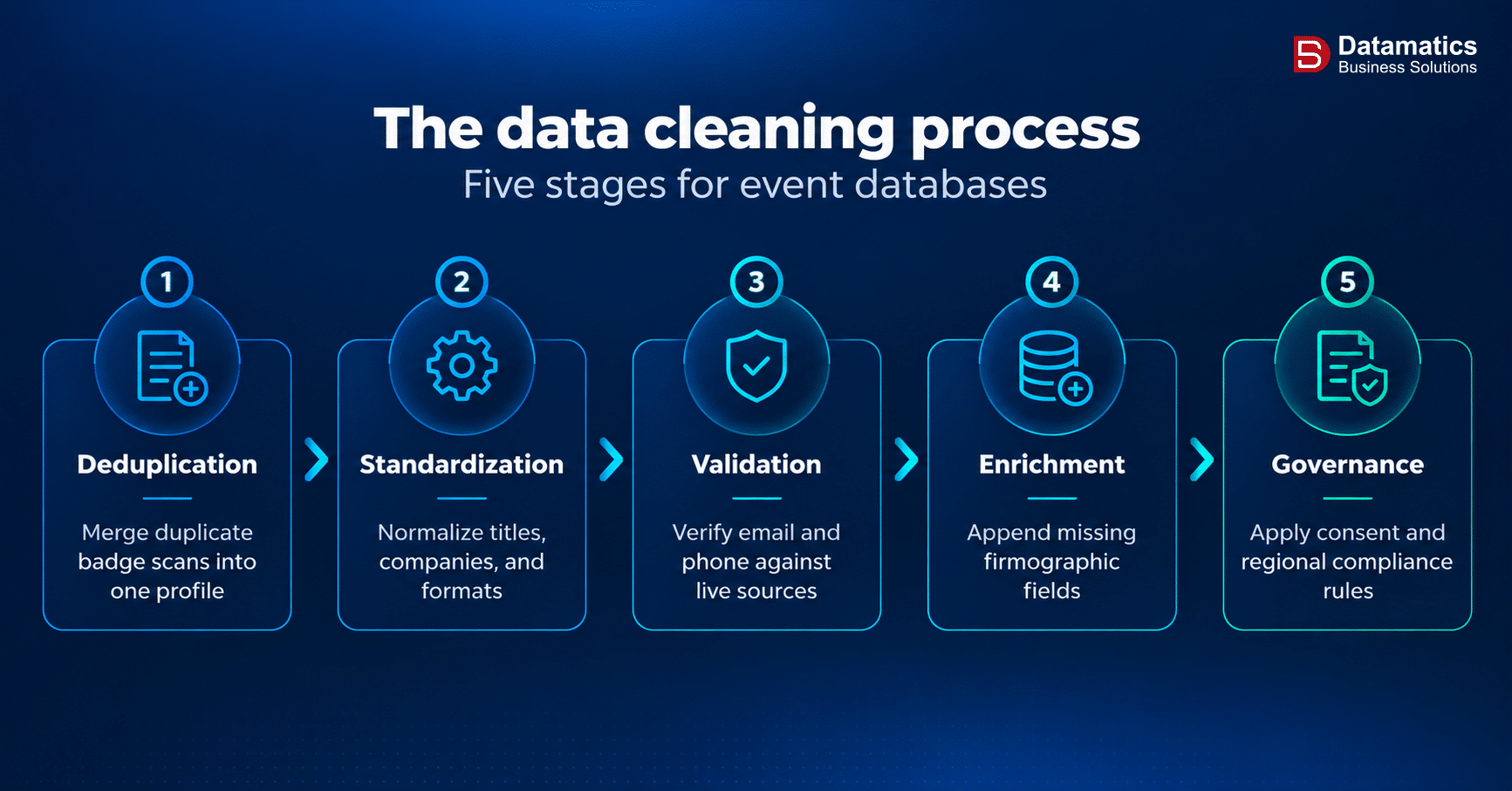
A complete data cleansing process for event databases runs through several defined stages, not a single deduplication pass. Each stage exists to catch a different type of error, and event data tends to produce all of them at once.
Deduplication and standardization
- Merge duplicate badge scans and multi-event records into one profile
- Standardize company names, job titles, and geography fields
- Normalize formats across phone numbers, currencies, and date fields
A record captured at a Chicago trade show and the same contact captured again three months later at a webinar rarely match on the surface. One might list “Sr. Director” and the other “Senior Director, Marketing.” Standardization is what makes the system recognize both as the same person before deduplication can even run.
Validation and enrichment
- Verify email and phone data against live, current sources
- Append missing firmographic and technographic fields
- Flag unmatched records instead of forcing a low-confidence fit
Suppression and governance
- Remove contacts who have opted out or withdrawn consent at any prior touchpoint
- Apply regional data handling rules based on where each record was collected
- Tag every record with its source event, so the database stays auditable later
This last stage often gets skipped, and it is usually the one that causes the most damage. A badge scan collected under one country’s consent rules does not automatically carry the right permissions once that contact moves into a global campaign list.
Each stage feeds the next. A dataset that is deduplicated but never validated still carries dead contacts into the CRM. It just carries fewer duplicates of them, which can create a false sense that the database is now reliable.
- KEY TAKEAWAY
A complete data cleansing process combines deduplication, standardization, validation, enrichment, and governance. Skipping any single step leaves gaps that resurface later in the CRM, often at the worst possible moment, mid-campaign.
In-house data cleansing vs outsourced data cleansing: What to weigh
Factor | In-house data cleansing | Outsourced data cleansing |
|---|---|---|
Control over process | Full control, no external handoff | Managed by partner, governed by SLA |
Institutional context | Strong because the team knows which fields matter and which records still hold value | Limited unless explicitly briefed |
Capacity during peak season | Often stretched thin when shows overlap | Scales with event volume |
Multi-region compliance | Requires in-house expertise across every region | Typically built into the vendor’s process |
Access to verification tools | Limited to what the team already licenses | Included as part of the service |
Turnaround predictability | Tied to internal bandwidth | Tied to campaign launch dates |
Best fit | Lower event volume, single region, strong internal data ops | High event volume, multiple regions, tight campaign timelines |
Most data and insights managers ask the same question after a busy event season. Should the work stay with the internal team, or move to an outsourced data cleansing partner?
The financial case for getting this right is substantial. Poor data quality costs U.S. businesses an estimated 3.1 trillion dollars a year, according to IBM research published in Harvard Business Review.
At the CRM level, the impact lands directly on revenue. Validity’s State of CRM Data Management report found that 37% of CRM users lost revenue as a direct result of poor data quality, and 76% said less than half of their CRM data was accurate and complete.
In-house teams retain full control and institutional context around the data. They understand which fields matter most for the sales process and which historical records still hold value. Most content or operations teams, however, are not resourced to run continuous CRM data cleansing at the volume a full events calendar generates, especially during peak conference season when several shows can overlap in a single month.
Outsourced data cleansing tends to work well when:
- Event volume exceeds what an internal team can process between shows
- The database spans multiple regions with different formatting and compliance standards
- Enrichment requires verification tools the team does not license internally
- The team needs a predictable turnaround tied to campaign launch dates rather than whenever capacity allows
- KEY TAKEAWAY
The choice is rarely all in-house or fully outsourced. Most enterprise teams keep strategy and governance internal, and route the volume work of CRM data cleansing to a specialist partner.
What to look for in data cleansing companies
Not every vendor offering data cleansing services USA wide operates at the same standard. A few factors separate dependable data cleansing companies from the rest, and they matter more once event volume climbs into the thousands of records per quarter.
Process transparency
Ask exactly how duplicates get matched, how enrichment sources get verified, and what happens to records that cannot be cleaned with confidence. A vendor who cannot explain this clearly will not manage it well either.
Compliance handling
Event data crosses consent boundaries constantly, across booths, badge scans, and co-sponsored sessions. Confirm the vendor’s process aligns with data protection requirements across every region where the event data was collected.
Turnaround and scalability
Event calendars run in bursts, not at a steady pace. The right partner needs the capacity to scale processing around your show schedule, rather than applying one fixed timeline to every batch regardless of volume.
Industry context
A vendor that understands B2B buying cycles will make better judgment calls on ambiguous records, such as which title to keep when a contact lists two roles, or which of two similar company names is the correct one.
- KEY TAKEAWAY
Reliable data cleansing services combine transparent process, compliance discipline, and the scalability to absorb event-driven volume spikes.
How DBSL supports data cleansing for event databases
Datamatics Business Solutions Ltd. runs structured data cleansing services as part of its wider B2B data capability. Roughly 80% of the process runs on AI, covering deduplication, standardization, and first-pass validation across incoming event records. Human reviewers handle judgment calls on ambiguous matches, compliance checks, and final sign-off before a record reaches the CRM.
This combination holds accuracy at a minimum of 95% across every event dataset DBSL processes. The result is a database that is corrected, deduplicated, and verified at scale, ready for sales and marketing teams to act on immediately.
Request a demo for a detailed walkthrough of DBSL’s data cleansing services.
- FAQS
Frequently asked questions
1. What is data cleansing in the context of event data?
Data cleansing is the process of identifying and correcting inaccurate, incomplete, or duplicate records collected from events such as trade shows, webinars, and conferences. It typically includes deduplication, standardization, validation, and enrichment before the data enters a CRM.
2. How often should event databases be cleaned?
Cleansing should happen shortly after each event, ideally within one to two weeks, to catch duplicates and validate contact details while the data is still fresh. Beyond that, most CRM data cleansing programs run on a recurring quarterly schedule to manage ongoing decay.
3. What is the difference between data cleansing and data enrichment?
Data cleansing corrects and standardizes existing records, removing duplicates and errors. Data enrichment adds new information to those records, such as firmographic, technographic, or intent data. A complete data cleansing process typically includes both.
4. Should event data be cleaned before or after it enters the CRM?
Before, wherever possible. Cleaning data prior to CRM upload prevents duplicate records, broken matching rules, and reporting errors from entering the system in the first place. This combination maintains a minimum accuracy of 95%.
5. What should a company expect to pay for outsourced data cleansing?
Cost depends on database size, the number of fields being validated and enriched, and how frequently the service runs. Most data cleansing companies price on a per-record or subscription basis, so it is worth requesting a scoped quote against your actual event data volume rather than a general estimate. When comparing data cleansing services USA-wide, ask for that quote against a sample of your own data, not a generic pricing tier.