


Your CRM looks full, dashboards are green, and the pipeline forecast holds up fine in front of the board. That’s usually the moment to worry. A database can rot for a year before any of the metrics leadership actually watches shows it.
By the time bounce rates spike and deals go quiet, the damage already runs months deep. This piece breaks down what data cleansing services do in practice, how the work actually happens, what it costs, and the point where handing it off makes more sense than fixing it yourself.
The database that looks fine and isn't
AI is what changed the math here. Every model, scoring engine, or automated sequence you plug in inherits whatever’s already broken in the data, then acts on it at scale. A bad record used to cost an SDR twenty minutes. Now it misroutes an entire campaign.
The decay itself isn’t new. Dun & Bradstreet puts B2B data decay at roughly 30% to 40% per year, which means a third of your database can go unreliable within 12 months without anyone touching a single field.
The diagnosis is the hard part. Symptoms rarely get traced back to their actual cause. A rep blames the messaging, marketing blames the list, ops blames attribution — and nobody says the plain version, which is that the data is decaying at roughly 2.1% a month, compounding to about 22.5% a year, per the same Dun & Bradstreet benchmark. So the problem sits in plain sight, quarter after quarter, wearing a hundred smaller problems as a disguise.
What data cleansing services actually do
Strip the jargon out and the scope is fairly narrow. Data cleansing services find what’s broken in a database and fix it — five jobs, more or less.
Deduplication merges the three versions of an account that three different reps created independently.
Standardization takes “VP Mktg,” “V.P. Marketing,” and “Vice President, Marketing” and turns them into one format your filters can actually use. Then comes validation (checking whether emails and phone numbers still resolve), correction (fixing what’s salvageable), and purging (retiring what isn’t).
That covers the discipline. None of it is glamorous, but the leverage is real.
There’s one limit worth flagging: cleansing only touches what’s already there. It can’t fill in what’s missing. If half your records have no direct dial, or lack a firmographic field you need for segmentation, scrubbing the existing data won’t produce it out of nowhere.
That’s where data enrichment services come in — appending and building out records with information you never had. It’s a related job, but a different one, usually run as a separate step. Worth knowing the two aren’t interchangeable before you scope anything.
Why bad data quietly costs more than the fix
Run the numbers, because that’s what actually gets a budget approved. Gartner’s cross-industry research puts the average annual cost of poor data quality at $12.9 million across organizations. That’s an enterprise-wide average, so scale it to your own revenue rather than repeating the figure as-is — on a $50M operation, even a 5% efficiency drag works out to $2.5M a year.
Set against that, cleansing is inexpensive. A project priced in the five figures, measured against six or seven figures in ongoing leakage, tends to pay for itself in weeks rather than quarters — which is rare for anything in a marketing budget.
The part that’s easy to miss: the biggest cost isn’t the SDR hours you can actually count. It’s the strategic calls made on unreliable numbers — territories drawn wrong, forecasts missed, budget aimed at the wrong segment. That damage is real, and it almost never shows up as a line item, which is exactly why it goes unaddressed for so long.
The data cleansing process, step by step
The process follows a fairly repeatable arc. Skip a step and it tends to show up later as cost.
- Audit and profiling. Measure the current state — duplicate rate, completeness, decay, format inconsistency. Without a baseline, there’s no way to prove improvement later.
- Scope. Decide which records and fields actually matter. Trying to clean everything rarely pays off.
- Pilot. Test on a real sample first, to confirm accuracy and pricing before committing to the full volume.
- Dedupe, standardize, validate. The core mechanical work, including fuzzy matching to catch near-duplicates that simple rules miss.
- Enrich. Fill in the gaps the cleansing pass exposed.
- QA. Human review layered on top of the automated checks.
- Delivery. Clean records land back in your system, with an audit trail attached.
Most budget overruns on these projects trace back to skipping step three. Teams jump straight to processing the full volume, hit a data quirk nobody planned for, and end up reworking everything. The pilot exists specifically to surface that kind of surprise while it’s still cheap to fix.
Where in-house cleansing breaks down
In-house cleanup usually loses out, and it’s rarely because the people involved aren’t capable. It’s a structural problem.
Data hygiene is almost never anyone’s primary job. Your ops analyst already has a full plate, and “dedupe the CRM” sits near the bottom of it until a campaign breaks because of it. Cleanup handled after the fact, squeezed between higher-priority work, can’t keep pace with a database losing roughly 2% of its accuracy every month.
Then there’s the tooling gap. Real cleansing work needs fuzzy-matching logic, validation at scale, and governance discipline — retention rules, audit trails, consent tracking. That’s a specialist’s toolkit, not something to pick up between sprints.
One exception worth naming, since most vendors won’t bring it up themselves: if your database is small and simple — a few thousand clean records, one owner, low decay — you probably don’t need outside help yet. A capable analyst with a free afternoon can handle it. Outsourcing a 2,000-record cleanup is overkill. Know which situation you’re actually in before deciding.
When to outsource data cleansing: a decision framework
So when does that calculation flip? A handful of clear signals point toward outsourcing.
Trigger | You should probably outsource when… |
|---|---|
Record volume | You’re past ~25,000 records and manual review can’t keep pace |
Skill gap | Nobody in-house knows fuzzy-matching, validation, or governance |
Compliance exposure | You process personal data under CCPA, GDPR, or PIPEDA and can’t prove your handling |
AI readiness | You’re feeding data into scoring, routing, or generative tools that amplify errors |
Cadence | The work is recurring, not a one-time tidy-up |
The underlying pattern: outsource once the problem is continuous, large, or carries regulatory risk you can’t defend internally.
One exception still applies. If it’s genuinely a one-time cleanup on a small database, and you’ve got a capable analyst with room on their plate, keeping it in-house is still the better call. You skip onboarding, keep full context, and don’t pay for anything extra. Outsourcing earns its cost at scale and recurrence — below that line, it isn’t worth the overhead.
- Case Study
2 Million B2B Records Delivered for a Global SaaS Leader [Free Case Study]
See How Scale Met Accuracy
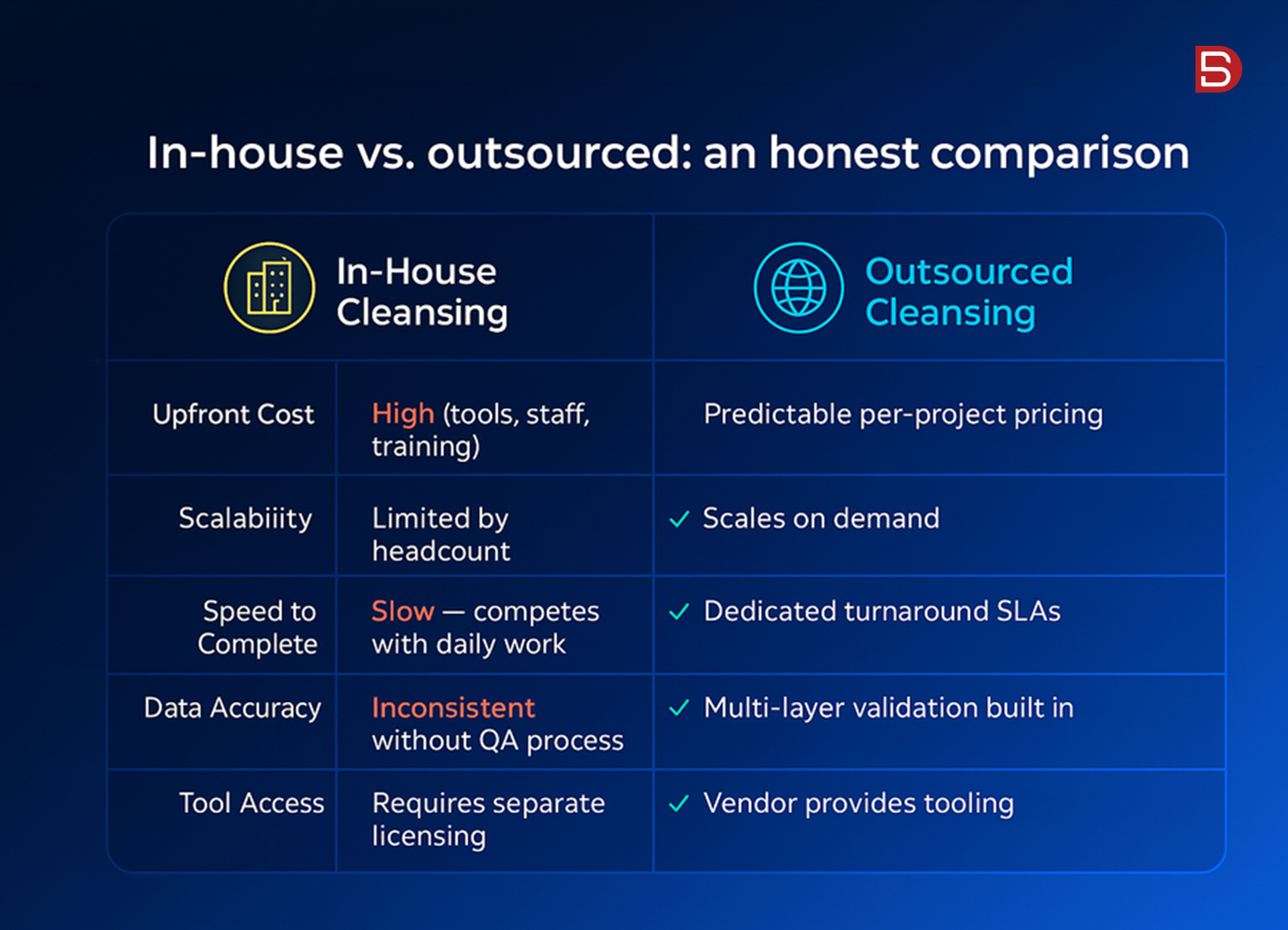
In-house vs. outsourced: an honest comparison
Factor | In-house | Outsourced |
|---|---|---|
Cost | Salaries, tooling licenses, and overhead run year-round, whether volume is high or low | Outsourced
Variable, tied to record count or project scope — you pay for what you use
|
Speed | Slow. Cleanup competes with quota-carrying work and usually loses | Fast. Dedicated teams process large volumes in parallel |
Accuracy | Depends on skill; manual matching misses fuzzy duplicates | Higher, with a human QA layer on top of automated checks |
Tooling | You buy, learn, and maintain the software | Included; providers already run enterprise-grade platforms |
Compliance | Your team owns CCPA, GDPR, and audit exposure | Certified providers carry documented controls |
Scalability | Hard to flex up for a one-time surge | Scales to millions of records on demand |
The real weak spot in outsourcing is context. A provider won’t know your naming conventions or legacy field logic the way your own ops lead does. Without solid onboarding and a regular communication rhythm, that gap turns into small errors that add up. Good data cleansing services close it with a documented spec and a pilot — not assumptions.
What data cleansing services actually cost
Pricing swings more than most buyers expect, so treat any single quoted number carefully.
Per-record cleansing usually runs a few cents up to around 25 cents per record, depending on complexity and how deep the verification goes. A full one-time project on a mid-sized database often lands in the low-to-mid five figures. Recurring retainers, where a provider keeps hygiene current on a rolling schedule, are typically priced monthly against database size and refresh frequency.
Offshore delivery costs less per record than fully US-based teams. That gap is real, and it’s a legitimate lever to pull if budget is tight.
One catch worth remembering: the cheapest per-record rate almost always means thin QA and no human verification layer. Automated-only cleansing catches formatting errors but misses the judgment calls, and you end up doing the cleanup you thought you’d already paid for. Cheap data cleansing services that skip human review often cost more once the rework is factored in.
CRM data cleansing services: the specifics that matter
Cleaning a static export is one job. Cleaning inside a live system is a different discipline entirely.
The safer CRM data cleansing services work directly inside your platform — Salesforce, HubSpot, Dynamics, whichever you run — with a full audit trail on every change. You can see exactly what was merged, updated, or purged, and roll it back if something looks off. That transparency matters when the database is actively feeding routing rules and scoring models in real time.
The riskier alternative is the export-clean-import cycle: pull records out, clean them offline, push them back in. Every hop is a chance to overwrite good data, break an association, or reintroduce a duplicate you’d just removed.
There’s a real downside to in-system work too — it demands tighter access controls and genuine trust in the provider, since you’re handing over entry to a live revenue system. That’s exactly why security certifications and scoped permissions matter here, not as a formality. Vet the access model before anyone gets credentials.
Why cleansing alone isn't enough: enrichment and maintenance
A one-time cleanup feels like the finish line. It isn’t. B2B contact data decays between 22.5% and 70.3% annually, email addresses alone decay at roughly 3.6% a month, and after a year without a refresh, 30 to 70% of your CRM contacts may be reaching the wrong person. A database cleaned in January is measurably dirty again by spring.
That’s why cleansing tends to pair with two other things. Data enrichment services fill the gaps cleansing exposes — appending firmographic, technographic, and contact fields so records are complete, not just accurate. And a recurring hygiene cadence, ideally re-verification every 90 days, keeps decay manageable instead of letting it compound quietly in the background.
The tradeoff is straightforward: a standing retainer costs more over a year than a single project, and it needs someone internally to own governance. Skip that ownership and even a well-run recurring program drifts off track. For any team running active outbound, the maintenance model is usually worth it anyway.
How to vet data cleansing companies without getting burned
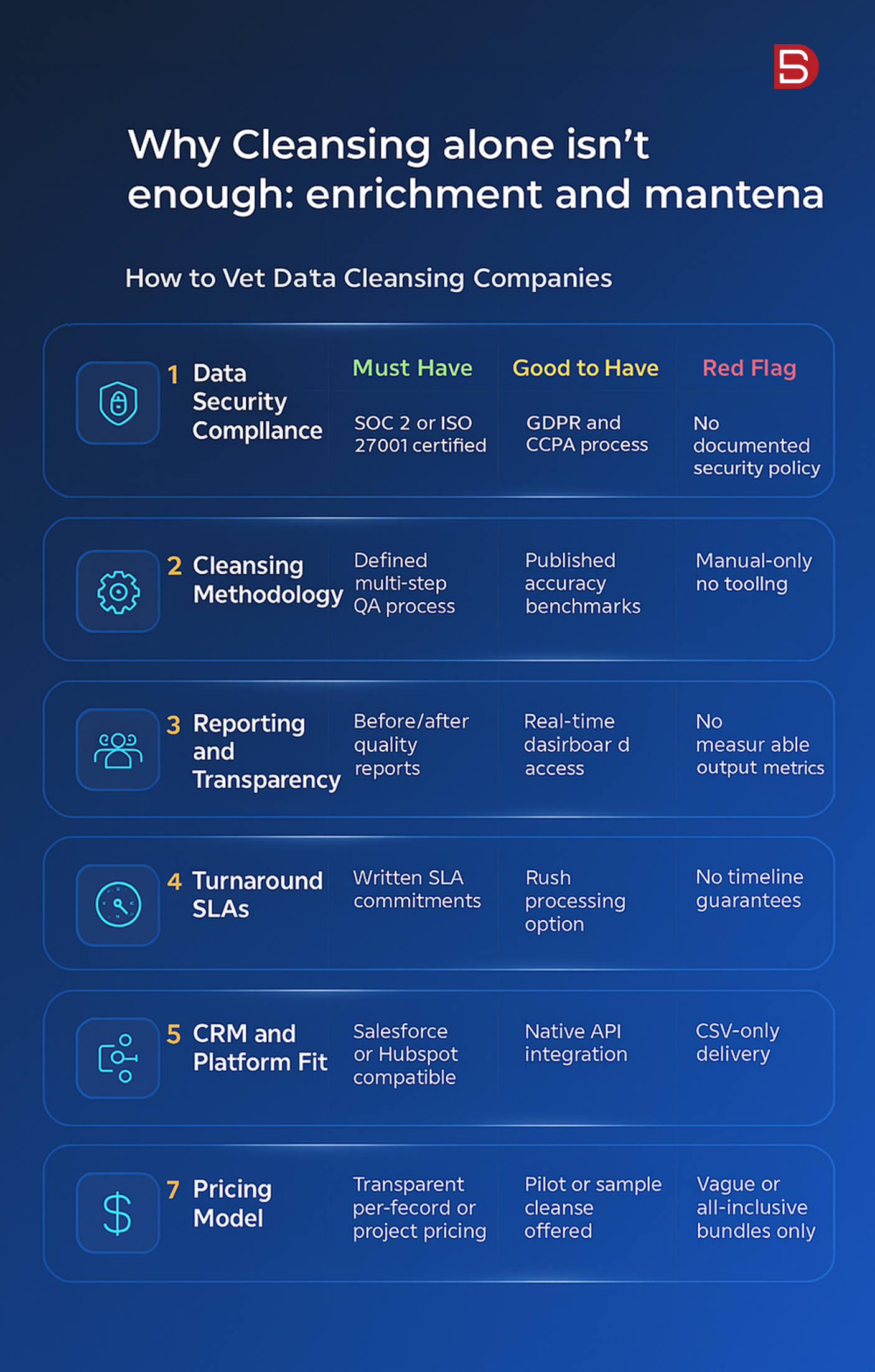
Not every provider delivers what their homepage promises. Run through this before signing anything.
- Pilot on your real data. A vendor confident in their process will clean a sample of your actual records and show a measured accuracy lift. No pilot, no deal.
- Accuracy SLAs in writing. Vague quality claims don’t count — ask for a committed accuracy percentage and what happens if they fall short of it.
- Security certifications. Look for documented standards like ISO 27001, plus clear CCPA, GDPR, and PIPEDA compliance — not just a reassuring line on the website.
- A defined communication cadence. Who’s your point of contact, and how often do you actually sync? Losing context is outsourcing’s biggest failure mode.
- A human QA layer. Automated matching alone misses judgment calls — ask specifically where humans review the work.
Two red flags matter more than the rest. Marketing language that stays vague on specifics usually hides thin delivery underneath. And rock-bottom pricing, as covered above, almost always means there’s no verification layer. When comparing data cleansing companies, weigh the proof over the polish.
Why Datamatics Business Solutions is a strong outsourcing partner
If outsourcing is the right call, here’s a candid case for one option.
Datamatics Business Solutions brings 50 years of operational history and a 600+ person demand generation team — enough scale to run volume, with a genuine human QA layer sitting on top of the automated checks. The operation carries ISO 9001:2015 and ISO 27001:2022 certification, so the security and quality controls buyers should be asking for are documented rather than just asserted. Processing aligns with CCPA, PIPEDA, and GDPR.
What sets it apart is scope: data building, cleansing, and enrichment all sit under one roof, so you’re not stitching together separate vendors for accuracy, completeness, and ongoing maintenance. That’s the model where a recurring hygiene cadence actually holds up over time.
One honest caveat: this fits mid-market-to-enterprise scale. If the job in front of you is a 2,000-record cleanup, a boutique tool or an afternoon of in-house work is the smarter call. This model earns its keep at volume and complexity — not at the small end.
Ready to see the numbers on your own data?
The most reliable way to judge any provider, this one included, is a scoped pilot on a real sample of your database — measuring accuracy lift and payback before committing to anything larger. It removes the guesswork and gives your team a concrete ROI figure to bring into the budget conversation. If that sounds like the right first step, the B2B Data Solutions team at Datamatics Business Solutions can help size the effort and set up a pilot. Reach out to start the conversation.
- FAQS
Frequently asked questions
1. What exactly do data cleansing services do?
Data cleansing services identify and fix problems buried in a database — removing duplicate records, standardizing formats for names, addresses, and phone numbers, validating and correcting email addresses, filling missing fields, merging fragmented contact records, and flagging outdated or invalid entries. The goal is a database your CRM, marketing tools, and AI models can actually trust. Most providers combine automated software with manual review, since some errors — mismatched company names, ambiguous duplicates — need human judgment to resolve correctly.
2.: How much do data cleansing services cost?
Pricing varies widely based on database size, complexity, and how much manual work is involved. Some providers charge per record, often a few cents each, while others bill hourly or offer flat project rates. A basic dedupe-and-standardize pass on a small list costs far less than deep enrichment and validation across hundreds of thousands of records. Expect ongoing subscription options too, since data decays continuously. Get a sample cleanse and a clear scope before committing, so you know exactly what you’re paying for
3. When should I outsource data cleansing instead of doing it in-house?
Outsource when your database is large, your team lacks the tools or time, or errors have started costing real money through bounces, stalled deals, or bad reporting. In-house cleaning still makes sense for small, one-time fixes, or when you already have dedicated data staff. If cleansing keeps getting deprioritized, or your AI and automation now depend on clean inputs, handing it off usually pays for itself. The honest signal: once maintaining data quality starts distracting from your core work, it’s time to outsource it.
4: How long does a data cleansing project take?
5. Is my data safe when I use an outside cleansing provider?
It can be, but verify the safeguards before sharing anything. Look for providers with clear data security policies, encryption in transit and at rest, signed data processing agreements, and compliance with regulations like GDPR or CCPA where relevant. Ask where your data is stored and processed, who has access, and how it’s deleted once the project ends. Reputable services limit access, anonymize where possible, and document their handling practices. If a provider is vague about security, treat that as a serious warning sign.