


Most B2B contact databases look fine on paper. Tens of thousands of records. Job titles. Company names. Email addresses. And then the sales team starts calling, and about a third of it goes nowhere.
Bad data is not a minor inconvenience. It is a structural pipeline problem. And it usually starts well before a single outreach email goes out.
What "high quality B2B data" actually means?
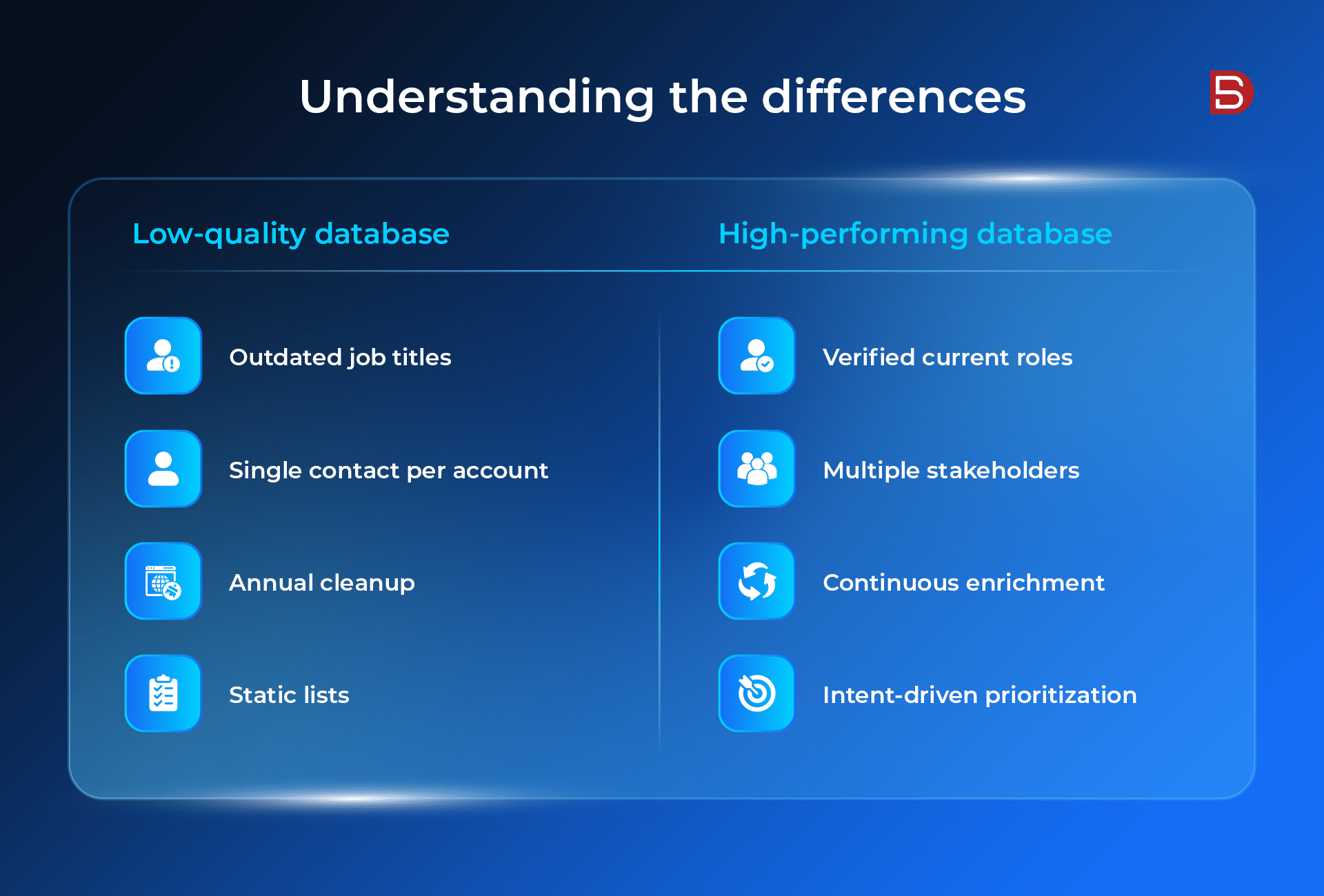
The phrase gets used a lot. But high quality B2B data is not just a large list with clean formatting.
It means four things, specifically: accuracy, completeness, recency, and relevance. A contact record that is missing a direct dial is incomplete. A record with a job title from two years ago is not current. A record from an irrelevant industry is not relevant, no matter how accurate the email is.
According to Gartner, poor data quality costs organisations an average of $12.9 million per year. That is not a rounding error. It is a consequence of treating data hygiene as a secondary task.
High quality B2B data means every record in the system is useful, correct, and actionable right now.
- KEY TAKEAWAY
Data quality is defined by whether a record can drive action today, not whether it exists in your system.
The fields that actually matter in a B2B contact database
Not every data field carries equal weight. A bloated B2B contact database with thirty fields per record is often less useful than a lean one with ten that are consistently filled and verified.
The fields that consistently affect conversion are verified business email, direct phone number, current job title, company size, industry, and intent signals where available. Everything else is supplementary.
LinkedIn’s B2B Institute research shows that buying decisions in B2B involve an average of 6 to 10 stakeholders. This means your database needs contacts across levels, not just one person per account. Many B2B databases fail because they are built around accounts, but operationally depend on one champion contact. The moment that person changes roles, the entire outbound motion stalls.
The goal is coverage and depth. Not just the CEO. The CFO, the procurement head, the end user who will actually champion the solution internally.
- KEY TAKEAWAY
A strong B2B contact database captures multiple stakeholders per account, with verified, role-specific data fields that matter to sales.
Why bigger B2B contact databases often perform worse
Many teams assume a larger database automatically creates more pipeline. In practice, oversized databases often create the opposite problem: low-confidence outreach, wasted SDR effort, duplicate records, and declining trust in the CRM itself.
A smaller B2B contact database with verified contacts, role-based coverage, and ongoing CRM database enrichment usually performs better than a massive static list filled with outdated records.
The issue is not database size. It is whether the data is current enough to support action.
- KEY TAKEAWAY
Database scale matters less than data usability. A smaller, verified database often outperforms a larger, poorly maintained one.
Why CRM database enrichment is not optional
B2B databases expire faster than most teams realize. People change jobs, companies restructure, and contact details go stale without warning.
According to Salesforce, B2B data decays by roughly 30% every year. This means a “reliable” database from last year is likely already negatively impacting your outreach and pipeline reporting today.
How you may ask? Well, calls go to the wrong person. Sales reps waste time cleaning records manually, which makes their actual job slow and inconsistent.
Database enrichment isn’t just about fixing typos. It is about keeping records usable. When bad data accumulates, sales teams stop trusting the CRM entirely. If they don’t trust the data, they won’t use the system.
When you combine Salesforce’s decay rates with Gartner’s cost estimates for bad data, the conclusion is clear. Poor CRM hygiene is a direct revenue risk, not just a minor operational headache.
- KEY TAKEAWAY
Database enrichment is not a one-time cleanup project. It is essential maintenance for a revenue asset that loses value every day it is left unmanaged.
How intent data changes what a B2B contact database can do
A list of verified contacts is useful. A list of verified contacts who are actively researching your category right now is a different thing entirely.
Intent data combines behavioral buying signals with firmographic and contact-level data to help sales teams identify accounts actively researching a solution category. It tells you which companies are visiting competitor websites, downloading relevant content, or spiking in keyword searches related to your solution.
According to TechTarget, companies that use purchase intent data report a 68% increase in revenue ROI from their campaigns. Why? Well, you are not guessing who might be in-market. You are finding the ones who already are.
This is where a B2B contact database shifts from being a static list to being a live intelligence asset. The contacts do not change. But knowing which of them to prioritise this week, based on actual buying behaviour, is the difference between cold outreach and warm, timely engagement.
- KEY TAKEAWAY
Intent data does not replace a clean B2B contact database. It tells you which records to act on first, so effort goes where buying signals are strongest.
The role of data governance in keeping a database usable
Even the most expensive B2B database will collapse without governance. Data governance is a set of rules that specifies how data enters your system, who is allowed to edit it, and what happens when things get messy.
Without these guardrails, a CRM quickly becomes a graveyard of high-confidence records mixed with total guesses. When that happens, sales reps lose faith and start building “shadow lists” in Excel. Your CRM stops being a tool and starts being an archive.
Experian reports that 83% of organizations believe bad data actively undermines customer experience. Poor data governance is a process problem.
What real data governance looks like?
Ownership: One person (or team) is actually responsible for data health.
Standards: Hard rules on what a “complete” record looks like.
Automation: A deduplication protocol that runs in the background so you aren’t relying on manual checks.
Audits: A regular, non-negotiable review cycle.
Without this structure, duplicates mess up your attribution, dead contacts stay on the list, and your reporting becomes a work of fiction.
- KEY TAKEAWAY
Intent data does not replace a clean B2B contact database. It tells you which records to act on first, so effort goes where buying signals are strongest.
How Datamatics Business Solutions can help
Datamatics Business Solutions helps sales and marketing teams maintain high-performing B2B contact databases through a combination of AI and human verification. We offer continuous CRM database enrichment and intent-driven data building services.
The focus is to provide usable, current, account-level data that improves outreach accuracy, reduces decay, and supports more effective pipeline generation.
- FAQS
Frequently asked questions
1. What is a B2B contact database?
2. How often should a B2B contact database be updated?
3. What is CRM database enrichment?
It is the process of adding missing information, correcting outdated records, and updating fields in an existing CRM or contact database. It improves accuracy, reduces bounce rates, and makes the database more actionable for sales teams.
4. What makes high quality B2B data different from a regular contact list?
High quality B2B data is verified, current, and relevant to your target market. A regular contact list might be a bulk export with no verification. The difference shows up in connect rates, bounce rates, and pipeline quality.
5. How does intent data work with a B2B contact database?
Intent data adds behavioral signals to existing contact records. It shows which companies are actively researching solutions like yours, so sales and marketing teams can prioritise outreach based on actual buying behaviour rather than assumptions.