

The Scaling CFO: Turning Finance Complexity into Competitive Advantage Podcast with Sumit Chaudhary, Group CFO of Expondo GmbH
In this episode of the CFO Talk Series, Raajiv Sachdeva, COO of Datamatics Business Solutions, speaks with Sumit Chaudhary, Group CFO of Expondo GmbH, one of Europe’s leading e-commerce marketplaces serving customers across more than 25 countries.
As organizations expand internationally, finance teams often face challenges that grow faster than revenue. Drawing from his experience leading finance transformation across telecom, consulting, travel, retail, and ecommerce, Sumit shares how CFOs can successfully navigate scale by combining automation, outsourcing, process redesign, and stronger finance operating models.
From managing tax complexity and working capital to building automation-first finance functions and cultivating values-driven leadership, this episode offers practical lessons for CFOs, finance leaders, and growth-focused organizations.
Discussion Highlights
- Why growth often creates complexity faster than revenue
- Moving from outsourcing as cost arbitrage to strategic capability building
- Building an automation-first and AI-ready finance function
- Managing multi-country tax, compliance, and regulatory complexity
- The impact of automation on decision-making and financial performance
- The importance of financial storytelling in the boardroom
- Mentorship, leadership, and building future finance leaders
- Practical advice for CFOs leading rapid growth and transformation
Voices Behind the Vision: Meet Our Host and Guest

Sumit Chaudhary
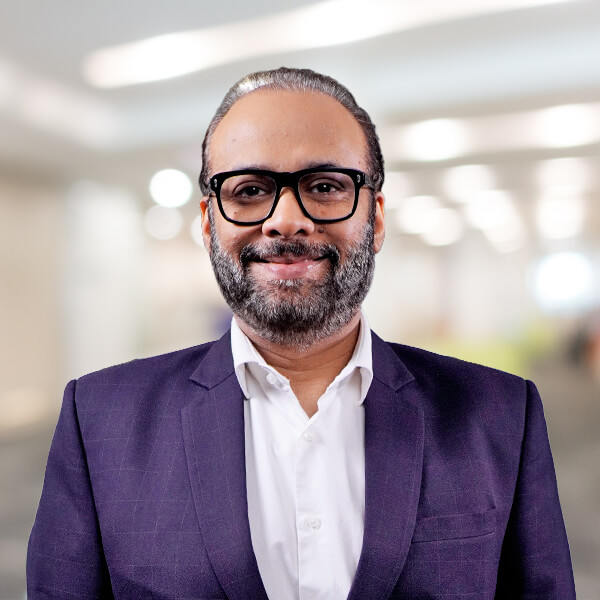
Raajiv Sachdeva
Raajiv:
Hello everyone, and welcome to CFO Talk Series, a leadership podcast by Datamatics Business Solutions, where we sit down with global CFOs and finance leaders to explore how finance is evolving from a control function into a true engine of growth.
I’m Raajiv Sachdeva, COO of Datamatics Business Solutions.
It is a privilege to officially welcome our new partner Sumit Chaudhary, Group CFO Expondo to Datamatics Business Solutions. As one of Europe’s leading e-commerce marketplaces serving over 25 countries, Expondo’s growth is remarkable and we are honored to be part of your next chapter.
Sumit is a strategic and transformation-focused CFO with a remarkable track record of leading enterprise transformation, turnarounds, and sustainable growth across geographies. The breadth and depth of his experience are truly impressive, spanning telecom, Big Four consulting, travel, retail, and now high-growth e-commerce.
Beyond financial performance, Sumit is a strong advocate of inclusive, values-driven leadership, championing mentorship, diversity, and greater representation of women in leadership roles within finance.
Welcome Sumit Chaudhary to the CFO Talk series.
Sumit:
It’s a pleasure to be here, Raajiv. As always, you’re too kind. Thank you.
Raajiv:
I’d like to start off with some questions for you and probably we can engage more on this while we are going through this podcast. One of them which we wanted to check with you, Sumit, high growth e-commerce companies often look effortless from the outside, but from a CFO’s seat, what really changes once a business starts scaling across the globe?
Sumit:
In a single sentence, this is really the struggle of dynamic capabilities. What this really means, Raajiv, is how do you transform and reconfigure your processes anticipating growth? If you’re not able to do that, then from the CFO chair, the following things start breaking. Your unit economics, whether it’s customer facing or fulfillment facing, start showing variances relative to your growth ambitions. I think that’s one. Second, your technology platform and your data assets get super complicated with a patch of assets coming in from time and again. Then there is this complete thing around the complexity that comes with growth in all kinds of your operations factories. I mean, from a finance factory point of view, increasing number of foreign currencies, increasing number of compliance requirements, etc., etc. And I think the last one is what I call as the stakeholder expectation curves. As you grow, you bring, you start touching multiple stakeholders and obviously expectations change. And I think pivoting with those changes in stakeholder expectations becomes super important. So what do you do as a CFO? It’s really what Spencer Stuart basically called as a growth architect. I think as a CFO, you have to move away from being an operator to being a growth architect. And then really, what does that mean? Essentially, it’s just figuring out how do you scale your finance factory. I think that’s the first thing. Second is how do you think about building capabilities within your organization to think about working capital to think about the linkages of unit economics to your cash burn and to the overall growth rate. And then finally, the topic that I think is increasingly important is in an increasingly regulatory and compliance complex world, how do you make sure that you anticipate your needs and set your tax structures in your compliance frameworks in time to help you with growth?
Raajiv:
That’s interesting. Thank you for answering that.
In the European e-commerce expansions, you’ve led or observed, what are the first finance stress points that appear?
Sumit:
I think the, see, the stresses of growth organizations, Raajiv, as you and I both know, is a topic that’s been written about a lot. There’s definitely, there’s a definite nuance, obviously, from an organization’s context, if you’re in Europe or if you are working in Europe, working with the US, etc. There’s that dimension to that.
But I think keeping that aside, if you really think about it, your issues really from a finance point of view is your close processes take more time. Your cycle times start suffering. Compliance and tax filings and your other filings start becoming problematic.
And I think the 4th piece is, and which I think people generally call as, is your cash burn and your liquidity management. But I think essentially it’s not just that. I think it’s really about being able to articulate your working capital and your cash burn.
Raajiv:
Absolutely. Is there a moment when CFOs realize that adding more people isn’t the answer?
Sumit:
That’s a very good question. This is essentially what the Brooks Law is. While it works for software organizations, I think it’s applicable everywhere. There’s also this concept of managerial diseconomies of scale. And I think basically, effectively what we are saying is that your cost of people increases year over year, but you do not necessarily see the benefits of that. The amount of time that you sit in meetings and coordination increases. Your processes increasingly become a patchwork versus being homogeneous. Your cycle times and your close processes continue to become more complex.
I think that’s really the time when these things happen in whatever sequence and they happen repetitively over a period of time. I think that’s really the ‘Aha’ moment for whether you’re a CFO or a VP Finance. I think that’s an indication that something different has to be done.
Raajiv:
Absolutely. And one of the things which I think is that we need probably more than the people headcount, it’s the quality of people which you get. And if you’re great quality, you don’t need to really add people.
I think, again, I read this somewhere, so this is not a framework of mine, but I think essentially as you think about organizations, you always have to think about capacity, capability, and communication. So you’re absolutely right.
Raajiv:
Yeah, absolutely. Many CFOs still see outsourcing as a tactical cost move. From your experience, when does it become strategic?
Sumit:
Yeah, I was hoping you won’t ask me this question because I thought the debate on this has been settled already. Look, I think increasingly labor cost arbitrage is a reality, but the quantum of that is definitely decreasing. Having said that, yes, there is definitely a benefit of cost arbitrage that you get when you start your journey in outsourcing. But I think the real critical question to ask, and which is the one that I ask myself, is really about capability and scale, is how do you get the most cost-effective way to scale your capability in the organization?
Now someone can tell me, but Sumit, this is basically the build versus buy argument. I think it’s not. It’s slightly more nuanced. I think it goes back to really kind of thinking about what your core capabilities are. And what I mean by core capabilities are capabilities that actually go into help with your competitive advantage. And I think if you use that yardstick and you kind of think about your capability and your organization’s and your finance functions capability, I think that’s where outsourcing stops just being a labor cost arbitrage and starts kind of going into the realm of strategic partnership.
Now, if you are a CFO that’s already in an outsourcing relationship, then I think again it’s a question of stepping back and really asking yourself this question about scale versus complexity versus capability and what’s the most cost effective way to kind of build that.
Raajiv:
Absolutely. Just adding to that, I think, like you said, it’s already a closed debate now. Probably 20 years back, 10 years back too, it was still in the question. And with now AI coming into place, the arbitrage is not anymore just outsourcing. It’s also the technology which you end up using.
In an European e-commerce context, which finance processes are best suited for outsourcing early?
Sumit:
Yeah, it’s a good follow-up question. Look, as I said, labor cost arbitrage is a reality.
And I think if you are a VP finance or a CFO that is starting your journey in outsourcing, a good way to kind of think about it is to look at processes or tasks that are repetitive in your organization or in your finance factory, as I call it, tasks that are routine, that are codified easily are really fit for outsourcing.
Because I think that’s where scale and cost benefits will show up very quickly in your P&L. Now, again, depending on your context and your organization’s realities, you can take it a step further and start thinking about your compliance processes. And how do you also outsource your compliance processes? So, for example, when we were talking about my situation, we very quickly moved from just a pure FNA factory to also thinking about compliance as an outsourcing engine.
Raajiv:
Absolutely. In fact, while you were answering, I was thinking about the journey which we have had with Expondo and Datamatics Business Solutions. How has been your experience outsourcing? I’m not sure whether you’ve done this before with other companies, but with us, with Datamatics Business Solutions, how has it been?
Sumit:
Yeah, look, I mean, I have been fortunate enough to be part of outsourcing or a shared service or a center of excellence at various organizations. But again, I think, you know, the shock that your organization goes through is even after having done this multiple times, and I use the word shock not in a very negative sense, but I think really, lifting and shifting or running business from one organization to another organization is definitely a very enriching experience. It comes with its set of challenges. I think in our case, we’ve had our fair share of challenges around that.
So I think the challenge part of it is lifting and shifting and just making sure that an offshore team gets embedded within your organization and its culture and its processes.
I think that’s one piece. The good side, Raajiv, has been that this has allowed us to really set the base for the true transformation and the true scale and the automation that I genuinely believe that outsourcing delivers to organizations. And we definitely are striving towards it.
Raajiv:
I know we have had it as part of the journey of learning. I’m sure we will all get there.
You often talk about automation, AI-first finance. What does that mean in practice and not theory?
Sumit:
Yeah, it’s more a mental model, Raajiv. And I think this is something that I’ve kind of learned over years. What it essentially says is, as you think about every process within your team or teams that you lead or you influence, think about how do you remove person and human dependence from the process. How do you make sure that your process becomes repetitive and the judgmental aspect of your processes are really very, very few. Now, having said that, I know that for not all the processes that lens cannot be applied, but by far for a lot of them that is applicable. So I think that’s one aspect of having an automation or AI first mindset.
I think the other thing that I’ve learned with time and having done a few, you know, ERP implementations and tech transformations is that as you think about your business, if you also start thinking about data and how is data being ingested and stored in the organization, and if you’re deliberate about it, then I think at a later stage, reaping the benefit of automation or ML or AI, etc. becomes very, very easy. I think that really for me is kind of leading with AI. And I think that’s really where we are in our journey as well.
And I think that’s the good side of it is because now our processes are getting codified. We are able to figure out why do we need, we are able to figure out which of these are repetitive, which of these are human dependent, which of these are person dependent.
And again, don’t get me wrong, I firmly believe, and I think I’m probably not the only one, that automation or technology, whatever you call it, is our last hope to really solve the great talent crunch.
Raajiv:
What kind of impact does this have on cash flow and decision making?
Sumit:
I think you start seeing, you don’t see impacts right away. I think the first and most obvious impact that your stakeholders would see is that reports are being published on time, error rates go down. But I think the real benefit that you start seeing if you’ve kind of been through this journey for a couple of cycles is that your SLAs start improving, your cycle times start improving, your finance teams are not busy in debating whether the data is right or not, but they’re actually looking at the data and figuring out what is the data saying. And I think that’s really when the real benefit of automation or AI really starts coming in.
Raajiv : Europe add’s another layer of complexity, different GAAP, VAT regimes, audits. How should CFOs prepare?
Sumit:
I mean, there are two, three ways to answer that question, Raajiv. I think with my personal journey, I can tell you, starting with the personal aspect is to be curious, learn a lot, you know, obviously, the whole regulatory environment and the compliance requirement and financial reporting requirement is only going to get more complicated. It’s not going to get simple. So I think it’s super important for VP finances or CFOs to always be on the know-how to kind of learn and read. And that helps you with two things. One, it allows you to connect the dots and 2nd, it allows you to anticipate.
I think the second thing that is good to do as well is to build an ecosystem of experts around you. And I think I’ve been fortunate enough to have an ecosystem or a network of experts who I can rely on whenever something’s not making sense to me. I think that’s important from a personal point of view.
From an organization design point of view, I think it really goes back to figuring out how can you still find some coherence in that complexity. And what I mean by that is you would still have the opportunity to make decisions about do you need to create a center of excellence to manage the complexity or can you break your complexity into tasks that can be automated or can be offshored or some kind of a hybrid framework, etc. This is what we were kind of talking about earlier in the journey. We operate in 25 countries in Europe, but we also have exposures in Asia. So that’s a lot of tax and a lot of compliance that we need to think about. Now, again, as you think about European tax compliance, there is definitely the complexity of every country having their unique way of looking at a business transaction. But at the end of the day, there is homogeneity with respect to when you do your compliance returns at the end of the month or the quarter or semi-annually or annually. There’s implicitly the same set of data parsed in different forms that you have to do and then submit. So that’s the element that you could kind of automate and reduce some complexity and workload for your team. So I think that’s probably a good starting point.
Raajiv:
I agree. Just continuing with that same topic, you also recently began sharing insights on tax governance transformation. Why is tax planning execution so challenging for large European companies with complex global operations?
Sumit:
In my limited experience, I think it boils down to two large factors. One’s internal, one’s external. I think the external one is obviously every country in Europe have their own interpretation of the law and they have their own setup of the law that brings complexity with itself. I think the recent regulations around digitization of European VAT is kind of adding another dimension, but I know we are not talking about that today.
So I think one, yes, the reality is that legislation is complex and it is not definitely homogeneous. I think that’s one. And that leads to the internal challenges. And the internal challenges almost always come down to capability to handle complexity and resource availability to handle complexity. I think organizations kind of get stuck in two. This is a continuum.
I think organizations get stuck somewhere and that probably ends up showing as the end outcome that organizations have challenges and kind of complications. Now, coming to the same topic, do you think outsourcing can play a role in this, de-risking the tax and the overall? Yes and no.
Yes, because I think there is definitely, as you look at your canvas of cross-border taxation or corporate income taxation or VAT law. Every individual has to take a decision of what of that is judgmental and what of that can be codified into repetitive steps. I think whatever can be codified into repetitive steps is ready for standardization and therefore outsourcing.
I would also say that, dependent on the context of the organization, you can also start building a hybrid structure where a part of your thinking is actually outsourced to a team of experts. And I think a lot of global organizations actually have a hybrid model where a part of the thinking is also outsourced to a global service partner.
That’s purely because, look, I am dealing with my problems, but let’s say you- the service provider, are dealing with 1000 clients who have the same problem. So you have the size, scale and the resources to be up-to-date on the law and the regulation. I think those are really the judgments that every individual will have to make.
Raajiv:
Yes, absolutely. So basically we can use the best practices from organizations we deal with, in newer contexts. Once finance operations are stabilized, what changes for the CFO?
Sumit:
Yeah, I think personally you have more free time to do the things that you enjoy doing, but I think I know that’s not the question.
Raajiv:
But what do you enjoy doing?
Sumit:
If I have free time, I definitely enjoy reading a lot. I definitely enjoy spending time with my wife. And both of us have a love for travel. So I think those are the things that we really enjoy when we have some free time.
But I think coming back to your question, look, I think, I use this framework that Deloitte had about the Four Faces of the CFO framework. I think essentially what happens is, when things get streamlined, you do not have to spend a majority of your time being an operator. You can then start doing the other good things. You can start becoming a catalyst of growth, you can start being a strategist, you could do whatever. I think you don’t have to be stuck in your trial balances and your month closes.
Raajiv:
Recently at the World Finance Forum where you were a speaker, I saw that you emphasized storytelling as a critical CFO skill. What separates good finance storytelling from boardroom changing storytelling?
Sumit:
So I think it starts with the why and this is not something that I am saying. I’m basically stealing from Simon Sinek. He says start with the why. I think that’s super important and I think the other thing is the ability to know that less is more and that’s something that I learned at Amazon.
So at Amazon you know complex ideas had to be written down in A4 pages and also with page limits. And what that taught me and a lot of us who’ve kind of worked or are working at Amazon is really less is more. Cut the noise, ask the right question, present the right data to answer that question, and articulate the right choices. And I think that really is effective storytelling, is how do you cut the noise, and how do you really get to the important topics?
Raajiv:
Very nicely articulated. Thank you.
You have held senior finance roles across industries, geographies, from telecom, like I mentioned in my introduction, Big Four, consulting to travel and now e-commerce, often in high-pressure complex situations. How did you think about risk, learning and leadership while navigating these transitions and building yourself as a global finance leader?
Sumit:
A couple of things, and again, these are things that I’ve learned from mentors that I’ve had or things that I’ve kind of read, etc. I think one is be curious and learn a lot. I think curiosity, I mean, it did kill the proverbial cat, but I think in the world today, curiosity doesn’t kill. So I think be curious. I think that’s super important. Second, careers are not a straight line.
Careers are a tussle between the intended and the emergent. So feel free to jump in, pick up problems and jump into problems. I think that’s the best way to grow. And I think the third thing which might sound very counterintuitive is don’t shy away from speaking about the value that you add because you are your best advocate. If you don’t speak about the value, if you don’t articulate the value that you bring, then you won’t get the growth that you deserve. I think that’s the third thing.
And then the fourth thing is obviously, make mistakes, learn from your mistakes. That’s, you get only one life. So have fun along the way.
Raajiv:
And just adding to that, like you said, continue learning as much you can because everything is changing, technology is coming up. And one of the things you just mentioned, another point that we need to, asking why. Sometimes in our context, in our cultures, we are hesitant to ask this question. I think that’s something which we as individuals, especially finance people, have to change.
In one of your recent posts, you reflected on leaders like Russi Modi, Ratan Tata. How important is mentorship and value-based leadership in high-pressure CFO roles?
Sumit:
I would say very important and my answer could be very biased, but that’s probably because I have genuinely been fortunate enough in my life to have a lot of mentors. Some of them have sought me and some of them I have gone after and kind of, learned from them. Essentially, the relation between a mentor and a mentee is a relationship where there is no judgment and it’s a relationship where you as an individual can talk about your fears and your biases and your challenges and everything, and then kind of learn from the other person. I think as leaders, it’s lonely at the top and it’s again well documented that true leadership is about giving. And in order to give, you have to be full yourself.
Now some people call it starting with a position of abundance. My coach taught me that in my last session. So start with the position of abundance. And I think these are the kind of things that your mentors teach you. And it’s super important. I think so regardless of whether your organization invests in mentorship as a program or not, I would highly encourage anyone who’s listening to go out and get a mentor. And I think kind of be true to that relationship. And then you talked about value-based leadership.
I think again, look at the end of the day, who are we but if we don’t have values?
I think there’s this great, there’s this person who, I probably get his name wrong, but Viktor Frankl who basically said, is what makes you human is the split second between a stimuli and how you react to that stimuli. And I think that split second is really about the values that you have. Now in an organization context, you could call it tenet, so you could call it whatever. But I think at the end of the day, value-based leadership is always about applying the lens of values to every decisions you take. And I think in personal life as well, it’s equally important.
Raajiv:
Before we wrap up, if you had a chance, give one piece of advice to CFOs navigating rapid expansion today.
Sumit:
I think I would probably repeat what I said slightly earlier is 1. Always think about capacity, capability, and the managerial diseconomies of scale. I think if you apply these three dimensions to organizations and as you think about processes and growth, I think it’s going to be helpful.
That’s #1.
Number 2, have the confidence that someone, somewhere out there has solved the problem that you’re facing. So, you’re not alone.
Raajiv:
That’s absolutely amazing advice.
Thank you so much, Sumit, for being here for the podcast in India. It was a pleasure.
Sumit:
Thank you, Raajiv. Pleasure to be here.