


Ask ten US revenue leaders how they plan to build pipeline this year, and you’ll notice something. Almost nobody says “build a team” anymore. Nobody says “hire an agency,” either. They say “both.” That quiet shift matters more than it looks, because it means the real question changed underneath everyone’s feet. The debate isn’t outsource or don’t. It’s what belongs inside your walls, and what runs better outside them. And most teams still get that split wrong.
The build-vs-buy question US B2B leaders keep getting wrong
Here’s the thing: framing this as an either/or decision is where most teams lose. You either build the team or you buy the service, right? Wrong question.
The US market moved past “should we outsource?” a while ago. The HubSpot 2025 Agency Benchmark found that 58% of B2B companies use a hybrid model, keeping strategy in-house and execution outside. That’s the majority. The interesting question now is narrower: what do you keep in-house, and why?
Most decision-makers get it wrong because they compare the wrong numbers. As one 2026 framework put it bluntly, the biggest mistake in this decision is comparing the agency monthly retainer to the marketer’s salary . That comparison ignores ramp time, tooling, turnover, and idle capacity.
The catch with a pure hybrid? It drifts. Someone still has to own outcomes, or the model just splits accountability across two teams that each assume the other has it covered. Hybrid without an owner isn’t a strategy. It’s a gap.
What does outsourced demand generation actually cover?
Short answer: more than most people assume, and less than they hope.
Outsourced demand generation typically spans content syndication across publisher networks, BANT-qualified lead delivery, appointment setting with decision-makers, webinar programs, and buying group engagement across the full committee. In practice, that’s the execution layer. Agencies also take on the operational burden: hiring, training, tooling, data, copy, and ongoing optimization. That’s overhead you don’t carry internally.
That matters more in 2026 than it used to, because buying is crowded. B2B decisions involve 6 to 10 stakeholders per Gartner’s 2025 Buyer Survey. Reaching one contact rarely moves a deal anymore.
But here’s the caveat nobody in a sales pitch will tell you. An external partner amplifies a foundation you already have. It doesn’t invent your positioning, define your ICP, or write your strategy from scratch. Hand a vendor a muddy value prop and unclear targeting, and you’ll get high-volume campaigns pointed at the wrong people, faster. Outsourced demand generation extends your engine. It isn’t your engine.
What does an in-house demand generation team really cost?
Way more than the salary line. That’s the honest answer.
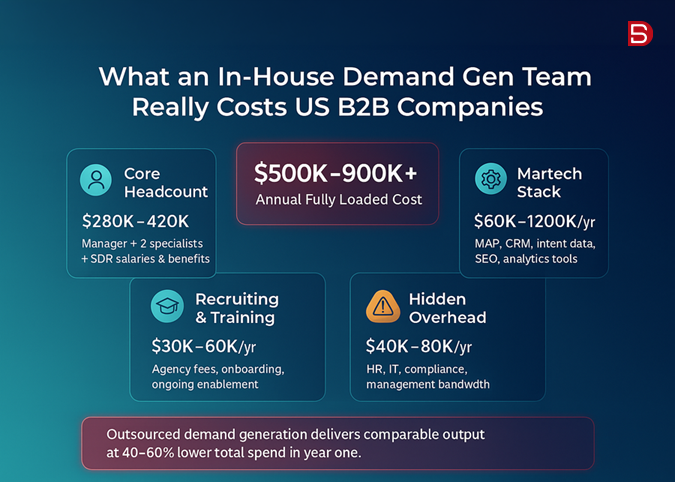
A realistic team isn’t one person. A standard B2B demand-gen pod includes a manager, two SDRs, a content writer, and an ops analyst. Using Glassdoor’s 2026 US salary data, fully loaded costs run about $520,000 per year with benefits, tools, and taxes. That is $43,000 per month before you buy a single ad (Source: Glassdoor, 2026). Read that last line twice.
Then there’s ramp. New SDR representatives require 60–120 days reaching productive capacity, during which companies pay full salaries for partial output (Source: AVPIA, 2025). You’re paying full freight for a fraction of the pipeline.
Turnover makes it worse. The Bridge Group 2025 SDR Report shows average SDR tenure at 14 months, with replacement costs of $115,000 per seat (Source: The Bridge Group, 2025). Slow quarters add idle capacity you can’t easily shed.
To be fair, in-house isn’t just cost. It builds something you can’t rent: an in-house team builds institutional knowledge, owns the data, and sits inside your compliance program. That compounding knowledge is the real asset.
Demand generation pricing: how the outsourced models compare
You’ll run into three main structures. Each hides something different.
Retainer is the most common: a fixed monthly fee for an agreed scope. A solid starting budget is $3,000–$8,000/month for a single-channel program. Multi-channel outbound programs typically start around $5,000–$10,000/month (Source: Cleverly, 2026). Predictable, but you pay whether or not the pipeline shows up.
Per-lead ties spend to delivery. According to 2025 industry benchmarks, B2B lead generation costs typically range from $150 to $1,200 per qualified lead, depending on industry and channel. US targeting sits at the higher end.
Performance models pay on booked meetings or opportunities. Lower risk on paper, higher per-unit cost in practice.
Now the warning. The cheapest cost per lead almost always hides something. Stop chasing the cheapest CPL. A good benchmark is keeping CPL under 10-20% of your annual contract value, and tracking cost per opportunity and cost per closed deal, not just cost per lead. Bargain leads are often shared across multiple buyers, loosely qualified, or built on data you don’t get to keep. Ask what you actually own.
Why in-house teams stall on speed (and outsourcing wins on ramp)
Speed is where outsourcing earns its keep. It’s not close.
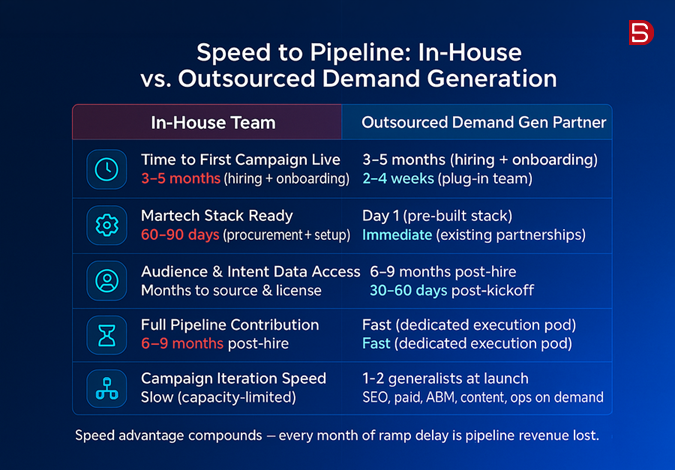
Building internally is slow by design. According to Pavilion’s 2025 GTM Benchmark Report, the median SaaS company takes 4.5 months to hire a senior demand gen marketer and another 3–6 months for that hire to ramp to full productivity. That’s 7–10 months before your in-house hire produces pipeline. Nearly a year of runway gone before the first qualified meeting lands.
An external partner starts from a running position. Agencies typically produce measurable pipeline within 30–60 days. In-house teams take 7–10 months. The infrastructure, playbooks, and trained people already exist. You’re renting a warm engine instead of building a cold one.
Then a rep quits, and the rehiring cycle resets the clock. That’s the recurring tax on internal builds.
Here’s the tradeoff, though, and it’s a real one: fast external launches carry an exit risk. When the contract ends, the knowledge and the momentum can walk out with the vendor, unless you’ve kept your data, your ICP, and your reporting inside your own systems from day one. Speed you rent is speed you can lose.
Where in-house still beats a demand generation agency
When does keeping demand gen internal actually make sense? More often than the outsourcing crowd admits.
If your pipeline volume is steady and predictable quarter over quarter, an internal team pays for itself. There’s no per-lead markup, no contract renewal negotiation, and no ramp lag when priorities shift midweek.
Deep product complexity is the other big one. If it takes six weeks to teach someone why your platform matters to a niche buyer, an external rep churning through accounts won’t carry that nuance. Internal teams absorb it and keep it.
Strong existing competency seals the case. When you’ve already got demand gen operators who know your ICP cold, adding outside help can slow you down, not speed you up.
Here’s the honest catch: in-house rarely flexes well against uneven demand. A product launch, a new market push, or a slow summer exposes fixed headcount fast. You’re either overstaffed and burning budget or understaffed and missing the window. That rigidity is exactly where a hybrid earns its keep.
The data and compliance layer most demand generation companies underestimate
Why do good campaigns quietly bleed money regardless of who runs them? Bad data.
Dead records, wrong titles, and stale phone numbers drain budget on both in-house and outsourced models. B2B data decays fast, with contact information degrading at roughly 30% per year as people change jobs. Every bounced email and disconnected call is spend you never recover.
Compliance is the second silent cost. US buyers now operate under CCPA, and state-level privacy laws keep multiplying, each with its own consent and opt-out rules. A pure list broker hands you records and walks away. When a regulator or an angry prospect asks how a name entered your database, “we bought a list” isn’t a defense.
This is where a certified data operation earns trust that a broker can’t. ISO 27001-certified processing, documented consent, and human QA on records mean the data holding up your campaigns is data you can actually stand behind.
The uncomfortable truth: many demand generation companies treat data as an afterthought. Fix the foundation first, then worry about volume.
The hybrid model: own strategy and data, rent execution
What does the winning arrangement actually look like for US mid-market teams? Keep the brain in-house, rent the muscle.
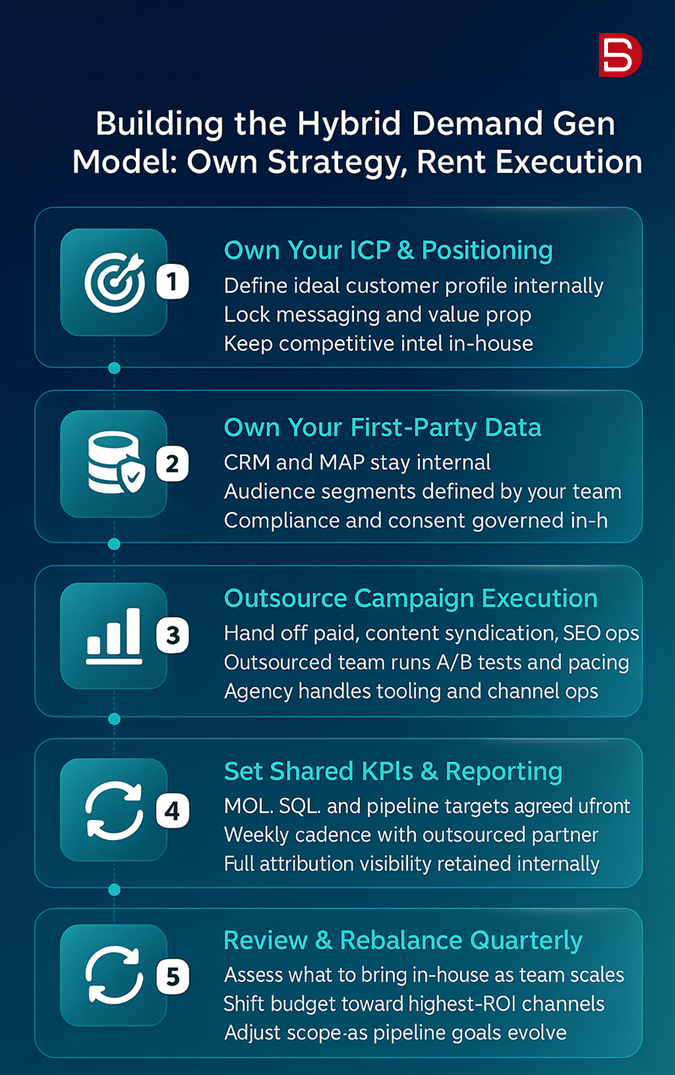
Most teams that land here own strategy, ICP definition, messaging, and CRM hygiene internally. Then they hand execution, content syndication, BANT qualification, appointment setting, and buying group outreach to an external partner built for scale.
Function | Keep in-house | Rent (outsource) |
|---|---|---|
ICP and positioning | Yes | No |
Messaging and content strategy | Yes | No |
CRM and data hygiene ownership | Yes | Support only |
Content syndication | No | Yes |
BANT lead qualification | No | Yes |
Appointment setting | No | Yes |
Buying group outreach at scale | No | Yes |
The flag worth raising: hybrid breaks when you rent the wrong layer. Hand off your ICP and messaging, and you’ve outsourced your own pipeline logic to someone who doesn’t live in your market.
Own the strategy. Rent the execution. That split is why outsourced demand generation works best as amplification, not replacement.
How to choose: a build-vs-buy checklist for US revenue leaders
So how do you actually decide? Run your situation through four questions.
Volume. Is demand steady or spiky? Predictable volume favors in-house. Uneven or seasonal demand favors an outsourced or hybrid setup that flexes without fixed headcount.
Stage. Early-stage and testing new segments? Outsourcing buys speed and avoids a premature hiring bet. Mature motion with a proven playbook? Internal ownership compounds.
Budget. Fully loaded internal cost, salary, tools, data, and idle capacity, often runs higher than leaders expect. Compare it honestly against a demand generation agency retainer before assuming in-house is cheaper.
Geography. Selling across US regions or into new markets? An external partner with verified data and compliance coverage shortens the runway.
No single answer fits every company. The right call shifts as you scale, and the team that’s pure in-house at 50 employees usually runs hybrid by 500. Revisit the math yearly, because the answer that fit last year rarely fits the next one.
Ready to pressure-test your build-vs-buy math?
- FAQS
Frequently asked questions
1. What is outsourced demand generation?
Outsourced demand generation is when a US B2B company hires an external agency or specialized partner to run pipeline-building activities like content, paid media, SEO, email, and lead nurturing. Instead of staffing every role internally, you rent proven expertise, tools, and processes. It works best for functions that need niche skills, fast scaling, or channels your internal team lacks bandwidth to master. Most successful teams blend outsourced execution with in-house strategy and brand ownership rather than handing over everything.
2. Is it cheaper to outsource demand generation or build an in-house team?
It depends on scope and timeline. Building in-house carries salaries, benefits, tools, and ramp time, often exceeding $500K annually for a full team. Outsourcing converts that into a predictable monthly retainer with faster time to value and no hiring risk. For early-stage or scaling companies, outsourcing is usually cheaper upfront. For mature teams with steady, high-volume needs, in-house can lower long-term cost per lead. The smartest approach compares total cost of ownership, not just headline price.
3. What should stay in-house versus be outsourced?
Keep strategy, brand voice, positioning, product knowledge, and customer data ownership inside your walls. These define your identity and require deep context. Outsource execution-heavy or specialized functions: paid media management, SEO, content production, technical campaign builds, and channels requiring rare expertise. This split lets your internal team focus on direction while partners deliver scale and speed. Getting the boundary wrong, outsourcing strategy or insourcing niche skills you lack, is where most US B2B teams lose momentum.
4. How do I know if my company is ready to outsource demand generation?
You are likely ready if pipeline goals outpace internal bandwidth, you lack expertise in key channels, or hiring timelines are too slow for your targets. Other signals include stalled growth, unclear attribution, or a small team stretched thin. Before outsourcing, define your goals, target accounts, and success metrics clearly. A partner amplifies a working foundation but cannot fix broken positioning or a missing ideal customer profile. If your strategy is solid but execution lags, outsourcing fits.