


Most sales teams do not have a volume problem. They have a relevance problem.
The pipeline looks full. The leads do not convert. Sales burns hours chasing contacts with no budget, no authority, and no urgency. That is a qualification problem, not a lead generation one.
Outsourced B2B lead generation solves exactly that. Done well, it protects your account executives by ensuring they only talk to people ready for a real conversation. But it requires process discipline, a shared definition of “qualified,” and the right metrics to track whether it is working.
Why MQLs are not enough: The case for sales qualified leads
Treating marketing qualified leads and sales qualified leads as the same thing is where most B2B pipeline problems start.
An MQL has shown interest: downloaded a whitepaper, attended a webinar, clicked a campaign. They know you exist. That is the beginning, not the finish line.
An SQL is further along. Someone has spoken to them, confirmed a live business problem, verified authority and budget, and established that the timing is real.
Industry data puts the average MQL-to-SQL conversion rate at 13% across B2B. That means 87 out of every 100 MQLs handed over by marketing will not become sales opportunities.
An outsourced B2B lead generation partner sits between those two stages: filtering the MQL pool, running qualified conversations, and passing only leads that meet SQL criteria. Your AEs should not be doing that filtering.
- KEY TAKEAWAY
Define the partner’s role as qualification, not just outreach. MQLs start the process. SQLs are the goal.
BANT lead qualification: Why it is still the gold standard
BANT is not new. It is also not going away, because it asks the four questions that determine whether a conversation is actually worth having.
Budget: Does the prospect have capacity to buy?
Authority: Are you talking to a decision-maker?
Need: Is there an active problem your product solves?
Timeline: Is there pressure to act soon?
A good outsourced team does not work through BANT as a checklist. They work through it as a conversation. A checklist produces yes/no answers. A conversation surfaces nuance, identifies objections early, and gives your AEs the context they need going in.
This is where a specialist earns the fee. A generic call center reads a script. A specialist runs a BANT sales process because they understand the value is not in call volume; it is in qualified pipeline.
Companies using BANT report 59% higher conversion rates than teams without a structured qualification framework. When a prospect arrives at your AE already BANT-qualified, the conversation starts from a completely different position.
- KEY TAKEAWAY
BANT lead qualification is not a formality. It is what separates a provider worth paying from one that is generating noise.
B2B lead generation pricing: What you are actually paying for
The first question most companies ask about outsourced B2B lead generation is: what does it cost? It depends entirely on what you are buying.
Cost per lead in B2B ranges from $175 to $850 in 2026, depending on channel and industry. SEO leads sit at the lower end; event-sourced leads can exceed $800. Outsourced BANT qualification adds a layer on top because you are paying for human judgment applied to each conversation, not just raw contact volume.
Two main pricing structures exist. Pay-per-lead suits teams that need volume and have an internal qualification layer. Retainer-based works better for complex, high-value sales cycles where the provider needs time to understand your product, buyers, and competitive context.
The cheap leads calculation looks good on a spreadsheet until you count how many your AEs actually converted. A lower cost per lead at 5% conversion almost always costs more than a higher one at 25%.
Build in two to four weeks of onboarding regardless of which model you choose. The provider needs to absorb your buyer personas, objection landscape, and brand voice before they can represent you credibly.
- KEY TAKEAWAY
Judge pricing by cost per qualified lead. That single shift in the denominator changes the whole ROI picture.
The KPIs that actually tell you if outsourced B2B lead generation is working
Most companies default to tracking lead volume. That is the wrong number. Volume tells you how busy the partner is, not whether your pipeline is better.
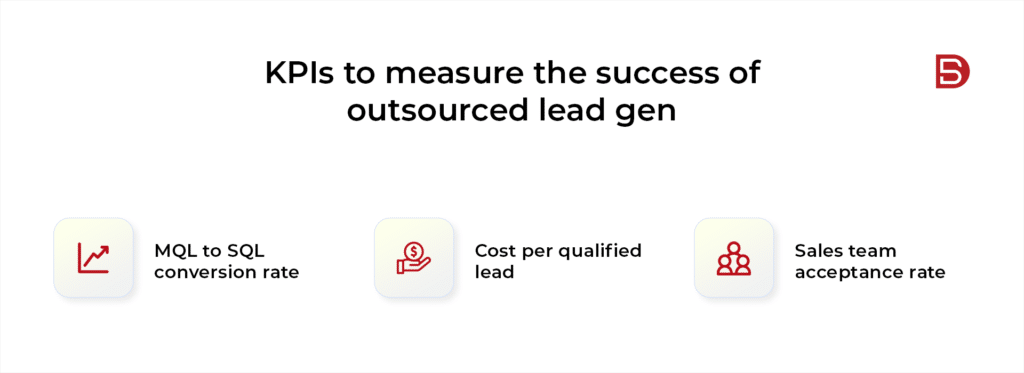
Three metrics actually matter.
MQL to SQL conversion rate. This is the primary signal of qualification quality. According to HubSpot’s 2026 State of Marketing Report, lead quality and MQLs are the top priority metric for 39% of B2B marketers. If the conversion rate from your outsourced partner consistently sits well below industry benchmark, the problem is either in the brief, the ICP, or the BANT criteria. All three are fixable.
Cost per qualified lead. Take the total engagement cost and divide by the number of SQLs delivered. This is the number that makes or breaks the ROI case. Nothing else comes close.
Sales team acceptance rate. Track how many outsourced leads your AEs actually progressed. If sales is consistently walking leads back, that is not random variance. It is feedback. Feed it directly back to your outsourced partner and adjust the qualification criteria.
That feedback loop is the mechanism by which the engagement gets better over time.
- KEY TAKEAWAY
Track MQL-to-SQL conversion rate, cost per qualified lead, and AE acceptance rate. Those three numbers together tell the full story.
How Datamatics Business Solutions approaches this
At Datamatics Business Solutions, outsourced B2B lead generation runs on a structured process. It includes data-verified prospect lists, multi-touch outreach, and BANT-aligned qualification handled by trained specialists.
Onboarding is deliberate. Before a single call is made, the team maps your ICP, buyer personas, objection landscape, and competitive context. That groundwork is what separates a partner that builds pipeline from one that builds reports. If there is a gap between MQL volume and actual sales-ready pipeline, that is a solvable problem.
Book a 15-minute qualification gap assessment to see where the drop-off is happening and what a structured lead qualification process could deliver instead.
- FAQS
Frequently asked questions
1. How long does it take to see results from outsourced B2B lead generation?
When it comes to outsourced B2B lead generation, most teams start seeing meaningful results in about 30 to 60 days. The first few weeks usually go into onboarding and getting the external team up to speed on your product, your buyers, and how you position yourself. After that, it shifts into testing messaging, refining outreach, and figuring out what actually works. Once that groundwork is in place, you will start seeing a more consistent flow of sales-ready conversations. Teams that rush this part often end up with volume, but not quality.
2. Is BANT lead qualification still relevant in 2026?
Yes, and for a simple reason. It still answers the questions that matter. Whether the prospect has the budget to invest or if they are the right people. All these are answered by BANT lead qualification. Some teams layer in additional signals now, like stakeholder complexity or buying intent. However, BANT continues to be the backbone of most serious qualification processes.
3. What is the typical B2B lead generation pricing model?
There are two types of B2B lead generation pricing models. The pay-per-lead model is straightforward and works when the goal is scale. A retainer-based model is more common in complex B2B environments, where qualification takes time and context. In those cases, you are not just paying for leads. You are paying for better conversations. That is why retainers tend to produce more consistent SQL quality, especially for enterprise sales.
4. How do you ensure the outsourced team actually understands your product?
It comes down to how seriously onboarding is handled. The better the handover, the better the output. This means sharing clear buyer personas, common objections, product nuances, and even how your sales team typically handles conversations. The more context the external team has, the faster they start sounding like an extension of your own team instead of a third party.
5. What is the difference between an MQL and a BANT-qualified SQL?
An MQL is someone who has shown interest. They have interacted with your content or engaged with a campaign. That is a signal, but it is still early. A BANT-qualified SQL has had a real conversation. There is a defined problem, some level of budget alignment, clarity on who is involved in the decision, and a sense of timing. One sits in your funnel. The other is something your sales team can actually act on.