


Sales reps rarely struggle to find contacts. They struggle to trust the ones already sitting in the CRM. A B2B contact database that looks complete in a dashboard can still send a rep calling a number disconnected months ago. That gap between volume and usefulness decides whether a pipeline converts or stalls.
Building a B2B contact database a sales team actually opens and works from takes a different approach than importing a purchased list and calling the job done. This blog walks through what that approach looks like in practice.
Why most B2B contact databases lose sales team trust
A B2B contact database rarely fails because it is empty. It fails when the records inside stop matching reality. Job titles change, people switch companies, and phone numbers get reassigned faster than most teams update their systems.
Independent research on data decay puts the scale of the problem in perspective. B2B contact data decays at roughly 2.1% every month, which compounds to close to 22.5% annually. Nearly a quarter of a typical database becomes materially inaccurate within twelve months.
Job changes drive much of this. Dun & Bradstreet estimates that roughly 20 to 30% of firmographic B2B data becomes obsolete each year, since a single move to a new company invalidates a title, an email, and a phone extension all at once.
The cost shows up in rep hours, not only in bounced emails. ZoomInfo research shows sales reps lose close to 27% of their working time to bad data, equal to roughly 550 hours and 32,000 US dollars in lost productivity per rep each year. For a twenty person sales team, that waste adds up fast.
A maintenance plan fixes this. A B2B contact database needs ownership, structure, and a refresh cycle built in from day one, not added once the complaints start.
- KEY TAKEAWAY
Data decay is constant and measurable. A B2B contact database without a maintenance plan degrades on a predictable schedule, and the cost lands on sales productivity first.
What a usable B2B contact database needs beyond contact information
Volume gets a database built. However, the structure of the database is what makes it usable. A sales rep needs more than a name, an email, and a company name. These are going starting points, but not enough to close deals. They need enough context to know who to call first.
What does a well-built B2B contact database include?
Contact details alone rarely tell a rep whether an account is worth prioritizing. Depth matters more than volume once a database reaches a reasonable size. The fields below give reps the context to make that call without leaving the CRM.
- Firmographic detail such as company size, industry, and revenue band
- Role level, department, and reporting line
- Buying signals such as recent funding, expansion, or leadership change
- Source and last verified date on every record
Without this layer, reps spend research time recreating context that should already sit in the record.
Why custom data solutions outperform generic exports
A list bought off the shelf reflects someone else’s definition of a good fit account, not the definition built for your pipeline. Working with a partner who can customize your database around your actual ideal customer profile, industry vertical, and deal size produces records a rep can act on immediately.
Custom data solutions also carry weight for compliance. Fields, consent status, and source tracking need to match the regions a company sells into, something a generic list rarely accounts for, and something worth building into the database from the start rather than patching in later.
- KEY TAKEAWAY
A B2B contact database earns trust when it is built around a defined ideal customer profile, not assembled from a generic list and hoped into shape.
Data building services versus buying from B2B data providers
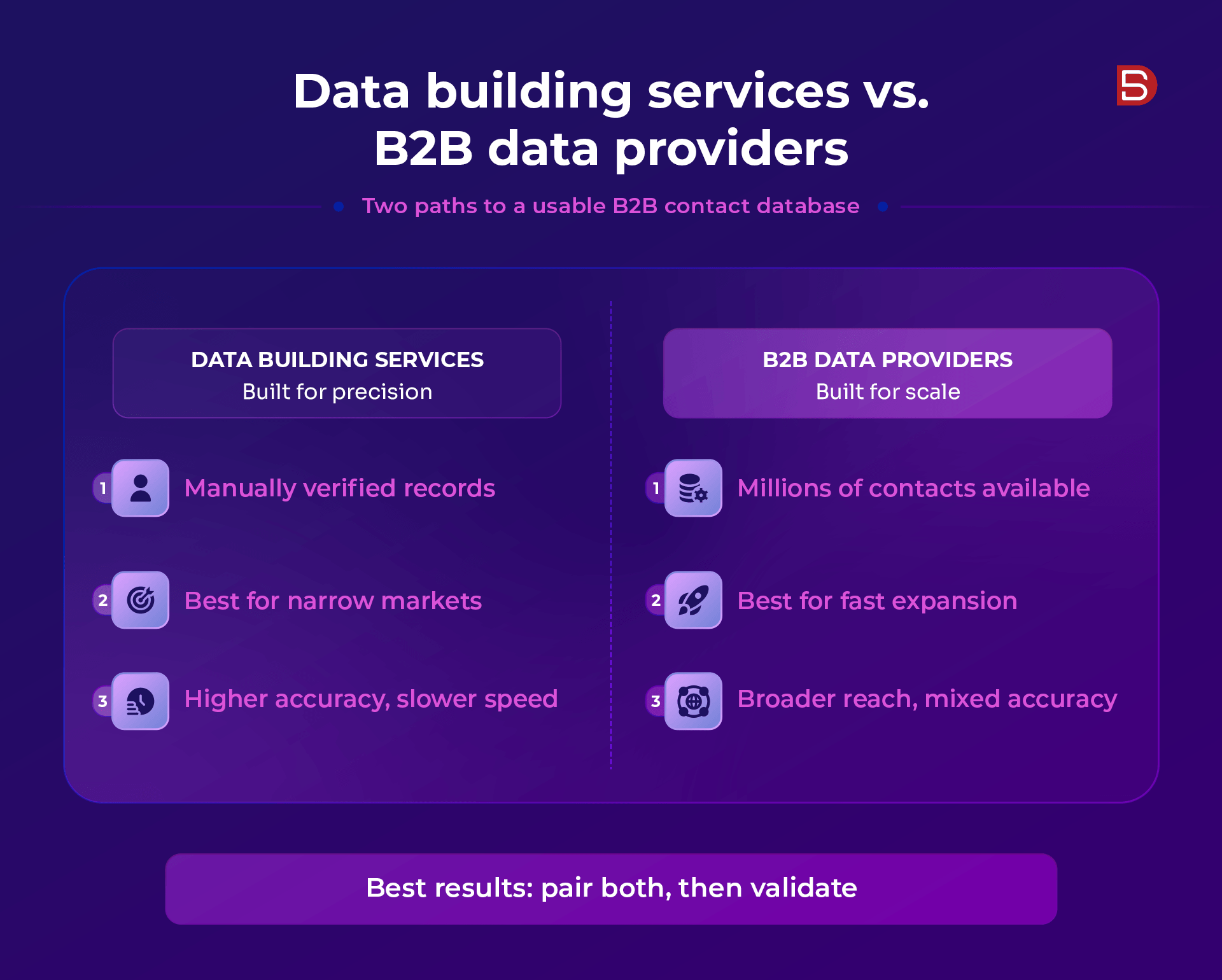
Teams generally choose between two paths to build a database: use dedicated data building services to construct records from scratch, or purchase data from established B2B data providers and layer enrichment on top.
When data building services make sense
This path suits a company selling into a narrow, well defined market where precision matters more than speed. A research team can verify each record against public filings, company websites, and direct outreach. That level of accuracy is hard for automated scraping to match on its own.
When B2B data providers make sense
Scale is the draw here. Established B2B data providers maintain databases running into millions of contacts, refreshed on a set schedule, which works well for a company expanding into new markets or industries quickly. The catch is that accuracy across these purchased lists varies a fair amount, and merging several sources without deduplication piles up conflicting or duplicate records fast.
Most enterprise teams end up using both. A core list built through targeted data building services anchors the database, B2B data providers fill in the coverage as the company grows, and a validation step catches conflicts before anything reaches the CRM.
- KEY TAKEAWAY
Data building services bring precision, B2B data providers bring scale. Pairing them, with a verification step in between, tends to outperform relying on either alone.
Keeping the B2B contact database accurate after launch
A B2B contact database needs upkeep the same way a CRM pipeline does. Skip the refresh cycle and the accuracy built in on day one starts eroding within a few months.
The right cadence depends on how fast a segment moves. Software and technology contacts shift often enough to need monthly or quarterly checks. Manufacturing and other steadier sectors can go longer between passes.
Some of this can run inside the CRM itself:
- Flag records untouched for more than ninety days
- Require a source and date on every new entry
- Route duplicate detection before records merge
None of these are complicated on their own. Together, they are what keeps a sales team’s confidence in the data intact.
- KEY TAKEAWAY
A B2B contact database holds up only when refresh cycles and ownership are part of the daily process, handled by someone specific, rather than a clean-up project that gets scheduled when the complaints start.
Getting sales to actually use the database
Clean data will not pull a rep away from their personal spreadsheet on its own. Adoption is more about visibility and trust than it is about accuracy alone.
Reps check the CRM first when it gives them a reason to. Put the most current, most relevant records at the top of the queue rather than behind filters. A visible data source and last verified date also helps, since reps can see exactly what they are working from instead of guessing.
Feedback matters here too. A rep flagging a bad number or an outdated title should update the actual source record, not just live in a personal note somewhere. That is what eventually makes the database feel like something the team owns together, rather than something handed down to them.
- KEY TAKEAWAY
A B2B contact database earns adoption once reps notice it is saving them time rather than adding to their workload.
How DBSL supports B2B contact database and demand generation programs
Datamatics Business Solutions Ltd. supports enterprise teams across this entire process, from building the database to keeping it accurate long after launch. DBSL has delivered more than 232 million data records to clients across more than 15 industry verticals, with data accuracy at 95%.
The combination of scale and precision comes from targeted efforts. Using a hybrid approach, which sees a combination of AI and humans, DBSL offers targeted data building services, custom data solutions matched to a defined ideal customer profile, and verification cycles that do not stop once the database goes live.
The result is a B2B contact database sales teams actually trust, one that supports stronger demand generation and gives leadership numbers they can act on with confidence.
- FAQS
Frequently asked questions
1. What is a B2B contact database?
A B2B contact database is a structured collection of business contact records, typically including names, roles, company details, and communication information, used by sales and marketing teams to identify and reach decision makers.
2. How often should a B2B contact database be updated?
Update frequency depends on how fast a market moves. Fast moving sectors such as technology benefit from monthly or quarterly verification, while more stable industries can run on a longer cycle without significant accuracy loss.
3. What is the difference between data building services and B2B data providers?
Data building services construct records manually or semi-manually for precision in a narrow market, while B2B data providers supply large volumes of pre-built contact data at scale. Most enterprise teams combine both for coverage and accuracy.
4. How can a company customize its database for its own sales process?
Customizing a database means mapping fields, segments, and enrichment data to a specific ideal customer profile, rather than relying on a generic template. This makes records easier for a rep to prioritize and act on.
5. Why do sales teams stop using the database in their CRM?
Sales teams disengage from a CRM database when the records inside it are outdated or incomplete. Once reps lose trust in the data, they build workarounds such as personal spreadsheets, which fragments accuracy further.