


Demand generation for SaaS has changed more in the past two years than in the previous ten. Buyers research alone. They ask AI tools before they ask a salesperson, and they arrive at a shortlist long before anyone fills out a form.
Programs built for 2022 buying behavior are quietly failing in 2026. This playbook lays out what demand generation for SaaS actually requires now, and how to build a program that holds up against real buyer behavior.
Why demand generation for SaaS needs a new operating model
The old model assumed buyers wanted a salesperson early. That assumption no longer holds.
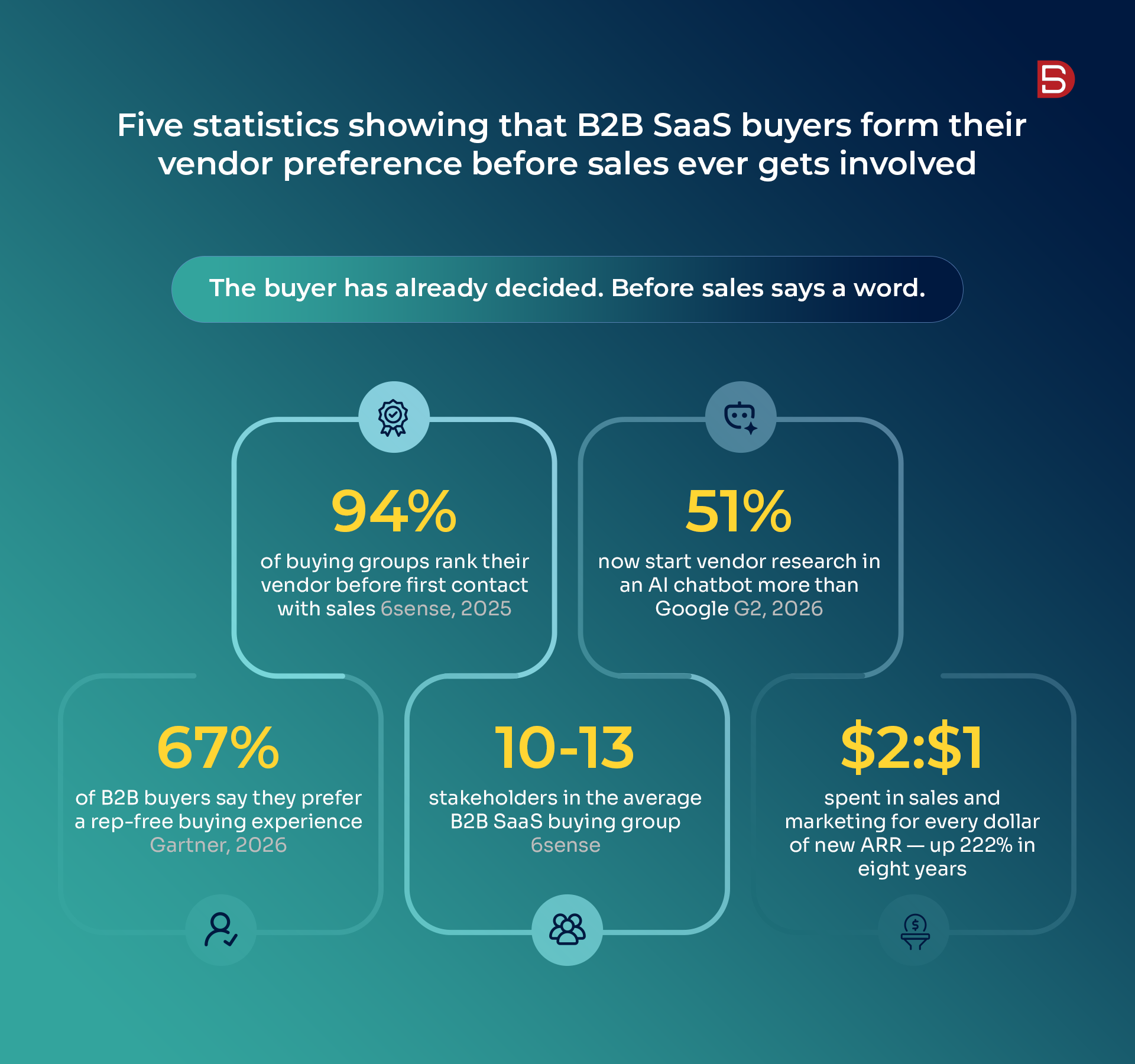
Gartner’s 2026 survey puts a number on it: 67% of B2B buyers now prefer a rep-free experience, and 45% used AI somewhere in a recent purchase. The buyer journey isn’t just moving online. It’s moving away from sales entirely, at least at the start.
That shift shows up before sales ever gets a call. 6sense’s 2025 B2B Buyer Experience Report, drawn from over 4,000 B2B buyers, found that 94% of buying groups already have vendors ranked by preference before they talk to a single seller. And those ranking sticks. The vendor sitting at number one closes the deal 77% of the time.
- KEY TAKEAWAY
If a brand is not visible while the buying group is still forming its ranking, it will not be first choice by the time sales gets the call.
The buying committee is bigger, and the funnel was not built for it
SaaS purchases are rarely single-buyer decisions anymore. 6sense’s research on B2B buying groups puts the average buying group at roughly 10 to 11 people in North America, and closer to 13 in APAC. Each one can stall the deal for a different reason: end users, technical evaluators, finance, compliance, and an executive sponsor all weigh in.
This is where demand generation best practices diverge from lead generation tactics. Lead generation captures one name. Demand generation for SaaS has to build awareness and trust across the entire committee, not just the person who filled out the form.
- KEY TAKEAWAY
A single MQL says nothing about whether the buying group is aligned. Programs need to reach the full committee, not just the form-filler.
Demand generation best practices for the AI search era
Buyer research has moved into AI tools, and most SaaS companies have not caught up. G2’s April 2026 report, based on a March 2026 survey of 1,076 B2B software buyers, found that 51% now start their vendor research in an AI chatbot more often than in Google. This is up from 29% just eleven months earlier.
That shift carries a direct cost for vendors who aren’t visible inside it. The same G2 research found that 69% of buyers chose a different vendor than they had originally planned, based on what an AI chatbot recommended. Moreover, one in three purchased from a vendor they had never heard of before. Invisibility in AI-mediated research doesn’t just mean fewer leads. It means getting swapped out for whoever the AI does surface.
Closing that gap means building content for both search engines and AI answer engines, and tightening ICP scoring at the top of the funnel. Volume without qualification only inflates a number that leadership has stopped trusting.
- KEY TAKEAWAY
Where ABM demand generation fits into the SaaS growth stack
Not every account is worth the same effort. That’s the logic behind ABM demand generation: put budget where accounts are actually likely to close, then keep content, paid media, and outreach saying the same thing to each one.
For SaaS companies with a clear ICP and a contract value worth chasing, this usually beats broad-funnel campaigns on pipeline efficiency, even with fewer accounts in the mix. The catch is discipline. Account tiering. Real alignment between sales and marketing. And the nerve to walk away from accounts that don’t fit the ICP.
- KEY TAKEAWAY
ABM demand generation works when the target list is tight and the message is coordinated across every channel that account touches.
Choosing a B2B demand generation agency for scale
Building all of this in-house takes time most SaaS companies do not have. This is usually when a B2B demand generation agency enters the conversation.
Acquisition costs make the case for getting this right. A study found that the median SaaS company now spends roughly 2 US dollars in sales and marketing for every 1 dollar of new annual recurring revenue. A ratio that has worsened 14 % in the past year and 222 % over the past eight. Inefficient demand generation for SaaS is no longer a marketing problem. It is a unit economics problem.
The right B2B demand generation agency should report on pipeline and revenue contribution, not just MQL volume. Any partner offering B2B demand generation services should be able to explain, account by account, which activity produced which opportunity.
- KEY TAKEAWAY
Rising CAC makes reporting discipline non-negotiable. A capable B2B demand generation agency is measured on pipeline, not activity if the reporting stops at MQLs, the partnership will too.
How DBSL supports demand generation for SaaS
Datamatics Business Solutions supports SaaS and B2B technology companies across the full demand generation for SaaS lifecycle, from verified B2B data and ICP-aligned targeting to content, ABM demand generation programs, and SDR-ready pipeline handoff.
DBSL’s B2B demand generation services are built around measurable business outcomes: visibility, qualified pipeline, and conversion, not activity volume. For companies evaluating a B2B demand generation agency built for operational maturity and scalability, DBSL offers a structured, data-driven starting point.
- FAQS
Frequently asked questions
1.What is demand generation for SaaS?
Demand generation for SaaS is the set of activities that build awareness, trust, and buying intent among target accounts before they ever contact sales. It spans content, SEO, paid media, and account-based programs, and it is measured by pipeline contribution rather than lead volume.
2. How is demand generation different from lead generation?
Lead generation captures contact information from buyers who are already looking. Demand generation for SaaS creates the awareness and trust that gets a buyer to that point in the first place. Most mature programs run both, with demand generation feeding lead generation over time.
3. What demand generation best practices matter most for SaaS specifically?
Three things matter most: content built for the full buying committee, visibility inside AI-mediated research, and tight ICP scoring that keeps volume from masking quality. SaaS companies that skip any one of these tend to see MQL counts rise while pipeline stays flat.
4. When should a SaaS company bring in a B2B demand generation agency instead of building in-house?
Once the buying committee, channel mix, and reporting requirements outgrow what a single in-house function can maintain, a B2B demand generation agency usually accelerates results and shortens the learning curve. The right time is often before internal capacity becomes the constraint, not after.