


A whitepaper sitting on a company website only reaches people who already know it exists. Someone has to search for the topic, land on the page, and choose to fill out a form. Content syndication services remove that dependency, placing the same asset in front of buyers who match the target profile but have never visited the site.
That shift matters more now. Marketing and sales leaders are judged against a pipeline number every quarter. B2B content syndication services have moved from a supporting tactic to one of the more dependable ways to build that pipeline, because the audience is defined before the campaign launches instead of assembled afterward from whoever happened to convert.
- What are B2B content syndication services?
Content syndication services distribute an organization’s existing content, such as whitepapers, guides, and research reports, through third-party publisher networks to reach a defined B2B buyer audience that would not otherwise find it.
What content syndication services actually deliver
Two things determine whether a B2B content syndication program performs. The mechanics behind it and the content chosen to run through it. Here is a breakdown of how the process actually works, then what makes certain assets convert better than others.
How the process works
A syndication provider hosts the asset on its network and builds a target audience using filters such as job title, industry, and company size. The content sits behind a short registration form. Every completed form returns as a lead with verified contact and firmographic data attached.
This works differently from paid advertising, which is priced on clicks, or social promotion, priced on impressions. B2B content syndication services are built around attention from a specific, permissioned audience, and that attention converts into leads sales can follow up on with confidence.
Why the content itself matters
Assets that perform well in syndication solve a real operational problem for the reader instead of promoting a product directly. A few formats consistently outperform product brochures on registration rate:
- Benchmark reports, since they let a buyer compare their own numbers against a market standard
- Buyer’s guides, since they support a decision the buyer is already trying to make
- Research-backed whitepapers, since they carry data a buyer cannot easily get elsewhere
NetLine’s 2025 State of B2B Content Consumption and Demand Report recorded 7.9 million first-party content registrations in 2024, a 27% increase over the prior year. Buyer appetite for gated, third-party content is accelerating, not slowing down.
- KEY TAKEAWAY
Content syndication services turn passive content into an active lead generation channel by placing it directly in front of a matched buyer audience, instead of waiting for that audience to arrive on its own.
How content syndication services qualify leads: MQL, HQL, and BANT explained
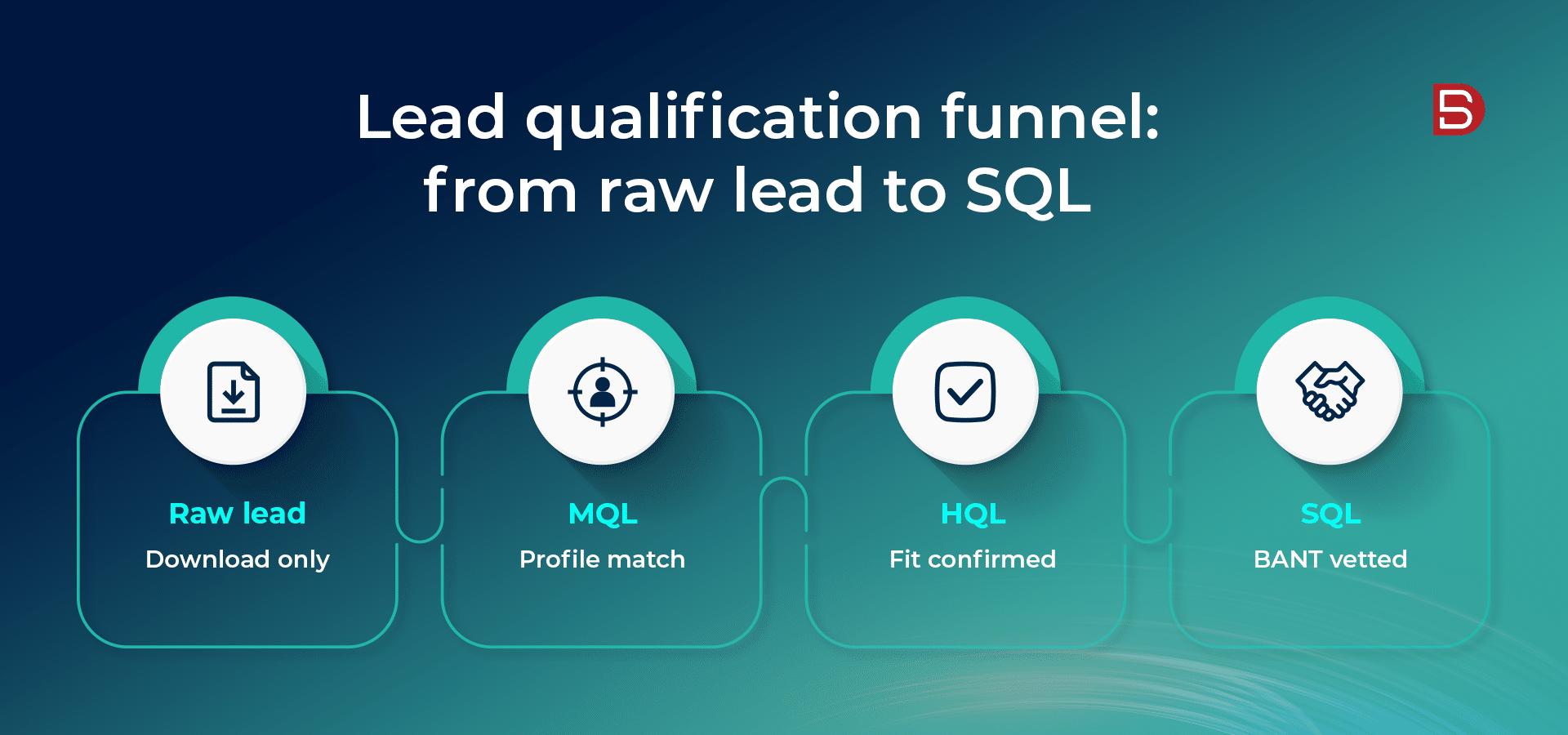
Leads come at different levels of readiness. Every registration moves through four stages before it reaches sales. A mature content syndication strategy filters and sequences them. It moves each contact from raw lead to Marketing Qualified Lead and further before it reaches a sales inbox. That structure keeps sales confidence high.
What defines a Marketing Qualified Lead (MQL)
A Marketing Qualified Lead (MQL) has engaged with the content and fits the target buyer profile: industry, seniority, company size. First Page Sage puts the average lead-to-MQL conversion rate at 31% across industries. That gives marketing teams a real benchmark to plan against.
What defines a High-Intent Qualified Lead (HQL)
An HQL narrows the pool further. Agencies often call this stage a Hand-off Qualified Lead. It layers firmographic and technographic fit onto engagement data, so sales spends time only on accounts that match the ideal customer profile. Reputable content syndication providers build this filter into their targeting from the start.
What is BANT when it comes to Sales Qualified Lead (SQL)
A Sales Qualified Lead (SQL) goes one step further. It gets screened against BANT, the framework sales teams have used for decades:
- Budget checks whether the account has funding allocated for this
- Authority checks whether this contact can influence or make the decision
- Need checks whether the engagement maps to a real operational problem
- Timeline checks whether there is a defined window for deciding
Content syndication services qualify leads through data. Registration forms capture job title, company, and industry at the point of download, and that data gets scored against the ideal customer profile. This is when the lead gets qualified as MQL.
Engagement signals, such as which asset a buyer chose and how they interacted with it, add a second layer of scoring. Firmographic and technographic filters narrow the pool further, confirming company size and tech stack match before a lead earns sales attention. This forms the second layer.
A final BANT layer screens for budget, authority, need, and timeline, usually through the registration form itself or a short follow-up call.
Each layer either advances the lead or stops it, and that sequence is what turns a download into a Sales Qualified Lead.
Marketing and sales track Marketing Qualified Leads and Sales Qualified Leads as separate numbers. That is how both teams stay aligned on what qualified actually means.
- KEY TAKEAWAY
MQL identifies interest, HQL confirms fit, and BANT confirms readiness. Together they turn a content download into a genuine Sales Qualified Lead.
Building a content syndication strategy that performs
A content syndication strategy fails most often when teams chase cost per lead over cost per qualified lead. A cheap, broad list looks efficient until sales rejects most of it.
Start with a clearly defined ideal customer profile. Every filter downstream, MQL, HQL, BANT, depends on getting this input right. A profile built on job title alone misses buying committees, budget authority, and company maturity.
Content format matters as much as the profile. Early-stage buyers respond to educational guides. Buyers closer to a decision respond to benchmark reports and calculators that let them see where they stand against peers.
HubSpot’s 2026 State of Marketing Report found that 40% of marketers now rank lead quality and MQL volume as their top success metric, ahead of every other measure they track. A B2B content syndication program optimized purely for registration volume is optimizing for the wrong number.
Measure MQL-to-SQL conversion, not registration volume. A campaign producing 500 registrations and 20 sales-ready leads outperforms one producing 2,000 registrations and 15.
- KEY TAKEAWAY
A content syndication strategy built around ICP fit and funnel-stage content converts more efficiently than one built around volume alone.
Choosing content syndication partners and providers
Not every content syndication partner operates with the same rigor. Some rely on generic opt-in lists with limited firmographic accuracy. And there are others that maintain first-party permission data and verified professional audiences. So how are these different? Well, it shows up directly in MQL and HQL conversion rates.
When evaluating content syndication providers, look for:
- Verified, permissioned audiences rather than purchased lists
- Filtering by firmographic and technographic criteria
- Clear reporting on engagement and buyer intent
- Support for GDPR and regional data protection requirements
Methodology is the real test. A B2B content syndication provider that can explain how it sources the leads, verifies those, and whether it refreshes its audience data gives marketing something to audit. One that cannot answer basic questions about data provenance is a compliance risk as much as a performance one.
- KEY TAKEAWAY
The right content syndication partners treat lead quality as a shared outcome. Reliable reporting and audience transparency matter more than list size.
Content syndication for agencies: Why the model scales
Content syndication for agencies solves a resourcing problem. Agencies managing multiple B2B clients cannot build a dedicated demand generation function for each account. Syndication offers a repeatable channel that plugs into existing content libraries instead.
The strongest content syndication providers support white-label reporting, flexible campaign structures, and fast asset turnaround. That combination lets an agency stand up a new client program without rebuilding its process each time, or waiting weeks between asset submission and a live campaign.
Attribution is where this matters most. When each account’s leads carry a documented source and engagement history, an agency can show clients exactly what the spend produced. This can be done without building custom tracking for every client relationship.
- KEY TAKEAWAY
Content syndication for agencies turns existing client content into a scalable, trackable lead generation channel, without expanding headcount.
How DBSL supports content syndication and demand generation
DBSL structures content syndication around multiple stages. Every lead generated using the syndication capabilities run through multiple checks that combine AI screening with human review.
With a massive third-party platform reach, DBSL offers services across North America, EMEA and APAC. All syndication campaigns are tracked in real time, and underperforming segments get flagged and adjusted mid-flight.
With clients witnessing 35%+ MQL to SQL conversions and 3x higher lead verification accuracy, DBSL uses B2B content syndication to deliver quality leads that are also CRM-ready. Want to know more about DBSL’s content syndication services? Schedule a 15-minute demo call.
- FAQS
Frequently asked questions
1. What is the difference between content syndication and content marketing?
Content marketing covers the full practice of creating and distributing content to build audience and trust. Content syndication is a specific distribution tactic within that practice, placing existing content on third-party platforms to reach a wider, targeted audience and generate first-party leads.
2. How is a lead qualified as an MQL versus a Sales Qualified Lead?
A lead becomes an MQL once it matches the target buyer profile and has engaged meaningfully with content. It becomes a Sales Qualified Lead once it has been vetted against additional criteria, often using the BANT framework, confirming budget, authority, need, and timeline before sales invests time in outreach.
3. What makes a lead an HQL instead of just an MQL?
An HQL adds firmographic and behavioral filtering to MQL data, confirming that the lead matches the ideal customer profile before it reaches sales. In agency programs, this stage is sometimes called a Hand-off Qualified Lead.
4. Is content syndication suitable for smaller B2B budgets?
Yes. Campaigns can be scoped by volume, industry, and audience size, so content syndication services scale to fit budgets smaller than those required for broad paid advertising, while still delivering first-party, permissioned leads.
5. Can content syndication support agency-run, multi-client programs?
Yes. Content syndication for agencies works best with providers that support white-label reporting and flexible campaign structures, letting one team run compliant, well-targeted programs across several client accounts at once