


Marketing hands over 500 leads from last quarter’s content syndication push and calls it a win. Three months later, the pipeline report barely shows movement, and sales starts asking pointed questions on the weekly forecast call. So, the question is where did all these leads go?
Nobody made an error entering the numbers. A lead is a person who downloaded something. An opportunity is a person actively evaluating a purchase, with budget and a timeline attached to it. Most B2B teams lose the plot in the space between those two definitions, and closing that space starts with naming it honestly instead of arguing over whose report is wrong.
Why content syndication leads look strong on paper
Content syndication leads pile up fast because the format is built for volume. A gated asset placed across a partner network reaches thousands of professionals who match a target list. Every download becomes a lead the moment someone submits a form.
That speed creates an optical illusion. Gartner has found that 67% of B2B buyers now prefer a rep-free buying experience. This means that most of these downloads happen long before anyone is ready to talk to sales. Someone filling out that form in week one of their research is doing exactly what marketing wants. Calling them a buyer three months early, before a pipeline review makes the mismatch obvious, is where the trouble starts.
Volume also compresses quality signals. First Page Sage’s research puts the average lead-to-MQL conversion rate across all industries and channels at 31%. That is the baseline content syndication leads have to earn against. Scale without qualification just produces a longer list, and a longer list does not tell sales which fifty names are worth calling first.
Marketing leadership often leans on that raw number because it is the easiest thing to report on a monthly dashboard. It shows up the moment the first form comes in, weeks before anyone knows whether the account will amount to anything. Pipeline takes months to materialize, and depends on variables nobody in marketing controls directly.
That timing gap explains why the two numbers feel disconnected even when the program is healthy. A campaign launched in January can still be feeding qualified conversations in April, but the lead count from January already got compared against February’s pipeline report, as if the two numbers should line up on the same calendar.
- KEY TAKEAWAY
A high lead count from content syndication reflects reach, not readiness, and reach alone rarely survives contact with a sales team.
Where B2B content syndication leads stall before pipeline
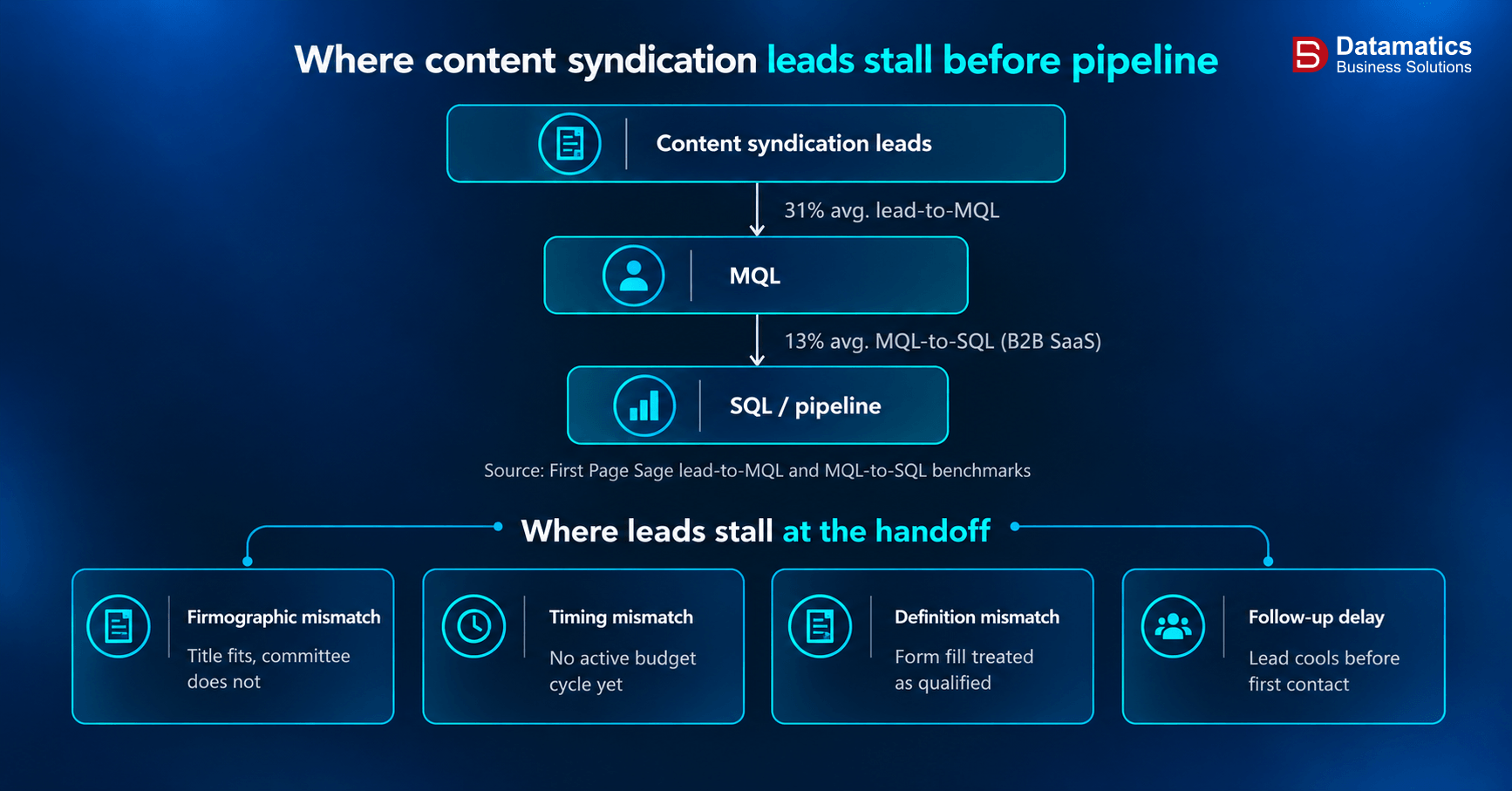
The drop-off between B2B content syndication leads and closed pipeline usually happens in the handoff and not during the campaign itself. Marketing and sales frequently define “qualified” differently, and that mismatch shows up as leads sales will not touch. This is regardless of how well the original campaign performed.
First Page Sage’s industry benchmarks show B2B SaaS companies converting MQLs to SQLs at just 13% on average. Even leads that clear the first qualification bar face a second, steeper one before they count as real revenue potential. Most syndication programs are never measured past that first bar.
Four breakpoints account for most of the loss:
- Firmographic mismatch, where a title or company size fits the campaign filter but not the actual buying committee behind the account
- Timing mismatch, where the prospect downloaded an asset for research and has no active budget cycle to act on it
- Definition mismatch, where marketing counts a form fill as qualified while sales requires demonstrated intent before engaging
- Follow-up delay, where a lead cools before a sales rep makes first contact, losing the momentum the download created
NetLine’s 2025 State of B2B Content Consumption and Demand Report notes that B2B registrations have increased every year since 2020, while what the report calls the Consumption Gap has widened alongside them. Buyers are downloading plenty of content. However, most programs still struggle to get the right content in front of the right buyer at the right stage of their research.
Consider a typical scenario. A campaign delivers 400 downloads against a well-built ideal customer profile, and marketing marks all 400 as qualified because each one matched the target list. Sales works through the first fifty, finds most of them are individual contributors researching for a manager, and quietly stops calling the rest. The targeting brief did its job. What it never included was a way to separate a matching title from a genuine buying signal. This single missing filter is what produced the stall.
- KEY TAKEAWAY
Most content syndication leads do not fail because the targeting was wrong. They fail because the definition of “ready” was never shared between marketing and sales.
Turning content syndication qualified leads into revenue
Content syndication qualified leads earn that label only when a program filters for fit and intent before the lead ever reaches a sales inbox. That filtering step is where scalability and precision meet, and it is usually the step programs skip when they are optimizing for lead count alone.
A tighter qualification layer typically includes four components. Firmographic and technographic screening belongs in the targeting brief itself, not applied after the fact once leads have already arrived. Intent signals should sit on top of a simple form fill, drawing on content depth, repeat engagement, or account-level research activity to separate a curious visitor from an active buyer.
A shared scoring model, built jointly by marketing and sales, removes the ambiguity around what an MQL and an SQL mean inside a specific organization. A follow-up service level agreement then moves fast-moving leads to a rep within hours rather than days, since intent fades quickly once a download is complete.
None of this requires slowing volume down. It requires building visibility into which leads are worth acting on, so sales effort goes toward accounts with real business outcomes at stake instead of a broad and unfiltered list that looks impressive only until someone tries to work it.
The teams that get this right tend to treat qualification as a shared responsibility rather than a marketing checkbox. Sales contributes the pattern recognition, since reps know within a few calls which firmographic combinations and content-engagement patterns predict a real opportunity. Marketing then builds those patterns back into the targeting and scoring model, so the next wave of content syndication qualified leads arrives already closer to what sales is looking for.
- KEY TAKEAWAY
Quality filtering does not shrink a content syndication program. It tells sales exactly where to spend the hours they already have.
A content syndication strategy built for pipeline
A content syndication strategy that reports on registrations alone hides its own weak spots. Measuring the full funnel and reporting each stage separately instead of as one blended number shows exactly where pipeline gets stuck.
That means tracking lead-to-MQL, MQL-to-SQL, and SQL-to-opportunity rates by source, the same way First Page Sage segments its benchmark data by channel and industry. A campaign that produces fewer, better-matched leads at each stage often outperforms one that produces more raw volume with weaker downstream conversion, even when the second campaign looks better on a top-line report.
It also means building a feedback loop between the two teams. Sales insight on which accounts progressed should shape the next targeting brief, the next asset, and the next syndication partner selection, so each cycle of content syndication leads gets closer to pipeline instead of further from it. Programs that skip this step tend to repeat the same targeting mistakes campaign after campaign, simply because no one closed the loop.
A quarterly funnel review, with marketing and sales looking at the same stage-by-stage numbers together, is usually enough to keep both teams honest about what the program is producing. It replaces the annual argument over whether syndication “works” with a running record of exactly where value is created and where it leaks out.
- KEY TAKEAWAY
Optimization happens stage by stage. A content syndication strategy measured only on lead count will keep generating the same mismatch quarter after quarter.
How DBSL supports content syndication services that convert
Datamatics Business Solutions Ltd offers content syndication services that combine targeted distribution with structured qualification, so lead volume and lead quality grow together instead of trading off. Our B2B data and demand generation teams build firmographic and technographic filters into the campaign brief from day one, then track performance through to SQL and opportunity stage. The result is a content syndication program built for measurable business outcomes, not just registration counts.
To see how DBSL’s content syndication services could apply to your funnel, get in touch with our team.
- FAQS
Frequently asked questions
1. What is the difference between content syndication leads and pipeline?
Content syndication leads are contacts who engaged with a gated asset and match a target profile. Pipeline is the smaller subset of those leads that sales has vetted, engaged, and moved into an active opportunity with a defined value and stage. The distance between the two is a qualification process, not a data problem.
2. Why do content syndication leads convert at a lower rate than other channels?ate lead quality from a content syndication vendor?
Content syndication reaches buyers earlier in their research, often before they have an active budget or a defined project. That earlier stage means more nurturing is required before a lead is ready for a sales conversation, which naturally produces a longer and lower-converting path than a channel like referrals, where intent is already established.
3. What is a good content syndication qualified leads conversion rate?
There is no single universal benchmark, since conversion depends on industry, deal size, and how strictly a team defines “qualified.” Tracking lead-to-MQL and MQL-to-SQL rates by source, and comparing them against a company’s own historical performance, gives a more accurate target than an industry-wide number borrowed from a different funnel.
4. How can marketing teams improve content syndication lead quality?
Build firmographic and intent filters into the campaign brief before launch, agree on MQL and SQL definitions with sales in advance, and route hot leads to a rep within hours of a download. Each of these steps closes part of the gap between lead volume and pipeline value, and together they tend to matter more than any single targeting tweak.
5. Is content syndication still worth the investment in 2026?
Yes, when it is measured on downstream conversion rather than lead count alone. Programs that track performance through to SQL and opportunity stage consistently outperform those that stop measuring at the point of the form fill, since that is where the real signal about revenue impact shows up.