


Why the database underneath matters more than the tool
Let’s do some uncomfortable math first. B2B contact data rots at about 2.1% a month. Doesn’t sound like much until you compound it: that’s nearly a quarter of your database gone unreliable inside a year. So if you refresh annually – and most teams do – you’re dialing stale numbers for eleven of those twelve months. Dun & Bradstreet’s estimate is even uglier: 30 to 40% decay per year.
This isn’t a rounding error on the P&L, either. Gartner’s research on data quality puts the average cost of bad data at $12.9 million per organization, per year. Some of that is obvious waste, like campaigns sent to dead inboxes. Most of it is quieter: deals that never happened because the account owner changed eight months ago and nobody noticed. Your SDRs feel it daily too – studies suggest reps burn roughly 27% of selling time on bad data. That’s a full day a week. Gone.
One more thing, because vendors love this trick: a big database is not a good database. I’d take 100 million verified records over 500 million scraped ones every single time. Volume hides verification gaps. It doesn’t fix them.
- KEY TAKEAWAY
The outreach tool you run matters far less than the accuracy of the B2B contact database feeding it. B2B data decays 30-40% per year, so evaluate providers on verified match rate and refresh cadence, not raw record volume.
What is B2B data building?
Worth defining, since half the vendors on this list use the term differently. B2B data building is researching, compiling, verifying, and then maintaining contact and company records against a spec you define – your ICP. Industry, headcount, revenue band, geography, tech stack, the job titles that actually sign. You hand over the spec; the records get built to it.
That’s the opposite of buying a list. A list already exists and you filter it. A built database didn’t exist until you asked for it. The good providers stack three layers: firmographics (the company), technographics (what it runs), and contact-level detail (verified emails and dials for real humans). Then – and this is the part that separates a partner from a list broker – someone checks the records. A person, not just a script.
- KEY TAKEAWAY
B2B data building means constructing verified contact and company databases to a client’s exact ICP specification – combining firmographic, technographic, and contact-level data – rather than selling filtered exports from a static index. Human verification is the defining differentiator.
How to evaluate the best B2B data providers: 4 criteria
Ignore the homepage numbers. Four things actually predict whether a provider will work for you:
- Match rate against your real ICP – not the vendor’s total record count
- Verification method – human-checked, registry-sourced, or algorithm-only?
- Freshness and refresh cadence – how often do records get re-validated?
- Compliance posture – CCPA, GDPR, PIPEDA, plus certified data operations
And a habit worth stealing from the better RevOps teams: they’ve stopped trusting any single platform’s firmographics. They blend providers – waterfall enrichment, more on that below – because no one source wins every field. Keep that in your back pocket while reading the list.
- KEY TAKEAWAY
Evaluate B2B data providers on four criteria: ICP match rate, verification method (human-verified beats algorithm-only), refresh cadence, and compliance posture under GDPR, CCPA, and PIPEDA. Total database size is the least reliable signal of quality.
10 Best B2B Data Building Companies in USA for 2026
1. Datamatics Business Solutions
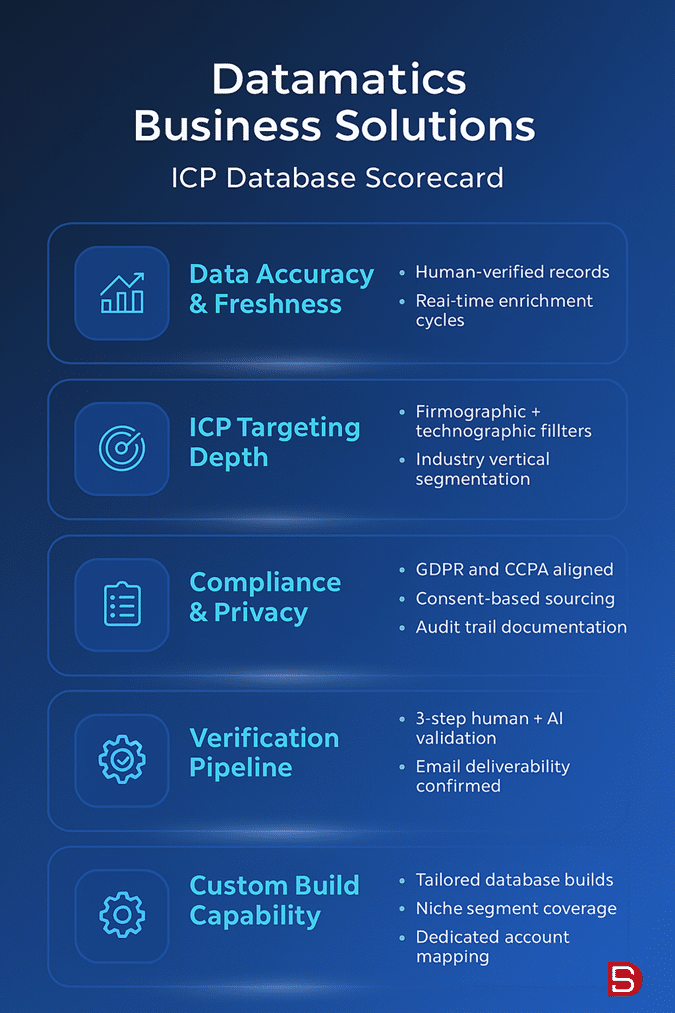
Datamatics Business Solutions sits at the top because it runs the model this whole article argues for. Nothing here comes pre-filtered from a static index. You bring the spec – ICP, TAM, firmographic and technographic requirements – and a 600-plus person delivery team builds the database to it, with human QA on the records before they reach you.
The same team handles data cleansing and enrichment, so a CRM that’s gone stale gets repaired instead of replaced. Operations are certified against the ISO/IEC 27001 information security standard, which matters more than it sounds once procurement starts asking questions. The human layer is really the whole pitch. It’s the difference between a list and a verified list, and anyone who’s burned a sender domain on the former knows exactly what that difference costs.
Fair warning, though: this is a delivery-led service, not a SaaS dashboard. There’s no logging in at 2 a.m. to pull a self-serve export. If that’s your team’s buying motion, look elsewhere. If you want accuracy scoped to your business, this is the fit.
Best for: Teams that need human-verified, compliant, built-to-spec custom ICP databases – with data cleansing and enrichment under one roof – rather than self-serve software.
2. Bright Data
Bright Data is playing a different sport entirely. Think large-scale, custom-collected datasets pulled from public web sources, with coverage that’s genuinely global. If you’ve got data engineers who want raw material to shape themselves, the collection infrastructure here is the real draw.
The flip side: raw is the operative word. You’ll be normalizing, deduping, and verifying that output yourself, and it’s closer to a data pipeline than anything a rep could dial from. No data ops owner on the team? This gets heavy, fast.
Best for: Engineering-led teams building proprietary, web-scale datasets in-house – not sales teams that need finished, verified ICP lists on day one.
3. UpLead
UpLead is here on reliability, not size. Real-time email verification, clean records, an interface that stays out of your way. For a mid-market team that wants decent data without an enterprise contract and a six-week procurement cycle, it’s a sensible place to start.
Where it runs thin: international depth. US-centric mid-market ICP? You’re fine. Chasing enterprise accounts across APAC or EMEA? You’ll find the gaps quickly. And there’s no real custom-build capability, so treat it as list-buying, not a scoped database project.
Best for: Mid-market, US-centric teams that prize verified, clean records and a simple interface over global scale or custom database builds.
4. Lusha
Lusha does one job well: the fast lookup. Rep’s mid-workflow, needs a direct dial or a verified email for the account on screen, hits the Chrome extension, done. For small teams working a target list one contact at a time, that convenience is worth paying for.
Just don’t ask it to be more than that. There’s no depth for a proper ICP database project, no firmographic and technographic layering across thousands of accounts. Point tool, not a data-building partner. Nothing wrong with that, as long as you know which one you’re buying.
Best for: SDRs and small teams doing tactical, one-contact-at-a-time prospecting who need quick verified emails and direct dials inside their browser workflow.
5. Cognism
Cognism’s calling card is phone-verified mobile data, and if your outbound motion lives and dies by connect rates, that verified mobile layer earns its price. The compliance handling is genuinely disciplined too – a relief for anyone operating under strict privacy regimes.
Geography is the catch. The sweet spot skews UK and EU, not deep US mid-market. North American teams should sample-test their exact segments before signing anything. And ask about freshness on those mobile numbers specifically; direct dials churn faster than any other field the moment someone changes jobs.
Best for: Dialer-first outbound teams targeting UK and EU accounts that depend on phone-verified mobile numbers and strict privacy compliance.
6. Adapt
Adapt gives you breadth: a multi-industry mix of contacts and company records at pricing that sits comfortably below the enterprise tier. When you need straightforward list building across several segments at once and can’t justify a big contract, it’s a reasonable pick.
The asterisk – and reviewers keep flagging this – is that accuracy varies by segment. Some verticals look sharp. Others show decay you’ll feel on the very first send. So Adapt rewards a disciplined buyer: sample your ICP, check match rates segment by segment, scale only into the slices that hold up, and skip the rest without sentiment.
Best for: Budget-conscious teams building general-purpose, multi-industry contact lists who are willing to sample-test each segment before scaling.
7. SalesIntel
SalesIntel’s reputation rests on two things: human-verified contacts, and a research-on-demand model where a record that doesn’t exist yet can be built for you by an actual research team. Among B2B data building companies, that second one is rarer than it should be.
In practice the mobile and direct-dial coverage holds up well in outbound, and the human QA keeps the bounce-and-burn cycle – the one that quietly wrecks sender reputation – at bay. What you give up is breadth. Total coverage runs narrower than the mega-databases, so an ICP scattered across dozens of niche international markets will hit walls.
Best for: Accuracy-first outbound and ABM teams that would rather work a smaller human-verified list – with research-on-demand backup – than a bloated, stale one.
8. Lead411
Lead411 keeps it simple: competitive pricing and contact data that actually gets refreshed on a regular cycle. For SMB-to-mid-market teams watching every line item, that combination is hard to argue with, and the steady refresh cadence saves you real cleanup work downstream.
Two limits to know going in. The data leans heavily North American, and native integrations run thinner than the bigger vendors offer. Before committing, confirm the specific connectors your stack depends on exist natively – stitching together manual exports six months in is nobody’s idea of a value pick.
Best for: Cost-conscious, US-centric SMB and mid-market teams that want regularly refreshed contact data without an enterprise contract or complex integrations.
9. InfobelPRO
InfobelPRO isn’t really competing with the contact-first vendors above. Its game is registry-verified company records, delivered in bulk with full commercial rights – the kind of clean, rights-cleared foundation you want under a data warehouse, a TAM model, or a large enrichment project.
Which also tells you what it isn’t: rep-facing. The records run company-heavy and light on individual contact detail, so you’ll pair it with a contact source or an enrichment layer to reach named buyers. Think of it as infrastructure. The backbone, not the dial pad.
Best for: Analytics and data teams that need registry-verified firmographic company data at scale for TAM modeling, enrichment, and data-warehouse workflows.
10. IndustrySelect
IndustrySelect closes the list as the specialist. Its research-team-verified database goes deepest in manufacturing and industrial sectors, and if that’s where your ICP lives, few general providers can match the specificity – the records hold up well for territory planning and account targeting in those markets.
Vertical strength is vertical narrowness, though. Sell mainly into SaaS or professional services and this is simply the wrong tool. That’s not a criticism; it’s the design.
Best for: Sales and marketing teams selling into manufacturing, distribution, and industrial accounts that need research-verified vertical depth over broad coverage.
How the 10 providers compare
Treat this as a quick reference, not a verdict. The right pick depends on your ICP, your compliance bar, and honestly on whether you want a platform to search or a team to deliver.
Companies | Best for | Standout strength | Watch-out |
|---|---|---|---|
Datamatics Business Solutions | Custom, spec-built ICP databases | Human-verified, ISO 27001:2022 delivery | Delivery-led, not self-serve SaaS |
Bright Data | Data-engineering teams | Large-scale custom web-sourced data | You normalize and verify raw output |
UpLead | Mid-market list building | Real-time email verification | Thinner international depth |
Lusha | Quick contact lookup | Fast Chrome-extension workflow | Limited custom-build capability |
Cognism | Dialer-heavy outbound | Phone-verified mobile data | Skews UK/EU coverage |
Adapt | General multi-industry lists | Broad, affordable coverage | Accuracy varies by segment |
SalesIntel | Accuracy-first ABM | Research-on-demand + human QA | Narrower total coverage |
Lead411 | Cost-conscious North American teams | Fresh data, competitive pricing | Fewer integrations, NA-focused |
InfobelPRO | Analytics + enrichment | Registry-verified company records | Light on contact-level detail |
IndustrySelect | Manufacturing / industrial | Deep vertical verification | Poor fit outside industrials |
- KEY TAKEAWAY
No single B2B data provider wins every category. Datamatics leads for custom human-verified builds, Cognism for phone-verified UK/EU outbound, UpLead for mid-market simplicity, and InfobelPRO for company-level analytics. Match the provider’s verification method and coverage to the accounts you actually sell into.
Waterfall enrichment: why smart RevOps teams blend providers
Here’s a pattern that’s gone from clever to standard in about two years. Instead of trusting one vendor’s coverage, you query providers in sequence: check each record against provider A, fill the gaps from B, then C. That’s waterfall enrichment, and the logic is simple – every provider has strengths by region, vertical, and field type, so the blend beats the monolith. Teams running waterfalls routinely report match rates a single source can’t touch.
A setup we see often: registry-verified company data (something like InfobelPRO) for firmographics, a contact platform for emails, a phone-verified source for dials, and then a managed partner like Datamatics to verify, dedupe, and maintain the merged result so it doesn’t rot back into chaos by Q3.
- KEY TAKEAWAY
Compliance essentials: GDPR, CCPA, and CAN-SPAM
Compliance decides which records you can legally touch and how, so it can’t be an afterthought. Targeting contacts in Europe? The official GDPR compliance guidelines govern how data gets collected, stored, and used – and if you’re relying on legitimate interest, that reasoning needs to be documented, not assumed. Stateside, the California Attorney General’s CCPA overview covers the rights of California residents, while the FTC’s CAN-SPAM compliance guide sets the ground rules for commercial email: honest headers, honored opt-outs, no games.
Three questions worth asking any provider before money moves: Where does each record come from? How do opt-outs flow back into the database? And if a regulator comes knocking, what documentation exists? A certification like ISO 27001 won’t answer those by itself, but it’s a decent proxy for whether the vendor has ever thought about them.
- KEY TAKEAWAY
B2B outreach compliance rests on three frameworks: GDPR for EU contacts, CCPA for California residents, and CAN-SPAM for US commercial email. Choose data providers that document record provenance, propagate opt-outs, and hold certifications like ISO 27001 for data operations.
How often should you refresh your B2B database?
With decay running 2-3% a month, an annual cleanse isn’t maintenance. It’s triage. If you run high-velocity outbound, verify email deliverability continuously – at minimum before every major send – re-validate direct dials quarterly, and do a full firmographic refresh every six months. Slower ABM motions can stretch the firmographic pass to once a year, but contact-level checks still belong on a quarterly cycle. People change jobs on their schedule, not yours.
Not sure where you stand? Watch your hard-bounce rate. Past 2-3% on a send, your sender reputation is already taking hits and the cleanse is overdue.
- KEY TAKEAWAY
Refresh B2B contact data on a quarterly cycle at minimum: verify emails before every major send, re-validate phone numbers quarterly, and refresh firmographics every 6-12 months. A hard-bounce rate above 2-3% signals the database is overdue for cleansing.
How to choose, and why verification beats volume
Most vendor demos gloss over the same inconvenient fact: a big number on a homepage tells you nothing about whether the hundred accounts in your ICP are accurate today. Coverage claims are cheap. Freshness is hard.
Decay is the quiet pipeline killer – SiriusDecisions was pegging B2B database rot at roughly 30% a year long before AI made everyone care about data again, and nothing since has slowed it down. So flip the evaluation on its head. Don’t ask how many records a vendor holds. Ask how they verify, how often they refresh, and what happens to a record when it fails a check. The strongest providers treat verification as a process that never finishes, not a one-time export.
It’s also exactly where custom builds earn their keep. A database constructed to your firmographic and technographic spec, then cleaned and enriched on a cycle, will beat a bulk pull every time. Not sometimes. Every time.
- KEY TAKEAWAY
Judge B2B data building companies on ICP match rate and freshness, not headline record counts. A custom-built, human-verified database paired with ongoing data cleansing and enrichment services outperforms any bulk data pull.
Before you sign anything: run the sample test
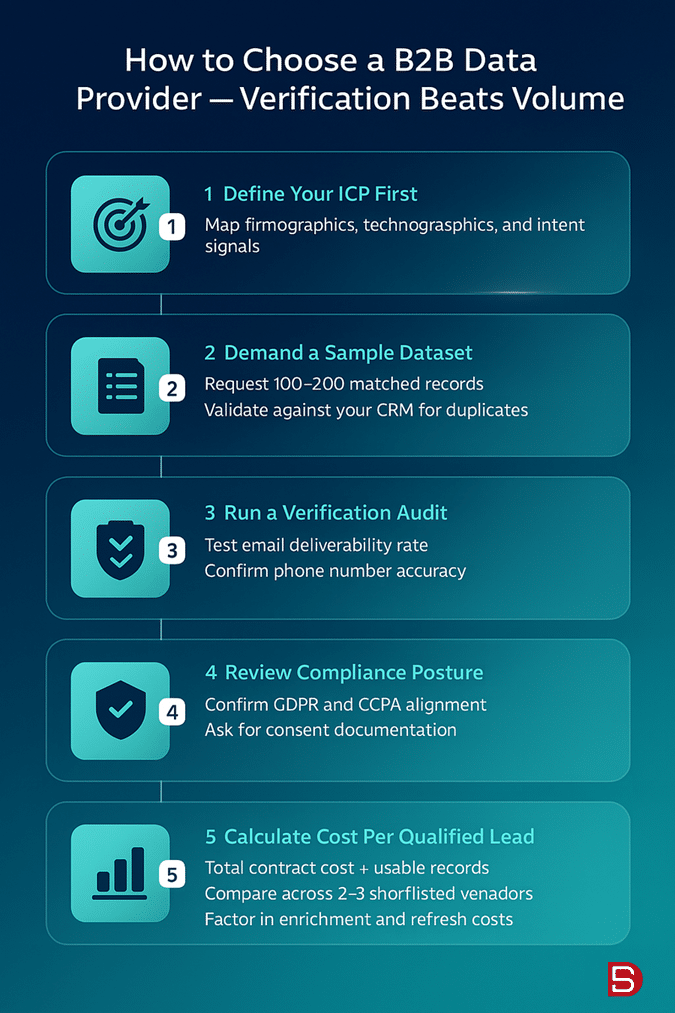
The fairest way to compare providers is also the simplest: make them prove it. Pull a real 100-account sample from your own ICP and pressure-test three things – match rate, freshness, verification method. Whoever returns the most accurate, deliverable records against your actual target list wins. The marketing doesn’t get a vote.
And if you’d rather run that comparison with a partner instead of a spreadsheet, Datamatics Business Solutions will do a scoped sample build alongside data cleansing and enrichment, so you can measure quality directly against your current source before committing a dollar. Fifty years in the business, a 600-plus person delivery team, ISO 27001:2022 certified operations – the whole model is built around human-verified accuracy rather than search-and-hope. If clean B2B data is anywhere on this year’s roadmap, it’s worth a conversation. Talk with Datamatics and put your ICP to the test.
- FAQS
Frequently asked questions
1. What is a B2B data building company?
A B2B data building company researches, compiles, verifies, and maintains business contact and company databases matched to a client’s ideal customer profile. Unlike list sellers, these companies construct records to specification – combining firmographic, technographic, and contact-level data – and apply verification and compliance checks so sales and marketing teams work with accurate, deliverable records.
2.How much does B2B data decay each year?
B2B data decays at roughly 25-40% per year, driven by job changes, promotions, mergers, and company closures. Monthly decay of around 2.1% compounds to about 22.5% annually, while Dun & Bradstreet estimates 30-40% yearly decay. That’s why quarterly verification and ongoing data cleansing outperform an annual refresh.
3. What does ICP-matched data mean?
ICP-matched data means contact and account records filtered and verified against your ideal customer profile: target industry, company size, revenue, technology stack, job titles, and geography. Instead of a generic list, you receive prospects that resemble your best customers, which cuts wasted outreach and lifts conversion rates.
4. How do I choose the best B2B data building company?
Evaluate providers on data accuracy, verification method, refresh frequency, and coverage for your target market. Check ICP-based filtering across firmographic, technographic, and intent signals; confirm GDPR and CCPA compliance; review CRM integrations and pricing transparency; and always request a sample dataset to test match rate before committing.
5.Is buying B2B data legal in the United States?
Yes – purchasing B2B data is legal in the United States when the provider collects and processes information in compliance with applicable laws. The CAN-SPAM Act governs commercial email, the CCPA applies to California residents, and GDPR applies if you target contacts in Europe. Reputable providers source data ethically, honor opt-out requests, and document consent where required.