


Most B2B tech companies lose deals not because their product is weak. They lose because qualified buyers never entered the pipeline in the first place.
Selecting the right B2B demand generation agency is one of the highest-stakes decisions a revenue leader will make. Get it wrong, and you spend months generating activity that does not convert. Get it right, and you build a pipeline with real commercial potential.
Complex tech sales make this harder. Buying groups are larger, sales cycles are longer, and generic outreach does not move the needle. You need a B2B demand generation company that understands the mechanics of enterprise buying, not just the mechanics of lead volume.
Why agency selection matters
In complex technology sales, demand generation affects more than top-of-funnel activity. The right partner helps build buying group visibility, aligns with sales expectations, and contributes to pipeline progression. The wrong one creates noise, consumes internal bandwidth, and reports on activity that never translates into revenue.
Gartner reports that complex B2B purchases typically involve six to ten stakeholders, each conducting independent research. Agencies that optimize for lead volume rather than buying committee engagement often miss how enterprise decisions are actually made.
- KEY TAKEAWAY
The cost of choosing the wrong agency is not just budget. It is lost time, reduced credibility, and missed pipeline opportunities.
Four criteria that separate capable demand generation companies from the rest
Not every firm that sells demand generation services is built for complex, long-cycle tech sales.
In my experience, most demand generation programs underperform for three reasons: poor data quality, weak sales alignment, and reporting disconnected from revenue outcomes.
The criteria below help separate activity-driven vendors from true pipeline partners.
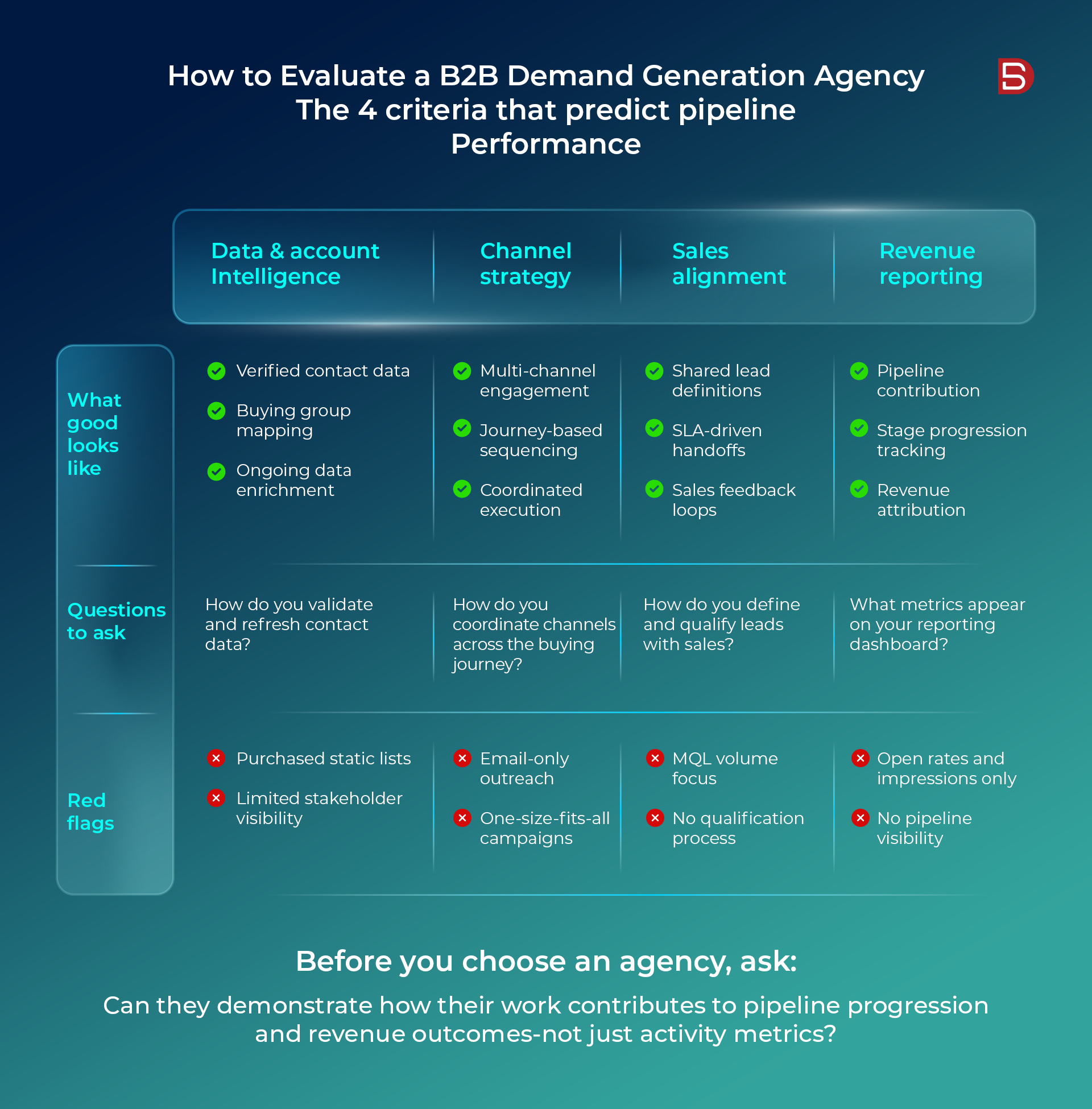
1. Data depth and account intelligence
The foundation of any effective B2B demand generation agency is data quality. Before a single outreach is sent, the agency must demonstrate that it can identify the right accounts, map the correct stakeholders within those accounts, and enrich those contacts with verified, current information.
Demand generation companies that rely on static, purchased lists are not equipped for enterprise sales environments. Forrester research shows that 27% of B2B contact data becomes inaccurate within a single year. An agency that cannot maintain data hygiene will degrade pipeline quality over time.
2. Channel fluency across the full buying journey
Complex enterprise tech deals are never won through a single channel or touchpoint. To win, a demand gen partner must seamlessly coordinate email, LinkedIn, content syndication, programmatic display, and direct outreach into a sequence that matches real-world buyer research.
When vetting an agency, ask exactly how they coordinate these channels across the awareness, engagement, and activation stages. Agencies that rely on single-channel tactics almost always struggle in complex enterprise environments.
3. Sales-marketing alignment as a process, not a promise
Outsourced demand generation fails most often at the handoff. The agency defines a qualified lead differently from the sales team. Leads sit in limbo. Sales dismisses them. The relationship breaks down.
Mature agencies define qualification jointly with sales and establish clear SLAs for handoffs. Accountability should extend beyond lead volume to lead quality.
4. Reporting tied to revenue, not activity
Vanity metrics are the refuge of underperforming B2B demand generation services. Impressions, open rates, and form fills are not pipeline. A capable agency reports on account progression, buying stage movement, and pipeline contribution by source.
Reporting should demonstrate pipeline influence, account progression, and contribution to revenue and not just campaign activity.
- KEY TAKEAWAY
Evaluate any B2B demand generation agency on data quality, channel sophistication, handoff discipline, and revenue-tied reporting. These four criteria predict performance more reliably than case studies or credentials alone.
What effective B2B demand generation looks like
When outsourced demand generation works, it doesn’t feel outsourced. Sales and marketing are aligned on who they are trying to reach. The key decision-makers are identified early. And outreach evolves based on how accounts engage over time.
In enterprise settings, this often overlaps with account-based marketing (ABM), which prioritizes meaningful engagement with multiple stakeholders in high-value accounts rather than chasing lead volume.
According to LinkedIn’s B2B Institute, only 5% of buyers are actively in market at a given time. High-performing programs create visibility with the remaining 95% until buying intent emerges.
- KEY TAKEAWAY
Demand generation works best when it combines long-term awareness with structured pipeline activation.
Red flags to identify before you sign
The following patterns indicate a demand generation company that is unlikely to perform in complex technology environments.
- They lead with MQL volume as a primary success metric without defining what qualifies an account to receive outreach.
- They cannot demonstrate data hygiene practices or explain how they maintain accuracy across their contact database.
- They have no documented process for sales-marketing alignment or lead handoff accountability.
- They present case studies from high-velocity SMB sales without comparable enterprise technology examples.
- They cannot explain how their B2B demand generation services integrate with your existing CRM and marketing automation stack.
- Their reporting framework is built around campaign activity, not pipeline movement or revenue influence.
Any one of these flags in a scoping conversation warrants a harder line of questioning before proceeding.
- KEY TAKEAWAY
Data quality management requires discipline across process, technology, and partnership. No single intervention is enough on its own
How DBSL supports B2B demand generation for complex technology sales
DBSL helps tech companies build demand generation programs that deliver. We identify your ideal accounts and stakeholders, then run coordinated outreach and qualification processes your sales team can actually trust.
Tailored to your specific goals, our services include content syndication, BANT-qualified leads, appointment setting, and targeted engagement across the sales cycle.
As one of the leading B2B demand generation agencies, we focus entirely on building a healthy pipeline, opening doors to high-value buyers, and giving your sales team the confidence to close.
- Case Study
112,091 Qualified Leads. 100% Validation Accuracy.
See how DBSL scaled enterprise demand generation for a global B2B procurement platform.
- FAQS
Frequently Asked Questions
1. What does a B2B demand generation agency actually do?
A demand generation agency handles the heavy lifting of pipeline creation. For complex tech sales, this goes way beyond basic email blasts. A strategic partner maps your target buying committees, tracks real-time intent signals, and runs coordinated, multi-channel campaigns to hand off highly qualified, sales-ready opportunities.
2.How is outsourced demand generation different from building an in-house team?
Outsourced demand generation gives you instant access to enterprise-grade data tools, specialized tech stacks, and execution expertise without the months of ramp time and high fixed overhead of internal hiring. It is the fastest route to pipeline visibility for tech companies entering new markets or scaling rapidly. The trade-off? It requires strict vendor management and clear SLAs to protect output quality.
3.What performance metrics should a demand gen partner be accountable for?
Move past raw MQL volume. A reliable partner should be measured on metrics that impact the bottom line: Sales Qualified Lead (SQL) conversion rates, pipeline contribution by source, account engagement depth, and deal stage velocity. In high-performing programs, revenue attribution is the ultimate benchmark.
4. What are the most important questions to ask an agency during vetting?
Skip the standard RFP and push for operational transparency with these four questions:
- Data: “How do you source your contact data, and what is your specific process for real-time validation?”
- Qualification: “How do you align your lead definitions with our Ideal Customer Profile (ICP) and sales expectations?”
- Reporting: “Can we see a live sample dashboard that tracks pipeline influence, rather than just clicks and opens?”
- Proof: “Do you have a case study from a tech company with a comparable sales cycle length and deal size?”