


Most IT companies do not have a demand problem in 2026. They have a scale problem. The two look identical on a dashboard, but the difference sits in the data underneath.
Pipeline targets keep rising while channel costs keep climbing. The playbook that filled the funnel three years ago now returns thinner yield for the same spend. Scaling demand generation services is not about pushing more volume through an unchanged funnel. It is about reaching the right in-market accounts, repeatedly, at a cost that holds steady as the program grows.
This blog sets out the shifts shaping demand generation for IT companies this year and shows where most programs lose efficiency.
What scaling demand generation actually requires in 2026
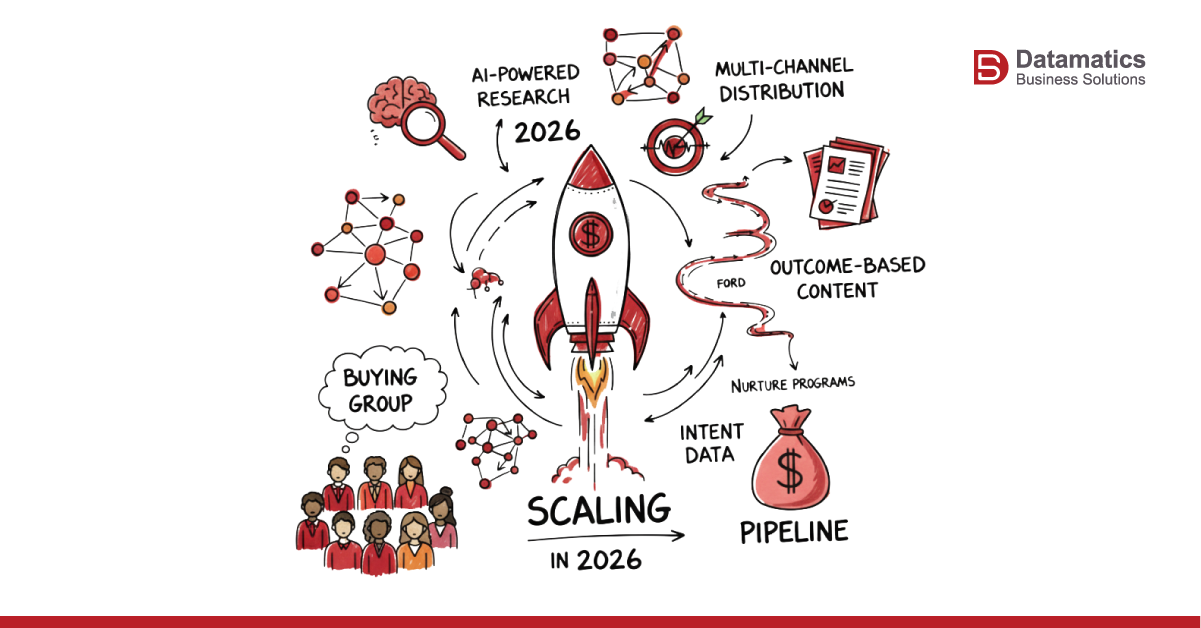
Scaling demand generation services is not raw lead volume. It is the capability to reach in-market accounts predictably, at a unit cost that holds as the program grows.
A team can double its lead count and still miss revenue. Most of those extra leads never had a live buying motion behind them.
Buyers now stay anonymous for longer. Forrester research found that 89% of B2B buyers have adopted generative AI as a top source of self-guided information across every stage of the buying process. Tools such as ChatGPT and Perplexity are shaping vendor shortlists long before a prospect visits a company website.
That shift makes attribution slower to prove. Pipeline can move before a dashboard can explain why. Build that lag into reporting expectations rather than treating it as a gap in the program.
- KEY TAKEAWAY
Scale is measured in efficiency and repeatability, not lead volume. Anonymous, AI-assisted research means attribution now lags the buying activity it is meant to explain.
The buying committee, not the contact, is the real unit of demand
Single-contact lead capture assumes one person decides. In IT purchases, that assumption no longer holds.
Gartner research shows the typical buying group now includes 6 to 10 stakeholders, each arriving with 4 to 5 independently gathered sources of information they must reconcile as a group. 77% of B2B buyers describe their most recent purchase as extremely complex or difficult, a signal of how much coordination sits behind every decision.
Forrester’s latest research puts the number even higher for complex purchases. A typical buying decision now includes 13 internal stakeholders and 9 external influencers, with that count rising for strategic or high-value deals. In IT, those seats typically span security, finance, procurement, legal, and the line-of-business owner, each holding effective veto power.
- KEY TAKEAWAY
Scale is measured in efficiency and repeatability, not lead volume. Anonymous, AI-assisted research means attribution now lags the buying activity it is meant to explain.
Who typically sits on an IT buying committee
Who typically sits on an IT buying committee
- Security and compliance leads, who assess risk exposure
- Finance and procurement, who own budget and contract terms
- IT and operations, who evaluate technical fit
- Legal, who reviews data handling and liability
- The line-of-business owner, who owns the outcome the purchase is meant to deliver
Full-committee coverage costs more to orchestrate than chasing a single contact. It is also where win rates concentrate. Forrester found that 94% of buyers in groups of six or more report clear benefits from that structure, including broader perspectives and a stronger case for budget approval.
- KEY TAKEAWAY
Coverage across the full buying committee, not a single champion, is what protects win rate. Content built for one persona misses the people who can still block the deal.
Data quality and intent signals form the foundation for scale
Decayed and duplicated records quietly cap every program downstream. An intent model scores contacts who have left the company. A syndication vendor bills for addresses that bounce. A buying-group outreach plan targets a committee that reorganized months ago.
B2B contact data decays continuously. Industry research based on MarketingSherpa data puts the rate at roughly 2.1% a month, compounding to close to 22.5% a year. Every downstream demand generation investment inherits that error rate.
Cleansing data feels slow, and it delays the campaigns leadership wants launched now. Skip it, and the program spends premium budget reaching contacts who no longer exist in that role. Fix the foundation first, and everything built on top scales with less waste.
Intent data adds real value once the data foundation is solid. Used well, it shows which accounts are actively researching, so outreach lands where it can convert. Used without verification, it sends sellers chasing accounts that clicked once and moved on.
- KEY TAKEAWAY
Clean data is the prerequisite for every other investment in the funnel. Intent signals sharpen targeting only when they sit on top of a verified database.
Where AI helps demand generation, and where it does not
AI is now standard practice in demand generation. That is precisely why it no longer sets a program apart on its own.
AI scores accounts faster, enriches records at scale, and drafts campaign content in hours rather than days. Most competitors run comparable tools on comparable data sources. When the tooling is common, the tooling stops being the differentiator.
The edge now comes from original insight and executive-level thought content, the work AI can support but not originate on its own. Point of view still has to come from people who understand the account and the industry.
Qualification needs a rebuild alongside AI adoption. Confirmed budget, authority, need, and timeline still reduce wasted sales cycles once a deal reaches sales. But IT purchases run long, and a large share of the decision is typically formed before a vendor is ever contacted. A rigid BANT score can disqualify an account that would still convert on a longer horizon.
Treat BANT as a snapshot rather than a verdict. Route fully qualified accounts to sales immediately. Keep partially qualified accounts in nurture instead of discarding them, since so much of the decision is already forming before that first sales conversation.
- KEY TAKEAWAY
How to build a scalable demand generation strategy for IT services
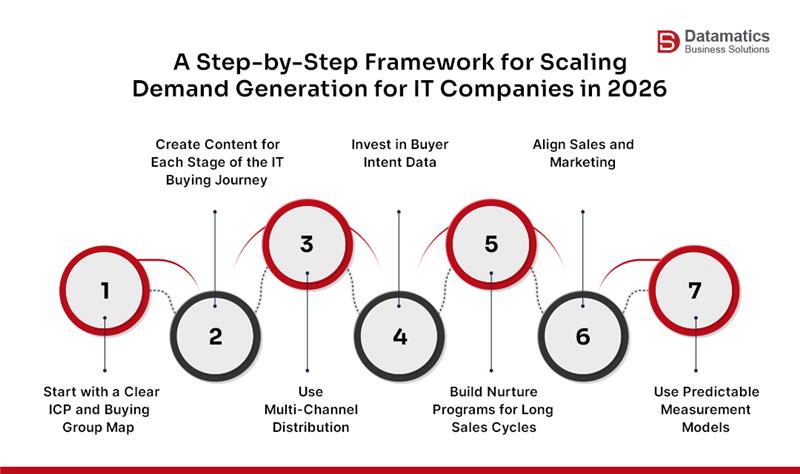
A scalable demand generation strategy for IT services is less about which channel to pick and more about who owns what as volume increases. Before any campaign decision gets made, IT companies need clarity on who owns strategy, who owns execution, and how the two stay connected once the program is actually running.
1. Define the ICP and map the buying group
An ideal customer profile is more than an industry label. Company maturity, team structure, existing tool stack, budget realism, geography, regulatory context, and the operational pain points that actually trigger a buying cycle all belong in it.
Once the ICP is set, map the buying group behind it. In IT companies, that usually means the CIO, CTO, IT manager, security lead, operations lead, and finance lead, each carrying a different priority into the deal. Messaging has to speak to all of them. A team that knows who influences the decision and why has a far easier time forecasting how a deal will move.
2. Build content for each stage of the buying journey
IT buyers research extensively before a vendor ever hears from them. Content has to meet them at each point in that process.
- Problem awareness: Buyers are still naming what is changing or going wrong. Blogs, trend analyses, and market reports do the work here.
- Solution exploration: Now they are weighing different approaches against each other, so explainers, comparison guides, and points of view carry more weight than a product pitch.
- Vendor evaluation: This is where fit gets tested. Case studies, ROI models, pilot frameworks, and security or compliance detail either hold up or they do not.
- Decision: The group needs to align internally before signing. Live demos, roadmap conversations, implementation plans, and stakeholder consultations are what get them there.
Forrester found that 62% of B2B buyers can now build their selection criteria, or even finalize a shortlist, from digital content alone. A vendor whose content skips the harder questions is usually out before a sales call gets booked.
3. Distribute with intent
IT buyers do not move in a straight line. They circle between LinkedIn, search, peer review sites, and technical communities, picking up pieces of information at each stop. The number of channels matters less than whether each one is doing a distinct job.
- LinkedIn and ABM platforms carry personalized messaging to each member of the buying group
- Technical communities such as Reddit, Stack Overflow, and GitHub build credibility through real expertise, not a pitch
- Analyst platforms such as TechTarget or Gartner put a brand in front of accounts already deep in research
- YouTube gives hands-on evaluators the product demos and technical walkthroughs they are looking for
A buyer entering through any one of these channels should still recognize the same story on the next one.
4. Invest in verified buyer intent data
Intent data has become one of the steadier levers in IT demand generation, since it shows which companies are actively researching a category. That lets outreach focus where a buying motion is already forming.
Forrester found that 85% of companies using B2B intent data reported measurable business benefits from it. The same research flagged where teams still struggle: identifying who actually sits on the buying team and filtering out false positives. Intent data does its best work as a prioritization layer sitting on top of a clean, verified database. Treated as a lead source by itself, it tends to disappoint.
5. Build nurture programs for long sales cycles
Enterprise IT buying cycles typically run 6 to 18 months. Buyers need education, reassurance, and validation for most of that stretch, and a nurture program is what keeps a vendor present through it without forcing a sales conversation at every step.
Good nurture goes past a basic email drip. Retargeting, webinars, deeper technical content, ROI narratives, short case studies, and executive-level insight all have a role. Done well over time, a vendor becomes the default choice long before the final decision meeting.
6. Align Sales and Marketing
Demand generation stalls when sales and marketing run as separate functions. Both teams need the same CRM, the same definition of a sales-ready lead, joint account reviews, and engagement signals that flow in both directions. In IT, where deals involve several stakeholders over long cycles, this is what actually shapes pipeline quality, velocity, and conversion.
7. Use Predictable Measurement Models
A traditional MQL count says very little about how IT buying really works. Programs built to scale track buying-group penetration, engagement across touchpoints, content consumption patterns, pipeline influence, and deal velocity instead, since these signals move ahead of revenue rather than behind it.
- KEY TAKEAWAY
Precision targeting, content built for each stage, deliberate channel distribution, verified intent data, sustained nurture, and a measurement framework built around buying-group behavior are what separate a program that scales from one that stalls.
Common Mistakes IT Companies Make in Demand Generation
Most scaling problems come from a handful of decisions repeated across a program rather than one dramatic failure. Catching them early keeps a team from spending months unwinding something a faster review would have flagged.
Lead volume gets treated as a proxy for pipeline. A dashboard full of leads with no live buying motion behind them still will not convert.
Campaigns get built for a single buyer persona. IT purchases run through a full committee, so content aimed at one champion leaves the rest of the stakeholders unaddressed, and any of them can still kill the deal.
Data cleansing gets skipped to hit a deadline. The error rate from decayed or duplicated records does not disappear. It just shows up later as wasted spend instead of a visible failure at launch.
Intent data gets used as a lead source instead of a signal. It points to where to look, not who to call. Sellers who chase it as a lead list end up pursuing accounts that clicked once and moved on.
BANT scoring stays rigid on cycles that are not. An account without a confirmed budget in month 1 may still close in month 9. Scoring that drops it too early gives up pipeline a longer evaluation window would have converted.
Delivery models get blended without shared definitions. Strategy and execution teams working from different definitions of a qualified account absorb the exact efficiency the blended model was supposed to create.
- KEY TAKEAWAY
Most of these problems are avoidable, and they typically trace back to decisions made under deadline pressure rather than a flawed strategy.
A 90-day sequence to scale without breaking what already works
Scaling does not require a full rebuild. A phased rollout is slower than a full relaunch, but it carries far less risk to pipeline that is already in motion.
Days 1 to 30: Fix the data
Cleanse, deduplicate, and enrich existing records before spending on anything downstream. Every later program depends on this foundation.
Days 31 to 60: Layer in intent and full buying-group coverage
With clean data in place, add verified intent signals to prioritize in-market accounts. Extend outreach across the full buying committee rather than a single contact, in line with the 6-to-10-stakeholder reality most IT purchases now involve.
Days 61 to 90: Add measurement and scale channels
Stand up tracking for sourced pipeline and cost per opportunity. Introduce content syndication and webinar programs once acceptance criteria and follow-up speed have been defined.
Reporting the trajectory to finance
- KEY TAKEAWAY
Sequence protects what already works. Data quality first, committee coverage second, measurement and channel scale last.
How DBSL supports demand generation at scale
Datamatics Business Solutions Ltd. helps IT and technology companies build the data foundation and demand generation programs this blog describes. DBSL combines verified B2B data, buying-group intelligence, and full-funnel campaign execution to improve visibility into in-market accounts and support measurable pipeline growth. For teams assessing where their scale is actually constrained, the DBSL demand generation team offers a working review of the current program.
- FAQS
Frequently Asked Questions: Demand Generation Services for IT Companies
Q1. What does scaling demand generation services mean for IT companies?
Scaling demand generation services means building the capability to reach the right in-market accounts repeatedly, without a proportional rise in cost. It is not about increasing raw lead volume. For IT companies in 2026, that requires identifying genuine buying intent, engaging the full buying committee, and maintaining efficiency as pipeline targets increase.
Q2. How can teams scale demand generation when buyers stay anonymous longer?
Focus on account-level signals rather than individual leads. Firmographic data, engagement patterns, and verified intent signals help identify in-market accounts even when individual contacts remain hidden. Coordinate marketing and sales around those accounts rather than relying on gated conversions alone.
Q3. Why does the traditional demand generation playbook lose effectiveness at scale?
The traditional playbook assumes that pushing more volume through the same funnel produces proportional results. As channels become more expensive and buyer fatigue increases, that assumption breaks down. The fix is sharper targeting of in-market accounts and stronger efficiency measurement, not additional spend.
Q4. Which metrics matter most when scaling demand generation services?
Sourced pipeline, sales-accepted lead velocity, and cost per opportunity are the metrics that connect marketing activity to revenue outcomes a finance leader recognizes. Raw lead counts can mask declining yield, so account-level performance data gives a clearer picture of program health.
Q5. How can IT companies scale demand generation without losing efficiency?
Prioritize precision over reach by concentrating resources on accounts that show verified buying intent. Align sales and marketing so that engaged accounts do not fall through gaps between teams. Track cost per qualified account consistently as the program grows to keep efficiency stable.