


- QUICK ANSWER
Data enrichment services for fintech sales teams come in two models. Platforms like ZoomInfo, Apollo.io and Cognism enrich records in real time and suit teams with a RevOps owner. Managed services like DBSL add analyst-verified depth on defined target accounts and custom fields. Many teams use a hybrid: a platform at the point of entry and a managed refresh for priority accounts.
Fintech sales reps spend most of the week on work other than selling. Salesforce’s State of Sales report, 7th edition (2026) puts the split at 40% selling and 60% non-selling, and manual data entry is part of that second figure.
The right data enrichment services can help reduce time spent researching and updating records. This article shows how platform and managed models differ and which approach suits your pipeline, with five providers compared along the way.
Data enrichment services fill gaps in the records already sitting in your CRM. A provider matches those records against available data sources and validates the results before they reach the fields your reps use.
Fintech deals rarely rest with one person. Gartner’s survey of 632 B2B buyers, released in May 2025, found buying groups of five to 16 people spread across as many as four functions. At a financial institution, risk, compliance, technology and finance often each have a say.
Contact data enrichment supplies the titles and verified contact details for each of those stakeholders. Reps can then reach the whole buying group early in the cycle, which improves visibility into each account.
Email addresses go out of date too. ZeroBounce’s 2026 Email List Decay Report found that at least 23% of an email list becomes invalid or risky within a year, based on its 2025 verification data. Rates vary between organizations, so regular verification and CRM enrichment help teams spot outdated records and fix contact details before outreach.
Validity surveyed 500 marketing professionals for its State of CRM Data Management in 2026, and 62% of organizations reported lost revenue directly linked to CRM data quality. Enrichment belongs in the same planning conversation as pipeline targets.
Fintech teams often face closer scrutiny on how they gather and use contact data. A documented, compliant enrichment source helps outreach performance and gives internal risk reviewers a clear trail to follow.
Which Fields Matter Most in B2B Data Enrichment?
Good data enrichment services begin with a clear field list. A focused list keeps cost in check and gives reps attributes they use every day.
- Verified work email and direct phone number
- Current job title and function
- Company size and revenue band
- Regional presence
- Technology stack in use, which shapes integration conversations
- Buying group role, such as economic buyer or technical evaluator
For fintech teams selling into banks and financial institutions, enrichment may also include institution type, parent-subsidiary relationships, regulatory responsibilities and the technologies used across payment or banking operations. These details help sales teams distinguish between accounts that look similar on paper but have different decision-making structures.
B2B data enrichment at this level of detail helps reps prioritize accounts faster and tailor the first message to each function.
Start with the segment that produces most of your pipeline, then extend the same fields to the wider database. This sequence shows results sooner and keeps early spend contained.
- KEY TAKEAWAY
Decide the five to eight fields your reps use daily before you brief any provider.
Platforms vs Managed Enrichment: Which Model Fits Your Team?
Most data enrichment services fall into one of two models. They solve different problems, and matching them to your workload shortens the path to usable data.
Data enrichment tools are subscription platforms that return results in real time. A managed service places a provider team between your CRM and the raw sources.
Where Data Enrichment Tools Work Best
- Real-time enrichment of new inbound leads as they enter the CRM
- Self-serve search for net-new accounts and contacts
- Teams with an in-house RevOps owner who can set matching rules
- Native sync with systems such as Salesforce and HubSpot
Results depend on segment coverage and credit limits, so a RevOps owner should review a sample before a full run.
Where Managed B2B Data Enrichment Works Best
- Niche roles that large databases may cover thinly, such as heads of payments risk
- Custom fields tied to your ideal customer profile
- Planned refreshes of a defined target account list
- Teams without capacity to review enrichment output in-house
Managed services run in planned batches, so they suit scheduled refreshes more than instant form enrichment. The provider team manages the enrichment workload as requirements grow, which lets your reps and RevOps staff stay focused on pipeline work.
How a Hybrid Approach Works
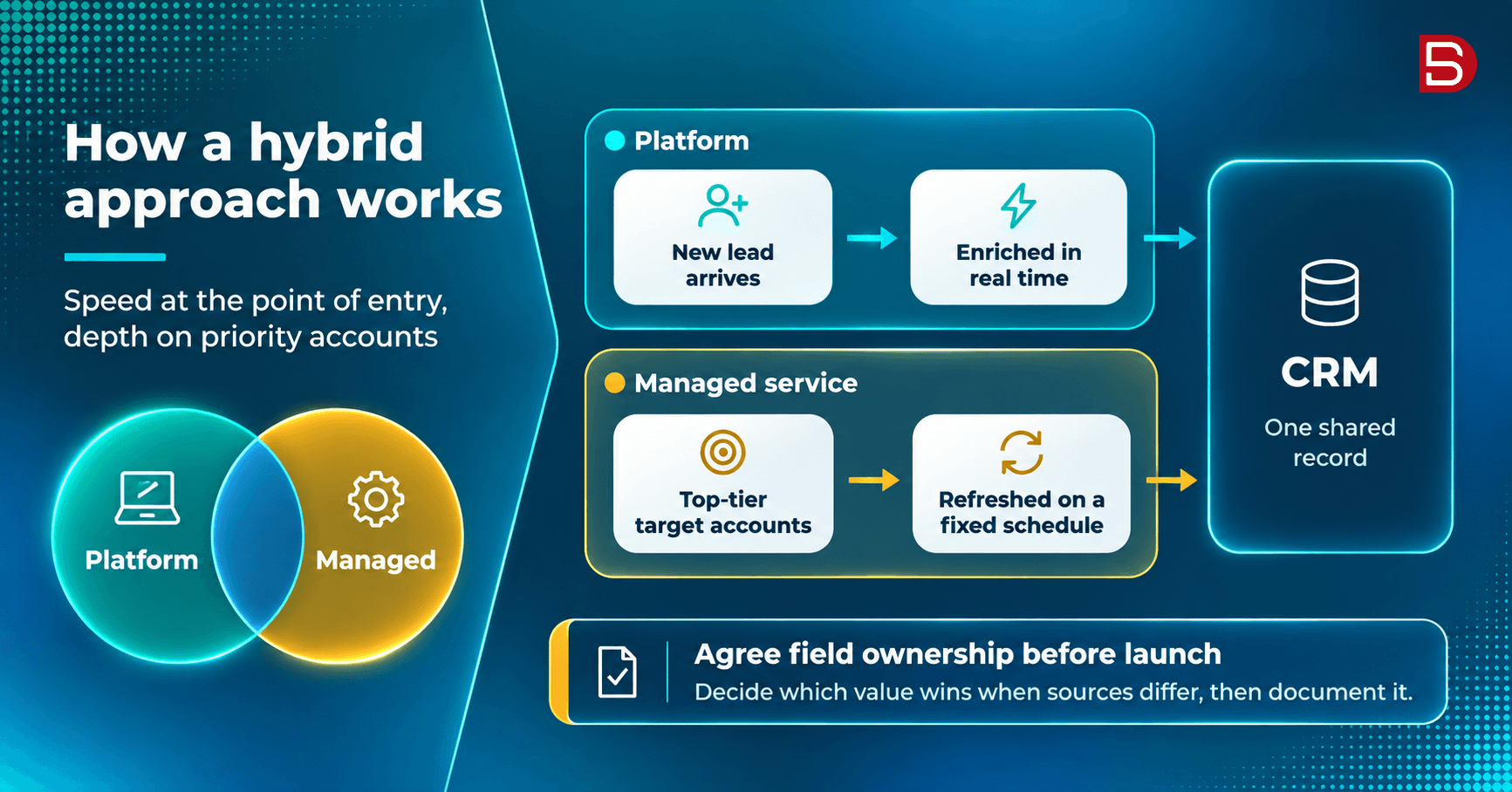
A platform can enrich records as they enter the CRM, while a managed service refreshes the top tier of target accounts on a fixed schedule.
Agree on field ownership before launch. If the platform writes job titles and the managed service verifies them, decide which value wins when the two differ, and record that rule in your CRM documentation.
- KEY TAKEAWAY
Start with a platform if speed at the point of entry drives your results, and consider a managed service when verified depth on priority accounts matters more.
Data Enrichment Companies Compared for Fintech Use
The table places five data enrichment companies side by side, with Datamatics Business Solutions Ltd. (DBSL) listed first. Entries describe each provider’s published product positioning and are not rankings, and provider names link to current vendor documentation.
Provider | Delivery Model | Enrichment Approach | Core Strength | Best Fit |
|---|---|---|---|---|
Datamatics Business Solutions | Managed service | Managed research with AI validation and human review | Custom fields, cleansing and database builds | Verified depth on defined target accounts |
ZoomInfo | Subscription platform | Automated CRM enrichment, real-time or scheduled | Contact and company data with native CRM sync | Real-time enrichment inside the CRM |
Apollo.io | Self-serve platform, credit-based | Real-time enrichment inside the CRM | Database, enrichment and outreach in one tool
| Smaller teams that want one flexible tool |
Cognism | Subscription platform | Enrichment through API, CRM integration or batch delivery | Phone-verified mobiles and compliance-led sourcing | Phone-led teams in the US and Europe |
Dun & Bradstree | Licensed data products | Company-level enrichment matched by D-U-N-S Number | Company identity and corporate hierarchies | Account matching across large enterprise structures |
Data enrichment companies differ mainly in who does the work. On a platform, your team runs searches, sets sync rules, and reviews records. With a managed service, the provider team handles those steps against a brief that you approve.
Pricing follows the same split. Platforms typically charge by subscription or credit, while managed providers quote by record volume and enrichment depth. Ask each vendor for a written quote on the same sample so the numbers compare fairly.
Read the table against your territory plan, since regional strength differs by provider.
- KEY TAKEAWAY
Shortlist two providers from different models and test both on the same sample, such as 500 records as a practical starting point.
How to Evaluate Data Enrichment Services Before You Commit
A short evaluation protects budget and gives reps data they trust from the first week. It also prepares your CRM for AI-assisted selling, where record quality shapes every output.
Gartner’s survey of 1,203 data management leaders, released in February 2025, found that 63% of organizations were unsure about, or lacked, the right data management practices for AI. Enrichment standards set during vendor selection help close that gap.
Check Sourcing and Privacy Practices
Fintech buyers expect outreach to follow privacy rules. Ask how each provider sources contacts and which regions its compliance program covers. Request details on how phone numbers are screened against do-not-call lists, and have your legal team review the answers.
Security deserves early attention as well. Ask for data handling documentation and relevant certifications, and involve your information security team before a pilot starts.
Ask About Coverage for Your Target Roles
Fintech teams often sell to specialist roles. Contact data enrichment only helps where a provider holds the titles and regions in your territory plan, so request coverage figures based on your own account list.
Test Accuracy on Your Own Records
Send each provider the same sample from your active target accounts. Your reps already know many of the correct answers, which makes the sample a practical benchmark.
- Match rate against your CRM records
- Email validity after verification
- Title and function accuracy
- Phone numbers that reach the right person
Score every provider on the same sheet so the comparison stays consistent.
Confirm CRM Enrichment Rules and Refresh Cadence
CRM enrichment works best with field-level rules, such as which source wins when two values conflict. Document how duplicates and overwrites are handled. Agree on a refresh schedule that fits how quickly your target roles change.
Confirm what happens to enriched fields if the contract ends and how deletion requests are handled.
Link Enrichment to Business Outcomes
Track meetings booked per rep and research time per account before and after enrichment. Compare the same segment across at least one sales cycle. Those figures show whether the investment improves performance.
- KEY TAKEAWAY
Pilot each provider on the same CRM sample and compare match rates, contact accuracy, sourcing practices and compliance documentation before committing.
How Datamatics Business Solutions Helps with B2B Data Enrichment
Datamatics Business Solutions Ltd. (DBSL) helps fintech sales teams build, clean and enrich B2B datasets around their ideal customer profiles. AI handles discovery and validation first, and human analysts then verify the results. The aim is better contact accuracy and a more complete database.
For teams selling to financial institutions,
Datamatics Business Solutions enriches existing CRM records with contact details and company data, such as firmographics and technology in use. Sales teams can then identify key stakeholders and keep account information current, which makes it easier to prioritize outreach.
Datamatics Business Solutions can enrich an existing database or build a targeted list of decision-makers, and the work runs as a managed service scoped to your sales requirements.
Build a More Reliable Fintech Sales Database
Explore Datamatics Business Solutions B2B Data Enrichment Services to see how verified data can support your sales and marketing work.
- FAQS
FAQs About Data Enrichment Services
1. What Are Data Enrichment Services?
Data enrichment services add missing or updated information to existing records, such as job titles, company size, verified emails, phone numbers, and technology use. Providers match your CRM records against available data sources, validate the results and write them back to the fields your team uses. The outcome is a more complete database that supports targeting and prioritization.
2. What Is the Difference Between Data Enrichment Tools and Managed Enrichment?
Data enrichment tools are subscription platforms that your own team operates, typically with real-time CRM sync. Managed enrichment is delivered by a provider team that validates and completes records in planned batches, which suits custom fields and verified depth.
3. How Often Should Teams Run Contact Data Enrichment?
A quarterly refresh is a practical starting point for most active outbound lists, while priority accounts may justify a monthly cycle. Email data changes steadily through the year, so a fixed schedule is easier to manage than occasional clean-ups. Teams that sell into several regions may stagger refresh cycles by territory.
4. Are Data Enrichment Services Compliant for Fintech Outreach?
Compliance depends on how a provider sources data and where your contacts are located. Ask how contacts are sourced and phone numbers are screened, then have your legal team review the answers. This is general information and not legal advice.
5. How Can Teams Measure the Return From CRM Enrichment?
Compare email bounce rate, connect rate, meetings booked per rep, and research time per account before and after enrichment. Use the same segment for the comparison and allow at least one full sales cycle where possible