

Most campaign reports describe the buyers who clicked. They say little about the buyers who researched and decided elsewhere.
That hidden activity is the dark funnel, and it often explains why pipeline moves before the dashboard does. This blog shows how to read dark funnel demand while demand generation campaigns are still running, so teams can adjust well before the quarterly review.
What The Dark Funnel Is And How it Reshapes The B2B Buying Funnel
The dark funnel covers buyer activity that standard tracking cannot see. It includes peer conversations, private communities, review sites, podcasts and AI assistant queries. None of these produce a form fill or a tracked click.
The traditional B2B buying funnel assumes a visible path from awareness to lead to opportunity. In practice, buyers form views long before they identify themselves. The visible stages record only the final part of the journey.
Buyers Form Preferences Before They Contact Sales
The 2025 Buyer Experience Report from 6sense found that 94% of buying groups ranked their preferred vendors before first contact with any seller.
6sense also reports that the vendor a buyer prefers before engaging with sellers still wins 80% of deals. Sales teams are therefore confirming decisions that began earlier.
For marketers, this raises the value of visibility into the period before contact. That period is where preference is built.
The goal of a campaign therefore shifts toward earning a place on the shortlist before buyers begin to compare vendors. It becomes a question of visibility and intelligence, with lead capture following from it.
Why Most Of The Market Stays Out Of Sight
Research from the LinkedIn B2B Institute, developed with Professor John Dawes of the Ehrenberg-Bass Institute, estimates that only 5% of B2B buyers are in the market at any given time. The researchers treat the figure as a guide rather than an exact measure.
Campaigns aimed only at that 5% compete with every other vendor for the same few accounts. The other 95% continue to research and form shortlists out of view.
What This Means For a Campaign In Progress
A live campaign shapes this hidden activity. Each webinar, article and podcast appearance adds to what buyers discuss inside their own organizations.
The effect often appears later, as faster deals or higher win rates, rather than as immediate leads. Teams that wait for closed-loop attribution usually review results after the window to act has closed.
Content that answers real buyer questions travels furthest in this hidden stage. Articles, benchmarks and expert commentary get shared in private channels, where tracking does not follow.
- KEY TAKEAWAY
Preference forms before contact, and most of the market is out of view at any moment. A report built only on tracked touches describes the end of the buying journey.
Signals That Reveal Dark Funnel Demand In Live Demand Generation Campaigns
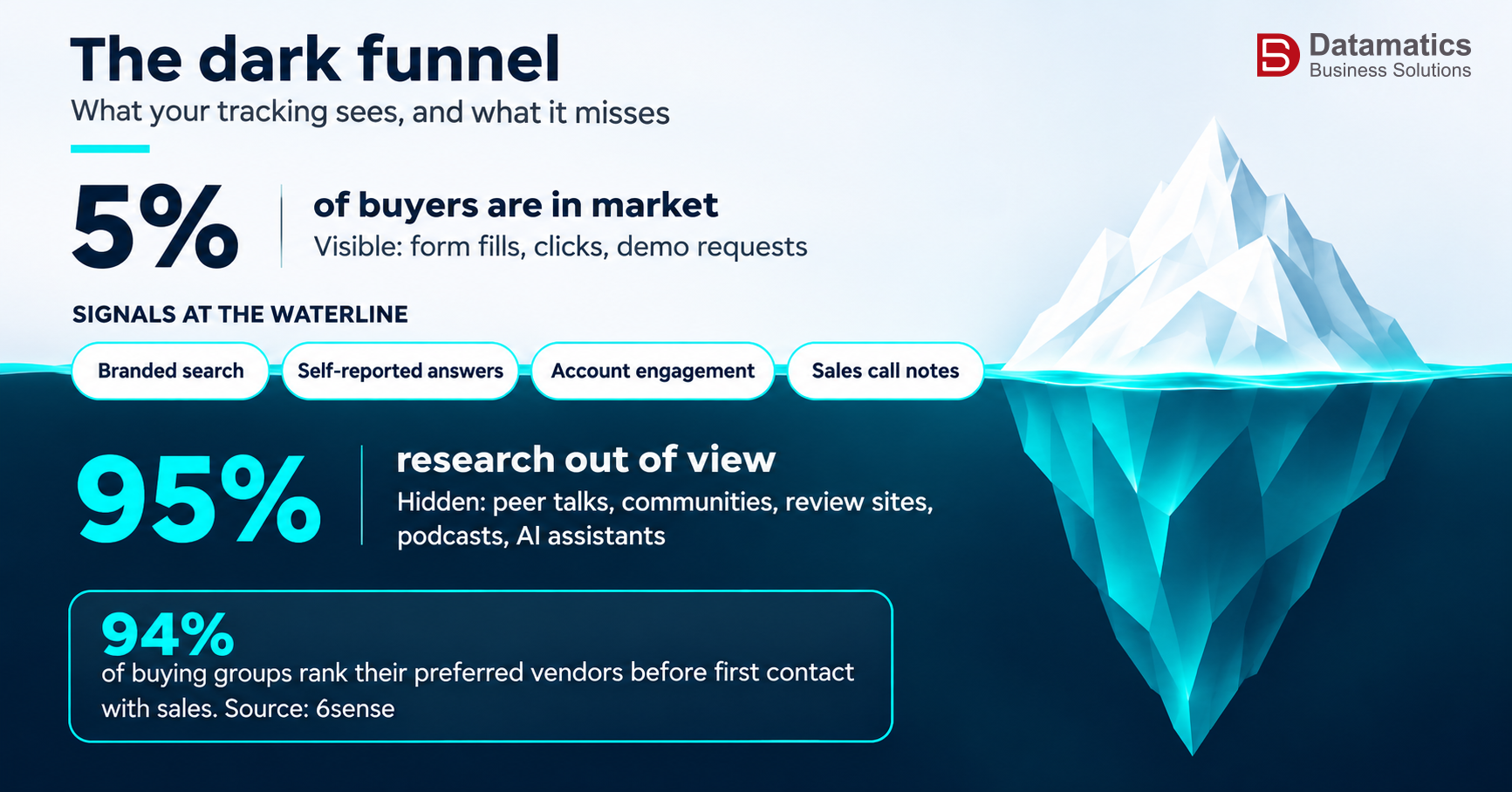
No single signal explains hidden demand. A small set of indicators, read together, gives a dependable picture within a few weeks of launch.
Branded Search And Direct Traffic
When a campaign builds awareness, branded search and direct visits tend to rise before form fills do. Track both weekly against a baseline taken before launch.
Rising branded demand with flat lead volume points to buyers who are researching and have not yet engaged. Account for seasonality and unrelated press coverage before drawing conclusions.
Pair these trends with direct visits to pricing and case study pages. Buyers who land there without a referral have usually encountered your brand somewhere else first.
Self-Reported Attribution
Add an open-text question to demo and contact forms asking how the buyer first heard about your company. Buyers often name podcasts, peer recommendations, communities and AI tools, which tracking scripts cannot capture.
Keep the question short and optional. A simple prompt records the buyer’s own words, which are more useful than a fixed dropdown list.
Review the answers monthly and group them into themes. Compare those themes with what your platform attribution report shows.
Account-Level Engagement And Intent Data
Account-level data shows whether several people from one company engage across channels. Intent data adds topic research that happens on third-party sites.
Buyers do much of this research without a seller. Gartner found that 61% of B2B buyers prefer an overall rep-free buying experience.
Early Sales Conversations
Ask sales to record the first question each buyer raises. A buyer who opens with integration or pricing detail has already done substantial research. A buyer who asks for a general overview is earlier in the journey.
Those notes turn individual calls into a pattern that marketing can use to refine content.
A weekly review should cover these signals.
- Branded search volume against the pre-campaign baseline
- Direct visits to pricing, case study and service pages
- Themes from free-text attribution answers
- Number of contacts engaging within each target account
- Competitor or prior-touchpoint mentions in sales call notes
- KEY TAKEAWAY
Hidden demand leaves traces. Branded search, self-reported answers and account engagement together show where interest builds before leads appear.
Demand Generation Metrics That Still Work When The journey Is Hidden
Last-touch attribution and lead volume were designed for a visible funnel. Demand generation metrics now need to describe influence and progression as well.
Leading Indicators To Keep
These measures show whether awareness is turning into consideration, even when the early journey is not recorded.
- Pipeline velocity by account segment
- Share of target accounts with multi-contact engagement
- Shortlist inclusion rate in competitive deals
- Win rate where the buyer cited a source that tracking missed
- Time from first tracked touch to opportunity creation
Reviewed together, these demand generation metrics support performance decisions earlier than lead counts allow.
Each indicator needs an owner. Assign pipeline velocity to sales operations and engagement measures to marketing operations, then review them in one meeting.
Suppose branded search rises for three weeks while lead volume stays flat. If multi-contact engagement in target accounts rises at the same time, the campaign is working on the buying group, and lead volume is likely to follow.
How To Set A baseline before launch
Choose a four-week window before the campaign starts. Record branded search volume, direct visits, average contacts per target account and the current win rate. These figures become the reference for every later comparison.
Use the same definitions each month. Changing what counts as an engaged account midway makes the trend difficult to read.
Metrics To Reframe
Cost per lead remains useful for efficiency tracking, yet it should not decide budget alone. Channels that build awareness often show weak last-touch numbers and strong influence on later deals.
Report attributed sources and self-reported sources side by side. The gap between them estimates how much of the dark funnel your current model cannot see.
- KEY TAKEAWAY
Pair efficiency metrics with progression metrics. The comparison between attributed and self-reported sources gives a practical measure of what the model misses.
How to Adjust Demand Generation Campaigns While They are Live
Move Spend Toward The Channels That Start Account Engagement
Review the signals every two weeks. When target accounts show growing engagement, move budget toward the channels where that engagement began, even if those channels produce few leads.
Reduce broad outreach to accounts that show no activity. Gartner also found that 73% of B2B buyers actively avoid suppliers that send irrelevant outreach.
Avoid cutting awareness channels because their last-touch numbers are low. Check first whether account engagement and branded demand moved during the same period.
Give Sales and Marketing One Shared View
Share the weekly signal summary with sales. Ask representatives to log how each buyer describes their research, since those notes confirm which dark funnel channels are working.
Agree on a short list of high-engagement accounts and plan outreach around what each has already read or heard. Relevant first contact protects the preference the buyer has already formed.
Consistency matters as well. Gartner reports that 69% of B2B buyers see inconsistencies between a seller’s website and the information sellers provide.
Keep The Review Cycle Short
Establish a baseline in the first two weeks, then act on trends at each two-week review. Small adjustments made early cost less than large corrections made late.
Set decision rules before launch, such as the level of branded search growth that triggers a budget review. Clear rules keep the team from reacting to a single noisy week.
Document each adjustment and the signal that prompted it. After two or three cycles, the team holds a record of which signals predict pipeline in its own market.
- KEY TAKEAWAY
Treat the campaign as a live system. Two-week reviews of account signals allow budget and outreach to follow buyer interest as it develops.
How DBSL Demand Generation Services Improve Dark Funnel Visibility
Datamatics Business Solutions Ltd. addresses dark funnel demand through its social activation solution. Paid social builds familiarity with buyers on LinkedIn, Meta, YouTube and Reddit during early research. DBSL demand generation services then engage that same audience. Qualified leads arrive with sales intelligence, which supports clearer visibility and stronger business outcomes.
- FAQS
Frequently asked questions
1. What is the dark funnel in B2B marketing?
The dark funnel is the buyer research and conversation that happens outside your tracking. It includes peer discussions, communities, review sites and AI assistants. This activity shapes vendor preference before a buyer fills in a form.
2. Can the dark funnel be measured directly?
Not fully. Teams can estimate its size and direction through branded search trends, self-reported attribution, account-level engagement and sales call notes. Read together, these indicators show where interest is building.
3. Which demand generation metrics matter most when attribution is incomplete?
Pipeline velocity, multi-contact engagement within target accounts, shortlist inclusion and win rate by source type give the clearest view. Cost per lead and last-touch conversions remain useful for efficiency and should sit beside these measures.
4. How does the dark funnel change the B2B buying funnel?
It moves much of the decision ahead of the first visible interaction. The funnel stages still exist, yet awareness and consideration take place largely where marketing teams cannot track them. Planning should reflect that earlier timeline.
5. How soon can a team act on dark funnel signals during a campaign?
Most teams can set a baseline in the first two weeks and act on trends at the first two-week review. Early, modest budget shifts carry less risk than late corrections, and they give the team more time to test the result.