


Every event marketing team eventually asks the same question. A pipeline fills up, yet conversion stays flat. The instinct is to check and analyze the campaign efforts. Often, the answer sits inside the database itself. A broken database rarely announces itself early. Left unchecked, it compounds quietly into a major challenge.
This is where database building services earn their place inside a RevOps stack, turning a list of names into a working system of record that sales can actually use.
Most teams treat the database as a byproduct of the event, exported once badges are scanned and leads are counted. A database built with intent works differently. It captures firmographic accuracy, verified contact details, and buying group context at the point of entry. Sales inherits records ready for immediate follow-up rather than a week of cleanup before the first call.
This changes how conversion behaves. Unverified or duplicated records inflate pipeline size while sales spends its time chasing dead ends. A smaller database, structured around defined buying groups and enriched with role-level detail, gets sales to a real conversation faster. The leads that arrive are usable from the first touch.
Database building services close the gap between volume and quality. They bring structure to what event lists, web forms, and third-party sources hand over in fragments, and align that structure with how sales actually works. A dashboard can make a database look complete. Whether it holds up depends on what a rep finds when they open the record.
Why event industry contact lists lose value faster than teams expect
Registration lists look complete on the day an event closes. Within weeks, the picture shifts. Attendees change roles, companies merge, and titles get reassigned as budgets move.
A contact captured at a trade show in March can already be inaccurate by the following quarter. Email addresses stop working. Phone numbers get reassigned. The record still sits in the CRM, counted as an asset it no longer is.
Industry research places average annual decay for B2B contact data at roughly 22.5%, based on a documented monthly rate of 2.1% (HubSpot benchmark, cited in ZoomInfo Pipeline research). For an event industry database built from multiple shows a year, that decay does not pause between events. It accumulates continuously, across every source feeding the system.
Wasted campaign spend follows directly from this decay. Emails bounce, calls reach disconnected lines, and sales development reps spend hours chasing contacts who changed roles months earlier. None of that shows up as a line item, yet it quietly erodes the return on every event sponsorship.
The event calendar itself keeps growing, which raises the stakes. UK exhibition venues hosted 1,145 exhibitions and conferences in 2024, a 4% increase over 2023 and the highest volume recorded since 2017 (2024 UK Events Report, cited by Quadrant2Design). Each additional show adds fresh contacts to a database that already needs active maintenance.
Marketing teams often measure event success by attendance and lead volume. Database health rarely appears on that scorecard, even though it determines whether those leads convert months later.
- KEY TAKEAWAY
A growing event calendar means a growing database. Left unmanaged, decay outpaces the value each new event adds.
What a reliable event database vendor actually delivers
Verification before volume
A dependable database starts with source-level verification, not resold or scraped records. Contacts should trace back to primary sources such as event registration systems, exhibitor directories, or direct opt-in forms.
- Source-level verification against primary records, not resold lists
- Enrichment fields for job title, seniority, and department, refreshed on a defined cycle
- De-duplication across multiple event sources feeding the same CRM
- Firmographic context, such as company size and industry vertical, attached at the point of entry
Event industry data also spans more than email and phone. LinkedIn presence, session attendance, and exhibitor booth interactions all add context that a generic contact database rarely captures. A vendor built specifically for the event industry should treat these signals as standard fields, not custom requests.
Compliance built into the process
Any contact database provider working with UK or EU event data must build GDPR compliance into collection and storage from the outset. Retrofitting consent tracking after the fact creates legal exposure that outweighs any speed gained upfront.
Consent basis, collection source, and retention period should travel with each record, not sit in a separate document that nobody checks before a campaign launches.
- KEY TAKEAWAY
A dependable contact database provider treats verification and compliance as part of delivery, not as an optional add-on.
Building versus buying: The case for database building services USA
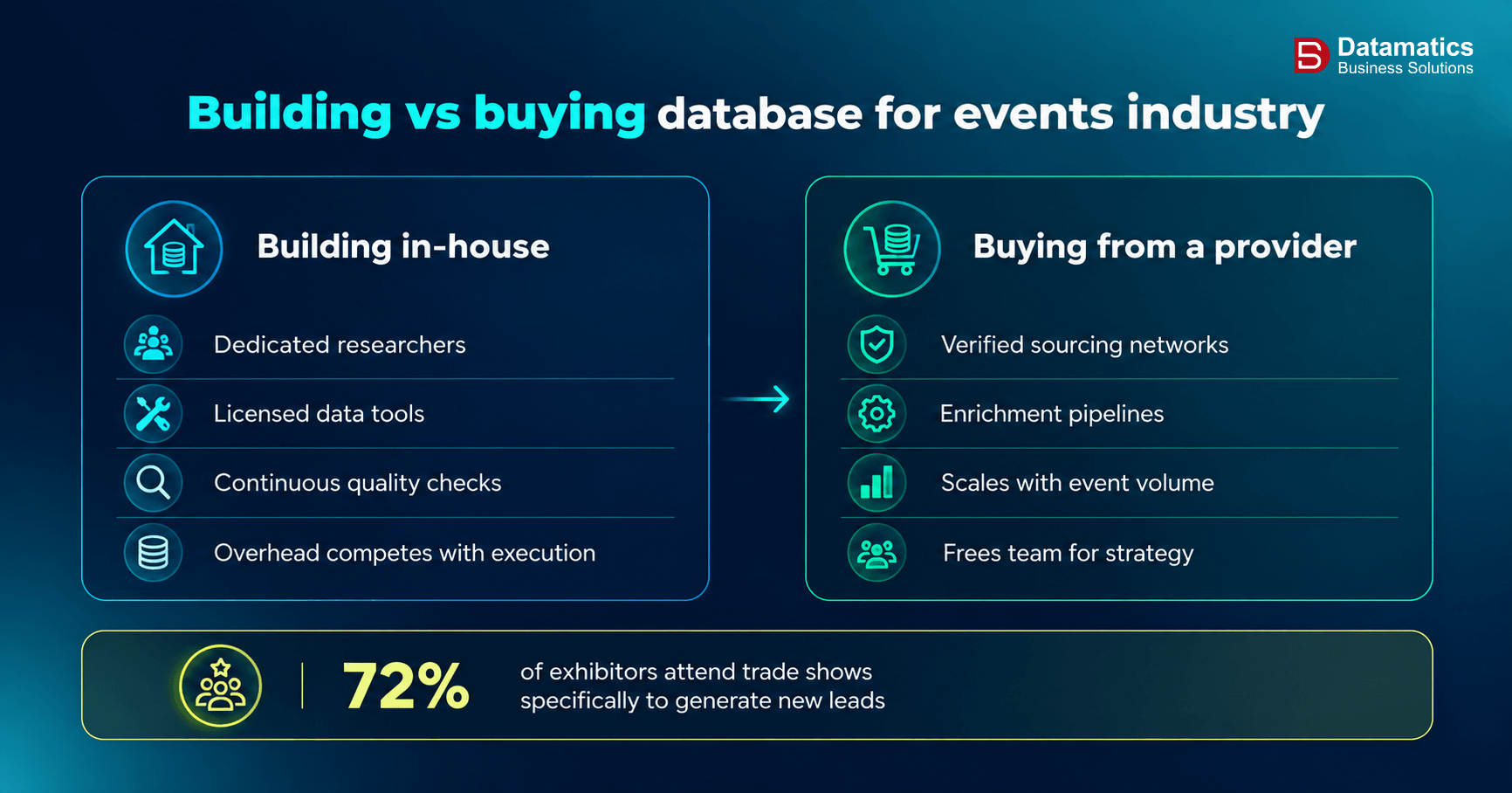
In-house list building demands dedicated researchers, licensed data tools, and continuous quality checks. For a lean marketing team already stretched across campaigns, that overhead competes directly with execution.
The cost of getting this wrong is measurable. 72% of exhibitors attend trade shows specifically to generate new leads. A database that cannot support that objective limits the return on every event a company sponsors, regardless of how well the booth performs.
Database building services USA providers bring infrastructure that most internal teams cannot replicate cost-effectively: verified sourcing networks, enrichment pipelines, and capacity that scales with event volume rather than headcount.
This shift matters beyond cost. Moving data collection to a specialized provider frees internal capability for data application, campaign strategy, segmentation, and follow-up sequencing.
Marketing managers evaluating this decision should weigh total cost of ownership, not just the invoice. Internal research hours, tool licensing, and the opportunity cost of delayed campaigns all belong in that calculation.
When evaluating a database building services USA provider, ask for a sample verification report before signing a contract. A provider confident in its process will show match rates, source documentation, and refresh frequency without hesitation.
- KEY TAKEAWAY
Outsourcing database construction converts a fixed internal cost into a scalable, outcome-linked capability.
Embedding a contact database provider into a RevOps cadence
A database is not a one-time deliverable. Performance depends on a maintenance cadence built into the RevOps calendar, not a project that ends at handover.
- Quarterly re-verification of high-value segments, prioritized by pipeline stage
- Waterfall enrichment across more than one data source to close coverage gaps
- Shared field definitions between sales and marketing to prevent duplicate or conflicting records
- Defined ownership for data quality, assigned to a specific role rather than left ambiguous
Sales and marketing teams frequently work from separate versions of the same contact, each partially updated. A shared cadence, owned jointly, closes that gap before it affects a live deal.
ROI from a maintained database compounds over multiple event cycles, not a single show. Marketing managers who track database health alongside campaign metrics typically see stronger year-over-year conversion, because the underlying contact pool degrades more slowly.
Treating the event industry contact database as a living asset, rather than a static file, protects the return on every event investment that feeds it. This is where modernization of the data function pays off in measurable pipeline performance, not just in cleaner reporting.
- KEY TAKEAWAY
Database performance depends on cadence, not on the initial build. A RevOps calendar keeps the asset current.
How DBSL supports event industry database building
Datamatics Business Solutions Ltd. supports event and exhibition teams with database building services built on verified sourcing, structured enrichment, and compliance-first collection. DBSL helps enterprises convert raw event contacts into a sales-ready database.
The result is pipeline visibility and measurable business outcomes from every show.
The data building process uses a hybrid approach that runs on 80% AI-driven profiling and 20% human verification. The databases provided also hold records to a 95% accuracy rate. DBSL works with enterprise clients across the Middle East, Europe, the Americas, and Asia Pacific, providing the same standard of data accuracy regardless of region or industry.
- Case Study
How One Events Leader Tripled Footfall Across Three Flagship Events
Half the cost per acquisition. 150% more ROI.
- FAQS
Frequently asked questions
1. What are database building services in the context of the event industry?
Database building services combine sourcing, verification, and enrichment to convert raw event contacts into structured, sales-ready records. For event marketing teams, this typically covers attendee lists, exhibitor contacts, and registration data collected across multiple shows.
2. How often should an event industry contact database be refreshed?
Most B2B databases benefit from a quarterly refresh cycle for high-value segments, given that contact data decays at roughly 2.1% per month. Fast-moving sectors within the event industry may need more frequent verification.
3. What is the difference between a contact database provider and a general data vendor?
A contact database provider specializing in events understands show-specific data such as exhibitor categories, session attendance, and registration type. A general data vendor may supply volume without that structure, which limits how the data can be used downstream.
4. Is outsourced database building compliant with GDPR for UK and EU events?
A reputable event database vendor builds consent tracking and lawful basis documentation into the collection process itself. Marketing teams should confirm this before onboarding any provider handling UK or EU event data.
5. Can database building services USA providers support international event portfolios?
Providers offering database building services USA often support global event portfolios, provided their sourcing and compliance processes extend beyond a single region. Marketing teams should verify regional coverage before scaling a single vendor across markets.