


US tech buyers do not wait for a sales call to start deciding. They read the guide, compare three vendors, and download the report, often before anyone on the vendor side even knows they exist. That is the entire reason content syndication lead generation works. The research is already happening, with or without a seat for marketing at the table.
Cold outreach and paid ads chase someone who has not made up their mind yet. Content syndication lead generation skips that guesswork and shows up where the buyer already is, inside the guide or whitepaper they went looking for on their own. Run it as a real channel with a real budget and the pipeline gets predictable fast. Run it as an afterthought to hit a quota, and the results will look like one.
What is content syndication lead generation?
Content syndication lead generation is the practice of distributing content, such as whitepapers and guides, through third-party platforms to capture qualified, permission-based leads from buyers who are already researching a topic.Lorem ipsum dolor sit amet, consectetur adipiscing elit. Ut elit tellus, luctus nec ullamcorper mattis, pulvinar dapibus leo.
What content syndication lead generation actually delivers
B2B buyers now consume an average of 15 pieces of content during their research process before ever engaging a vendor, according to Informa TechTarget’s 2025 Media Consumption and Vendor Engagement Study, which surveyed more than 1,700 global technology buyers.
Put a whitepaper into an established publisher network, and every download comes back as a name, a title, a company, and some evidence that this person cared enough to trade their information for it. Nothing more complicated than that sits underneath content syndication lead generation.
A cold email is a guess about who might be interested. Content syndication lead generation is not a guess, since the buyer already asked. That is why the leads it produces tend to know the vendor’s name before a rep even picks up the phone.
Most reputable programs run a double opt-in before a lead ever lands in a rep’s inbox. Skip it, and the CRM fills up with bounced addresses and made-up job titles within a month.
The Content Marketing Institute found content marketing generates three times more leads than traditional marketing, at 62% lower cost. That is a wide enough gap to explain why content syndication companies have become a fixture in nearly every serious B2B demand generation stack, not just a nice-to-have channel.
- KEY TAKEAWAY
Content syndication lead generation turns a buyer’s own research into a qualified, permission-based lead, for a fraction of what most traditional channels cost to run.
Why US tech buyers respond to content syndication lead generation
Enterprise and mid-market technology buyers do most of their research alone now, long before a vendor enters the picture. NetLine’s 2025 State of B2B Content Consumption and Demand Report counted 7.9 million first-party content registrations in 2024, a 27% jump over the year before.
That volume tracks with how much ground buyers now cover on their own. Content syndication lead generation is built for exactly that stretch of the journey. It is about meeting a buyer already digging instead of interrupting one who is not.
Format matters inside that behavior too. Demand Gen Report found short-form content and webinars are the formats buyers rate most valuable to their decision-making, at 67% and 65% respectively. This is proof that people want something they can act on quickly.
- KEY TAKEAWAY
US tech buyers are already deep into their own research before a vendor shows up. Content syndication lead generation puts a vendor into that research on the buyer’s terms, not the vendor’s.
Building a content syndication strategy that targets the right buyer
A content syndication strategy earns its budget or wastes it in the targeting step. Job title, industry, company size, and technology stack decide which publishers are worth paying for and which are just noise.
Format choice carries its own weight. A rushed VP skims a two-page guide. A technical evaluator wants the benchmark report with the methodology attached.
Paid search is not getting any cheaper. WordStream’s 2025 Google Ads Benchmarks report, built from more than 16,000 campaigns, puts the average cost per lead at $70.11, up from $66.69 the year before. A well-targeted content syndication strategy routinely beats that number, and it hands over more context on why the buyer converted in the first place.
Layering intent data on top sharpens things further. Instead of syndicating broadly, a team can prioritize the accounts already researching adjacent topics, and skip the rest.
- KEY TAKEAWAY
Targeting and format decide whether a content syndication strategy produces leads sales wants to work, or just more names in a spreadsheet.
Choosing between content syndication vendors and B2B content syndication services
Broad content syndication vendors | Specialized B2B content syndication services | |
|---|---|---|
Targeting approach | Generic network, wide reach | Industry, job function, or intent-based |
Lead quality | Inconsistent, higher bounce risk | Higher fit, more verified |
Data verification | Often minimal | Typically built into the process |
Publisher relationships | Single generic network | Relevant technology and business publications |
Pricing | Looks cheaper on paper | May cost more per lead, but converts better |
Publisher relationships are the real tell. A vendor with genuine standing across relevant technology and business publications delivers more consistent audience fit than one leaning on a single generic network stretched across every industry it can find.
Demand Metric puts the average cost per lead for content syndication at $43, cheap enough to explain the category’s growth. Pairing the right content syndication vendors and B2B content syndication services with that cost advantage is what keeps it cheap without turning it into junk data.
- KEY TAKEAWAY
Cheap leads and usable leads are not the same thing. The right content syndication vendors and B2B content syndication services deliver both.
Aligning content syndication lead generation with sales follow-up
A qualified lead does not stay qualified forever. The window that matters most is the first 24 to 48 hours after a download, before the buyer’s attention is already somewhere else.
Get sales and marketing to agree on scoring and routing before the campaign goes live, not after leads start piling up in a shared inbox nobody is watching that week.
A fast, relevant response is not just about closing deals quicker. It tells the buyer their instinct was right, that the resource was worth handing over their information for.
- KEY TAKEAWAY
Content syndication lead generation only works if sales follow-up is fast and the routing rules are already set before the first lead shows up.
Measuring performance beyond cost per lead
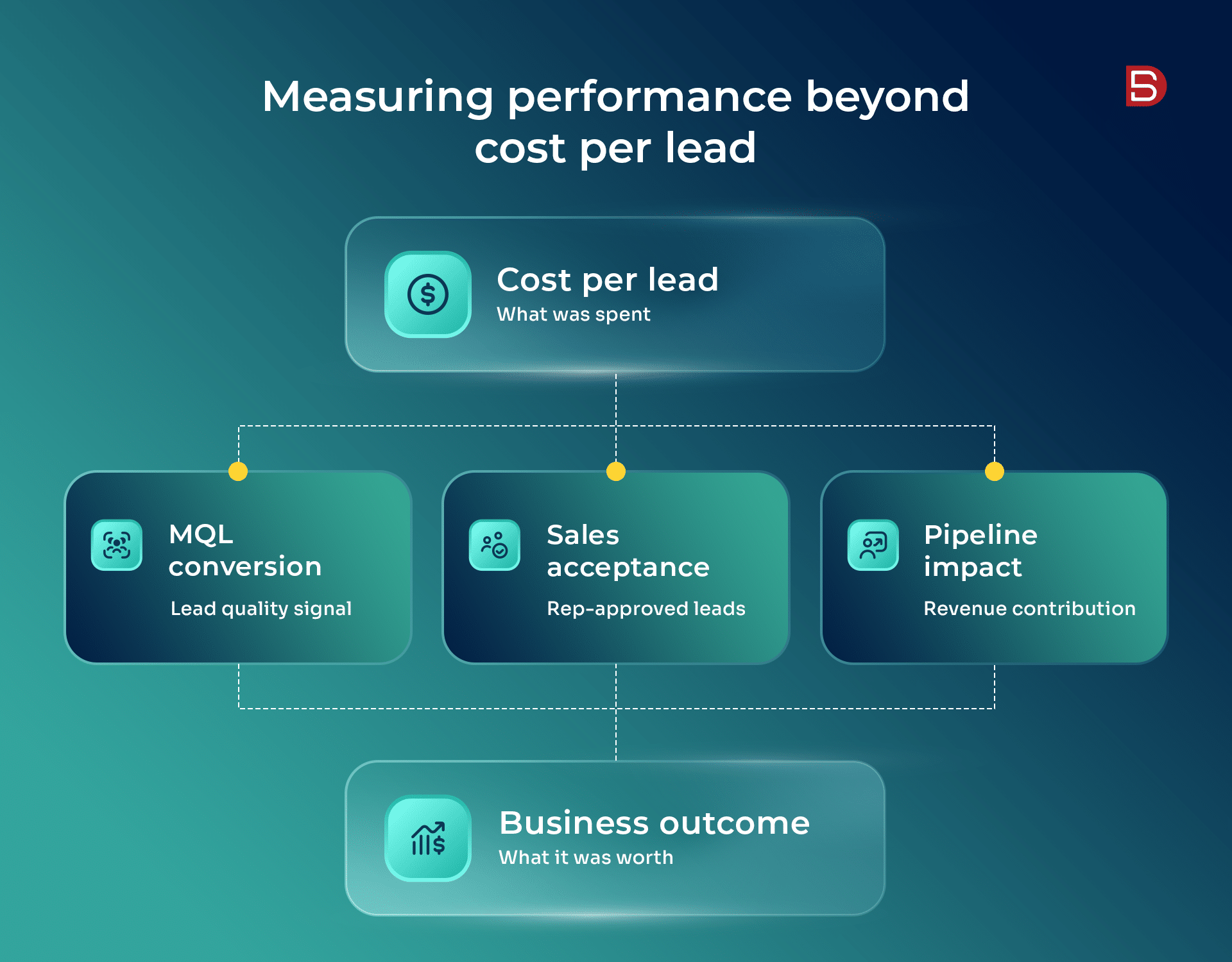
Cost per lead is the number every dashboard leads with, and it is also the least honest one. What actually tells you whether content syndication lead generation is working is lead-to-MQL conversion, sales acceptance rate, and pipeline contribution.
Track those consistently and targeting gets sharper every cycle, because the team is chasing revenue instead of a lower CPL that might just mean worse leads.
That same data makes the budget conversation easier. A channel that can point to business outcomes is a channel that survives the next round of cuts.
- KEY TAKEAWAY
Cost per lead tells you what a campaign spent. Pipeline contribution tells you what it was actually worth.
How DBSL supports content syndication lead generation
Datamatics Business Solutions Ltd. builds content syndication programs on verified data and defined targeting. Our B2B content syndication capabilities cover asset distribution, lead qualification, and campaign optimization, turning buyer research into pipeline a sales team can actually work.
For companies scaling US tech buyer acquisition, that is what makes content syndication lead generation repeatable, not just a campaign that runs once and gets shelved.
- FAQS
Frequently asked questions
1. What is content syndication lead generation?What is content syndication lead generation?
It is the practice of distributing content such as whitepapers and guides through third-party platforms to capture leads. A buyer trades contact details for the content, which produces a permission-based lead instead of a cold contact.
2. How is content syndication different from paid advertising?
Paid advertising interrupts a buyer who has not asked for anything. Content syndication lead generation responds to a request the buyer already made, which is a large part of why the leads convert better.
3. What should companies look for in content syndication vendors?
Targeting accuracy, data verification, and privacy compliance matter more than volume. A high lead count from a content syndication vendor means little if half the records bounce or belong to the wrong buyer.
4.How much does content syndication lead generation typically cost?
Demand Metric puts the average around $43 per lead, though the real number moves with industry, targeting, and asset type.
5. How can B2B SaaS companies measure content syndication success?
Look past cost per lead to lead-to-MQL conversion, sales acceptance rate, and pipeline contribution. That combination shows whether syndicated leads are actually turning into revenue.