


Most B2B content strategies are built around a single buyer persona.
The problem: enterprise deals are never decided by a single buyer.
Gartner’s research puts the typical B2B buying group at six to ten decision-makers. Each one brings different priorities, different objections, and a different definition of value. Content built for one persona while ignoring the rest stalls deals before they reach sales.
A buying group content strategy fixes that. It maps content to every relevant stakeholder, at every stage of the buying journey, across every channel they use.
Why single-persona content kills enterprise pipeline
The legacy B2B content model optimized for the MQL. One buyer, one content track, hand the lead to sales.
That model does not reflect how enterprise purchasing actually works.
Forrester puts 63% of B2B purchases at four or more stakeholders. Each one can stall, veto, or champion a deal. A CFO evaluating cost efficiency needs different content than an IT director assessing integration risk, or an end-user evaluating workflow fit.
The bigger challenge is not a lack of content. It is a lack of visibility. Marketing teams engage the first person who responds and assume they represent the buying committee. They rarely do. Other stakeholders enter later with entirely different concerns, and by then the content program has nothing for them.
A buying group engagement strategy treats each stakeholder as a distinct content audience. It does not just generate awareness. It builds consensus.
- KEY TAKEAWAY
Pipeline stalls when content addresses one persona in a multi-stakeholder deal. Map messaging across every stakeholder in the decision, not just the first one who raised their hand.
The four layers of a high-performance buying group content strategy B2B
Building an effective strategy requires four foundational layers working together.
1. Stakeholder intelligence
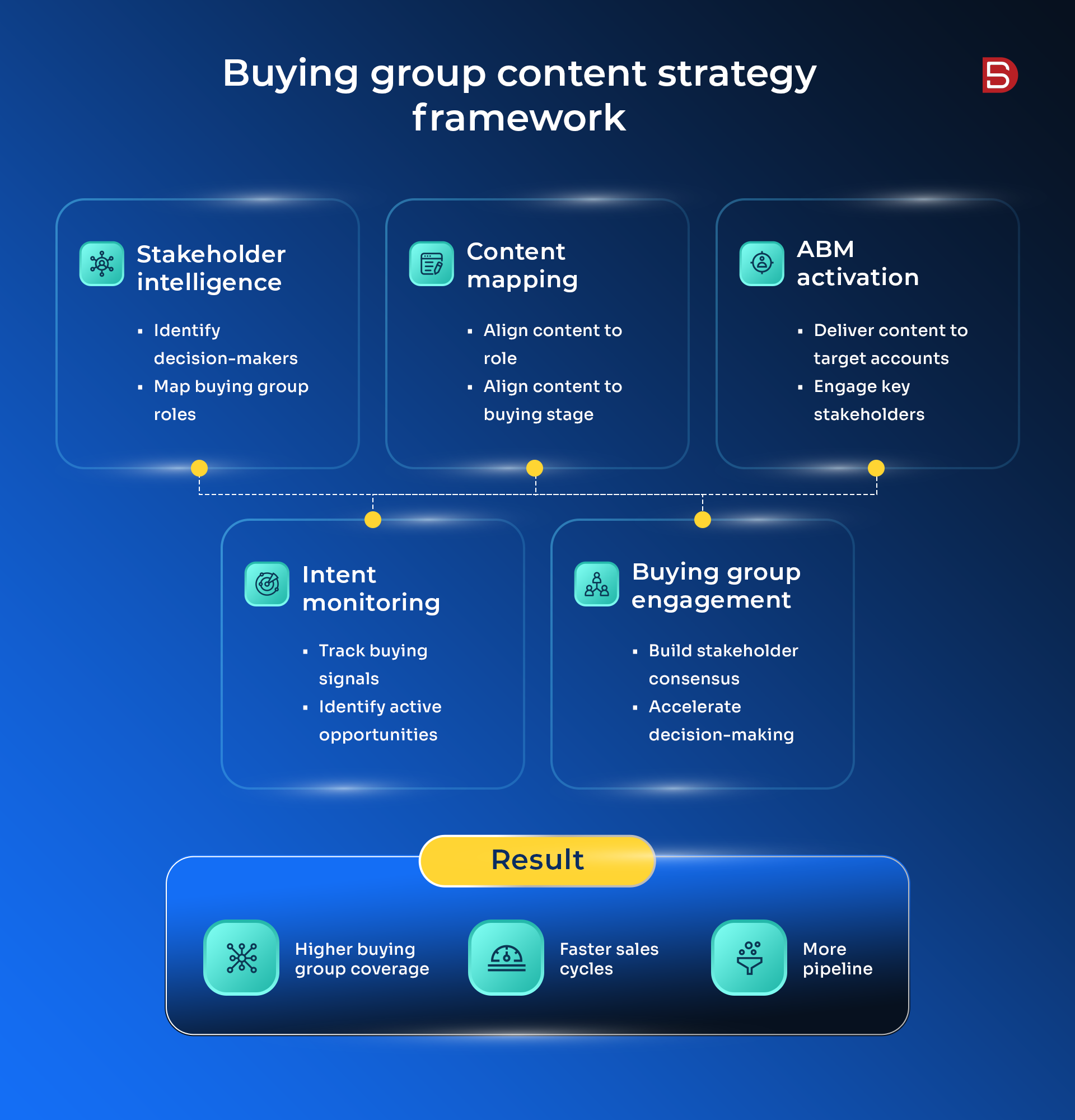
Before content, map the buying group. Titles, departments, business priorities, and where each role typically enters a buying cycle. Bad data here like outdated contacts, wrong firmographics, incomplete mapping, means content reaches the wrong people. Everything downstream fails.
2. Content mapping by role and stage
A CIO in problem-definition mode needs a different asset than a procurement manager in vendor evaluation. The format, depth, and business frame all shift. Map each asset to a role, a stage, a concern, and a desired outcome. That is a content architecture. Not a content library.
3. ABM integration
Distribution must be account-specific. Intent data layered with account data ensures content reaches the right stakeholders, not just whoever shows up in your traffic report. Accounts showing active buying signals convert at higher rates when engaged during that window. Waiting for inbound means entering the conversation late.
4. Channel activation
Senior decision-makers find thought leadership on LinkedIn. Practitioners want webinars, case studies, and technical content. Neither group follows a single path. A coordinated multi-channel approach keeps relevant content in front of the right stakeholder at each stage, so by the time sales reaches out, the buying group already knows who you are.
- KEY TAKEAWAY
A structured buying group content strategy B2B teams can scale requires four layers: stakeholder intelligence, role-and-stage content mapping, ABM-aligned distribution, and coordinated multi-channel activation.
How buying group intent data services change the content activation model
Most content programs are reactive. Someone downloads an asset, gets added to a nurture sequence, and waits. Meanwhile, five other stakeholders in the same account are actively researching the same solution category and receiving nothing.
Buying group intent data services close that gap. They aggregate behavioral signals across multiple stakeholders within the same account, so instead of tracking what one person clicked, you can see what an entire buying group is doing.
That changes how and when content gets deployed. An account where three stakeholders are simultaneously researching a solution category is a different priority than an account with one curious practitioner. The content response should reflect that difference.
Sales cycles shorten when content reaches the full buying group during the active consideration window. Not because the content is better. Because it is better timed.
- KEY TAKEAWAY
Buying group intent data tells you when an account is actually in motion. Act on that window and content reaches the full buying group when it matters most.
Measuring buying group content performance: The metrics that matter
Lead counts lie. One download from a ten-stakeholder buying committee registers as a win. Nine decision-makers have never seen your content. The deal stalls.
The fix is better measurement, not better leads. Track these instead:
Buying group coverage — What percentage of mapped stakeholders in a target account have engaged with at least one asset?
Multi-stakeholder engagement rate — How many target accounts show two or more stakeholder interactions?
Content-influenced pipeline — What share of active deals have content touchpoints across multiple stakeholders?
Buying group velocity — How does time-to-opportunity change when full buying group coverage is achieved?
These metrics connect content performance to revenue. They end the attribution argument and start a different conversation in the QBR.
- KEY TAKEAWAY
Lead-based metrics only tell part of the story. Buying group coverage, multi-stakeholder engagement, and pipeline influence show what actually moves revenue.
How DBSL helps B2B marketing teams execute buying group content strategy
Enterprise buying decisions do not happen in a single conversation. They happen across six to ten stakeholders, multiple geographies, and months of internal debate. Most of which your team never sees.
DBSL exists for that problem.
B2B demand generation teams use DBSL’s verified buying group data to build accurate account maps, identify who is actually involved in a purchase decision, and get contact-level intelligence on each of them. Intent signals surface which accounts are actively in-market. Stakeholder engagement data tells you whether the right people are paying attention.
The result: marketing programs built around real buying momentum, not lead volume.
When you are running ABM programs across dozens of accounts and multiple regions, the margin for error on targeting is zero. One wrong assumption about the decision-making group and you are nurturing the wrong person for six months.
DBSL closes that gap with the data infrastructure to map the full buying group and the activation support to reach them at the right moment.
Pipeline outcomes follow from that. Not the other way around.
- FAQS
Frequently asked questions
1.What is a buying group content strategy in B2B marketing?
A buying group content strategy B2B teams use maps content to every stakeholder involved in an enterprise purchase decision. Rather than targeting a single buyer persona, it assigns specific content assets to specific roles, buying stages, and business priorities across the full decision-making group.
2. How is buying group content strategy different from standard account-based marketing?
Standard ABM targets accounts as a unit. A buying group content strategy goes further by targeting individual stakeholders within those accounts based on role, stage, and intent. Buying group targeting ABM combines account-level precision with stakeholder-level content relevance.
3. What data is needed to build a buying group content strategy?
You need accurate stakeholder data for target accounts, including verified titles, department-level contact intelligence, and behavioral intent signals. Buying group data for ABM and buying group intent data services provide the foundational layer for mapping and activating stakeholder-specific content.
4. How do you measure the success of a buying group engagement strategy?
Measure buying group coverage (percentage of target account stakeholders reached), multi-stakeholder engagement rate, content-influenced pipeline, and buying group velocity. These metrics connect content activity directly to pipeline and revenue outcomes.
5. When should a B2B marketing team invest in buying group content strategy?
When average deal size is high, sales cycles are long, and multiple stakeholders are involved in purchase decisions, a buying group engagement strategy becomes essential. If content is generating leads but deals are stalling before close, incomplete buying group coverage is usually a contributing factor.
6. How many stakeholders should a buying group content strategy target?
While the exact number varies by industry and deal complexity, enterprise buying decisions often involve multiple stakeholders across business, technical, financial, and operational functions. Rather than focusing on a fixed number, marketers should identify the roles that influence evaluation, approval, and implementation within each target account and ensure content addresses their distinct priorities.