


Most B2B marketing teams invest heavily in content. The whitepaper gets written. The report gets designed. And then it sits on a landing page, waiting.
Content syndication companies exist to solve exactly this problem. But with dozens of vendors in the market, the real challenge is not whether to syndicate. It is choosing the right partner for your pipeline goals.
Why the vendor decision matters more than the strategy
Content syndication as a channel works. The data is clear. According to a 2026 B2B vendor guide by ContentSyndication.org, more than 90% of companies using content syndication plan to maintain or increase their investment. The channel delivers reach at scale. The problem is execution.
A poor-fit content syndication partner produces form fills, not pipeline. Leads that do not match your ICP, data that fails validation, and no visibility into downstream performance. These are not small inefficiencies. They drain budget and erode confidence in the channel.
The right b2b content syndication services partner brings three things to the table: precise audience targeting, lead quality validation, and reporting that connects distribution to revenue. That combination is what separates a functioning syndication program from an expensive list-building exercise.
- KEY TAKEAWAY
Vendor selection is the single biggest variable in content syndication performance. Strategy without the right partner rarely converts.
What to evaluate before shortlisting content syndication vendors
Before comparing content syndication vendors by name, a demand generation team needs a clear evaluation framework. There are five factors that consistently determine program success.
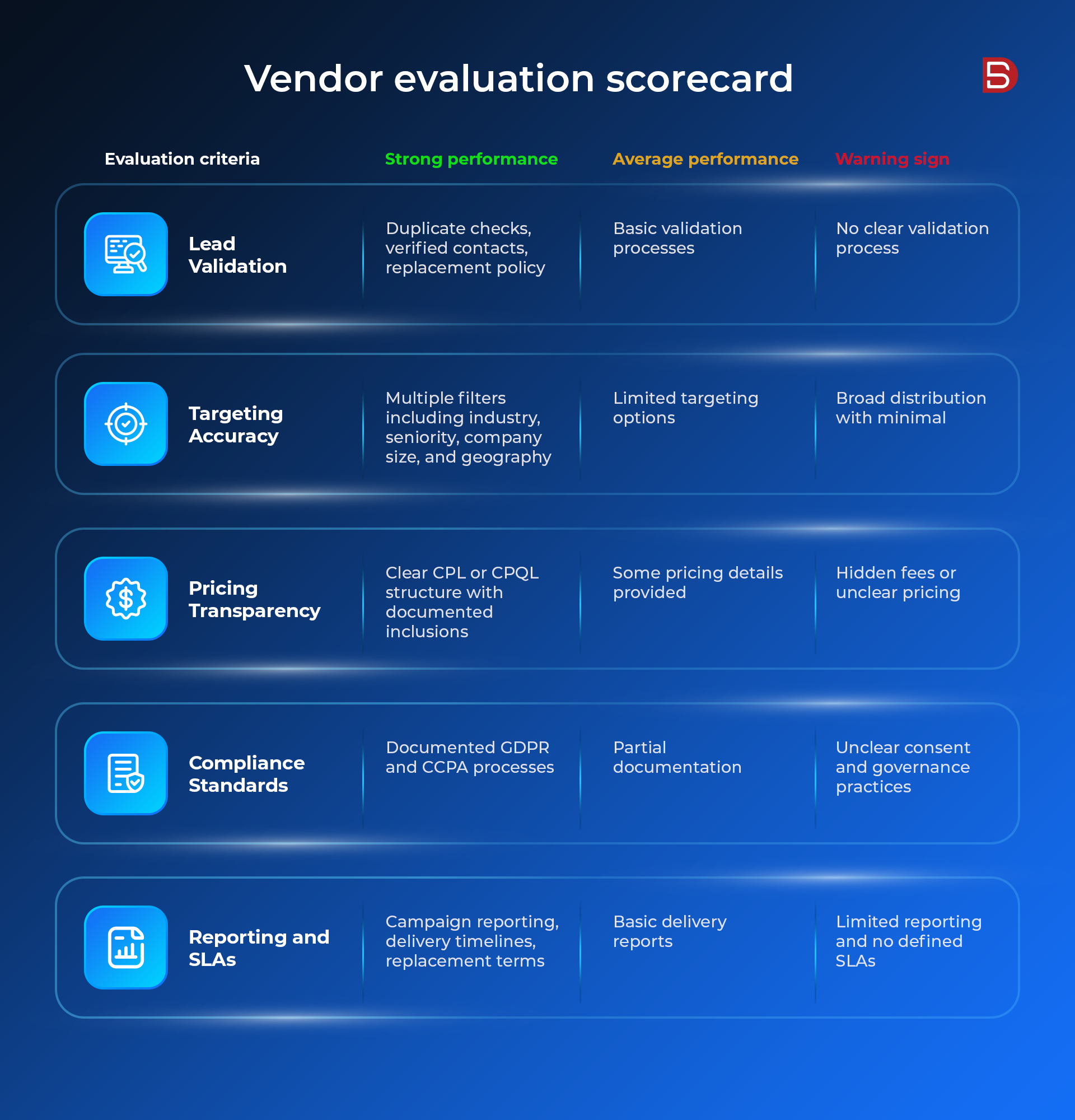
Lead quality and validation. Does the vendor verify leads before delivery? Do they remove duplicates and provide replacement policies for invalid data? This is the foundation.
Targeting precision. The best content syndication partners offer targeting by industry, job role, seniority, company size, and geography. Broad distribution without filters produces volume, not quality.
Pricing transparency. Most content syndication companies price on a cost-per-lead (CPL) or cost-per-qualified-lead (CPQL) model. LeadSpot’s 2025 data puts average B2B CPL between $65 and $250, depending on channel and industry. Understanding where a vendor sits on that spectrum matters before any commitment.
Compliance and data governance. GDPR and CCPA compliance is non-negotiable for enterprise buyers. Confirm the vendor maintains proper consent records and documented data handling processes.
Reporting and SLAs. Clear delivery timelines, lead replacement terms, and campaign-level analytics are table stakes. Without these, there is no way to optimize.
- KEY TAKEAWAY
Define evaluation criteria before vendor conversations begin. Without a clear rubric, selection defaults to brand recognition rather than fit.
A comparison of leading content syndication companies
The market for b2b content syndication services has matured significantly. A handful of vendors consistently appear across shortlists for enterprise demand generation programs.
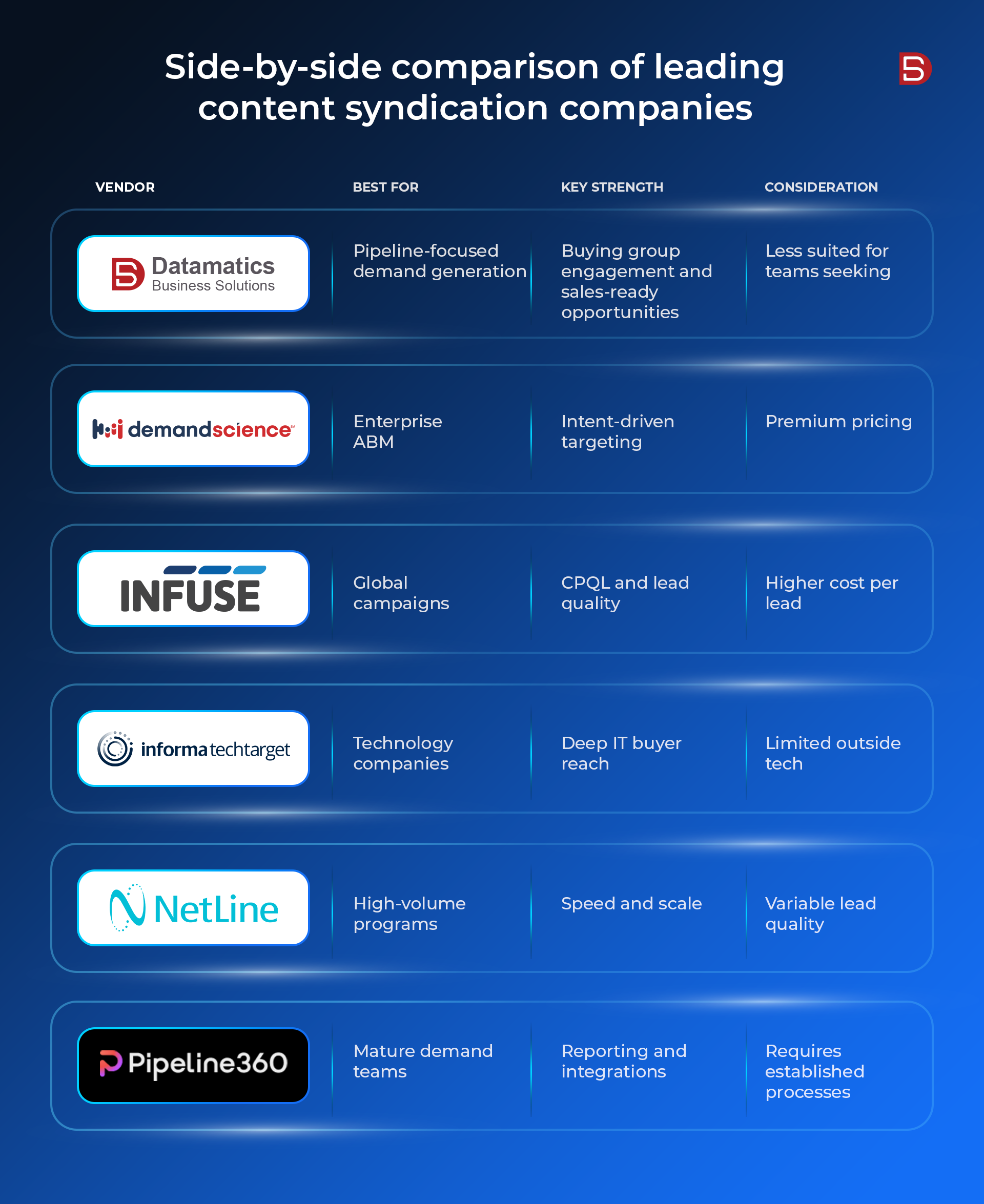
1. Datamatics Business Solutions
- Shifts the focus from single form-fills to “Buying Group Acquisition,” mapping and engaging multiple stakeholders to build consensus across the entire purchasing committee.
- Intercepts “dark funnel” intent by pairing multi-channel syndication with real-time account intelligence, reaching buyers exactly when they are looking to switch or invest.
- Replaces raw, unverified downloads with full-funnel qualification—combining 95%+ data accuracy guarantees with optional BANT qualification and direct appointment setting to deliver genuinely sales-ready opportunities.
2. DemandScience
- Built for enterprise-scale programs that rely heavily on intent-data targeting.
- Pinpoints and captures accounts that are actively researching relevant solutions in real time.
- Works best for marketing teams running structured account-based marketing (ABM) playbooks.
3. INFUSE
- Operates on a transparent Cost Per Qualified Lead (CPQL) pricing model to eliminate budget waste.
- Specializes in delivering highly vetted leads across complex, multi-region campaigns.
- A go-to choice for enterprise growth teams requiring consistent lead quality across a global footprint.
4. TechTarget
- The dominant heavyweight for tech, IT, and enterprise software sectors.
- Leverages a massive, proprietary network of tech publications to monitor and map true buyer behavior.
- Delivers highly efficient Cost Per Lead (CPL) performance when targeting technical decision-makers.
5. NetLine
- Engineered for rapid, high-volume lead generation and massive audience reach.
- Uses a self-service campaign deployment model that lets you test content performance in days, not weeks.
- Lead quality leans closer to medium compared to premium vendors, but it excels in sheer velocity and scale.
6. Pipeline360 (Integrate)
- Uses a data-driven distribution model backed by highly granular account filtering.
- Built to pass clean data directly into your CRM via tight native integrations with your marketing automation stack.
- Gives marketing leadership exceptional, transparent visibility into campaign-level performance.
Each of these content syndication vendors solves a different problem. The right choice depends on your ICP, geography, sales velocity, and the asset type you are syndicating.
- KEY TAKEAWAY
No single vendor wins across every use case. Match the vendor’s core strength to your specific program requirement.
How to choose a content syndication company
Choosing a content syndication partner is a pipeline decision, not a line item on a media spend checklist. Treat it like a commodity and you will end up with a database full of junk.
A disciplined, six-step framework ensures you pick partners that actually drive revenue.
Step 1: Document your hard boundaries (ICP)
Before talking to a single sales rep, lock down exactly who you need to reach. Define the industries, job titles, seniority, company size, and geographies that matter to your business. If a vendor cannot filter tightly for these, they are not a fit.
Step 2: Lock in your core goal
What do you actually need right now? Massive lead volume to feed a hungry SDR team? Highly qualified accounts for an enterprise ABM play? Global reach? Different vendors are built for radically different outcomes. Be honest about your priority before you start shortlisting.
Step 3: Vet against a strict scorecard
Look past the pitch decks. Grill them on the details that determine lead quality: How do they catch duplicates or fake emails? Are their GDPR and CCPA processes airtight? Is the cost per lead fully documented, or are there fees buried in the contract? If they cannot answer these cleanly, move on.
Step 4: Run an apples-to-apples pilot
Test your top choices at the same time. Give them identical target audience criteria and the same content asset. There is no other way to establish a fair baseline. Staggered pilots introduce too many variables to be useful.
Step 5: Track what happens after delivery
A download is not a win. Ignore the initial spreadsheet of form fills. Watch the downstream data over the next 30 to 60 days. The metrics that matter are ICP match rates, MQL-to-SQL conversion, and actual pipeline created. Everything else is noise.
Step 6: Double down on what works
Only scale budget after a vendor proves they can consistently deliver prospects who engage with your sales team. Cut the laggards. Shift resources to the winners. There is no loyalty reward in demand generation.
- KEY TAKEAWAY
The cheapest lead on paper is often the most expensive mistake your sales team will make. High-performing syndication programs are built on hard data, not vendor promises.
The content syndication strategy that makes vendor performance matter
Even the strongest content syndication partners cannot compensate for weak program design. A content syndication strategy that produces qualified pipeline follows a consistent structure.
Asset selection comes first. Demand Gen Report research found that short-form content (67%) and webinars (65%) ranked highest for aiding B2B purchase decisions. Whitepapers and research reports also perform strongly when they address a specific operational problem, not a general topic.
Audience definition follows. The more precisely you can define your target buyer by firmographic and behavioral criteria, the better your vendor can filter for match. Vague audience definitions produce vague leads.
Integration with nurture is what separates a lead generation tactic from a pipeline program. A 2024 Forrester study found that B2B organizations using syndication reported a 25% higher conversion rate from MQL to SQL compared to email-only campaigns. That lift does not happen without structured follow-up that references the syndicated asset.
- KEY TAKEAWAY
A content syndication strategy needs three components to deliver pipeline: the right asset, a precise audience definition, and an integrated nurture sequence. Vendor performance multiplies on this foundation.
How DBSL helps B2B organizations build and execute syndication programs
We do not just syndicate content. We build the entire infrastructure to make it perform. DBSL handles everything from mapping your exact ICP to running the multi-channel outreach and lead qualification required to hand off sales-ready opportunities.
We do not expect you to take our word for it. Our framework is proven to deliver at scale. For a global HR tech platform, DBSL’s intent-driven syndication scaled demand across 7 international markets in just 90 days. By replacing raw form-fills with rigorous validation, the program delivered a 70% increase in MQLs, a 40% reduction in cost-per-MQL, and a 55% increase in MQL-to-SQL conversion. All backed by a 95% data accuracy guarantee.
That is how you stop chasing empty campaign activity and start building a trusted, revenue-ready pipeline.
- FAQS
Frequently asked questions
1. What is the difference between content syndication companies and content syndication platforms?
The core difference comes down to execution: companies are managed-service partners, while platforms are self-service software. A content syndication company handles the audience targeting, lead validation, and campaign optimization for you. A platform gives you direct, self-service access to a distribution network to run campaigns yourself. Most enterprise teams lean toward managed services because they provide tighter quality control and manual reporting oversight.
2. How do I evaluate lead quality from a content syndication vendor?
3. What pricing model should I expect from B2B content syndication services?
You will almost always encounter Cost Per Lead (CPL) or Cost Per Qualified Lead (CPQL) models. While a standard CPL model is cheaper upfront, pricing fluctuates heavily based on how niche your targeting is. CPQL models demand a higher price per lead but filter out junk data before it hits your database, ultimately yielding much stronger downstream conversion rates and saving your sales team time.
4. How does content syndication fit into an ABM strategy?
Content syndication acts as a high-intent, top-of-funnel engine for Account-Based Marketing. Instead of spraying content across a broad audience, you hand your vendor a specific list of target named accounts and tiered buyer personas. The vendor then concentrates distribution strictly within those high-value accounts, accelerating engagement with the exact stakeholders your sales team is actively chasing.
5. What content formats perform best for B2B syndication?
High-value, educational assets always outperform product pitches. Original research reports, comprehensive whitepapers, and tactical “how-to” guides pull the highest engagement because enterprise buyers download them during their initial research phases. Webinar recordings and benchmark reports also convert well. Purely promotional or product-heavy content consistently underperforms because syndication audiences are looking to solve a problem, not sit through a sales pitch.