


The whitepaper download is not what you think it is
Five hundred contacts download your whitepaper. Sales makes the calls. Half do not pick up. The other half say they were just browsing. Sound familiar?
This is the core failure of pay-per-lead content syndication as it has been practiced for the last decade. Marketers buy volume. Revenue suffers.
The problem is not effort but measurement. Zero-click search behavior has changed how buyers research. According to Forrester, more than 70% of the buying journey now happens before a prospect ever talks to a sales rep. Buyers read analyst summaries, watch peer reviews on G2, absorb LinkedIn threads, and compare vendors in private Slack communities. A gated PDF download is one small signal in a much larger, largely invisible research process.
What a whitepaper download actually tells you is this: someone at a company was curious enough to fill out a form. That is not intent. That is curiosity.
The more productive question is: what else is that account doing? Are multiple people from the same company reading related content? Is there pattern behavior across personas and topics? That is where real buying signals live.
- KEY TAKEAWAY
A single lead from a content download tells you almost nothing. Account-level activity across multiple touches is where real intent becomes visible.
Why enterprise deals stall at the lead-passing stage
Enterprise deals do not stall in negotiation. They stall much earlier, when marketing hands sales a list of names instead of a picture of an account.
The average B2B technology purchase now involves 6 to 10 stakeholders, according to Gartner. That buying committee includes technical evaluators, financial approvers, end users, and a procurement lead. Each of them is doing their own research. Each of them forms their own opinion. And most marketing programs are capturing exactly one of them.
When a content marketing team passes a single MQL to sales, the sales rep calls that one person. That person says, “I am not the decision-maker.” The deal goes cold. Marketing gets blamed for lead quality. Sales gets blamed for follow-up. Nobody asks the more fundamental question: did we ever understand the full account?
Fragmented tracking is the structural cause. CRM systems capture contacts, not companies. Marketing automation measures form fills, not account-level engagement patterns. The data silos between marketing, sales, and revenue operations mean that no single team ever has the full picture of which accounts are actually in-market.
This is the gap that next-generation b2b content syndication services are built to address.
- KEY TAKEAWAY
Enterprise pipeline requires account intelligence, not individual contacts. Fragmented tracking creates data silos that prevent sales and marketing from seeing the full buying group.
How next-gen content syndication vendors surface dark funnel intent
Legacy lead brokers do one thing: they place your content in front of a large audience and hand you the contacts that downloaded it. That model made sense when the sales funnel was linear and buyers declared their intent through form fills. Neither of those things is true anymore.
Premium content syndication vendors operate on a different logic. Instead of tracking who downloaded one asset, they track which assets multiple personas from the same account have consumed over time. This is multi-touch intent mapping, and it represents a completely different operational model.
Here is what that looks like in practice. A senior IT manager at a mid-market company reads your cloud security guide. Two weeks later, a VP of Operations from the same company reads your ROI calculator content. A month after that, the company’s CTO engages with a comparison piece featuring your brand. A legacy lead broker gives you three separate contacts. A premium vendor surfaces one account showing coordinated, cross-functional research behavior.
That distinction matters enormously for pipeline quality. When you link content distribution with buying group intent data services, you start capturing what industry analysts call “dark funnel” demand, the market activity that happens outside your owned channels and never touches your CRM.
Demand Gen Report research consistently shows that account-based programs that incorporate buying group signals generate higher pipeline conversion rates than those relying on individual lead scores. The gap is not marginal. It is structural.
SiriusDecisions research has previously shown that fewer than 1% of raw leads ever become closed revenue in complex B2B environments. The issue is not top-of-funnel volume but lack of buying-context visibility. Revenue teams that prioritize account-level engagement and multi-persona intent signals consistently outperform teams still optimizing around isolated MQL activity.
- KEY TAKEAWAY
The best content syndication vendors connect multi-touch content consumption across an account’s buying committee. That is how dark funnel demand becomes actionable pipeline.
The checklist: Evaluating content syndication vendors for real pipeline ROI
Choosing the wrong content syndication vendor is an expensive mistake, and the evaluation process is where most teams go wrong. They ask about audience size and cost per lead. They should be asking about account intelligence and buying group coverage.
Here are four specific questions to put to any vendor you are evaluating.
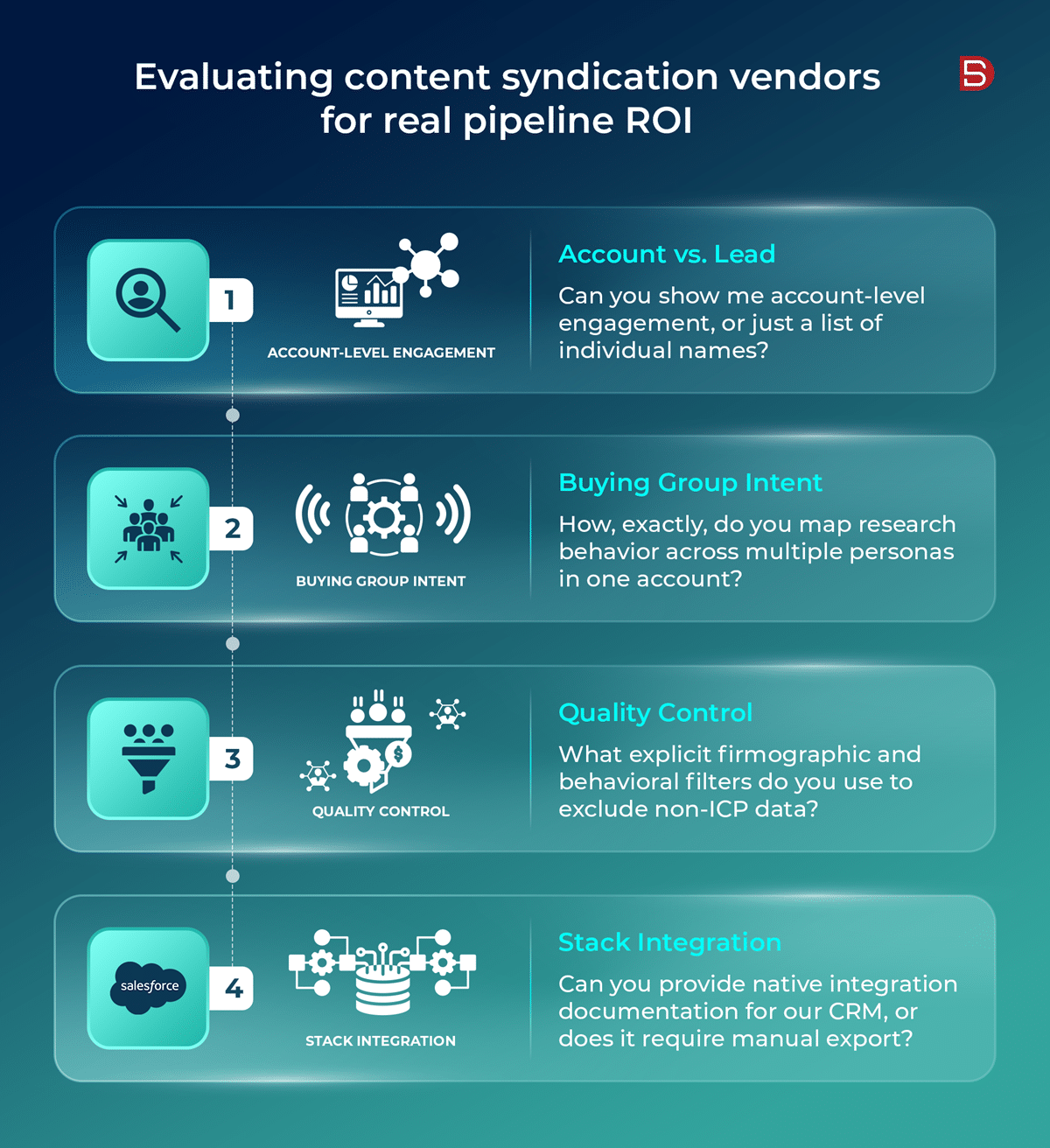
- KEY TAKEAWAY
Evaluate content syndication vendors on account-level intelligence, buying group visibility, audience quality controls, and CRM integration depth, not on lead volume or cost per contact.
How Datamatics Business Solutions helps you build intent-backed pipeline
Datamatics Business Solutions helps revenue teams move beyond lead lists by combining B2B content syndication with buying group intent intelligence. By tracking multi-touch engagement across accounts and activating those insights within CRM workflows, DBSL enables sales and marketing teams to prioritize high-intent accounts already in active research mode.
The future of content syndication is not generating more leads. It is identifying which accounts are already moving toward a decision before your competitors do.
- FAQS
Frequently asked questions
1. What is the difference between content syndication and lead generation?
Content syndication distributes your content across third-party networks to reach audiences outside your own channels. Lead generation is the broader process of capturing interest. The two overlap, but syndication specifically focuses on content placement. The problem is that most vendors treat syndication outputs as finished leads, when they are really early-stage signals that need further qualification before they reach sales.