


For years, B2B marketing teams drew a clean line between ABM and demand generation. One was precise. The other was broad. One targeted specific accounts. The other filled the top of the funnel. In 2026, that separation is quietly killing pipeline efficiency.
If your team is still treating these as two separate programs, you are likely leaving pipeline on the table.
The original distinction no longer holds
Demand generation was built to cast a wide net. You create content, run paid campaigns, generate MQLs, and hand them to sales. ABM was the opposite. Pick your target accounts, build custom campaigns, and go deep with personalization.
The problem is that buyers stopped behaving in ways that fit neatly into either model.
B2B buying committees now average 11.2 stakeholders for deals over $50,000, up from 9.7 in 2024, according to Forrester. You cannot manage that with a lead-centric demand gen program. But you also cannot build full ABM programs for hundreds of accounts at once.
So, teams started blending both. Not as an experiment. As a necessity.
- KEY TAKEAWAY
The old ABM vs. demand generation debate assumed buyers were simpler than they are. Larger buying groups have made a hybrid approach the default, not the exception.
What the convergence of ABM demand generation actually looks like
Research from Demand Gen Report shows that almost 60% of B2B marketers are already blending ABM and demand gen initiatives. And the motivation is not philosophical. It is pipeline pressure.
Most teams already operate some version of this blend. An ABM motion focused on a short list of priority accounts runs alongside inbound, paid media, SEO, webinars, and outbound programs built to keep the pipeline moving.
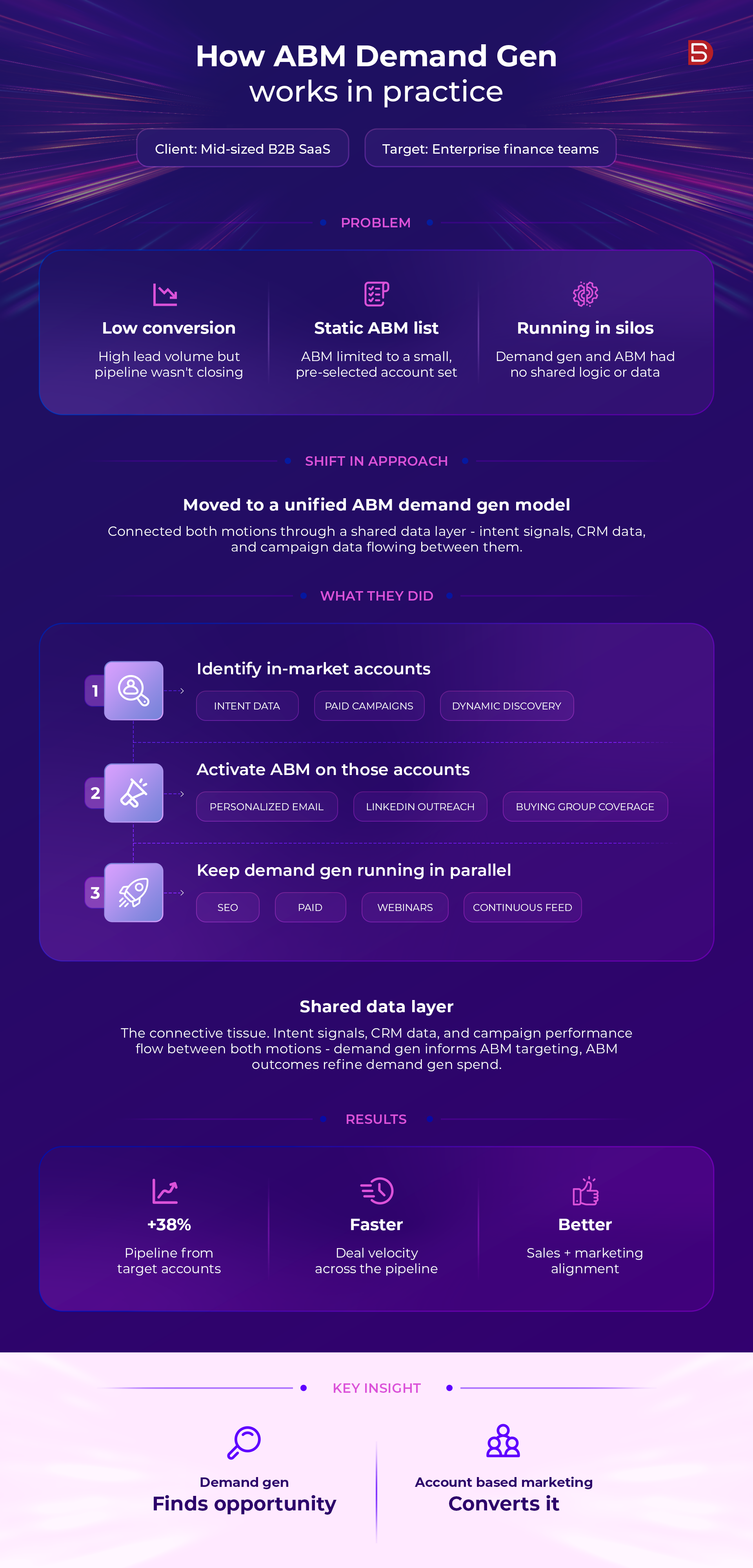
In practice, the convergence looks like this: demand generation builds awareness and pulls in accounts showing intent signals. ABM then layers personalized outreach on top of those same accounts. The same data informs both motions.
Demand marketers are getting access to technologies and deeper insights that used to be the sole purview of ABM teams. At the same time, ABM teams are learning about successful demand tactics and multi-channel approaches they can apply to their ABM efforts.
The result is not a hybrid strategy on paper. It is one revenue program with a shared data layer.
- KEY TAKEAWAY
ABM demand generation convergence is not about merging two org charts. It is about using the same intent data and account intelligence to run both motions from a single playbook
The performance gap is widening between converged and siloed teams
This is where the numbers get hard to ignore.
ABM-led programs generate 2.6 times more pipeline per marketing dollar than broad-reach demand gen, according to ABM Leadership Alliance. But that number assumes ABM is paired with a functioning demand engine.
Account-based motions compress time-to-close by 25-40% across the same deal bands. A $500,000 to $1 million opportunity that takes 189 days in a standard sales-led motion runs 113 to 142 days in a mature ABM program.
That is not just a marketing win. That is a sales-cycle and revenue-forecasting win.
Meanwhile, broad demand generation programs that have not integrated account-level thinking are stalling. Programs that adopted AI-assisted scoring and dynamic nurture are pulling pipeline coverage up to 4-5 times quota, while volume-only programs are stalling at 2.5 times quota.
The gap is structural, not tactical.
- KEY TAKEAWAY
Teams running unified ABM demand generation programs are decisively pulling ahead in pipeline efficiency. The gap between converged and siloed approaches is growing every quarter.
Where B2B demand generation services fit into this shift
Most B2B teams don’t struggle with ideas. They struggle with execution across disconnected systems.
Running demand generation and ABM as one motion requires more than campaigns. It requires a shared data foundation, coordinated outreach, and content mapped to how buying groups actually make decisions.
This is where B2B demand generation services have evolved.
The role is no longer to generate leads in isolation. It is to build and operate a pipeline system that continuously connects demand signals and account-level engagement. That includes identifying in-market accounts using intent data, dynamically prioritizing them, and activating coordinated outreach across channels and stakeholders.
The difference shows up in how programs are run. Instead of measuring success by lead volume, high-performing teams track account progression, buying group coverage, and pipeline velocity. Demand generation surfaces opportunity. ABM converts it. The system works because both are designed to work together from the start.
The gap in the market is not effort. It is orchestration. And that is what separates a partner that drives pipeline from one that simply reports on activity.
- KEY TAKEAWAY
B2B demand generation services have evolved beyond lead volume. The best providers now run integrated programs that align demand creation with account-based targeting from the start.
How Datamatics Business Solutions can help?
Datamatics Business Solutions helps B2B organizations move from fragmented campaigns to a unified pipeline motion.
Instead of treating demand generation and ABM as separate programs, DBSL builds systems where both operate on the same data, the same account intelligence, and the same revenue goals.
What sets this approach apart is not the channels or tactics. It is the structure behind them. Every program is designed to connect demand creation with account-level engagement, so that awareness, intent, and conversion are part of a single workflow.
The result is not just more leads. It is a more predictable pipeline, stronger account penetration, and faster paths to close. Sales teams engage accounts that are already showing intent. Marketing operates with a clearer view of what is driving revenue.
That is the shift from running campaigns to building a system that consistently produces a pipeline and that shift is already separating leaders from everyone else.
- FAQS
Frequently asked questions
1. What is the difference between ABM and demand generation?
Demand generation builds broad pipeline awareness and attracts qualified leads across a wider audience. ABM targets specific high-value accounts with personalized campaigns. The key difference is focus: demand gen goes wide, ABM goes deep.
2. Can you run ABM and demand generation at the same time?
3. Which is better for enterprise B2B: ABM or demand generation?
For enterprise deals with large buying committees and long sales cycles, ABM is essential. But it works best when demand generation is running underneath it to build category awareness and surface in-market accounts. Neither approach alone is enough
4. How do I know if my team is ready to run an ABM demand generation program?
Start by checking whether your sales and marketing teams share a target account list and a common definition of a qualified opportunity. If they do not, that alignment comes first. Once you have shared data and shared goals, you can layer in both motions.
5. What should I look for in a B2B demand generation agency?
Look for a B2B demand generation agency that works at the account level, not just the lead level. They should offer intent data capabilities, clear attribution reporting, and the ability to connect demand creation to ABM outreach without treating them as separate programs