

A buyer can shortlist your company before your website records a single visit. AI assistants now shape that shortlist, and the signals they leave behind look different from the ones most dashboards were built to read.
Live lead tracking gives revenue teams visibility into those early signals while they can still influence the outcome. This guide explains what a modern lead tracking system needs to capture and how to evaluate the software behind it. You will finish with a four-step setup plan and a self-check you can complete in five minutes.
How AI Discovery Is Reshaping The B2B Buying Journey
For a growing share of buyers, research starts in a conversation with an AI assistant. Recent studies put numbers on the shift.
G2 surveyed 1,076 software buyers in March 2026 and found that 51% start research with an AI chatbot more often than with Google. A further 71% rely on chatbots at some point in their research.
Gartner reports that 67% of B2B buyers prefer a rep-free experience. In the same survey of 646 buyers, 45% said they used AI during a recent purchase.
The winning vendor was already on the buyer’s Day One shortlist 95% of the time, according to 6sense.
In the same 6sense study, 94% of buying groups ranked their shortlist before speaking with any seller, and buyers started 79% of first conversations.
Together, these figures describe a B2B buying journey in which preference forms early and largely out of view. A form submission records the moment a buyer is ready to talk, which arrives late in the process. Lead tracking that reaches the earlier stages gives teams visibility into where preference takes shape.
Why Live Signals Matter As Buyers Engage Earlier
6sense reports that buyers made first contact with sellers at 61% of the journey in 2025, compared with 69% in earlier studies. That shift brings the first conversation roughly six to seven weeks sooner.
The same research found that 58% of buyers engaged vendors early to understand how AI works inside the solutions they were evaluating. A prospect who reaches out sooner expects a timely, informed reply.
Gartner adds that confident buyers are twice as likely to report a high-quality deal as buyers with low decision confidence. Knowing what a buyer has already researched helps sellers reinforce that confidence from the first call.
- KEY TAKEAWAY
Extend lead tracking to the research stage, where shortlists take shape.
What a Lead Tracking System Needs To Capture Today
A lead tracking system records the source of each lead and the activity that follows. AI-assisted discovery adds new inputs to that record. A practical starting point for modernization is to add new fields and source categories to the current CRM.
AI Referrals as a Distinct Source
Visits from AI assistants may appear under generic labels such as direct traffic. Give them a separate source category so that marketing can compare their quality with search and paid channels.
Review the category weekly during the first quarter, until volumes settle into a pattern the team can trust.
Self-Reported Attribution
An AI answer can shape a decision before any click occurs. Add an open-text field to forms that asks how the buyer first heard about your company, then group the answers each month.
Self-reported answers often name sources that analytics cannot see, which makes them a useful cross-check on tracked data.
High-Intent Page Activity
6sense found that 62% of buyers needed sellers to answer AI-related questions about capabilities, cost, security, and privacy. Visits to pages on those topics signal readiness to talk.
Tag these visits as high-intent events and pass them to the lead record.
Ownership and Response History
Record who owns each lead and when the first sales action took place. This history shows managers how quickly teams act on live signals and where handoffs can improve.
Account-Level Activity Across The B2B Buying Journey
Buying groups often include ten or more people, according to 6sense. Account-level tracking joins their separate visits into one view of interest, which helps sales teams prioritize outreach.
- KEY TAKEAWAY
Give AI referrals their own source category and roll individual activity up to the account.
How to Evaluate Lead Tracking Software and Lead Management Software
The two categories overlap. Most enterprises need both lead tracking software and lead management software working from the same data.
Lead Tracking Software and Lead Management Software Compared
Dimension | Lead tracking software | Lead management software |
|---|---|---|
Primary purpose | Records where leads originate and how they engage | Prioritizes leads and assigns them for follow-up |
Core data | Source, channel, page activity, attribution | Lead status, score, owner, follow-up history |
Main users | Marketing operations and analytics teams | Sales development and revenue operations teams |
Typical output | Source and attribution reports | Prioritized lead queues and handoff workflows |
Use the comparison to set priorities. Limited source data calls for tracking capability first, while inconsistent follow-up calls for lead management capability first.
Capabilities to Test in Lead Tracking Software
Live capture: new activity appears in the lead record within minutes.
- Flexible sources: custom categories include AI assistants and self-reported attribution.
- Identity resolution: anonymous visits connect to known contacts and accounts.
- Data quality: enrichment and deduplication keep records accurate as volumes grow.
- Outcome reporting: dashboards connect each source to pipeline and win rate.
The word live needs a precise definition during evaluation. Ask each vendor to show how quickly a page visit and a form submission appear in a single lead record.
6sense recommends that revenue teams measure success by shortlist placement and win rate instead of raw lead counts. Reporting built around those measures turns lead tracking into a source of data-driven intelligence for the whole revenue team.
Questions to Put to Lead Management Software Vendors
- Which CRM and marketing platforms connect natively?
- How does the platform store and apply consent preferences?
- Can reports run at the account level as well as the contact level?
- What does implementation require from internal teams?
Consent management deserves early attention. Buyers research across regions, so the platform should apply consent preferences consistently wherever the data travels. Ask for documentation on data retention and deletion as well.
How To Set Up Live Lead Tracking in Four Steps
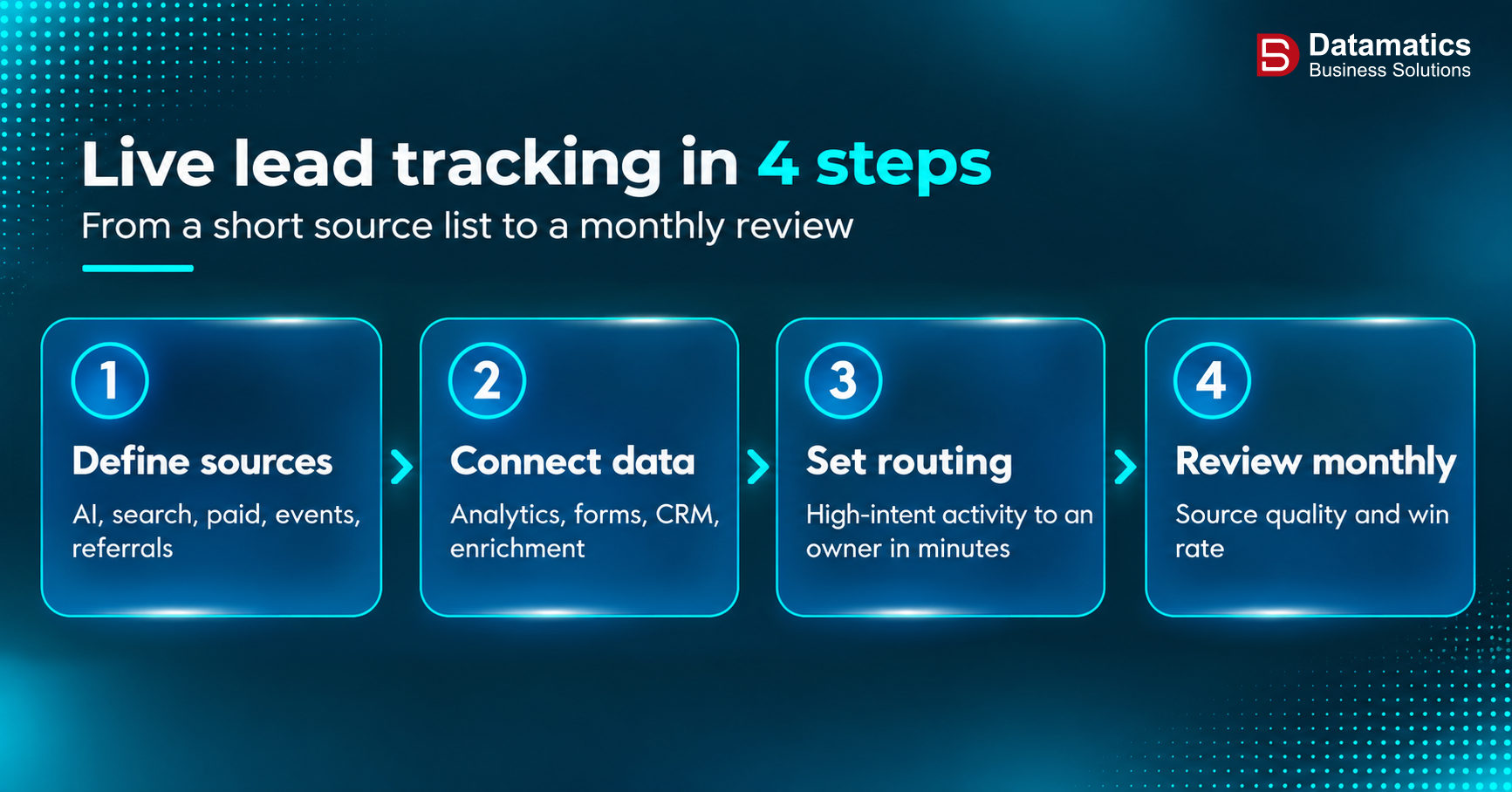
Step 1: Define The Sources
Step 2: Connect and Enrich The Data
Link web analytics, forms, marketing automation, and CRM so that each lead record updates automatically. Add firmographic details from a reliable B2B data provider to complete the account profile.
Step 3: Set Routing Rules
Send high-intent activity to the right owner within minutes. Agree on a response standard that sales teams can meet consistently, and document the rules so that new team members apply them in the same way.
Step 4: Review On a Fixed Cadence
Compare source quality and win rate every month. Refine the rules based on what the data shows, and retire categories that carry little volume.
Live lead tracking is a process transformation that begins with agreed definitions and clear ownership. Scalability follows from that foundation, and monthly optimization keeps the source list aligned with how buyers describe their own journey.
Five-minute self-check. Can your team report AI referrals as a separate source today? Does every lead carry a known source? Does a high-intent visit reach a named owner within minutes? Each answer of “not yet” identifies your next improvement.
- KEY TAKEAWAY
Begin with a short source list and a named owner for every lead, then expand the lead tracking system as the data proves its value.
Which Metrics Show That Lead Tracking is Working
Lead volume is a familiar starting point. A balanced scorecard adds measures that show how well the process captures influence from AI-assisted research.
Metric | What it shows |
|---|---|
Shortlist placement | Share of opportunities where your company was on the buyer’s initial list, confirmed in the first sales conversation |
AI-attributed share of leads | Proportion of leads that arrive from AI referrals or name an AI assistant as their source |
Attribution coverage | Percentage of leads with a known source |
Speed to first response | Time between a high-intent signal and the first sales action |
Win rate by source | Closed-won deals divided by qualified opportunities in each source category |
Read these measures together. A rise in AI-attributed leads alongside a steady win rate suggests that tracking has improved visibility without adding noise. A lower win rate in one source category highlights an opportunity to refine routing or messaging.
Record attribution coverage and win rate for one full quarter before making changes, so that later improvements in performance can be shown with evidence. Share the scorecard with sales and marketing leaders in one monthly meeting so that both teams work from the same numbers.
- KEY TAKEAWAY
Add shortlist placement and attribution coverage to the monthly scorecard alongside lead volume.
How DBSL Supports Lead Tracking in The Age of AI Search
Datamatics Business Solutions Ltd. (DBSL) helps B2B organizations build the data and demand programs behind effective lead tracking. Its B2B Data and Demand Generation capabilities provide accurate account profiles and structured campaigns, which improve visibility and business outcomes across the B2B buying journey. Speak with a DBSL specialist to review your current setup.
- FAQS
Frequently asked questions
1. What is lead tracking?
Lead tracking is the process of recording where each lead comes from and how that lead engages over time. The record gives sales and marketing teams a shared view of each lead’s origin and progress toward a sale.
2. How does AI search affect lead tracking?
AI assistants influence shortlists before a buyer visits a website or submits a form. Lead tracking needs to record AI referrals and self-reported attribution so that teams can see where early preference formed.
3. Is lead tracking software the same as a CRM?
A CRM stores customer and pipeline records. Lead tracking software focuses on source and engagement data, and many CRMs include some tracking features. Add a dedicated tool when attribution needs exceed what the CRM can hold.
4. How can teams track leads that come from AI assistants?
5. How often should teams review lead tracking data?
Review routing and response times weekly, and review source quality and win rate monthly. Revisit the source categories every quarter as new discovery channels emerge. This cadence keeps the data current without overloading the team.