


Partner programs have always had a coordination problem disguised as a data problem. Two companies decide to go to market together, then spend weeks arguing about which accounts belong to whom. By the time the list is clean, the quarter is half over.
AI-driven account mapping is changing that. And for teams running B2B partner marketing today, it is one of the more practical shifts happening right now.
The account mapping problem nobody talks about enough
Traditional account mapping is slow. A partner shares a spreadsheet. Your team cross-references it with your CRM. Someone figures out the overlaps manually. Half the data is outdated before you finish.
The bigger issue is what you miss. When mapping is manual, you are only working with accounts both parties already know. You are not finding the whitespace, the shared ICP accounts neither team has touched, or the partner relationships that could accelerate a deal already in motion.
According to Forrester, companies with mature partner ecosystems grow revenue roughly twice as fast as those without. But most teams are leaving that potential on the table because their account data is messy and the mapping process is too slow.
- KEY TAKEAWAY
Manual account mapping is not just inefficient. It actively limits what your B2B partner marketing programs can achieve.
What AI actually does differently in account mapping
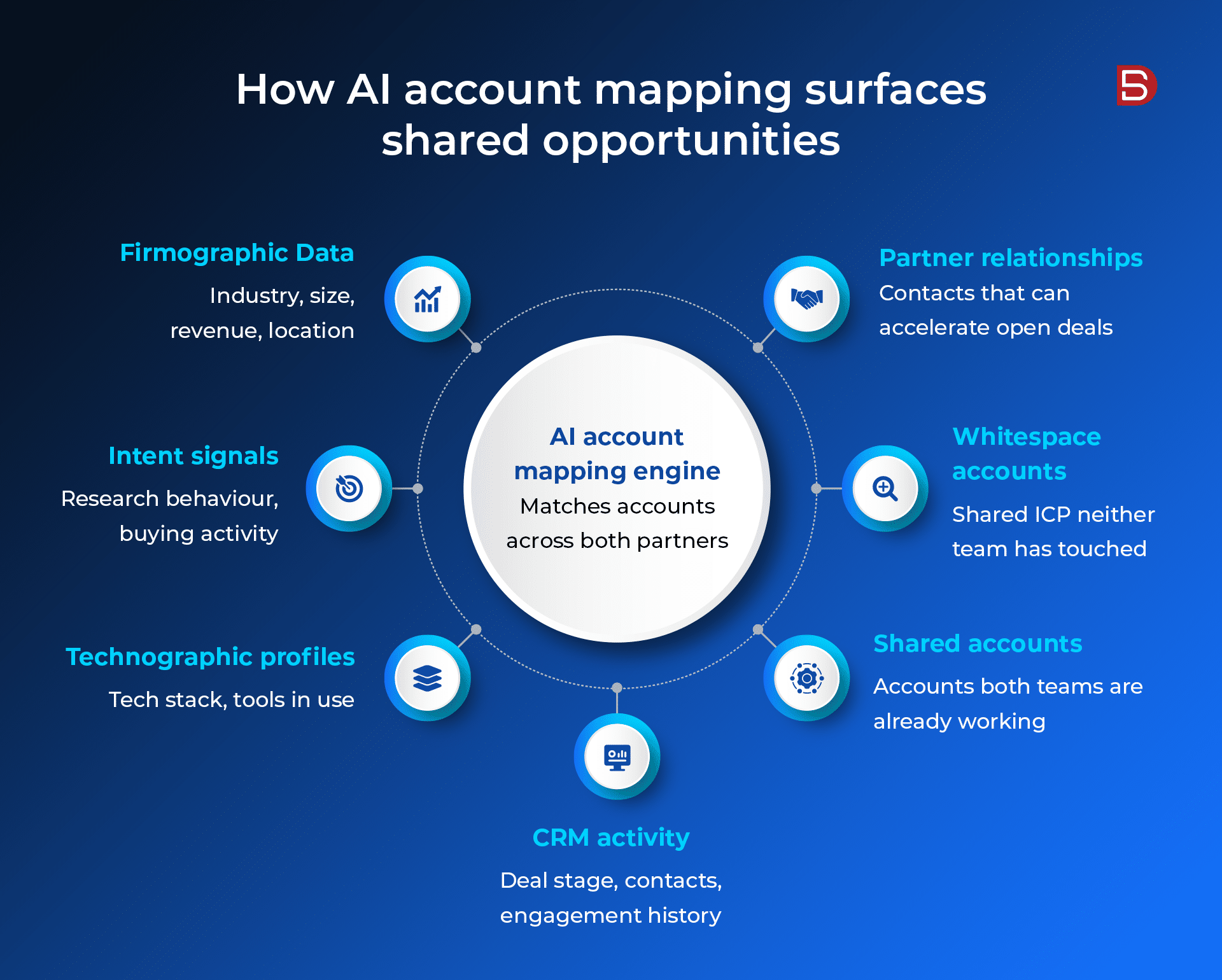
AI-driven account mapping does not just speed up the spreadsheet process. It changes the logic of how accounts get matched.
Instead of relying on exact-match company names or domain lists, AI tools use firmographic data, intent signals, technographic profiles, and CRM activity to find meaningful overlaps. The result is a more complete picture of where a partner relationship can create real pipeline.
Platforms like Crossbeam and Reveal have built their entire model around this kind of intelligent overlap analysis. What used to take a week of back-and-forth now happens in near real-time, with both partners seeing shared opportunities without exposing their full customer list to each other.
For B2B partner marketing campaigns specifically, this changes how teams coordinate targeting. When you know which accounts both you and your partner are already working, you can build campaign targeting that is actually coordinated, not just loosely aligned.
- KEY TAKEAWAY
AI account mapping gives B2B partner marketing teams the shared data foundation they need to run campaigns that are genuinely joint, not just co-branded.
How this changes the way teams build B2B partner marketing strategy
When account data is cleaner and faster to surface, the strategy conversation changes too.
Most B2B partner marketing strategy conversations start with, “Which segment should we go after together?” With AI-driven mapping, you can answer that question with data instead of instinct. You can see which industries have the most overlap, which accounts are showing intent signals from both sides, and where your partner has relationships you do not.
PartnerStack’s Partner Ecosystem Report found that companies using data-driven partner strategies reported 30% higher deal close rates compared to those running traditional channel programs. That gap is not surprising. Most partner programs do not fail because of poor intent data. They fail because both sides are working from different account realities.
For teams building out B2B partner marketing strategy in 2026, AI mapping moves the conversation from “who do we know” to “who should we be talking to, together.”
- KEY TAKEAWAY
AI account mapping makes B2B partner marketing strategy more precise. AI mapping shifts partner marketing from relationship-led planning to evidence-led prioritization.
How AI improves B2B partner marketing campaigns
Most partner programs do not fail because of poor data. They fail because neither side changes how they execute once better data becomes available.
The teams getting the most out of AI-driven account mapping are the ones feeding that data directly into their campaign workflows. Shared account lists go into ABM platforms. Intent signals inform which accounts get prioritized in outreach sequences. Partner-sourced contacts get routed into co-branded nurture tracks.
This is where B2B partner marketing campaigns start to look less like “we both sent an email” and more like a coordinated play. Both teams know which accounts are warm. Both teams know what stage those accounts are at. And both teams can run complementary touchpoints without stepping on each other.
To see this in action, imagine a practical scenario:
Your company sells cloud security software, and your partner sells IT infrastructure. In a manual setup, you would swap spreadsheets, take two weeks to find an overlap at “Enterprise X,” and likely step on each other’s toes with uncoordinated outreach.
With AI-driven mapping, the platform automatically flags that Enterprise X is a thriving customer for your partner, while your intent signals show they are currently researching security. This instantly triggers a coordinated play. The advantage is not just faster outreach. It is contextual trust. Your partner already has credibility inside the account. Your partner drops a co-branded case study to their existing internal champion, introducing your solution natively.
According to Demand Gen Report, ABM programs that incorporate partner data see up to 45% higher engagement rates on target accounts. But only if the campaign workflow is built to use it.
Over the next few years, the competitive advantage in B2B partner marketing will not come from having more partners. It will come from knowing which shared accounts are most likely to convert and coordinating around them faster than competitors can.
- KEY TAKEAWAY
AI-mapped account data is only as useful as the campaign infrastructure built around it. The teams winning in B2B partner marketing campaigns are the ones connecting intelligence to execution.
How Datamatics Business Solutions can help
Datamatics Business Solutions helps B2B teams turn partner data into actionable pipeline. From AI-driven account mapping and intent integration to coordinated ABM execution, DBSL enables partner marketing programs that identify high-value overlaps faster, prioritize the right accounts, and run campaigns with shared visibility across both teams.
- FAQS
Frequently Asked Questions
1. What is AI-driven account mapping in B2B partner marketing?
2. How is AI account mapping different from traditional partner mapping?
Traditional mapping relies on exact-match lists and manual review. AI mapping uses multiple data signals to find meaningful overlaps, including accounts neither partner has formally engaged yet. It is faster, more complete, and does not require sharing your full customer list with a partner.
3. Which tools are commonly used for AI-driven account mapping?
Crossbeam and Reveal are two of the most widely used platforms. Both allow partners to find shared accounts without exposing proprietary CRM data. Several ABM platforms also have native partner data features built in.
4. How does account mapping improve B2B partner marketing campaigns?
When both partners know which accounts are shared and where intent signals are strongest, campaigns can be coordinated rather than parallel. Outreach is better timed, messaging is more relevant, and neither team wastes effort on accounts the other has already closed or disqualified.