


Most B2B companies treat partnerships as a sales afterthought. A referral here, a co-branded PDF there. Then they wonder why pipeline is not moving.
A proper B2B partner marketing strategy is not a side program. It is a dedicated growth channel that opens new markets without doubling your headcount or budget. Here is how to build one that consistently drives pipeline.
What is partner marketing and why does it matter now?
Partner marketing, at its core, means collaborating with other companies to jointly generate demand, share audiences, and grow revenue together. Think technology vendors, consultancies, system integrators, and resellers who serve the same buyers you do.
The business case is clear. External partners influence 35% of annual revenue for roughly 60% of organizations. Most of those companies have no structured B2B partner marketing strategy behind it. They leave the pipeline on the table.
The timing also matters. The 2025 State of B2B Pipeline Growth report found that 45% of B2B marketers cite economic uncertainty as their top challenge. When your own channels are under pressure, partners who already carry buyer trust become far more valuable.
- KEY TAKEAWAY
B2B partner marketing is a structured revenue channel. Treat it like one from day one.
How to pick the right partners for your B2B strategy
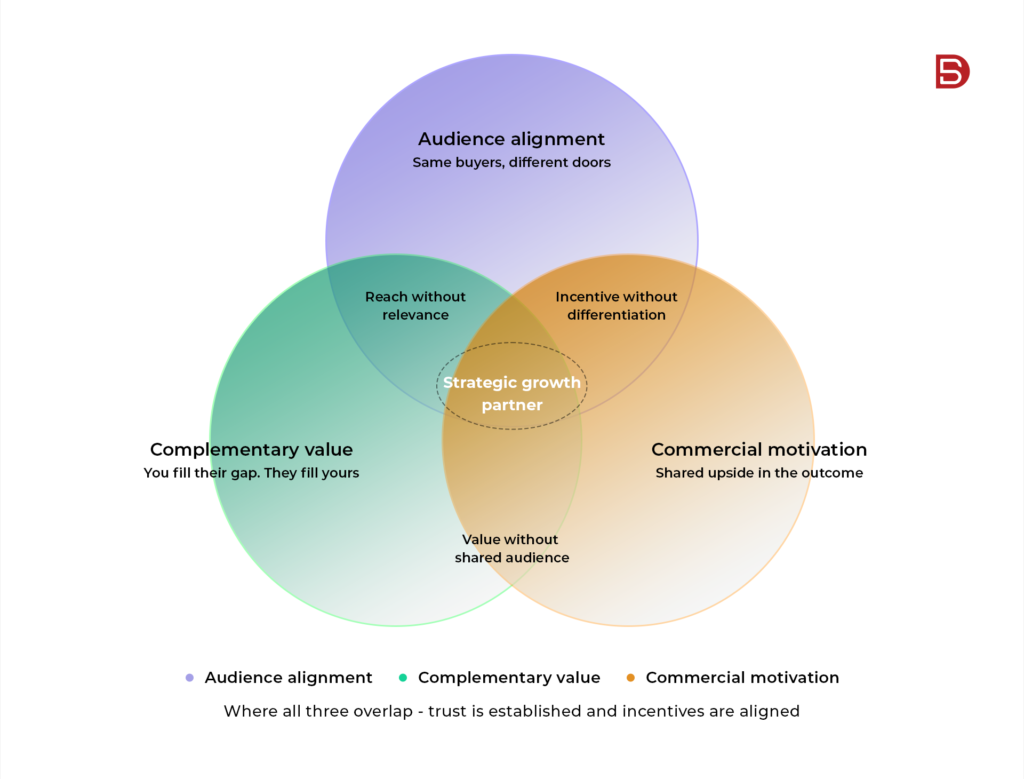
Most partner programs fail at selection. Companies sign agreements based on enthusiasm or brand name, not fit.
Three questions cut through that.
First, audience alignment. Does your partner already sell to your ideal customer? If you target mid-market manufacturers and your partner sells ERP to the same segment, that is a match. A misaligned audience means your joint efforts reach the wrong room.
Second, complementary value. A strong partner makes your product more useful or easier to discover. An integration partner gives buyers a reason to adopt both. A consulting partner adds implementation credibility you may not have. The test: does the partnership create something neither company can deliver alone?
Third, motivation and capacity. This is what most teams skip. A partner with no commercial incentive to refer your product will not do it consistently. Before formalizing anything, understand how their sales team earns and whether your deal fits their motion naturally.
Building new customer relationships ranks among the top four B2B marketing priorities in 2025, per LinkedIn research cited by Semrush. The right partner channel is one of the fastest ways to do that.
- KEY TAKEAWAY
Fit beats familiarity. Choose partners on audience match, genuine complementarity, and mutual incentive.
Building the co-marketing engine: From agreement to execution
A signed partnership agreement is not a B2B partner marketing strategy. Once partners are chosen, the actual build begins.
Start with a shared content foundation. Co-authored content, joint webinars, and case studies featuring mutual customers all do more work than a press release announcing the partnership.
For example, a SaaS company and an implementation partner running a joint webinar with shared follow-up and lead routing.
Focus on content that answers the shared buyer’s actual questions at each stage of the journey.
Align on lead routing before you run a single campaign. Who owns MQLs from joint activity? How do co-generated contacts get tracked in each CRM? What triggers a referral hand-off? These feel like operational details. They are actually where partner trust gets built or broken.
Then build joint sales enablement. A one-page battlecard and a clear referral trigger beat a 40-slide deck. Partners’ sales teams will pass on what they cannot explain quickly.
Research from Sword and the Script shows winning marketing teams are three times more likely to be fully integrated across functions. The co-marketing engine only works when both sides’ sales and marketing motions are genuinely connected.
- KEY TAKEAWAY
Execution is where most partner programs stall. Lead routing, enablement, and joint content need to be live before pipeline conversations happen.
Measuring what partner marketing actually contributes to pipeline
The hardest part of any B2B partner marketing strategy is not generating activity. It is proving contribution. That is a data infrastructure problem, not a strategy one.
Four metrics matter most: partner-sourced pipeline, partner-influenced pipeline, lead-to-SQL conversion rate on partner referrals, and average deal cycle length compared to direct-sourced deals.
75% of B2B sales leaders say referral leads are more likely to close. Partner referrals behave the same way: they arrive pre-credentialed, which shortens the cycle.
Start with the CRM. If there is no partner source field on your opportunities, attribution is impossible. Fix that before scaling volume. Then introduce quarterly business reviews with each active partner, not just to share pipeline numbers but to have honest conversations about where the program is and is not working.
- KEY TAKEAWAY
Clean attribution data is the foundation. Without it, you cannot improve the program or justify it internally.
When to bring in a B2B partner marketing agency
Building a B2B partner marketing strategy from scratch takes more internal resource than most teams expect. Program management, content production, partner enablement, and campaign execution all need to run at the same time.
Working with a B2B partner marketing agency can close that gap, particularly in the early stages. A good agency brings existing frameworks and ecosystem experience that would take months to develop in-house.
The long-term tradeoff is real, though. An internal program manager with deep product knowledge and direct partner relationships will outperform an agency over time. The agency is a starting mechanism, not a permanent substitute.
The same 2025 Pipeline Growth report found that nearly 70% of B2B marketers want actionable outcomes over additional tools. Whether you use an agency or not, the program needs to be judged by pipeline contribution, not activity.
- KEY TAKEAWAY
An agency accelerates the build. Internal ownership sustains it. Know which stage you are in.
How Datamatics Business Solutions can help?
Datamatics Business Solutions helps B2B organisations build partner marketing programmes that are accountable to revenue, not just relationships. This means building partner positioning, co-marketing content, and campaign infrastructure around pipeline contribution from the start.
If your current partner activity is not showing up in pipeline, that is the problem DBSL is set up to solve.
- FAQS
Frequently asked questions
1. What is B2B partner marketing?
It is a go-to-market approach where two companies jointly create demand, share audiences, and drive revenue together. Common forms include co-marketing campaigns, referral arrangements, joint content, and technology integrations targeting a shared buyer.
2. How is partner marketing different from a reseller program?
3. How long before partner marketing produces pipeline?
Typically three to six months from a standing start, assuming attribution, enablement, and joint campaigns are set up correctly. Programs with pre-existing partner relationships and clean CRM infrastructure move faster.
4. What metrics should I track?
Partner-sourced pipeline, partner-influenced pipeline, lead-to-SQL conversion on partner referrals, and deal cycle length versus direct-sourced deals. Revenue attribution by partner is the metric that justifies program investment over time.
5. Do I need a large team to execute a B2B partner marketing strategy?
No. Two to three well-managed partners outperform ten loosely managed ones. A single program manager with content and campaign support can run an effective B2B partner marketing operation, provided the infrastructure is in place.