


B2B sales has changed. Most deals today involve 6 to 10 stakeholders. Yet many sales teams still qualify leads as if one person can say yes.
That gap is where deals stall.
The debate between MEDDIC and BANT lead qualification is not just about methodology. It is about whether your sales process reflects how buying actually happens today.
Why BANT lead qualification still gets used and where it falls short
BANT stands for Budget, Authority, Need, and Timeline. It came out of IBM decades ago as a quick way to figure out whether a lead is worth pursuing.
The logic is straightforward. If someone has the budget, some level of decision making power, a clear problem, and a timeline, you move forward. If not, you don’t.
And to be fair, it still works in certain scenarios. If you are dealing with transactional sales, shorter cycles, or a single decision-maker, the BANT sales process does its job. It is fast. It gives reps structure. And it is easy to train teams on.
That is exactly why it has stuck around for so long. It is simple and scalable.
However, the issue starts when you try to apply that same logic to complex B2B deals.
Most buying decisions today involve multiple stakeholders. Gartner puts that number at 6 to 10. This means the person you are speaking to might have influence, but not actual ownership of the decision.
So, when a rep checks the “Authority” box after speaking to a VP, it can create a false sense of confidence. The deal looks qualified on paper, but in reality, you are only seeing part of the picture.
The same thing happens with “Need.” BANT treats it as a yes or no question. Either the prospect has a problem, or they don’t. But in most organizations, priorities compete. A problem existing does not mean it will get solved.
That is where deals start slipping. Not because the framework is broken, but because it was built for a very different buying environment.
- KEY TAKEAWAY
BANT works as a quick filter. But if you rely on it beyond that, especially in multi-stakeholder deals, you are going to miss things that matter.
What MEDDIC adds that BANT lead qualification does not
MEDDIC stands for Metrics, Economic Buyer, Decision Criteria, Decision Process, Identify Pain, and Champion (sometimes extended to MEDDPICC).
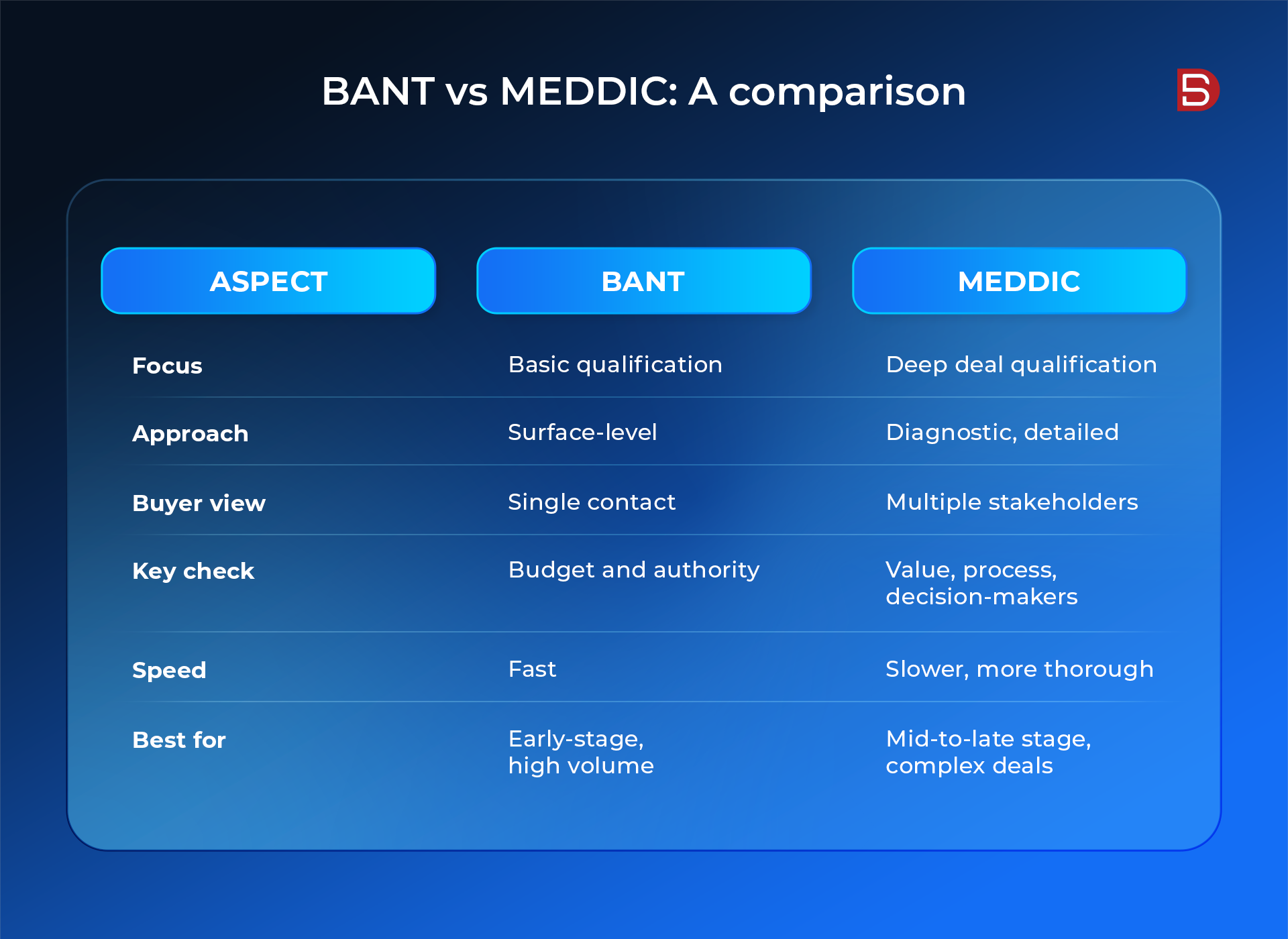
Where BANT checks for budget and authority, MEDDIC goes deeper. It asks questions like what is the business impact? Who actually signs off the deal? How does the decision get made?
The “Champion” piece matters a lot here. This is someone inside the account who wants your solution to win and pushes for it internally. Without that, deals tend to stall.
According to Forrester’s B2B Buying Study, 83% of B2B buyers said the vendor’s ability to demonstrate value in business terms significantly influenced their final decision. MEDDIC is built around exactly that capability.
A deal might look qualified under BANT, but without clarity on the buyer or the process, it can fall apart later. MEDDIC helps surface those gaps early.
That said, it is not lightweight. It takes more time, stronger discovery, and better-trained reps. For simpler deals, it can feel like overkill.
- KEY TAKEAWAY
MEDDIC surfaces risks that BANT misses, especially in deals with multiple stakeholders, long sales cycles, and high-value contracts.
The buying group problem that both frameworks underestimate
There is one gap neither framework really solves. Marketing qualified leads and sales qualified leads are still defined around individuals, not buying groups.
Most lead scoring models focus on one contact. But decisions are rarely made that way.
That “qualified” lead you pass to sales is often just one person in a much larger group.
That is where things start breaking. Marketing keeps nurturing the same contact. Sales builds a relationship with them. Meanwhile, procurement, finance, or IT are nowhere in the picture.
Then late in the deal, new stakeholders show up. Priorities shift. Things slow down.
And suddenly, a deal that looked solid was never fully qualified to begin with. If you are tracking leads but not stakeholders, you are only seeing part of the deal.
- KEY TAKEAWAY
The real gap is not MEDDIC vs. BANT. It is whether your qualification model accounts for the full buying group, not just one contact
How to choose the lead qualification model: A practical decision guide
This is not about choosing one framework over the other. It is about knowing when to use each. What works depends on your sales cycle and deal complexity. Here is how to think about it:
a. Use BANT lead qualification for early-stage filtering
When you are dealing with inbound volume, you need speed. BANT helps you quickly figure out if a lead is even worth a conversation.
b. Use MEDDIC once the deal is real
Every deal is equally real. But when there is clear intent, MEDDIC helps you understand if the deal will actually close. It forces you to look at decision-makers, process, and business impact.
But you know what works best? Most teams benefit from a hybrid approach.
Start with BANT to qualify quickly. Then shift to MEDDIC as the deal progresses and more stakeholders get involved.
- KEY TAKEAWAY
BANT and MEDDIC are not rivals. They address different stages. The best sales processes use both intentionally.
How Datamatics Business Solutions can help?
Datamatics Business Solutions helps B2B teams with both BANT lead qualification and full buying group coverage.
By combining intent data with account and stakeholder insights, DBSL ensures your marketing qualified leads and sales qualified leads reflect real buying readiness.
Whether you use BANT, MEDDIC, or a mix of both, DBSL helps you identify the right stakeholders and reduce blind spots across your pipeline.
- FAQS
Frequently asked questions
1. Is BANT lead qualification still relevant in 2026?
Yes, but with limitations. BANT works well as a quick filter for inbound leads and early-stage qualification. It starts to break down in complex B2B deals with multiple decision-makers and longer cycles.
2. What is the main difference between MEDDIC and BANT?
3. How do marketing qualified leads and sales qualified leads connect to these frameworks?
4. Can you use both BANT and MEDDIC together?
5. What is a "buying group" and why does it matter for lead qualification?
A buying group is the set of stakeholders involved in a B2B purchase decision, typically 6 to 10 people according to Gartner. Qualifying only one contact from this group, using any framework, risks missing the economic buyer, a key blocker, or a champion who could accelerate the deal.
6. Why do deals stall even after BANT qualification?
7. What does a false positive SQL look like?
A false positive SQL is a lead that appears sales-ready based on engagement or initial qualification but lacks key elements such as a defined buying group, confirmed decision criteria, or access to the economic buyer. These leads often progress initially but fail to convert.