


Most deals don’t stall because of timing. They stall because the wrong people were engaged from the start. You had activity, meetings, and content consumption. Your champion was responsive. The demo went well. And then nothing moved.
This is where most teams look for external reasons. They look at pricing. They analyze competition. They even make budget cuts.
The real issue is usually simpler. The buying group was never properly engaged in the first place.
A broken buying group engagement strategy does not announce itself. It hides behind a pipeline that looks active.
The problem with how most teams measure engagement
Open rates are up. Downloads are coming in. The last demo had a good turnout. And yet, the deal is not moving.
It often looks like this in practice.
You have had multiple conversations with your champion. They are engaged, asking questions, and bringing others into calls. The demo went well. Follow-ups are positive.
But no decision maker has entered the conversation. No one is discussing budget. No one is aligning on a timeline.
The deal feels active. But structurally, it cannot move.
This is the engagement trap. Activity metrics make deals look healthier than they are. Opens are not interest. Downloads are not evaluation. A demo request is not alignment.
According to Forrester’s 2024 State of Business Buying Report, 86% of B2B purchases stall at some point during the buying process. The reason is rarely a lack of effort. It is a lack of the right engagement, with the right people, at the right level.
The core issue with most buying group engagement strategies is that they measure activity, not decision-making. There is a difference. And confusing the two is expensive.
- KEY TAKEAWAY
High engagement metrics do not mean a deal is progressing. They mean people are paying attention. And that is not the same thing.
Enterprise deals are not one-on-one conversations
When a deal stalls, it is rarely one person who stopped it. It is a system of people who never fully aligned.
Enterprise purchases involve multiple stakeholders across different functions. Gartner research shows that B2B buyers spend only 17% of their total purchasing time meeting with vendors. The rest happens internally, in conversations you are not part of.
Most buying groups operate across three layers. The visible participants, the people you meet on calls. The active influencers, the people shaping internal discussions behind the scenes. And the hidden decision-makers, the ones who ultimately approve or stall the deal.
The gap in most buying group demand generation strategies is this: teams build strong relationships at layer one and assume it is enough. It rarely is.
- KEY TAKEAWAY
The people you are most engaged with are rarely the ones who make the final call. Your buying group engagement strategy needs to reach all three layers.
Four reasons deals actually stall
Most stalled deals trace back to one of four structural problems. These are predictable.
A missing decision-maker: The Economic Buyer has not entered the conversation. Every discussion happening below that level is useful context, but it cannot close a deal.
Single-threaded momentum: Everything runs through one contact. If that person goes quiet or changes roles, the deal goes with them. Research shows deals with three or more stakeholders engaged close 2.4 times faster than single-threaded ones.
Shallow engagement signals: Content downloads and email activity indicate awareness, not buying intent. A buying group content strategy built around top-of-funnel signals will keep producing sales qualified leads that do not convert.
Recency decay: A contact who was active 45 days ago is not warm. Internal priorities shift. Engagement that does not compound over time fades.
- KEY TAKEAWAY
These four problems repeat across industries and deal sizes. Recognizing them early is the difference between a fixable deal and a lost one.
The shift from chasing leads to building buying groups
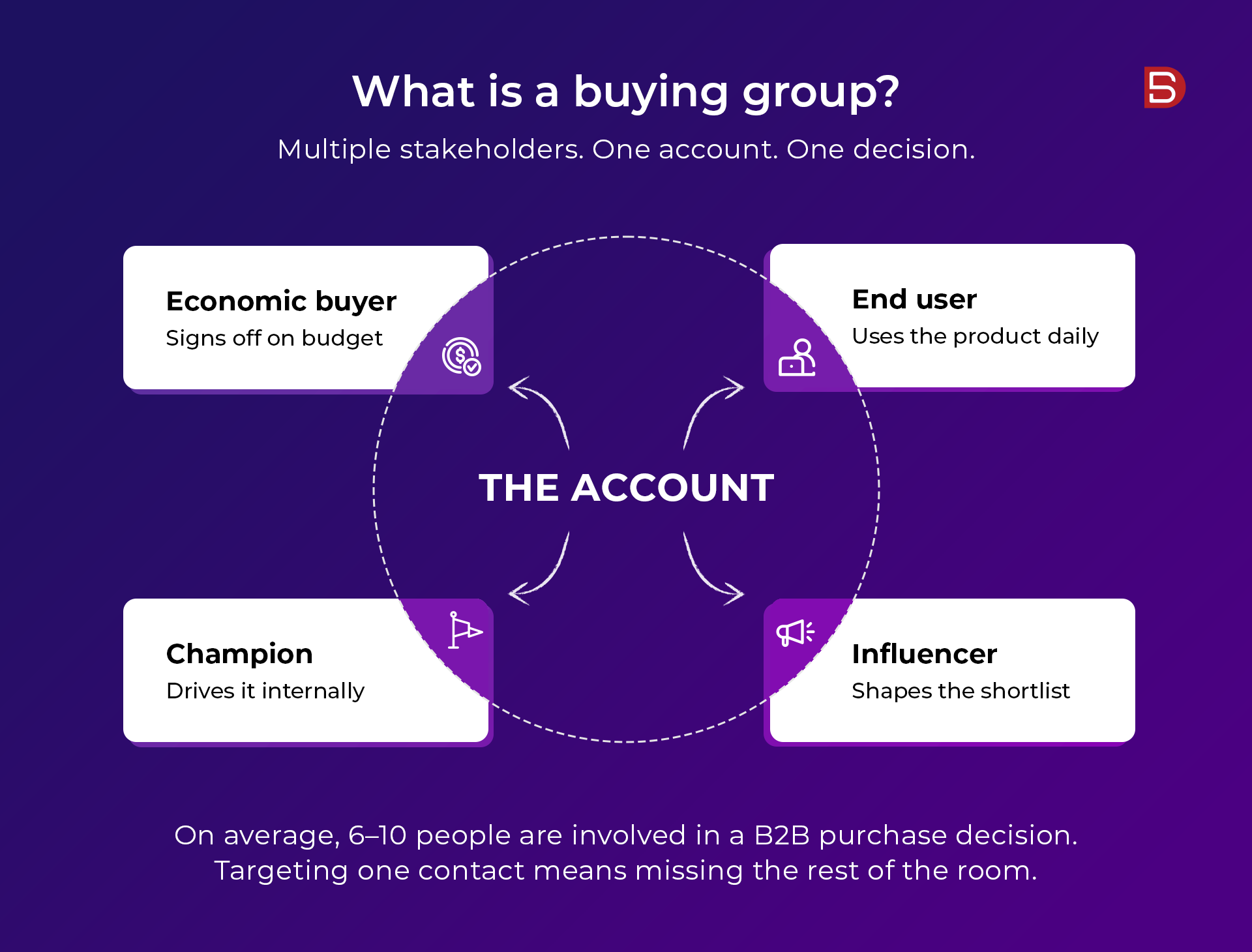
This is the mindset change that matters most in B2B buying group demand generation.
The traditional model was built around leads. Get a contact into the funnel, nurture them, and pass them to sales. That model assumes a single person drives the decision.
In enterprise sales, that assumption no longer holds. Lead-based thinking optimizes for activity. Buying group thinking optimizes for decisions.
It starts with a different question. Not “how many leads did we generate?” but “do we have the right stakeholders engaged to make a decision?”
A buying group engagement strategy is not about increasing activity. It is about building the structural conditions under which a decision can happen.
Buying group content strategy plays a specific role here. It is not just about producing content. It is about enabling internal conversations.
Economic buyers need business case clarity. Technical stakeholders need implementation detail. Champions need material they can use to influence others internally.
One message does not move a buying group. Alignment does.
- KEY TAKEAWAY
Shifting from lead generation to buying group engagement is not a tactic change. It is a shift in how you define a real deal.
A quick diagnostic: How strong is your buying group right now?
Before you move a deal forward, ask yourself these questions.
- Do you know all key stakeholders in this account? Not just your contacts, but the people influencing the decision from legal, finance, and the executive level.
- Is at least one of them a decision-maker with budget authority?
- Has each of them engaged meaningfully in the last 30 days? Not just opened an email. Actually engaged.
- Does your Champion have the internal influence to move this forward, or are they just responsive?
If you cannot answer yes to all four, the problem is not your pipeline. It is your buying group structure.
A buying group engagement strategy that does not account for these gaps will keep producing the same result: deals that look active but do not close.
- KEY TAKEAWAY
An agency accelerates the build. Internal ownership sustains it. Know which stage you are in.
How Datamatics Business Solutions can help?
If you are trying to operationalize this at scale, the challenge is not just understanding buying groups. It is consistently identifying, mapping, and engaging them across accounts.
Datamatics Business Solutions helps B2B teams build and score buying groups using verified contact data, intent signals, and multi-stakeholder mapping.
The approach connects buying group demand generation with pipeline readiness, so sales teams focus on accounts where real decision-making capacity exists.
The outcome is not more activity. It is fewer stalled deals and a pipeline built on actual buying groups, not individual leads.
- FAQS
Frequently asked questions
1. What is a buying group engagement strategy in B2B sales?
A buying group engagement strategy is a structured approach to identifying, mapping, and engaging all key stakeholders involved in an enterprise purchase decision. Rather than focusing on a single lead, it builds relationships and alignment across multiple roles: economic buyers, technical evaluators, champions, and influencers. The goal is to create the conditions under which a decision can actually be made.
2. How is buying group engagement different from traditional lead generation?
Traditional lead generation focuses on individual contacts moving through a funnel. Buying group engagement focuses on accounts, specifically on whether the right mix of stakeholders is engaged at the right depth. A buying group demand generation strategy measures coverage across the committee, not just activity from a single contact.
3. Why do sales qualified leads from buying groups convert better?
4. What does a buying group content strategy look like in practice?
A buying group content strategy maps content to specific roles within the committee. Economic buyers need business case support and ROI clarity. Technical evaluators need integration and security specifics. Champions need internal selling tools, materials they can share with stakeholders you have not met yet. One piece of content serving all roles is rarely enough.
5. How do you know if your buying group engagement strategy is working?
The clearest signal is multi-stakeholder engagement across different seniority levels within the same account, with recent and meaningful interactions, not just clicks. If your top opportunities all run through a single contact and lack decision-maker involvement, the strategy needs adjustment. Engagement breadth and recency are more reliable indicators of deal health than volume alone.